Best AI Dental Front Desk Software 2026: 6 Platforms Compared
Compare 6 AI dental front desk platforms in 2026: DentiVoice, Arini, TrueLark, Weave, Annie, Zaha. Features, PMS integration, pricing, and right fit.
Share:
Table of contents
Patients calling a dental practice today expect the phone to be answered. Not later. Not at voicemail. Now. The challenge for most practice owners is that a single front desk receptionist cannot answer every call during business hours, much less after hours, on weekends, or during lunch breaks. An AI dental front desk fills that gap by handling routine calls, booking appointments directly into the practice management system, and routing emergencies to the right person, all 24/7. This guide compares six AI dental front desk platforms used in 2026: DentiVoice by DentalBase, Arini, TrueLark, Weave, Annie AI, and Zaha AI. Each one fits a different practice profile. The right choice depends on practice size, integration needs, and whether the goal is phone coverage alone or a connected system that also generates the calls.
What is an AI dental front desk?
An AI dental front desk is a voice-based artificial intelligence system that answers patient calls, books appointments directly into the practice management software, and handles routine front desk tasks 24/7. It works alongside human staff, taking calls during overflow, after hours, and on weekends, while routing complex situations to a human team member.
The phrase "AI front desk" matters because it signals a role, not a feature. A voicemail system records messages. An answering service takes notes. The AI front desk performs the actual work of a receptionist: greeting the caller, understanding the request, checking the schedule, booking the appointment, and updating the patient record. The patient never knows they were the third call in a row to come in at 12:15 PM during the front desk lunch break.
Three numbers explain why practices are adopting this category:
- 38% of new patient calls go unanswered during business hours, according to ADA Practice Transitions data.
- 80% of callers who reach voicemail do not leave a message and do not call back, according to Forbes.
- After-hours calls represent 27% of total patient call volume, based on Dental Economics reporting.
Put together, those numbers mean the average practice loses the opportunity to book a meaningful share of inbound interest because of timing, not effort. This category exists to close that gap. For deeper context on what this looks like inside a single practice, see the DentalBase AI Receptionist complete guide.
Why are dental practices replacing front desk tasks with AI in 2026?
Three pressures are driving adoption. The first is cost. A loaded front desk hire, including salary, benefits, payroll taxes, training, and turnover, runs $55,000 to $78,000 per year per FTE in 2026. That investment buys roughly 2,000 hours of coverage. The phones can ring during the other 6,760 hours, and most of them do.
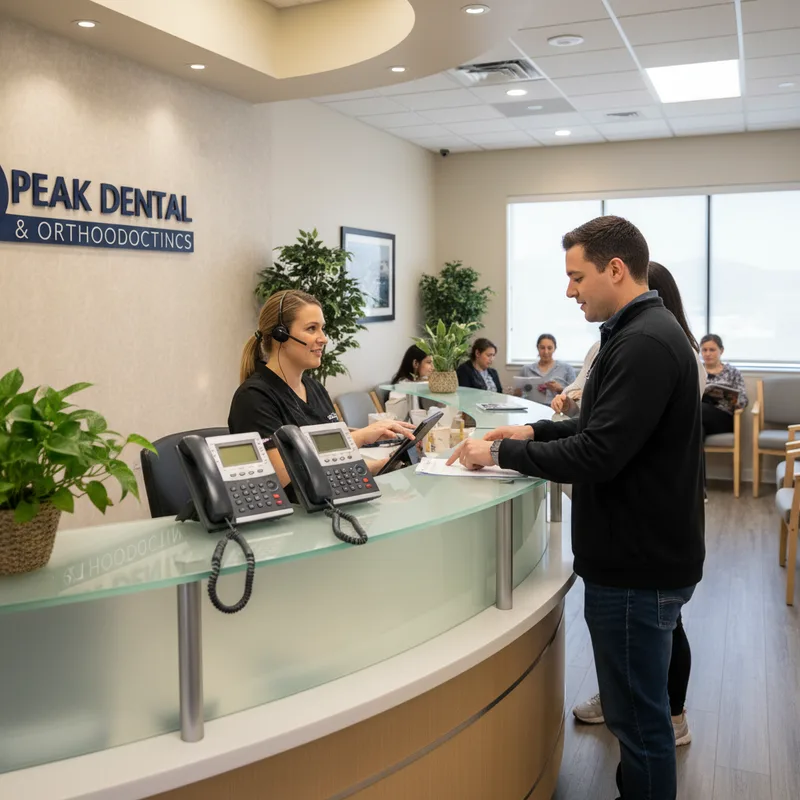
The second is turnover. Dental front desk roles see annual turnover above 50% in most markets. Each transition costs the practice $3,000 to $7,000 in recruiting and ramp time, and creates inconsistency in patient experience during the gap.
The third is patient behavior. Patients who do not get an answer call the next practice on the list. Most do not try again. The competitor down the road answers, and the lifetime value of that patient (often $12,000 or more) goes there instead.
Practice owners are responding by adding AI to the front desk rather than replacing it. The dominant model in 2026 is hybrid: human staff handles in-person check-in, complex insurance discussions, treatment plan presentation, and the relationship-building work that patients value. The AI front desk handles overflow, after-hours, and the routine scheduling calls that consume four hours of staff time daily without adding production. This division of labor is covered in detail in the AI receptionist plus human omnichannel guide. Reporting from Dental Economics indicates 73% of practices plan to adopt AI tools by 2027, and front desk automation is the most-adopted category.
See how an AI front desk handles overflow and after-hours calls
Watch DentiVoice take a real patient call, book the appointment into the practice management system, and flag anything that needs a human follow-up.
Book a Free DemoDentiVoice: An AI dental front desk inside a full marketing platform
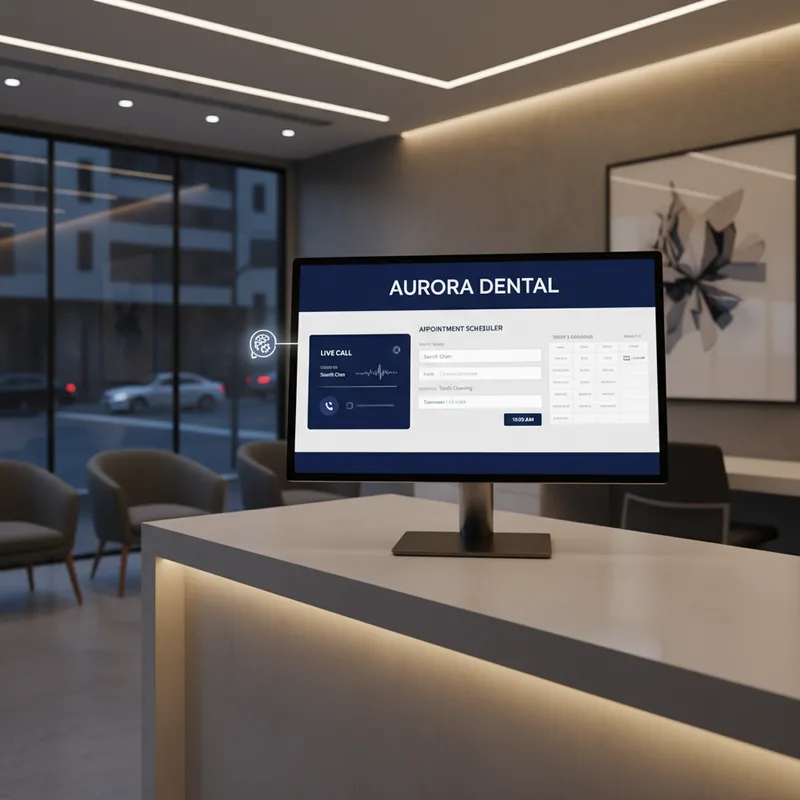
DentiVoice is the AI front desk built by DentalBase. What separates it from standalone AI phone tools is the broader platform it sits inside. DentalBase also handles SEO, Google Ads, social media, content marketing, custom dental websites, and reputation management. The system that generates patient calls and the system that answers them run from one vendor with one attribution layer. For practices currently paying separate vendors for marketing and phone coverage, the consolidation point is meaningful.
Inbound capabilities
DentiVoice answers calls 24/7 on the practice's existing phone number. No number port, no new hardware. The AI activates based on rules the practice defines: after a set number of rings, during specified hours, or as overflow when staff is busy on another line.
The conversation runs on natural language understanding trained on dental terminology. Patients speak normally ("I chipped a tooth" or "I need to schedule a cleaning") rather than navigating a phone tree. If the caller's number matches a record in the practice management system, DentiVoice greets them by name and pulls up their history before they finish the first sentence.
For new callers, DentiVoice captures the standard intake fields: name, date of birth, insurance, reason for visit, contact information. The data populates directly into the patient record without manual transfer. For returning callers, the AI handles rescheduling, cancellation, and billing inquiries that do not require a human.
Frequently asked questions are handled in-call: hours, services offered, accepted insurance, directions, parking, payment policies. Emergency calls are triaged differently. DentiVoice recognizes urgency cues (severe pain, swelling, trauma, knocked-out tooth), books an emergency slot or escalates to the on-call dentist, and sends an SMS summary to the practice manager so the team is ready when the patient arrives.
Concurrent call handling is built in. When five patients call at the same time, all five get answered. There are no busy signals and no patients sent to voicemail because the line was occupied.
Outbound capabilities
This is where DentiVoice goes beyond most platforms in the category. The same AI handles outbound campaigns as well as inbound calls:
- Missed appointment follow-up. Patients who no-show get a same-day call to reschedule, with the new appointment booked in the conversation.
- Patient reactivation. The overdue recall list is worked through systematically. The AI calls patients who are due for a cleaning or follow-up and books them on the spot.
- Post-treatment follow-up. After major procedures, DentiVoice can check in on patients and route concerns to the clinical team.
- Recall reminders by voice. Not just SMS. Some patients respond to a phone call when a text gets ignored.
Most platforms in this category are inbound-only or limited to text-based outbound. Voice outbound at this scope is unusual.
Practice management system integration
DentiVoice integrates natively with Dentrix, Open Dental, Eaglesoft, and Curve Dental. The integration is read and write. The AI checks live availability, respects provider preferences, appointment durations, and block templates, then writes the appointment directly into the schedule. There is no manual entry step between "patient says yes" and "appointment appears in the system."
Marketing attribution
Every inbound call DentiVoice answers is traced back to its marketing source: which Google Ad, which organic search, which Google Business Profile listing, which referral. Per-campaign data shows not just call counts, but how many calls became booked appointments and how many generated production. This attribution flows into the same DentalBase reporting layer that runs the practice's SEO, ads, and social, so return on investment is measured end-to-end in one place.
This capability is rare in the category. Most platforms answer calls and report basic call metrics. They cannot tell a practice owner which marketing dollar produced which patient. Practices that spend on Google Ads or SEO and want to measure return often need a separate call tracking vendor on top of their AI receptionist. DentiVoice combines both.
Hybrid mode and human handoff
DentiVoice runs alongside the existing front desk team. Human staff gets first priority on calls during business hours. The AI only picks up when the human cannot. The front desk does not need to learn new software or watch a dashboard. Clinical questions, complex insurance disputes, and billing escalations route to a human automatically. A summary email goes to the practice manager flagging anything that needs follow-up.
Compliance and infrastructure
DentiVoice is HIPAA compliant with a Business Associate Agreement provided as part of every implementation. All call data is encrypted in transit and at rest. The practice retains override and adjustment control at all times, and a unified dashboard displays call volume, bookings, attribution data, recordings, and transcripts.
Setup timeline and right fit
Implementation runs 2 to 4 weeks. The first phase customizes scheduling rules, appointment types, provider preferences, and office voice. The second runs simulated calls to refine responses before going live. Onboarding support helps the staff adapt, and the DentalBase team continues to monitor and refine the AI after launch.
DentiVoice is the right fit for practices that want one vendor handling both patient acquisition and phone coverage, especially those currently paying separately for a marketing agency, an SEO provider, and a phone tool. It is not the right fit for practices that only want phone answering with no interest in marketing services. For those, a standalone AI tool will be a better match.
See DentiVoice in action
Book a 15-minute demo to watch real-time scheduling, emergency triage, and PMS syncing in action.
Book a Free DemoHow do the top AI dental front desk platforms compare?
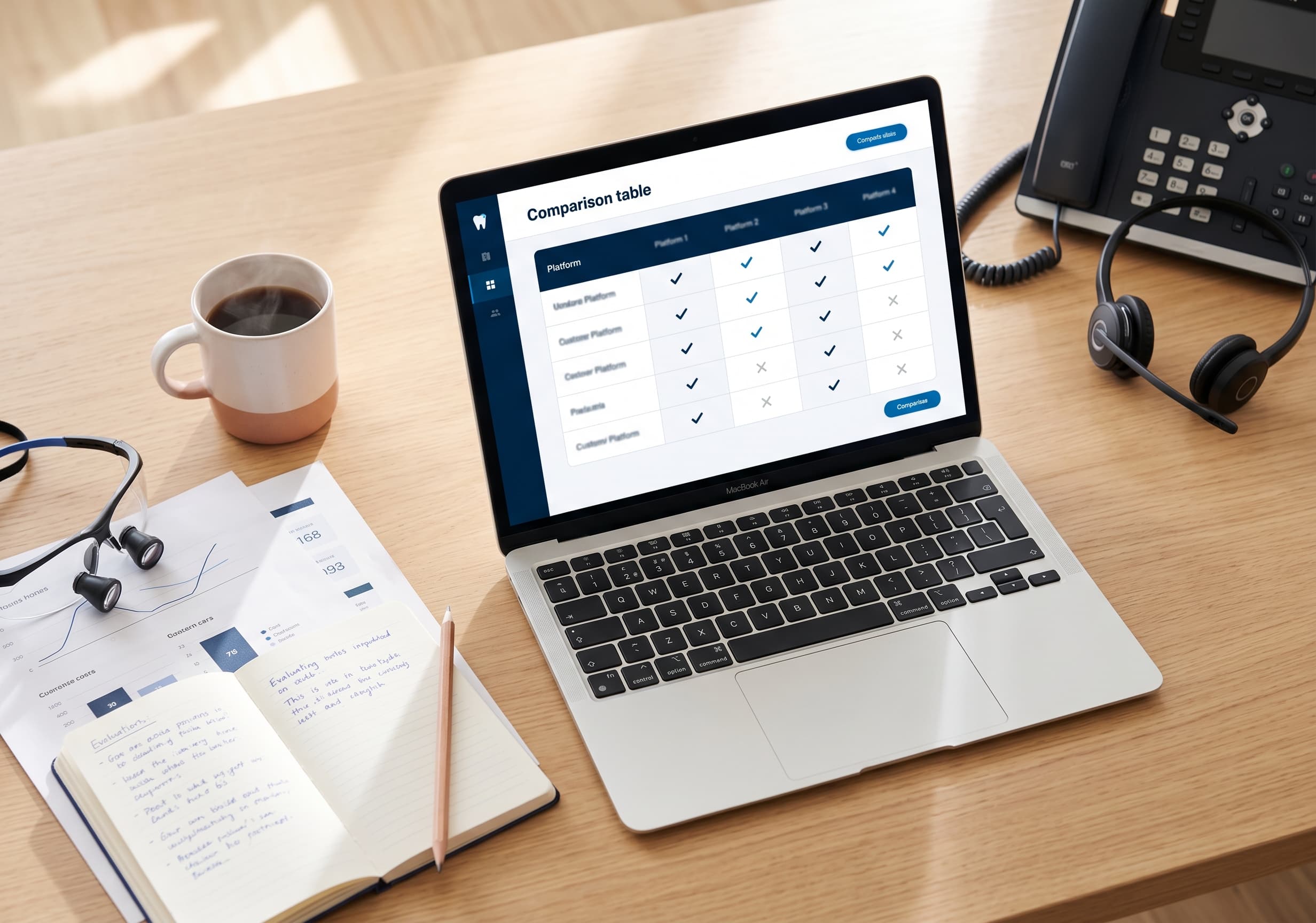
Six platforms account for the majority of deployments in this category in the U.S. dental market in 2026. Each one solves a slightly different version of the problem.
| Platform | PMS Integration | Outbound Voice | After-Hours Booking | Marketing Attribution | Multi-Location | HIPAA + BAA | Right For |
|---|---|---|---|---|---|---|---|
| DentiVoice | Dentrix, Open Dental, Eaglesoft, Curve | Yes (full) | Yes | Yes (built-in) | Yes | Yes | Practices wanting marketing + phone in one platform |
| Arini | Open Dental, Eaglesoft, Denticon, CareStack, Dentrix, Dentrix Ascend, Cloud9, Curve | Add-on | Yes | No | Yes | Yes | Practices wanting a focused, dental-only voice AI |
| TrueLark | Most major dental PMS | Limited | Partial | No | Yes (DSO-grade) | Yes | DSOs and multi-location groups |
| Weave | Native to Weave ecosystem | Limited | Partial | No | Yes | Yes | Practices already using Weave for phone and SMS |
| Annie AI | Direct PMS scheduling | Limited | Yes | No | Limited | Yes | Single-location, relationship-first practices |
| Zaha AI | Within mConsent ecosystem | No | Limited | No | Yes | Yes | Practices going fully paperless with digital intake |
Arini
Arini is a Y Combinator-backed AI receptionist built exclusively for dental. Strengths include a wide PMS integration list (Open Dental, Eaglesoft, Denticon, CareStack, Dentrix, Dentrix Ascend, Cloud9, Curve Dental), sub-300ms response latency that feels conversational, and documented outcomes at multi-location DSOs. The platform focuses tightly on call answering and scheduling. Outbound voice campaigns are an add-on rather than a core capability, and there is no built-in marketing attribution. Pricing is demo-based and not publicly listed. Right fit: practices that already have marketing handled and want a focused voice AI for the front desk.
TrueLark
TrueLark is one of the older AI receptionist platforms and is positioned for DSOs and multi-location dental groups. Its strength is omnichannel coverage (voice, SMS, web chat) and centralized management across locations. The AI is trained on more than 10 million dental conversations. The platform serves multiple verticals beyond dental, which can be a strength (mature platform) or a limitation (less dental-specific tuning) depending on perspective. Outbound voice is limited compared to inbound. Pricing is enterprise-grade and tiered by location count. Right fit: DSOs with 10 or more locations needing standardized workflows and cross-location analytics.
Weave
Weave is a dental communication suite that has added AI capabilities on top of its existing VoIP, SMS, reviews, and payments stack. The selling point is the unified ecosystem: phones, texts, scheduling, and patient communication in one platform. The AI receptionist sits inside the existing Weave workflow rather than as a standalone tool. After-hours booking capability is partial, and the AI is more recent than the rest of the platform. Right fit: practices already using Weave that want to add AI inside the platform they use daily, rather than introducing a separate vendor.
Annie AI
Annie AI is built by My Social Practice and emphasizes the relationship side of dental communication. The platform learns the practice's specific voice, policies, and protocols to deliver responses that feel personal. Annie integrates with the practice management system for direct scheduling, handles smart FAQ responses, and supports patient onboarding and intake. The platform is multilingual (English and Spanish). Multi-location support is more limited than the enterprise platforms. Right fit: single-location practices that want an AI front desk that sounds like an extension of the existing team.
Zaha AI
Zaha AI is part of the mConsent ecosystem, which provides digital forms, patient intake, consent management, and AI reception in one bundle. Zaha handles 24/7 communication, appointment booking, insurance checks, and no-show management. The integration with mConsent's intake forms is the differentiator. The trade-off is platform commitment: choosing Zaha means buying into the broader mConsent ecosystem. Right fit: practices going fully paperless that want intake automation and AI calls from one vendor.
Five additional platforms serve narrower audiences and are worth knowing about: HeyGent (lightweight, single-location, stronger on web chat than voice), TensorLinks (dental-focused with deep PMS integration), Viva AI (100+ language support, SOC 2 Type II), Rondah AI (DSO-only multi-agent system), and Dentina AI (clinical triage focus). For a deeper analysis of platform reviews and user-reported outcomes, see the 2026 dental AI receptionist reviews and the 10-platform comparison guide.
How should you decide which AI dental front desk fits your practice?
The decision is not "which platform is the right one" in the abstract. It is "which platform fits this specific practice's call patterns, existing tech stack, marketing situation, and budget." A five-step framework keeps the evaluation focused on the things that actually predict success.
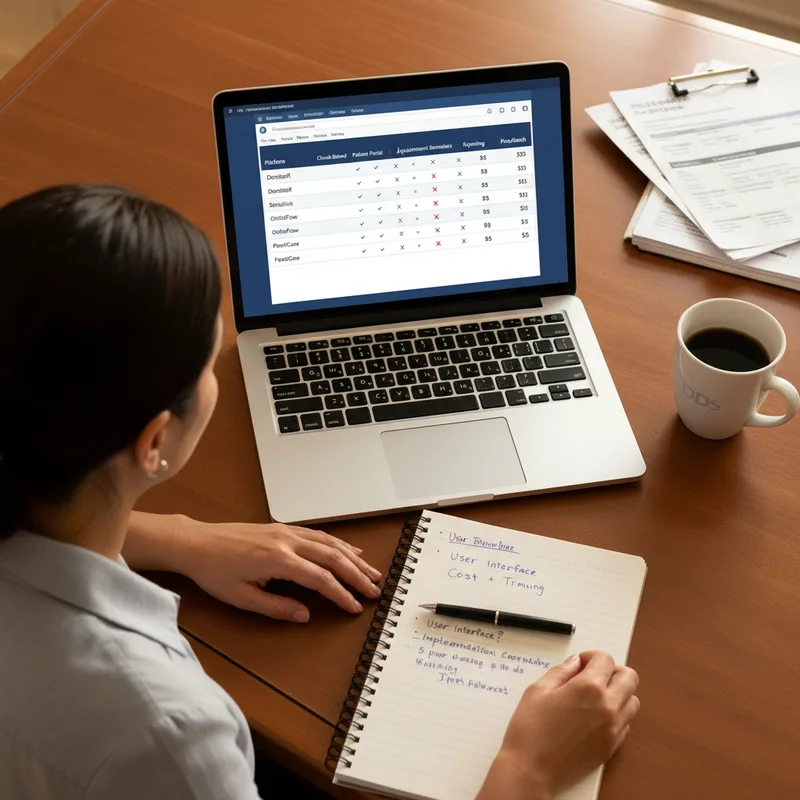
Step 1: Audit the current call situation
Pull the last 30 days of call data. Total inbound calls, missed call rate, after-hours call volume, average hold time before hangup, and time-of-day patterns. The goal is to identify the real bottleneck. Some practices miss calls during business hours because the front desk is overwhelmed. Others miss them after hours because nobody is there. Others lose them at 12:15 PM during the lunch break. The bottleneck determines what to look for in a platform. The dental tech stack audit guide walks through how to pull this data from most phone systems.
Step 2: Match practice profile to platform type
Practice size and structure narrow the field quickly. A solo practice needs simple setup, predictable pricing, and fast deployment. A multi-location practice with 2 to 9 offices needs centralized management, location-specific call flows, and unified reporting. A DSO with 10 or more locations needs enterprise SLAs, standardized workflows, and cross-location analytics. A practice already running a communication suite needs to weigh adding AI inside the existing stack against switching to a dedicated AI tool. A practice that also needs marketing services needs to weigh consolidation against running separate vendors.
Step 3: Evaluate against five non-negotiable criteria
Practice management system integration depth. Read-only or message-takes-and-staff-enters models add work rather than remove it. The AI must read AND write to the specific PMS in real time. Confirm native, tested integration with the exact PMS version (Dentrix and Dentrix Ascend are different products; Open Dental on-premises and cloud editions are different).
After-hours booking capability. 27% of patient call volume is after-hours. Some platforms answer after hours but cannot actually book in the moment. They collect the patient's information and queue it for the morning. That gap is where the patient calls a competitor and books with them instead.
Response latency. Anything above one second between the patient finishing a sentence and the AI responding feels robotic. Sub-300ms feels natural. Ask the vendor for a recorded demo call before signing.
HIPAA compliance and signed BAA. Required, not optional. Any vendor handling patient data is a business associate under HIPAA. Verify the Business Associate Agreement before the demo ends. Ask about encryption in transit and at rest, role-based access controls, and audit logging. Direct guidance from HHS HIPAA covers the BAA requirement in full.
Marketing attribution. Can the platform tell which marketing source generated each booked appointment? For practices that spend on Google Ads, SEO, or social, attribution is the difference between knowing return on investment and guessing at it. Most platforms in this category cannot do this.
Step 4: Calculate the real comparison cost
The honest comparison is not "AI cost vs nothing." It is "AI cost plus existing marketing vendors vs platform cost vs current loaded front desk cost plus missed call revenue loss." Standalone AI tools run $200 to $800 per month per location. Add the marketing agency, SEO provider, and call tracking the practice already pays. Compare against a platform that bundles AI plus marketing services. The AI receptionist ROI guide covers the full math, but the rough industry benchmark is that an AI front desk pays for itself when it recovers 3 to 5 missed appointments per month at average production value.
Step 5: Pilot before committing
Most platforms offer 30-day pilots or short initial contracts. Run the AI on after-hours and overflow only at first, not as a full replacement. Track three metrics weekly: answer rate, booking conversion rate, and patient satisfaction (a one-question post-call SMS works). Decide on full rollout after 60 to 90 days of measured data. The dental call measurement guide covers how to set up the tracking.
Want help applying this framework to your practice?
Book a 15-minute call with the DentalBase team. We will walk through the audit, the criteria, and the math for the practice's specific call patterns and goals.
Book a Free DemoHow much does an AI dental front desk cost in 2026?
Pricing falls into three tiers based on what the platform actually does.
Standalone AI front desk tools: $200 to $800 per month per location. This range covers most dental-specific platforms with PMS integration, 24/7 call answering, and basic reporting. Pricing typically scales with call volume, location count, and integration complexity. Some platforms publish rates; most use demo-based custom pricing. Setup fees range from $0 to $3,000 depending on PMS complexity.
Enterprise and DSO platforms: custom pricing, generally above $1,000 per location per month. These tiers add multi-location management, advanced analytics, dedicated account management, and SLA guarantees. Useful for groups with 10+ offices that need centralized infrastructure.
Platform solutions: priced by scope rather than per-seat. DentalBase, for example, prices the full bundle (DentiVoice plus SEO, ads, social, websites, reputation) based on practice size and service mix. The investment is higher than a standalone phone tool but replaces multiple separate vendor costs.
Three cost categories often get missed in initial budgeting:
- Implementation labor. Staff training time during onboarding runs 4 to 8 hours initially. Front desk team needs to learn the override controls and review flagged calls.
- Legacy PMS integration fees. Practices on older PMS versions or non-cloud editions sometimes pay additional integration costs ranging from $500 to $5,000.
- Optimization period. Most platforms take 60 to 90 days to fully tune to the practice's specific patterns. Performance improves over time, but the first month is a learning curve.
Return on investment math comes back to one number: the lifetime value of recovered patients. With average new patient value above $12,000 over a relationship and the AI front desk recovering missed calls that would have gone to voicemail, payback often arrives within the first 60 to 90 days for practices with meaningful missed call volume. The full calculation is in the AI dental receptionist ROI guide.
The bottom line on choosing an AI dental front desk
This category is no longer experimental. Six platforms have proven deployments at scale, each with a clear strength and a clear right-fit profile. The decision comes down to honest self-assessment about what the practice needs: phone coverage alone, or a connected system that also generates the calls it answers; single location simplicity, or multi-location management; relationship-first patient communication, or efficiency-first call handling. The framework in this guide is designed to be vendor-agnostic. Run the audit, match the profile, evaluate against the criteria, calculate the real cost, and pilot before committing. The platform that fits will become obvious during the demo phase, not before.
Ready to see what an AI dental front desk looks like in your practice?
DentiVoice answers calls 24/7, books into the practice management system, and connects to the marketing that generated each call. Book a 15-minute demo to see it run on real call scenarios.
Book a Free DemoSources & References
Frequently Asked Questions
An AI dental front desk is a voice-based artificial intelligence system that answers patient calls, books appointments directly into the practice management software, and handles routine front desk tasks 24/7. It works alongside human staff, taking calls during overflow, after hours, and on weekends, while routing complex situations to a human team member.
Yes, with the right platform. The AI must have read AND write integration with the practice management system, not just read-only. Platforms with native, tested integration check live availability, respect provider preferences and block templates, then write the appointment directly into the schedule with no manual entry step.
DentiVoice is the only AI dental front desk built inside a full marketing platform. The system that generates patient calls (SEO, ads, social, websites) and the system that answers them run from one vendor with one attribution layer. Arini focuses on dental-only voice AI as a standalone tool. TrueLark serves DSOs with omnichannel coverage across voice, SMS, and web chat.
Modern AI dental front desks use natural-sounding voice technology with sub-300ms response latency, which feels conversational to most callers. Patient satisfaction surveys report most callers value the convenience of 24/7 availability over knowing whether the agent is human or AI. Practice owners can listen to recorded demo calls before signing to verify voice quality.
Standalone AI dental front desk tools run $200 to $800 per month per location. Enterprise and DSO platforms start above $1,000 per location per month with custom pricing. Platform solutions like DentalBase price by scope rather than per-seat and replace multiple separate vendor costs (marketing agency, SEO, phone tool). Setup fees range from $0 to $3,000 depending on PMS complexity.
Was this article helpful?
Written by
DentalBase Team
Expert dental industry content from the DentalBase team. We provide insights on practice management, marketing, compliance, and growth strategies for dental professionals.