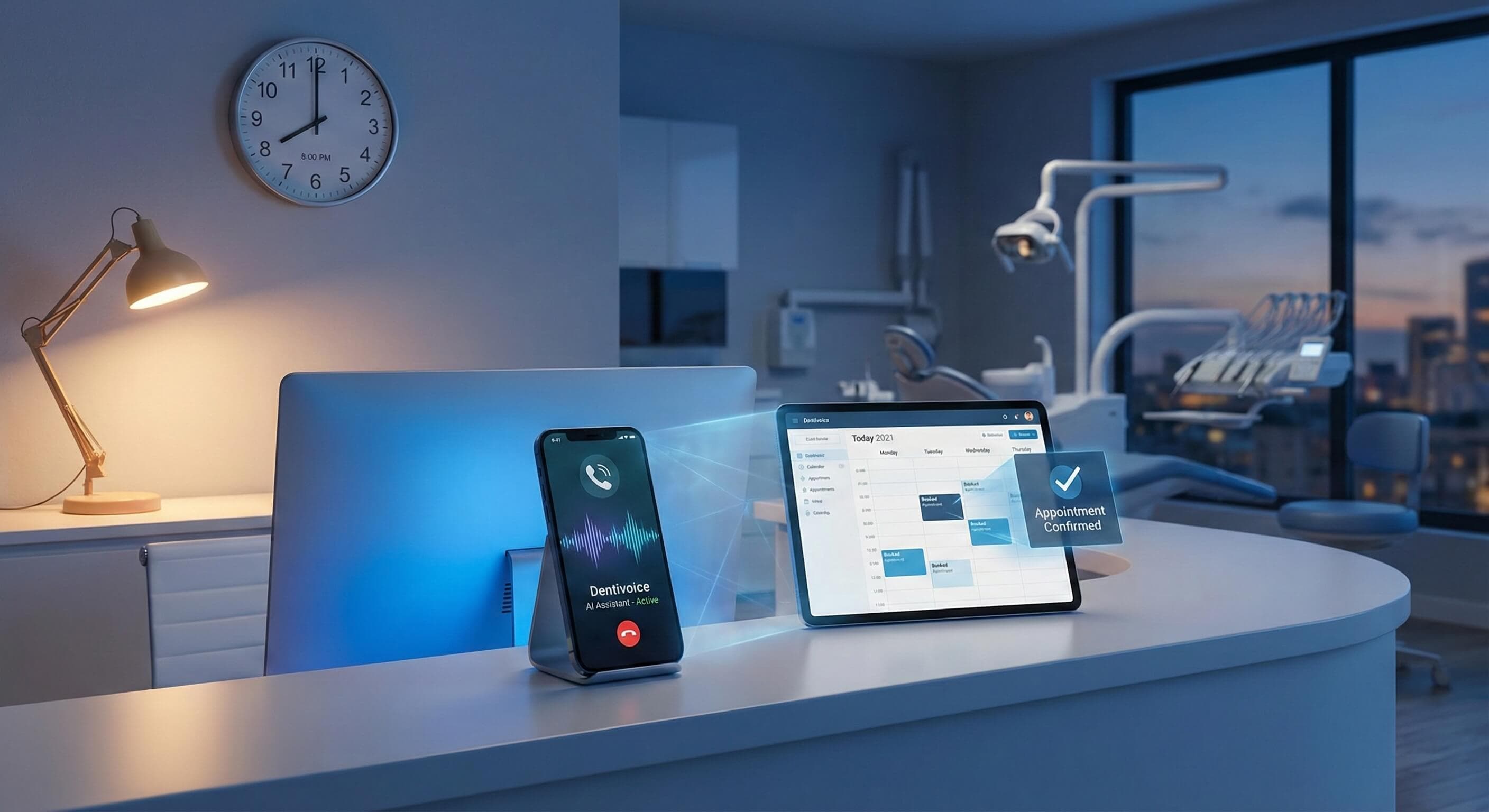
How Dentivoice AI Handles Bookings When Staff Can't
Discover how Dentivoice AI appointment booking dental work after hours, in lunch breaks, and peak times when dental staff are unavailable or overwhelmed.
Share:
Table of contents
AI appointment booking dental after hours solves a problem you already know you have: patients calling when nobody's there to pick up. A 2024 report from Dental Economics found that after-hours calls represent 27% of total patient call volume. That's more than a quarter of your potential bookings happening when your front desk is dark. This article walks through how AI-powered scheduling works after hours, where it fits into your existing workflow, and what it actually looks like for real patient scenarios.
You'll also get a clear breakdown of how this compares to traditional answering services, what the compliance picture looks like, and how to evaluate whether your practice is leaving chairs empty because of a phone gap.
Why Do Dental Practices Lose Bookings After Hours?
Dental practices lose after-hours bookings because no one is available to convert a caller into a scheduled patient. It's that simple. The phone rings, voicemail picks up, and 80% of callers who reach voicemail don't leave a message and won't call back, according to Forbes.
Staffing costs make 24/7 human coverage impractical for most practices. Extending hours means overtime rates or hiring a second receptionist just to cover phones after 5 PM. For most single-location practices, that expense doesn't justify itself when the calls are primarily routine booking requests.
But the real cost isn't the salary you'd pay. It's the patients you're losing. The average dental practice misses 15-20 calls per week, according to Dental Economics. That's during business hours alone. Add evenings and weekends, and the number climbs fast. Emergency situations don't wait for Monday morning. Without coverage during these windows, you're sending patients straight to the practice down the street that does pick up.
Stop Losing Patients to Voicemail
DentiVoice answers every call, books appointments into your PMS, and captures new patient info around the clock.
See How DentiVoice Works →How Does AI Appointment Booking Work for Dental Practices?
AI appointment booking for dental practices works by connecting a conversational AI system directly to your practice management software. The AI answers incoming calls, identifies whether the caller is a new or returning patient, determines the appointment type needed, and books it into your live calendar. No human intervention required for routine scheduling.
The technology behind this is natural language processing, the same type of AI that powers voice assistants, but trained specifically on dental workflows. When a patient calls and says "I need a cleaning next Thursday afternoon," the system understands the request, checks your calendar for matching openings, and confirms the booking. It doesn't just take a message. It completes the transaction.
What Happens During a Typical AI Booking Call
Here's how a typical call plays out. The AI greets the caller and pulls up their record using caller ID or asks for identifying details. For returning patients, it confirms identity through name and date of birth. New patients provide contact information and reason for calling.
Then it gets to scheduling. The system accesses real-time availability, filters by appointment type and duration, and presents options. "I have openings Tuesday at 10 AM or Wednesday at 2 PM. Which works for you?" After the patient picks a slot, the AI confirms the details, sends a confirmation, and the appointment appears in your PMS immediately. Most routine booking calls wrap up in a few minutes.
DentiVoice, for example, integrates with systems like Dentrix, Open Dental, Eaglesoft, and Curve Dental to sync appointments directly. No double-entry. No sticky notes for Monday morning.
Related: For a full breakdown of what AI receptionists can and can't do, see our complete guide. → DentalBase AI Receptionist: Complete Guide
What Happens When a Patient Calls After Hours With an Emergency?
When a patient calls at 8:30 PM on a Friday with severe tooth pain, an AI booking system triages the call based on urgency keywords and routes it appropriately. The patient doesn't hear a voicemail greeting. They get a live conversation that assesses their situation and takes action.
The AI identifies emergency indicators through specific language: "severe pain," "swelling," "broken tooth," "bleeding." Based on your practice's configured protocols, it can do one of several things. It might book the patient into a Saturday emergency slot if your practice holds those open. It could connect the caller to an on-call provider's direct line. Or it provides specific after-hours instructions while flagging the case for first-thing Monday follow-up.
What matters here is documentation. Every detail from the call, symptoms described, contact info, urgency level, gets logged and pushed into your system. When your team arrives Monday morning, they don't have to piece together a garbled voicemail. They have a structured summary ready for clinical review.
The Lunch Rush and Simultaneous Calls
Emergencies aren't the only gap. Consider a typical Tuesday at 12:15 PM. Your front desk person is at lunch. Three patients call within five minutes. One needs to reschedule, one is a new patient inquiry, and one has a billing question the AI can't handle.
A traditional phone system drops two of those calls to voicemail. An AI system handles all three simultaneously. The rescheduling request gets processed. The new patient gets booked. The billing question gets flagged for a staff callback with full context attached. No hold music. No "please leave a message."
According to Marchex, the average hold time before a patient hangs up is just 90 seconds. That's not a lot of patience. Concurrent call handling eliminates the queue entirely.
See What Your Practice Is Missing After Hours
Book a free demo and we'll show you exactly how DentiVoice handles calls, books appointments, and captures patients while your office is closed.
Book a Free Demo →How Does AI Booking Compare to Traditional Methods?
AI-powered after-hours booking outperforms traditional methods on availability, speed, and consistency. But it's not a perfect replacement for every interaction. Here's an honest comparison across the metrics that actually matter to your practice.
| Factor | Traditional Receptionist | AI Appointment Booking |
|---|---|---|
| Availability | Business hours only (40-45 hrs/week) | 24/7/365 including holidays |
| Hold Time | Variable, often minutes during peak periods | Zero, answers immediately |
| Concurrent Calls | 1 at a time per staff member | Unlimited simultaneous calls |
| Booking Consistency | Varies by staff, workload, and time of day | Identical process every call |
| Complex Situations | Strong, uses judgment and empathy | Limited, escalates to human staff |
| Cost (Annual) | Full-time salary + benefits + overtime | Fraction of receptionist cost |
The biggest gap is after hours. Period. Your receptionist goes home at 5 PM. The AI doesn't. That 27% of call volume happening outside business hours, per Dental Economics, represents real patients who want to book. Right now, most of them are hitting voicemail and moving on.
That said, AI isn't trying to replace your front desk team. Insurance disputes, anxious patients who need reassurance, treatment plan discussions: these still need a person. The real value of AI appointment booking dental after hours is that it handles the volume your staff physically can't cover, while your team focuses on the interactions that need a human touch.
Related: Wondering about the real financial impact of missed calls? We did the math. → 38% of Dental Calls Go Unanswered: The Revenue Impact
Is AI Booking HIPAA Compliant, and What Should You Evaluate?
Any AI system handling patient scheduling must meet HIPAA requirements for protected health information (PHI). That means end-to-end encryption during calls, encrypted storage for collected data, and access logs that create the audit trails HIPAA requires.
But "HIPAA compliant" isn't a checkbox you set and forget. Does the vendor sign a Business Associate Agreement (BAA)? Where is patient data stored? What happens to call recordings? These questions matter before you sign anything. Patients should also know they're speaking with an AI, and clear disclosure at the start of the call is increasingly required in several states.
Choosing the Right System for Your Practice
Not every AI booking tool is built for dental. Generic scheduling bots designed for salons or auto shops won't understand procedure durations, provider preferences, or the difference between a cleaning and a crown prep.
PMS Integration Depth
The system must write directly into your practice management software, not just send you a notification to book manually. True integration means the appointment shows up in Dentrix or Open Dental the moment a patient confirms. If the vendor says "we'll email you a booking request," that's not integration. That's a glorified answering service.
Dental-Specific Scheduling Logic
A hygiene appointment and a root canal consultation need different time blocks, different operatories, and possibly different providers. Your AI system should understand these distinctions and schedule accordingly. Ask vendors: can your system handle multi-visit treatment plans? Does it respect provider-specific schedules? Can it enforce pre-appointment requirements like medical history forms?
Escalation Protocols
Every AI system hits its limits. The question is what happens next. Good systems don't just say "sorry, I can't help." They capture all relevant details, explain to the patient that a team member will follow up, and send a structured escalation to your staff with the full context. Your front desk should never have to call a patient back and ask "so... what did you need?"
72% of patients say convenience is a top factor when choosing a dental provider, per the ADA. Your booking system is part of that convenience equation, and it's worth getting the evaluation right.
Built for Dental Compliance and Scheduling
DentiVoice operates with BAA coverage, encrypted data handling, and full call audit trails designed for dental practices.
Learn About DentiVoice →Related: For a deeper look at setting up your front office for maximum booking efficiency. → Front Office Setup That Books More Appointments
How Much Revenue Are You Losing to After-Hours Missed Calls?
The revenue impact of after-hours missed calls depends on your patient mix, but the math starts with two verified numbers. After-hours calls represent 27% of total call volume, per Dental Economics. And 80% of callers who hit voicemail won't leave a message and won't call back.
Run that against your own call volume. If your practice handles 200 calls per week, roughly 54 happen after hours. If 80% of those don't leave a message, 43 callers are gone. Even if only half were genuine booking inquiries, that's over 20 potential appointments per week you never had a shot at. Multiply by whatever your average appointment value is, and the gap gets real fast.
Those numbers assume a single-location practice. Groups with multiple offices multiply the problem. And these aren't hypothetical patients. They already picked up the phone. They already chose your practice. They just couldn't get through.
The 38% of calls that go unanswered during business hours, noted in an ADA Practice Transitions report, is a separate problem. After-hours AI scheduling for dental practices specifically targets the 27% window where you have zero coverage today. That's the lowest-hanging fruit for most practices: turning dead air into scheduled chairs.
The operational efficiency angle matters too. When AI handles routine scheduling, your front desk team gets time back for insurance verification, treatment plan discussions, and the face-to-face interactions that actually require a person. That's not a cost reduction play. It's a reallocation of your most expensive resource: trained staff attention.
Continuous Booking Coverage Changes How Your Practice Competes
AI appointment booking dental after hours isn't about replacing your team. It's about making sure every patient who calls your practice gets an answer, regardless of when they call. The 27% of volume happening outside business hours represents real revenue that most practices are currently leaving on the table.
If your practice is evaluating AI booking, start with one question: how many calls are you missing today? Pull your phone records for the last 30 days. Look at after-hours volume, lunch-hour gaps, and Monday morning spikes. That data tells you exactly how big the opportunity is.
The practices adopting continuous booking coverage now are building an advantage that compounds over time. Every patient who books at 7 PM instead of calling a competitor is a patient who stays on your schedule, refers their family, and returns for years of care.
Ready to Stop Missing After-Hours Patients?
See how DentiVoice books appointments, captures new patients, and handles calls 24/7 with a live demo tailored to your practice.
Book a Free Demo →Explore more guides and tools for dental practice growth.
Browse Resources →Frequently Asked Questions
Dental practices can use AI-powered solutions like Dentivoice to handle after-hours booking calls automatically. The AI system answers calls 24/7, provides appointment availability, schedules appointments directly into the practice management system, and sends confirmation details to patients. This ensures no booking opportunities are missed even when the office is closed or staff are unavailable.
When patients call and no one answers, they typically hang up and may contact competing practices instead. Studies show that a significant percentage of new patient calls go unanswered in dental practices. This results in lost revenue opportunities, frustrated patients, and potential damage to the practice's reputation as patients perceive unavailability as unprofessional service.
Yes, modern dental AI systems like Dentivoice are designed with HIPAA compliance and security protocols. They use encrypted communication channels, secure data storage, and follow strict privacy guidelines when handling patient information. The AI integrates securely with existing practice management systems while maintaining all regulatory compliance standards required for healthcare operations.
If the AI cannot understand a patient's request or if the query is too complex, it is designed to escalate the call to a human. During business hours, this may involve a seamless transfer to a front desk staff member. After hours, the AI will take a detailed message and ensure it is flagged for priority follow-up by the office staff the next business day. This ensures that no patient request is lost and that complex issues receive human attention.
Yes, besides booking new appointments, Dentivoice AI is fully capable of managing rescheduling and cancellation requests. The system can identify existing appointments, check the calendar for new availability based on the patient's request, and update the schedule in real-time. This automates the entire appointment lifecycle, freeing up staff from routine scheduling modifications.
Was this article helpful?
Written by
DentalBase Team
The DentalBase Team is a collective of dental marketing experts, AI developers, and practice management consultants dedicated to helping dental practices thrive in the digital age.