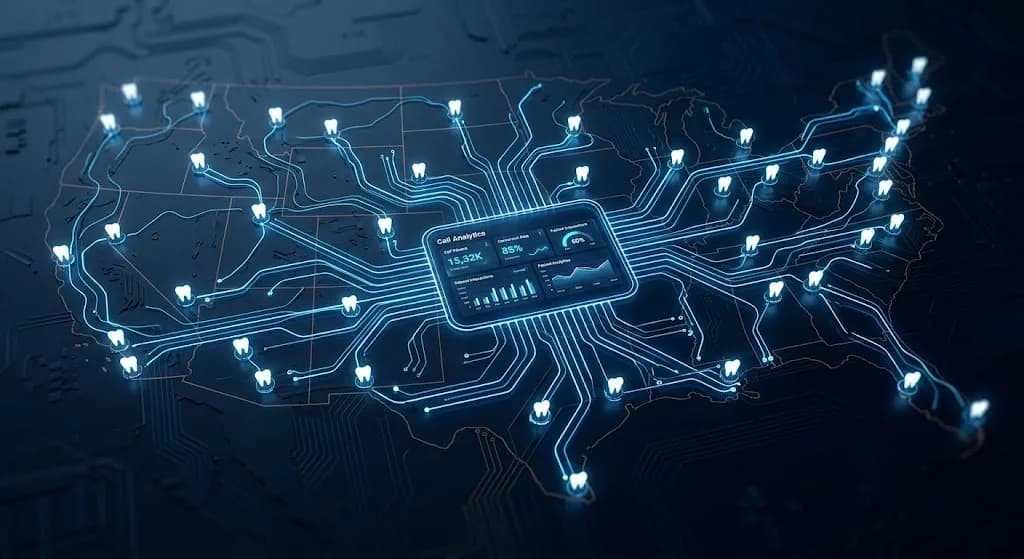
How DSOs Scale Patient Communication Across Locations
Struggling with DSO patient communication across locations? See how leading dental groups standardize calls and automate front-desk workflows.
Share:
Table of contents
Introduction
Call two of your locations back to back. At the first, a staff member picks up on the second ring, confirms a hygiene appointment in under three minutes, and answers the insurance question without putting the caller on hold. At the second - same ownership, same practice management system - the phone rings six times and reaches a voicemail that hasn't been set up yet. That is the time you should start focusing on your DSO patient communication.
That gap exists inside most dental groups. Patient communication across your group breaks down gradually and unevenly, and it's rarely obvious from the inside until you start measuring it. This article covers why it happens, what it costs, and what building a system that actually holds up at scale requires.
Why Patient Communication Fractures as DSO Groups Scale
The breakdown usually starts around location three or four. It's not dramatic - it's a slow drift.
The acquired practice keeps its old scripts. A new hire at location seven picks up habits from whoever trained her, not from any group standard. Location twelve, which opened last year, got a PMS walkthrough and a tour on day one. Nobody ever addressed how calls should be handled.
A few structural factors consistently drive this pattern:
Training that exists only in people's heads. When call protocols aren't documented at the group level, every turnover event resets the clock. Administrative staffing turnover in dental practices is persistently high - the American Dental Association consistently identifies administrative staffing as one of the most common operational challenges for practice owners. Without a written group-level playbook, each hire produces a slightly different version of DSO patient communication.
PMS fragmentation from acquisitions. If your locations run on Dentrix at some sites, Eaglesoft at others, and Open Dental at a third cluster, getting unified visibility into call volume and appointment conversion requires an additional layer on top. Most groups don't have it.
No real-time oversight. Most DSO leaders can't tell you - without calling each office manager - what their group's call answer rate is this week. That blind spot is common and expensive.
How the problem presents also depends on where your group is in its growth. A 5-to-10 location group typically has a protocol and documentation gap. A shared communication playbook and regular auditing can address most of it without major technology investment. A 25-plus location organization faces a different challenge: manual oversight doesn't scale, and training alone can't outrun ongoing turnover across that many sites. The underlying issue is the same, but the solutions are not interchangeable.
To make this concrete: a call performance audit across locations in the same group often reveals that one site answers more than 90 percent of incoming calls while another answers fewer than 60 percent - same PMS, similar patient volumes. The difference is almost never patient demand. It's workflow ownership and visibility.
What the Performance Gap Is Costing Your Group

The financial impact of inconsistent patient communication is easy to underestimate because it shows up as revenue that never entered the schedule, not as a line item you can find in a report.
A patient who couldn't reach your location on the first attempt has a reasonable chance of calling a competitor before trying again. Depending on treatment type and practice economics, a missed new patient call can represent meaningful lost revenue - and that pattern repeats across a full year and across multiple locations simultaneously. The aggregate impact for a group with several underperforming sites can be significant, even if no single missed call feels consequential.
The cost isn't limited to new patients either. Existing patients who can't reach a location to reschedule, ask a billing question, or follow up after treatment don't always call back. Some just stop coming.
Three metrics are particularly diagnostic for surfacing these gaps across your locations:
Call Answer Rate by Location
The share of incoming calls that reach a person or automated system rather than voicemail. Comparing this number across locations in the same group - using a tool like call volume tracking dashboards - often surfaces the largest performance gaps immediately.
New patient conversion rate from inbound calls. Of callers who do reach someone, what percentage book an appointment? A location answering most calls but converting few of them is handling calls poorly, not just missing them. Conversion rates that vary by 20 to 30 percentage points between comparable sites almost always reflect a training or process gap.
After-hours and overflow handling. Calls that arrive after close or during a busy front desk period are among the most commonly lost. What happens to those calls at each location today is worth knowing before evaluating any solution.
These three numbers, tracked by location and compared across the group weekly, typically surface the most actionable gaps without requiring complex data infrastructure to start.
The Three Layers of a Communication System That Scales
Groups that solve this problem don't rely on finding the right people at every location and hoping they all perform consistently. That approach doesn't scale, and turnover makes it fragile regardless of how well it works in the short term.
What scales is a system built on three interconnected layers - and all three need to be in place for any of them to work well.
A Group-Level Communication Protocol
A written standard covering how every location handles new patient calls, insurance questions, cancellations, and follow-up workflows. For smaller groups, this can start as a documented script with a designated owner at each site. For larger groups, it requires formal documentation, a regular audit schedule, and regional accountability. The protocol layer is the foundation - everything else depends on it.
Technology That Extends Your Team's Reach
Tools that work consistently across locations without requiring separate vendor relationships at each site: PMS-integrated call handling, automated reminders, overflow and after-hours coverage, and messaging that meets HIPAA requirements. Any vendor handling patient information on your behalf should be operating under a Business Associate Agreement - see HHS guidance on what that requires. One important note: technology doesn't replace the protocol layer. A call system deployed on top of inconsistent processes will consistently deliver an inconsistent experience.
Centralized Visibility Into Location-Level Performance
Group-level reporting that surfaces the metrics above by location, without requiring a phone call to every office manager. Problems become visible before they become expensive. For DSO patient communication, this visibility layer is often what's missing most - the protocol and tools exist in some form, but nobody is watching the data.
The Order Matters
Most groups reach for technology first because it's concrete and purchasable. Groups that build the protocol layer first and then use technology to extend it tend to get meaningfully better results from both investments. The technology amplifies whatever is underneath it.

Related Read
Best AI Receptionist for Multi-Location Dental OfficesWhat to evaluate in AI call solutions built specifically for dental groups managing communication across multiple sites.
Where AI Call Handling Fits In - and Where It Doesn't
AI-assisted call handling has become a practical option for dental groups extending communication coverage without proportionally expanding headcount. Worth being clear about what it actually addresses and where it has real limitations.
First, the limitations. AI call handling is not a substitute for well-trained staff or clear escalation protocols. A patient describing a dental emergency, a caller with complex insurance questions, a long-term patient who is frustrated and needs a real conversation - these are situations where an AI system falls short. Routing these calls incorrectly doesn't save time; it creates a worse outcome than if no one had answered. Any DSO patient communication system that relies entirely on AI to handle inbound calls is not a complete system.
Where it does add genuine value for multi-location dental groups:
- After-hours and overflow coverage. Calls that arrive after close or during peak front desk periods are the most common missed call scenarios. An AI that answers these calls, provides accurate location-specific information, and books directly into the PMS converts calls that would otherwise generate voicemails that may not be heard until the next business day.
- Consistent baseline performance across locations. A well-configured AI responds the same way at every location, every time. Achieving that consistency with human staff across 20 or more sites is genuinely difficult. This is the specific problem AI solves well in a group context.
- Central configuration with per-location customization. The better platforms allow a DSO to manage the system centrally while each location retains its own hours, providers, and scheduling parameters. That architecture is what makes sense for a group.
The right frame for AI in this context is as one layer in a larger system - not a standalone fix. Its job is to make sure no routine call goes unanswered while your team is occupied. That is a specific, solvable problem. It's not a replacement for the protocol and visibility layers that the whole system depends on.
A few questions worth asking any AI vendor before committing: Can it write appointments directly into your PMS, or does it create a callback queue someone has to work through manually? Can it be configured centrally for all locations? What is its escalation path when a call falls outside its scope?
Related Read
Best AI Receptionist for Front Desk AutomationA practical guide to automating front desk workflows in dental practices without losing the patient experience your team has built.
Key Takeaways
- Patient communication across DSO locations breaks down through accumulated drift - not single failures
- The problem looks different at 5-10 locations (protocol gap) versus 25-plus locations (infrastructure gap) - the solution path is not the same
- Three metrics surface the biggest gaps quickly: call answer rate, new patient conversion rate, and after-hours handling - tracked by location
- Scalable communication requires three layers working together: a group-level protocol, technology that extends your team's reach, and centralized visibility
- AI call handling is one part of a larger system - valuable for coverage and consistency, but not a substitute for the protocol layer or human judgment
Building the System Before Scale Exposes the Gaps
Consistent patient communication across a dental group is an operational achievement, not a technology purchase. It doesn't happen automatically when you add new software, and it doesn't get fixed by a memo. The groups that build it well tend to follow the same sequence: document the protocol first, use technology to extend what staff can reliably deliver, and maintain visibility to catch performance problems before they get expensive.
If you're not sure where your group currently stands, a call audit across your locations - comparing answer rates, conversion rates, and after-hours handling by site - typically surfaces the most significant gaps in a short time. That's often a more useful starting point than beginning with vendor evaluations. According to the Association of Dental Support Organizations, patient access and communication quality are increasingly central to how dental groups differentiate in competitive markets.
Not Sure Where Your Group Stands?
Start with a free call audit. We'll show you how your locations compare on answer rate, conversion, and after-hours coverage - with no commitment to anything beyond the conversation.
Get Your Free Call AuditFrequently Asked Questions
The highest-performing groups build in layers: a group-level call protocol every location trains to, technology that integrates with each site's practice management system, and a central dashboard for visibility. AI-powered call handling has become a key piece because it delivers consistent messaging at every location without adding headcount to each one.
Most high-performing DSOs combine a PMS (Dentrix, Eaglesoft, or Open Dental), an AI or automated phone solution for overflow and after-hours calls, a HIPAA-compliant messaging platform, and group-level analytics. The goal is giving each location the tools to perform while giving group leadership the visibility to catch problems early.
Consistency starts with a standardized communication playbook at the group level - call scripts, scheduling protocols, follow-up timing - enforced through regular auditing. Technology reinforces this, but it doesn't replace it. Groups that deploy call automation on top of inconsistent protocols tend to get consistent delivery of an inconsistent experience.
Yes, and this is where they deliver the most practical value for dental groups. A single AI system can manage calls across dozens of locations at once, each configured with location-specific hours, providers, and insurance information, all integrated into that location's PMS. The key is evaluating how deeply the system integrates with your PMS before committing.
The three most diagnostic: call answer rate (target 95% or above during business hours), new patient conversion rate from inbound calls (reveals training problems that answer rate alone won't surface), and after-hours call handling rate (often where the largest share of missed new patient calls occur). Track these by location and compare across the group weekly.
Was this article helpful?
Written by
DentalBase Team
The DentalBase Team is a collective of dental marketing experts, AI developers, and practice management consultants dedicated to helping dental practices thrive in the digital age.