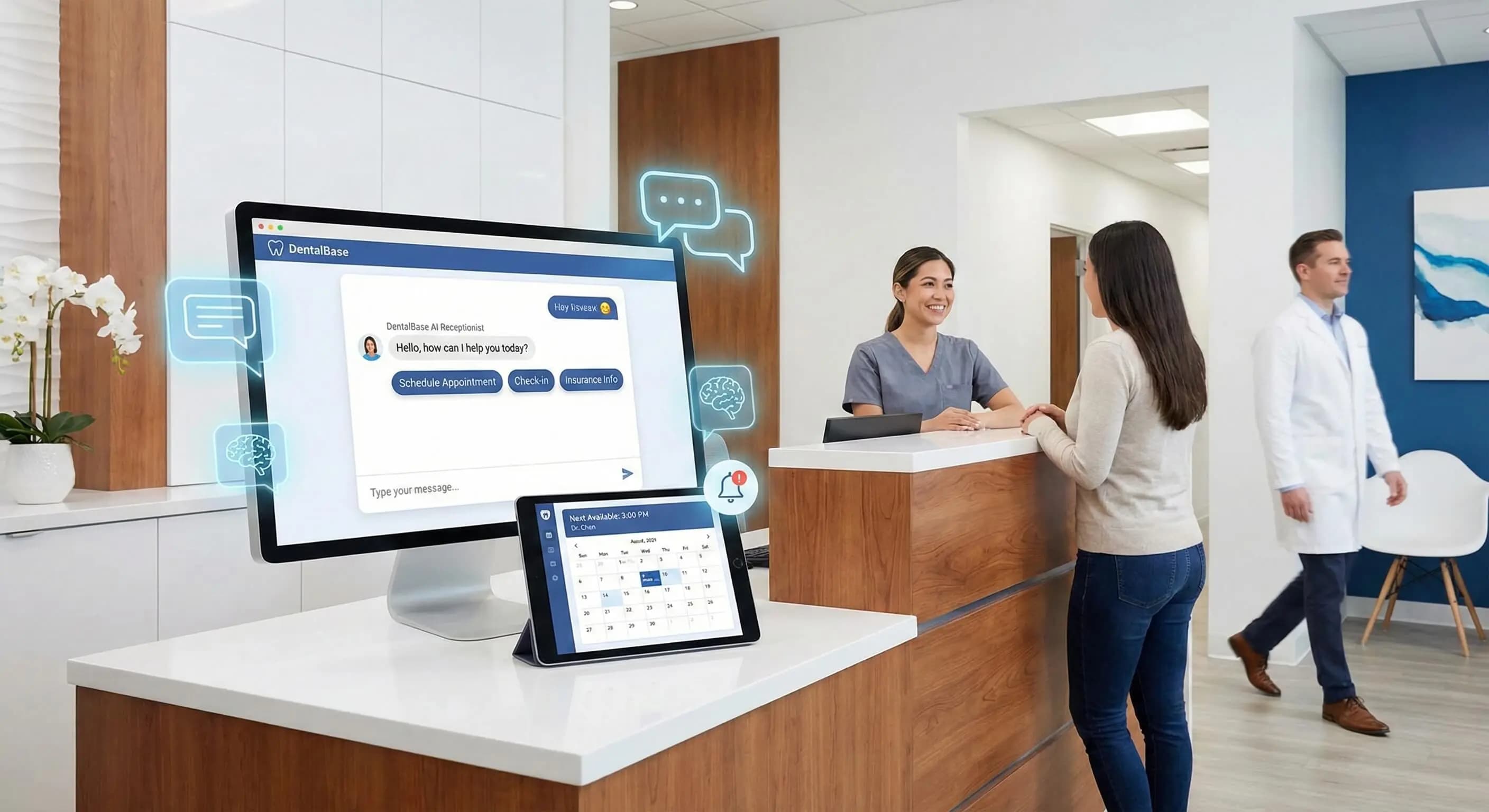
How North Carolina Dentists Are Using AI to Scale Patient Growth
Explore AI dental patient growth in North Carolina, strategies that scale bookings with faster response, automated follow-up, recall systems, and better conversion.
Share:
Table of contents
A North Carolina growth story you’ve probably lived
It’s 11:42 a.m. on a Tuesday. The front desk has a line. A hygienist needs help. Two patients are checking out. The phone rings—again.
It’s a new patient.
But no one can pick up.
The call rolls to voicemail. The patient sighs, opens Google again, and taps the next practice on the list. In a matter of 30 seconds, you didn’t “lose a lead.” You lost a booked appointment you never even knew you had.
That moment—multiplied across weeks—explains why so many offices feel busy but still struggle to grow predictably.
In 2026, North Carolina dentists are using AI to scale patient growth by making sure the practice can respond even when the team can’t. The goal isn’t to be futuristic. The goal is to stop bleeding opportunities during normal chaos.
Why scaling in North Carolina is its own challenge
North Carolina practices often sit inside a unique blend of growth pressures:
1) Fast-growing areas + shifting demand
Whether you’re near Charlotte, Raleigh-Durham, Greensboro/Winston-Salem, Asheville, Wilmington, or expanding suburbs, new residents bring new demand—but also new competition.
2) A mix of metro competition and “rural coverage”
Many practices serve patients who may drive farther, call after hours, or want quicker clarity before committing to a visit.
3) Staffing and time constraints
Even well-staffed practices hit capacity because the front desk role has expanded: calls, texts, insurance, online inquiries, confirmations, reschedules, forms, reviews—everything funnels through one team.
So when NC dentists say they want to “scale,” what they usually mean is:
Book more new patients without increasing phone tag
Convert more of the marketing they already pay for
Reduce no-shows/cancellations that flatten growth
Create predictable systems that don’t depend on one superstar staff member
That’s exactly where AI fits.
The real definition of “AI dental patient growth North Carolina”
AI growth isn’t “use AI and patients appear.”
It’s more practical than that.
AI helps your practice do five things consistently:
Answer more (so fewer inquiries vanish)
Respond faster (so interest doesn’t cool off)
Follow up reliably (so leads don’t disappear)
Protect the schedule (so booked time becomes production)
Reactivate patients (so growth doesn’t rely only on new leads)
Think of AI as a “communication engine” that keeps running even when your team is in the weeds.
Where practices actually lose growth (the 4 invisible leaks)
To scale, you don’t need to guess. You need to plug leaks.
Leak #1: Missed calls during rush windows
Rush windows are predictable. Missed calls are not “rare events,” they’re normal.
AI fix: Overflow answering + missed-call text-back.
Leak #2: After-hours demand is treated like low priority
Many patients call after work or submit forms at night. If the first response comes the next day, you’re already behind.
AI fix: After-hours capture + next-step texting.
Leak #3: Leads who hesitate are never guided back to booking
Not everyone books in the first conversation. Some want to compare, ask a spouse, check schedules, or verify insurance. Without follow-up, they drift away.
AI fix: Automated lead nurturing that’s short, helpful, and timed.
Leak #4: No-shows and cancellations create “growth ceiling”
If your schedule leaks chair time, growth stalls even if new patients are coming in.
AI fix: Confirmations, reschedule flows, and short-notice gap filling.
The “Scale Stack”: the AI workflows NC dentists are adopting first
Instead of repeating the same template, here’s a clearer model that NC practices are using—layer by layer.
Layer 1: Instant response (phones + texts)
AI front desk automation shines when it covers the first 60 seconds of an inquiry.
What this looks like:
AI answers overflow calls when staff is busy
AI provides basics (hours, location, services)
AI captures intent (new patient, emergency, hygiene, consult)
AI texts next steps if the call is missed
Why it scales growth: You stop losing inquiries at the front door.
Missed-call text-back (simple, high impact)
When a call is missed, the AI texts immediately:
“Sorry we missed you—are you trying to schedule an appointment?”
Then it asks:
“Routine visit or urgent issue?”
“Soonest available or specific days?”
“Best number + name?”
This turns voicemail into momentum.
Layer 2: Smart routing (less chaos, more conversion)
Routing isn’t glamorous, but it’s one of the biggest stress reducers.
AI can route calls by category:
new patient scheduling
existing patient reschedule
billing/insurance questions
urgent dental pain
specialty interest (implants, Invisalign, cosmetic)
Why it scales growth: Your team spends less time bouncing calls and more time closing appointments.
Layer 3: Lead nurturing (the difference between “interested” and “scheduled”)
Many practices lose the middle of the funnel: the “maybe” patients.
AI-driven dental lead nurturing keeps things moving without being pushy.
Here are examples of “helpful, not spammy” follow-ups:
“Do you want the earliest appointment, or a specific day next week?”
“We have a time available tomorrow afternoon—want me to hold it?”
“If mornings are tough, we can look at later options too—what works best?”
Short. Clear. Choice-based.
Why it scales growth: You convert leads that would otherwise evaporate.
Layer 4: Scheduling assistance (less phone tag)
Not every practice wants fully automated booking—and that’s fine.
A lot of NC practices scale successfully using AI scheduling assistant workflows that do one thing well:
Collect scheduling-ready information so staff can finalize fast.
AI gathers:
visit type
urgency
preferred windows
insurance note (optional)
location/provider preference (especially for multi-site)
Then staff sends two concrete options and closes.
Why it scales growth: Fewer back-and-forth loops = more bookings.
Layer 5: Retention automation (recall + reactivation)
Scaling isn’t only new patients. A strong practice grows because it keeps patients.
NC dentists are using automated recall campaigns to make retention consistent:
Recall messaging that works:
“It’s time for your 6-month visit—want the soonest opening?”
“We can reserve a spot for next week. Mornings or afternoons?”
Reactivation messaging that works:
“We haven’t seen you in a while—do you want to schedule a checkup?”
“If you’ve been meaning to come in, we can help you pick a time this week.”
Why it scales growth: A reliable recall engine stabilizes production and reduces dependence on constant new leads.
How multi-location and growing practices use AI differently
North Carolina has a lot of practices that are:
adding associates
adding operatories
expanding into second locations
consolidating back-office tasks
AI helps these practices by standardizing what usually varies wildly: phone handling and follow-up.
Instead of one location being “great on phones” and another being inconsistent, AI can:
maintain consistent scripts
route calls to the correct location
capture details uniformly
generate comparable reporting across sites
That’s true scaling: same standards, bigger footprint.
A simple “North Carolina Scale Scorecard” (track weekly)
If you want AI results without guessing, track these five numbers:
Answer Rate
How many calls were answered by a human or AI vs. missed?Response Time
How quickly do you respond to missed calls, forms, chat?Lead-to-Appointment Conversion
Of new inquiries, what percentage becomes scheduled?Show Rate
Of scheduled patients, how many show up (no-shows and late cancels)?Recall/Reactivation Bookings
How many appointments came from retention outreach?
Scaling happens when those improve—not when you “feel busy.”
Implementation plan (different, cleaner, less repetitive)
Here’s a rollout NC practices use that avoids overwhelming the team.
Phase A: Fix missed opportunities first (Days 1–10)
missed-call text-back
after-hours capture
basic FAQs + lead capture scripts
Phase B: Reduce front desk interruption (Days 11–20)
overflow call answering
smart routing rules
escalation rules for urgent calls
Phase C: Stabilize growth (Days 21–30)
lead nurturing sequences
recall + reactivation automation
confirmation/reschedule improvements
Then weekly: review transcripts, tighten scripts, watch conversion improve.
Common “scaling traps” (and how AI avoids them)
Trap 1: Spending more on ads to outgrow conversion problems
If conversion leaks exist, more ads just create more chaos.
Trap 2: Depending on one great front desk person to keep the machine running
When that person is out, growth stalls.
Trap 3: Treating recall as optional
Optional recall = unpredictable production.
Trap 4: Letting cancellations sit without a gap-fill plan
Schedule protection is growth.
AI helps because it turns these into systems.
Bottom line
North Carolina dentists scaling patient growth in 2026 are doing something refreshingly simple:
They’re building a practice that responds fast, follows up consistently, and protects the schedule—whether the team is busy or not.
That’s what AI dental patient growth North Carolina looks like in real life:
fewer missed opportunities
faster booking
consistent follow-up
stronger recall
less staff overwhelm
measurable growth
Was this article helpful?
Written by
DentalBase Team
The DentalBase Team is a collective of dental marketing experts, AI developers, and practice management consultants dedicated to helping dental practices thrive in the digital age.