Dental Branding Company: What They Do & How to Choose (2026)
A dental branding company shapes your identity, positioning, and patient story. See what they deliver, what it costs, and how to pick one in 2026.
Share:
Table of contents
A dental branding company builds the identity that a marketing company spends money promoting. That distinction matters more than most practice owners realize. You can pour $6,000 a month into Google Ads, but if your logo looks like it was designed in 2008 and your homepage says the same thing as every other general dentist in town, your cost per acquisition will climb and your close rate will suffer.
The dental branding space sits in an awkward middle. It is not just graphic design. It is not quite marketing. It is the strategic work of deciding what your practice stands for, then expressing that decision across every patient touchpoint. This guide breaks down what these firms actually deliver, when hiring one pays off, what to expect on pricing, and how to evaluate candidates without getting sold.
What Does a Dental Branding Company Actually Do?
A dental branding company develops the strategic identity of your practice, including positioning, visual system, messaging, and patient experience standards. The deliverables typically include brand strategy documentation, logo and visual identity, typography and color systems, voice and messaging guidelines, and applied assets like stationery, signage, scrubs, and a brand-ready website brief.
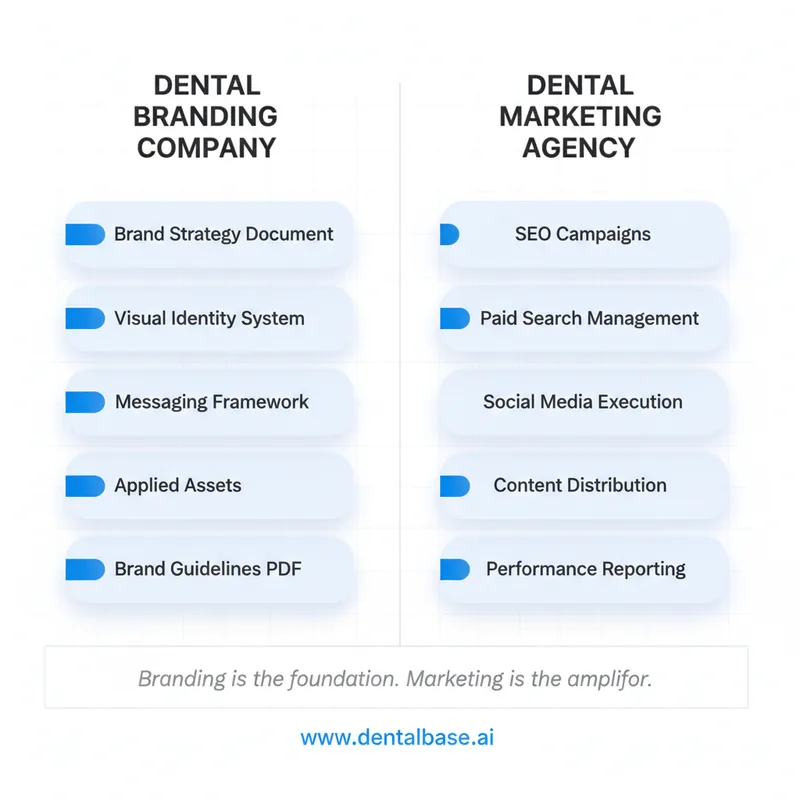
This is different from a dental marketing agency. Marketing agencies run campaigns. Branding firms decide what those campaigns should say. A well-run engagement starts with discovery, usually two to four weeks of interviews with you, your team, and sometimes patients. Then comes positioning work: who you serve, why they should choose you over the three other practices within a two-mile radius, and the words that make that case.
Only after strategy is settled does visual design start. A logo drafted before positioning is decided is a logo that will need a redesign within two years. According to the ADA Health Policy Institute, 67% of patients would travel further to receive preferred care, which means your differentiation has real economic weight. Branding is how you name that difference. For the wider context, see our complete guide to dental marketing.
Core deliverables you should expect
- Brand strategy document: positioning, audience profile, value proposition, brand pillars, and voice.
- Visual identity system: primary and secondary logos, color palette, typography, iconography, and photography direction.
- Messaging framework: tagline, boilerplate, key messages by audience and treatment line.
- Applied assets: business cards, letterhead, appointment cards, signage specifications, scrub and apron mockups.
- Brand guidelines PDF: the single source of truth your website designer, printer, and social media manager will work from.
Branding is the foundation. Marketing is the amplifier.
If you already have a defined brand and need the channels that put it in front of patients, start with the right service mix.
See DentalBase Services →When Does Your Practice Actually Need a Rebrand?
Your practice needs a dental branding company in three situations: you are opening or relocating, you are repositioning to attract different patients, or your current brand is actively hurting conversion. Branding work is not urgent for most established practices, but it becomes urgent when your visual identity and messaging no longer match the care you deliver.
The clearest signal is conversion drop-off on your website. If you are paying for clicks and your landing page turns them away, the problem is rarely the ad copy. It is usually that the site looks generic, the practice has no point of view, and the visitor has no reason to pick you over the next result. A Google Business Profile survey found that 44% of patients who found healthcare via mobile search scheduled an appointment, but that number only holds when the landing experience is credible.
A second trigger is partner change. New owner, merger, or a DSO acquiring a private practice almost always requires rebranding to signal continuity or a fresh start. A third trigger is treatment mix shift. A practice that built its reputation on family dentistry and now wants to compete for full-arch implants and cosmetic cases cannot do that under the same brand that says "friendly family care since 1998."
When you probably don't need one
Your brand is working if new patients cite specific reasons for choosing you, if referrals describe you consistently, and if your team can answer "what makes us different" the same way without coaching. If all three are true, spend your budget on local SEO, social media, or Google Ads instead. A branding engagement does not fix a demand-generation problem, and if you have not yet built a written marketing plan, that should come first.
How Much Does a Dental Branding Engagement Cost?
Dental branding company pricing ranges from $3,500 for a logo-only package to $45,000+ for a full strategic rebrand with applied assets, website direction, and photography. Most independent practices land between $8,000 and $20,000. Group practices and DSOs with multiple locations commonly spend $25,000 to $75,000 because the system has to flex across sites.
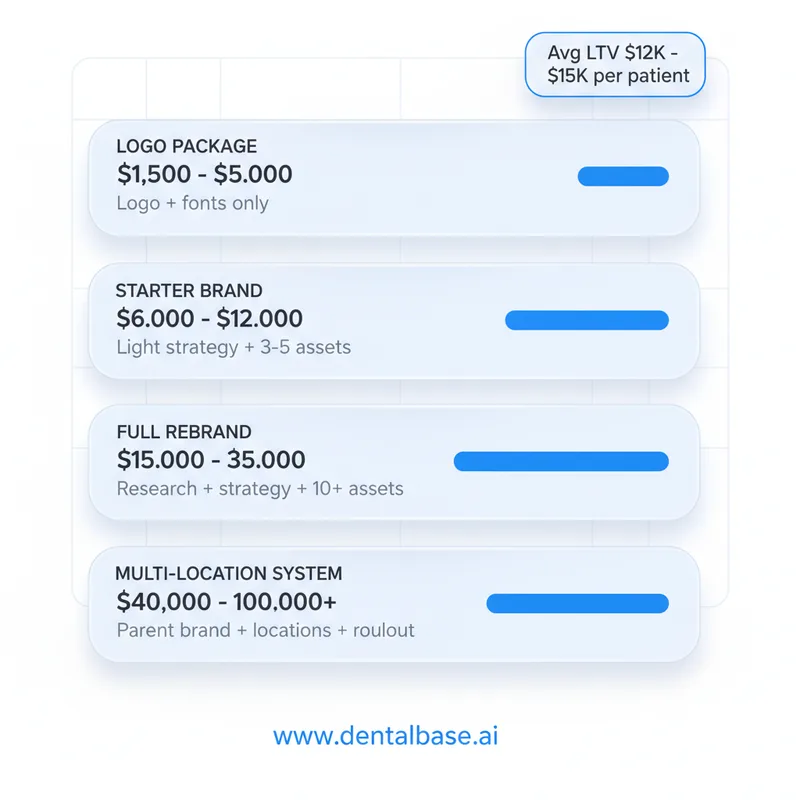
The difference in price is almost never about the logo file. It is about the depth of strategy, the number of deliverables, and whether the firm is doing research to support the decisions. A $4,000 engagement is a designer with a template. A $25,000 engagement is a team with a strategist, a designer, a copywriter, and a project manager running a structured process.
Here is a rough breakdown of what each tier typically includes.
| Tier | Typical Price | What's Included |
|---|---|---|
| Logo package | $1,500 - $5,000 | Logo, color palette, fonts. No strategy or applied assets. |
| Starter brand | $6,000 - $12,000 | Light positioning, full identity system, basic guidelines, 3-5 applied assets. |
| Full rebrand | $15,000 - $35,000 | Research, strategy, identity, messaging, guidelines, website direction, 10+ assets. |
| Multi-location system | $40,000 - $100,000+ | Parent brand plus location brands, scaled asset library, rollout plan. |
Run the numbers against patient lifetime value. Dental Economics pegs the average general dentist patient at $12,000 to $15,000 over the relationship. If a $15,000 brand investment brings in 15 additional new patients over its first two years, the math already works. Most practices see more than that when the brand drives a parallel lift in referrals and case acceptance.
Related: Before committing to a branding spend, know what your marketing budget needs to return. → Dental Marketing ROI: How Much to Spend and What to Expect
What Should You Look For in a Branding Partner?
Look for a dental branding company that leads with strategy before design, has at least five dental case studies, shows before-and-after data beyond visuals, and will not own your files after the engagement. Those four filters eliminate most of the noise. The firms left standing are the ones worth a discovery call.
The single biggest predictor of a bad engagement is a firm that shows you logos in the first meeting. Logos that appear before positioning is settled are guesses. You want to see a process that starts with questions about your patient profile, your treatment mix, and your competitive set. If that is missing, the firm is a design shop with branding in its service menu.
The questions that surface the real firms
- Walk me through your discovery phase. The answer should include stakeholder interviews, competitive audits, and sometimes patient research. If the answer is "we send a brief," move on.
- Can I see a dental case with before-and-after data? Not just visuals. New patient numbers, case acceptance changes, referral rate shifts. Good firms have this. Weaker ones will say "brands take time to measure."
- Who owns the files after delivery? The answer must be "you do." Source files for logos, fonts licensed to you, style guides in editable formats. If they hold anything hostage, walk.
- How do you connect brand to performance channels? A strong firm collaborates with your SEO, PPC, and social teams. A weak one hands off a PDF and disappears.
- What is your revision policy? Expect defined rounds, not unlimited revisions. Unlimited revisions signal a firm that will not stand behind its recommendations.
Check references the way you would check a clinical hire. Call two or three past dental clients and ask what the engagement was like six months after delivery. Ask whether the guidelines are being used, whether the website actually got built to spec, and whether the firm was responsive to questions after the final invoice. According to BrightLocal, 98% of people read local reviews before choosing a business, but B2B references are more useful than Google reviews when hiring a branding firm. If review management is itself part of what you need to fix, start with dental reputation management first.
Some practice owners want strategic advice without a full visual overhaul. A dental marketing consultant can be a lighter-touch alternative when your identity is sound but the strategy around it needs sharpening. Strong brand consistency is also a known ranking signal, which is why Moz categorizes brand authority as one of the long-term levers in organic search.
Your brand is the promise. Your operations keep it.
A great brand only pays off if the phone gets answered, the calendar stays full, and every patient call gets tracked. See how DentalBase connects brand, marketing, and operations in one system.
Book a Free Demo →How Does Branding Connect to Marketing ROI?
Dental branding affects marketing ROI through three measurable channels: higher click-through rates on paid ads, better conversion rates on your website, and larger average case values from patients who self-select based on positioning. A brand does not just make your practice look professional. It filters your funnel.
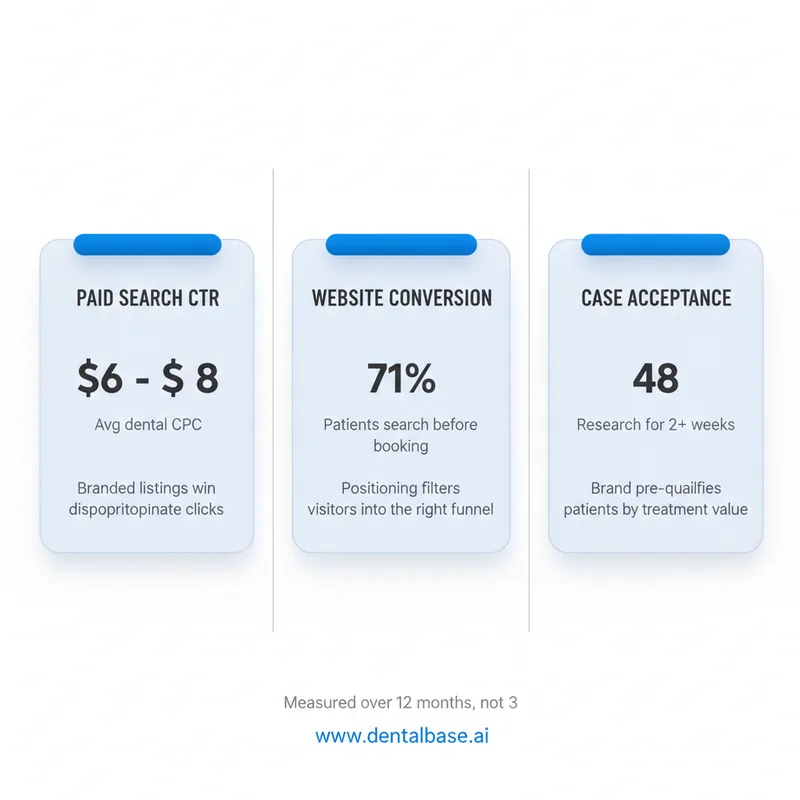
The clearest ROI lift shows up in paid search. When two practices bid on "dentist near me" and one has a distinctive brand while the other runs the stock Google Ads template, the branded listing takes a disproportionate share of clicks. This matters because the average cost per click for dental keywords runs $6 to $8, according to Google Ads benchmarks. A lift in CTR lowers your effective CPC, which raises the return on the entire PPC program.
The next lift is on-site. 71% of people looking for a dentist run a search before scheduling, according to Pew Research, and 48% conduct over two weeks of research. That is a lot of comparison shopping. A site with clear positioning converts better than a template site because it answers the unstated question every visitor has: "why you and not the next result?"
The case acceptance dividend
Here is the less obvious return. Branding affects case acceptance. A practice that positions around advanced prosthetic work attracts patients who expect to spend $8,000 on an implant case. A practice with vague "friendly family dentistry" branding attracts patients who balk at a $1,200 crown. The brand did not change the patient, but it changed which patients walked in. Positioning is a pre-qualifier.
Measure the effect over 12 months, not three. Look at average new patient value, referral rate, website conversion rate, and organic search rankings. If your branding firm cannot tell you which of these they expect to move, that is the signal. Either they cannot, or they have not thought about it. Both are reasons to keep interviewing.
Pick the right partner for what you actually need.
Branding, agency work, and marketing experts solve different problems. This guide lays out when each one fits.
Read the Full Comparison →How Do You Run a Rebrand Without Losing Control?
Work with a dental branding company by staying the decision-maker on positioning, delegating execution, and requiring a written brand strategy before any visual work begins. Your practice is your brand's product. No outside firm knows it better than you and your team, and the best firms know it.
Appoint one internal owner. Usually the practice owner or a senior team member with authority to approve work. Branding dies in committees. Every round of feedback filtered through three voices becomes a compromise, and compromised brands look like every other practice on the block.
Set the review cadence up front. Two rounds of strategy review, two rounds of design review, one final applied asset review. Beyond that, either the scope changes or the process is broken. Good firms welcome this structure because it protects their work from endless revision cycles. According to HubSpot, consistent brand presentation across channels can increase revenue by up to 23%, but only when that consistency is actually maintained after launch.
What to do after the final delivery
The brand guidelines PDF is useless if it sits on a server. Distribute it to your website vendor, printer, signage company, social media manager, and front desk team. Review it quarterly for the first year. Things will drift. Patient-facing emails will stop matching the voice. Scrubs will get reordered in the wrong color. Catch these early or the brand decays within 18 months of launch.
A well-built brand should outlast two marketing agencies and one website redesign. If the positioning is right, the surface elements can evolve without a full rebrand. That is the difference between a $15,000 investment that compounds and a $4,000 logo you replace in 24 months. Many practices pair a branding engagement with ongoing content marketing and hire dental marketing experts to carry the story forward.
A dental branding company is not the right first hire for every practice. It is the right hire when your current brand is holding back the practice you actually run, when you are entering a new market, or when you are repositioning to compete for different cases. For everyone else, marketing execution usually comes first.
If you are evaluating firms, build a short list of three to five candidates, run the question set above, and insist on references with data. The right partner will welcome the scrutiny. The wrong one will hedge. Either way, you will have your answer within two calls.
Start by mapping what your practice actually needs over the next 12 months: more new patients, different patients, or a cleaner story to tell the ones you already have. That answer tells you whether to call a branding company, a marketing agency, or both.
Turn a strong brand into booked chairs.
A great brand earns clicks. DentalBase makes sure those clicks become answered calls and scheduled appointments, with attribution that proves what works.
Book a Free Demo →Want more guides on growing a modern dental practice?
Browse Resources →Sources & References
Frequently Asked Questions
A dental branding company defines positioning, identity, and messaging. A marketing agency runs campaigns to promote that identity. Branding is the strategic foundation. Marketing is the distribution layer. You usually need branding first, then sustained marketing to put it in front of patients.
A standard dental branding engagement runs 8 to 14 weeks from discovery to delivery. Starter packages can finish in 4 to 6 weeks. Full strategic rebrands with research, applied assets, and website direction often extend to 4 months when stakeholder reviews and printed collateral are in scope.
You need a rebrand when positioning, messaging, or visual identity are unclear across touchpoints. You need a new website when the brand is solid but the site is slow, outdated, or fails to convert. Rebranding without a website update wastes the investment. Site changes without brand work rarely move the business.
A dental branding company does not directly change Google rankings, but strong branding improves click-through rates on search results and lowers bounce rates on your site. Brand authority is also a factor search engines weigh over time. You still need a dedicated SEO partner for technical and content work.
Track new patient volume, average case value, referral rate, website conversion rate, and paid search CTR over 12 months. Most branding engagements pay back through a combination of higher-quality patients and more efficient marketing spend, not a single metric. Compare to your pre-rebrand baseline quarterly.
A specialist dental branding company understands payer dynamics, treatment economics, and how patients choose dentists. A general firm may deliver stronger creative but will miss nuance. For practices focused on cosmetic or elective treatment, general firms with healthcare experience often outperform dental-only shops.
Ask about their discovery process, request case studies with before-and-after data, clarify who owns the files after delivery, confirm they will collaborate with your marketing and SEO vendors, and get their revision policy in writing. Firms that lead with logos instead of strategy should be eliminated early.
Was this article helpful?
Written by
DentalBase Team
Expert dental industry content from the DentalBase team. We provide insights on practice management, marketing, compliance, and growth strategies for dental professionals.