Local SEO for Dentists: Google's 2026 Ranking Updates
What Google's 2026 updates mean for local SEO dentist rankings: ranking factor shifts, profile requirements, and what to adjust now.
Share:
Table of contents
If you run a dental practice and you have not checked your Google Business Profile in the last 30 days, your dental local SEO may already be slipping. Google rolled out a March 2026 Core Update on March 27 that is still propagating into late April. Several connected changes have shifted what makes a profile rank, which features still exist, and how your patients actually find you.
The short version: Google removed the Q&A feature and replaced it with an AI experience called Ask Maps. The Core Update suspended thousands of profiles for keyword stuffing in business names. Maps now shows AI summary cards above the classic local pack. And profile freshness, review velocity, and structured website content matter more than ever.
This article walks through what changed, why dental practices are affected differently from other businesses, and a practical optimization plan you can run through this week.
What changed in Google's local search for dental practices in 2026?
Five connected changes hit dental local SEO in late 2025 and early 2026: the GBP Q&A feature was removed and replaced with AI-powered Ask Maps, the March 2026 Core Update suspended profiles for keyword stuffing, Maps now displays AI summary cards above the local pack, profile freshness became a stronger ranking signal, and Google Posts gained scheduling and multi-location publishing.
None of these arrived as a single big announcement. They rolled out across roughly six months, and most practice owners only notice the cumulative effect when their phone stops ringing. According to the Google Business Profile developer documentation, the Q&A API was officially deprecated on November 3, 2025, with the public feature phasing out from December 2025 onward. The March 2026 Core Update began on March 27 and is still propagating.
The connecting thread is AI. Google is shifting local search from a list of static profiles to a conversational layer where Gemini answers questions about your practice using your profile, reviews, and website as source material. If those sources are weak or contradictory, the AI fills the gaps with assumptions. That is the new risk. AI search optimization for dentists sits next to local SEO now, not separate from it.
The five changes at a glance
Here is the short version before the detail, worth bookmarking if you only have five minutes today.
- Q&A removed, Ask Maps added: Google's AI now answers patient questions using your profile, reviews, and website instead of a manually filled box.
- March 2026 Core Update: keyword-stuffed business names can now trigger a full profile suspension, not just a ranking dip.
- AI summary cards in Maps: a new impression surface now sits above the classic local pack for many searches.
- Freshness became a stronger signal: profiles idle for 30 or more days show measurable visibility drops.
- Posts gained scheduling: multi-location publishing is now built into the same screen as the calendar.
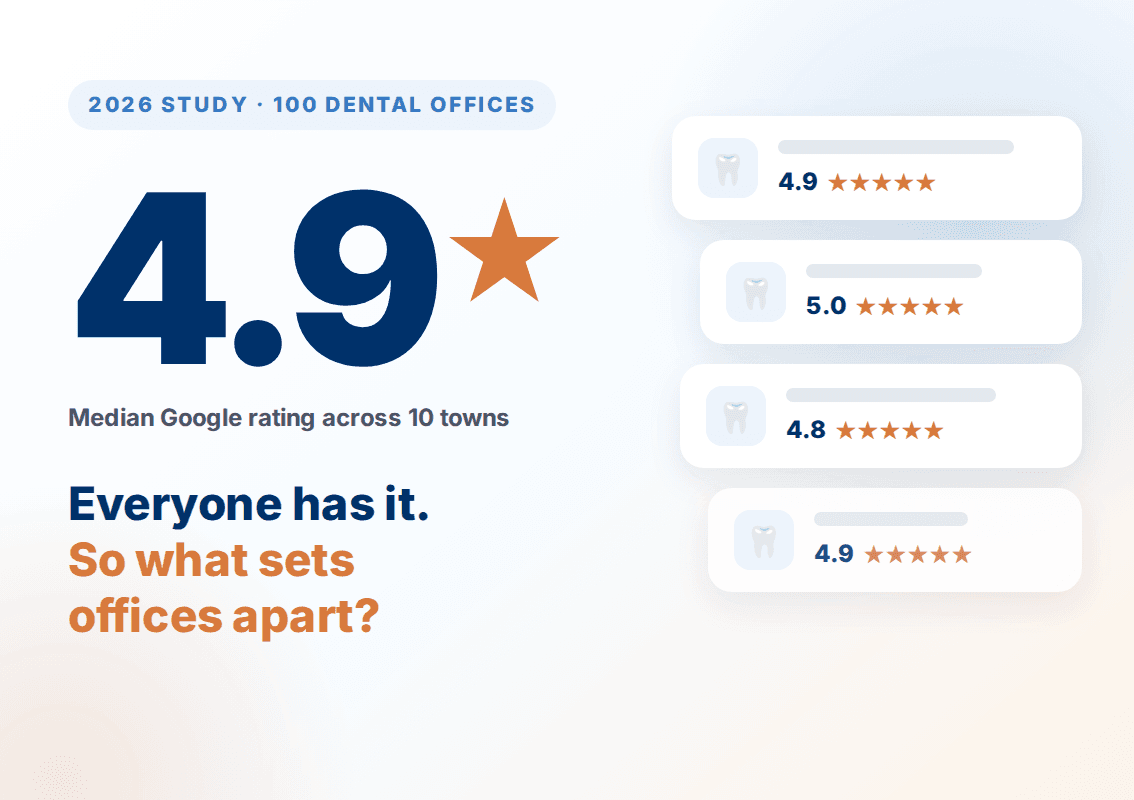
Local intent is not a small slice of search volume. According to Google, 46% of all searches carry local intent, which is part of why a dental profile change ripples into call volume faster than most other website updates would.
Why this matters more for dental than for most categories
Dental is a high-intent, high-competition local category. According to Google research, "dentist near me" generates over 1.2 million U.S. searches monthly, and 86% of users contact a dentist after running that kind of search. Anything that changes the search interface ripples directly into your call volume. If you have not mapped which terms drive your bookings, the top dental keywords to rank for is a useful starting list.
Why does the March 2026 Core Update hit dental practices harder than most?
The March 2026 Core Update hits dental practices hard because many use keyword-stuffed business names that now trigger suspension. Names like "Affordable Family Dental Implants of Springfield" or "24/7 Emergency Dentist Same Day Crowns" are exactly the pattern Google is removing from Maps. A suspension can wipe a practice from local results overnight.
According to multiple local SEO trackers covering the rollout, the sectors hit hardest are those with historically aggressive name optimization: locksmiths, movers, contractors, and yes, dental practices in saturated metro markets. Suspension can be soft (posts disappear, messaging disabled, profile still visible) or hard (profile removed from Search and Maps entirely). A hard suspension on a practice that gets 30% of new patients from Maps is a revenue event, not just an SEO event. If your ranking has already fallen and you are trying to work out why, our step-by-step Google Maps ranking drop diagnosis covers suspensions alongside the other five common causes.
The fix is simple to state and uncomfortable to do. Rename the profile to your legal business name, exactly as it appears on your business license and signage. Take the keywords out. The legal name is what Google now expects, and edits typically go through review in 3 to 5 days.
Worried your profile is at risk?
Our dental SEO team audits your Google Business Profile for suspension risk, name compliance, and category fit, then maps the fastest fixes.
See Dental SEO Services âThe trap of "Dr. Smith Dental Implants and Cosmetic Dentistry of Phoenix"
This kind of name was rewarded for years, which is exactly why it is now penalized. The legal entity is usually "Smith Dental, PLLC" or similar. That is the name that goes on the profile. The implants and cosmetic dentistry belong in your services list and category, not in the title.
How is the loss of GBP Q&A changing dental local SEO?
The loss of GBP Q&A pushes control of customer answers off your profile and onto your website. Google replaced the Q&A box with an AI feature called Ask Maps that pulls answers from your profile fields, reviews, and website content. In practice, that means FAQ pages and FAQ schema on your site are now your main lever for shaping how patients hear about you in Maps.
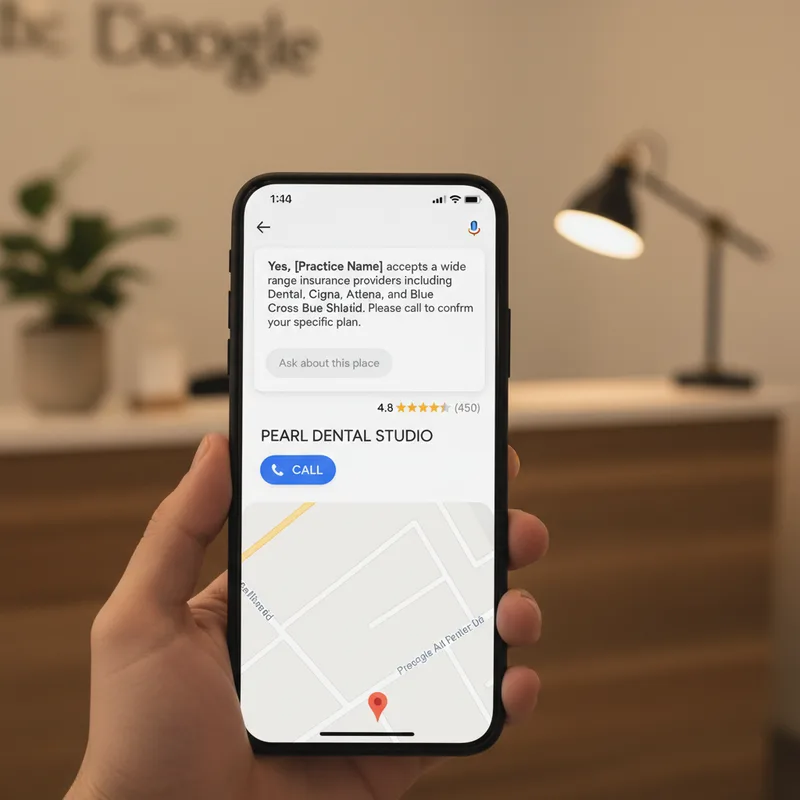
According to analysis of the Q&A removal, Google's AI now sources answers from six places: your profile information, your services and attributes, your reviews, your photos, your website content, and structured data on your site. The Q&A box, where many practices used to seed answers about sedation, insurance, or pediatric care, is gone.
This shift is not neutral for dental. Patients ask very specific questions before booking: do you accept Delta Dental, do you do same-day crowns, do you treat children, do you offer sedation. Those answers used to live in Q&A. They now need to live on your website, in clear language, with schema markup so Gemini can find them.
Old Q&A box vs. the new Ask Maps experience
| Feature | Old GBP Q&A (retired Nov. 2025) | Ask Maps (current) |
|---|---|---|
| Who writes the answer | Practice staff or the public, typed manually | Google's AI, generated automatically |
| Source material | Whatever text was typed into the box | Profile fields, reviews, photos, and website content |
| Practice's control | Direct: edit or delete the answer anytime | Indirect: only by improving the source content |
| Best lever today | Not applicable, feature retired | A website FAQ page with FAQPage schema |
What this means in practice
Build a real FAQ page on your site. Use plain question wording (not "frequently asked questions" headers, but actual questions like "Do you accept Cigna?"). Add FAQPage schema so Google can read it as structured data. Make sure your services list on the GBP matches what is on the website. Mismatch is exactly the kind of contradictory signal that produces vague AI answers.
If your website itself is dated or hard to update, the FAQ page is the wrong place to start. Our guide to choosing a dental website design company covers what to look for before you rebuild the FAQ and schema on top of it.
What dental local SEO signals matter most after these updates?
The dental local SEO signals that matter most in 2026 are profile completeness, primary category accuracy, review velocity over the past 90 days, photo and post freshness, and structured website content the AI can parse. Distance and prominence still matter, but those five inputs are what separate a profile that ranks from one that drifts. Review velocity is the highest-leverage signal, and our guide to Google reviews for dentists covers how to keep it consistent at 15-25 reviews per month.
According to BrightLocal's 2026 consumer review survey, 98% of consumers read local reviews before choosing a business, and review recency now weighs more heavily than raw count. A profile with 25 reviews in the past 90 days outperforms one with 200 reviews where the last one was six months ago. That is a real shift in how the algorithm reads social proof.
Primary category is the biggest single lever
Switching your primary category from "Dentist" to "Cosmetic Dentist," "Pediatric Dentist," or "Dental Implants Periodontist" can change Maps visibility more than any other on-profile edit. Pick the narrowest accurate category, then add the others as secondary. A general practice that does heavy implant volume should consider "Dental Implants Periodontist" if a credentialed provider is on staff, because that category has far less competition.
The 30-day freshness signal
Multiple independent local SEO trackers are reporting visibility drops on profiles that go more than 30 days without a new photo, post, or update. Google has not published a clean "30 day rule," but the pattern is consistent enough that treating it as one is safer than ignoring it.
Related: Want a deeper read on dental SEO that still works in 2026? â Dental SEO Strategies That Actually Work
Review velocity and reply quality
Aim for a steady cadence rather than bursts. Five new reviews a month, every month, ranks better than 30 in March followed by silence. Reply to every review within 48 hours. Generic AI replies are increasingly recognized as a red flag by patients and, anecdotally, by the algorithm. Specific replies that reference the procedure, the staff member, or the date show real engagement.
The payoff for replying shows up in the data. According to BrightLocal, 88% of consumers are more likely to use a business whose owner responds to all its reviews, not only the negative ones. For a look at what a strong review actually says, 5-star dentist review examples breaks down the patterns worth featuring on your site.
How should a dental practice optimize Google Business Profile in 2026?
To optimize a Google Business Profile in 2026, run through a 7-step audit: clean the business name, choose the narrowest primary category, fill every attribute and service, post weekly, build review velocity, add an FAQ page with schema to your site, and check your performance dashboard by surface every Monday.
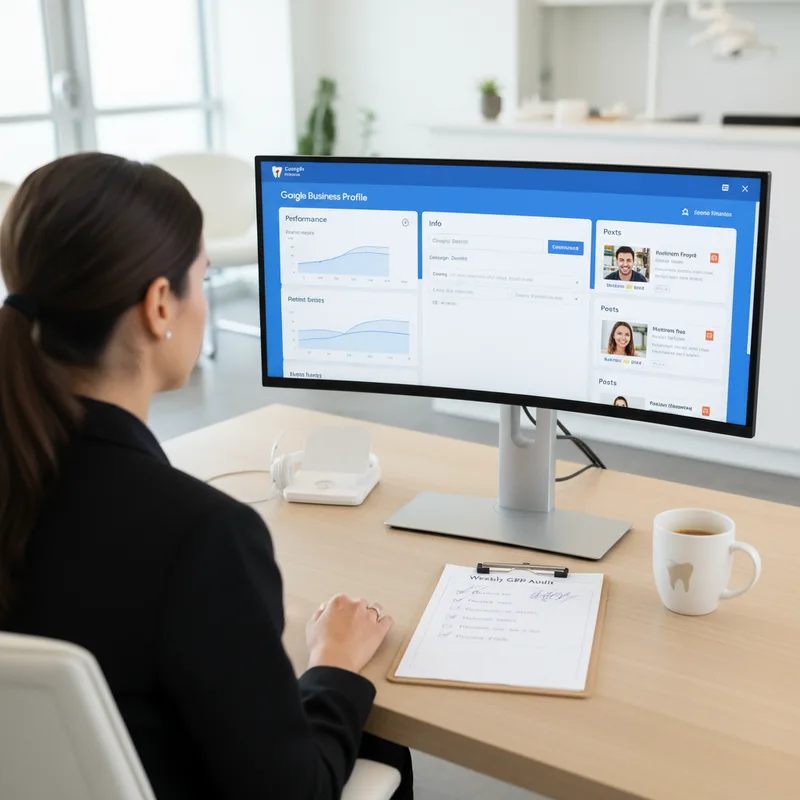
This is a checklist, not a strategy document. Each step takes between 15 minutes and a couple of hours, except the FAQ page which is a one-time build. Run them in order. The earlier ones set up the later ones.
1. Clean the business name
Match your legal entity exactly. No service keywords, no city names, no taglines. If you are unsure what counts as your legal name, use what is on your dental license or business registration.
2. Choose the narrowest accurate primary category
"Dentist" is the most competitive category. If you do significant cosmetic, pediatric, orthodontic, or implant work, set the more specific category as primary and "Dentist" as secondary. You can hold up to 10 categories total.
3. Fill every attribute and service
Attributes (wheelchair accessible, accepts new patients, free parking, online appointments, LGBTQ+ friendly) feed directly into Ask Maps responses. Services should match what is on your website word-for-word.
4. Post weekly using the new scheduling tool
Google now lets you schedule Posts and publish across multiple locations from one screen. Use it. Posts do not directly move ranking, but they lift click-through in the local panel and feed the freshness signal.
The lift is measurable. According to BrightLocal, dental practices that post regularly on their Google Business Profile see 35% more website clicks than profiles that go quiet, even before ranking position changes.
5. Build a review velocity system
Send a review request via SMS the same day a patient leaves the office. According to Dental Economics, practices that send reviews requests within 4 hours of the appointment see roughly 3x the response rate of practices that send them next-day. Volume from a steady cadence beats volume from a one-time push.
6. Build an FAQ page with FAQPage schema
Use real patient questions: insurance accepted, payment plans, sedation options, emergency policy, new patient process. This page is now your main influence over AI-generated answers in Maps and Search.
7. Check the performance dashboard weekly
The 2026 GBP performance view splits impressions by surface: classic local panel, Maps AI summary card, and Google Search. Watch the discovery search ratio (category and service searches, not your brand name) over a rolling 90 days. Rising discovery share is the cleanest signal that category and content work is paying off.
Better local SEO drives more calls. Are yours getting answered?
DentiVoice answers every patient call 24/7, books straight into your PMS, and tracks the source so you know which Maps queries actually convert.
See How DentiVoice Works âHow do you measure dental local SEO performance after these updates?
You measure dental local SEO performance in 2026 using four numbers from the GBP dashboard: discovery search share, calls, direction requests, and action rate. Aim for an action rate of at least 5% across all impressions, and watch the rolling 90-day trend rather than week-to-week noise. The new Maps AI summary card is now a separate impression surface in the report.
The dashboard now splits impressions by where they happened: classic local panel, the Maps AI summary card, and standard Google Search. Each surface behaves differently. AI summary impressions tend to convert lower per impression because Gemini already answered the question, but the patients who do click are deeper in the funnel.
What good looks like for a single-location dental practice
Rough benchmarks based on practices we work with: 1,500 to 4,000 monthly impressions in mid-size U.S. metros, 60% to 75% from discovery searches (not branded), an action rate around 6% to 9%, and 30 to 80 calls per month direct from the profile. Track those calls all the way to booked appointments, because Maps impressions are vanity metrics if the calls do not convert.
Dental groups tracking these numbers across many offices at once should also see our playbook for measuring SEO performance across every DSO location, which covers rolling those per-location metrics into a group-level dashboard.
Common reporting traps
Two patterns mislead practice owners. First, total impressions can hold steady while discovery share drops, which means your brand traffic is masking a category ranking decline. Second, calls can drop while website clicks rise, which usually means AI summary cards are answering simple questions before the patient calls. Track both, not just the one that looks good this month.
Where should you start this week?
Start with the items that carry the highest risk and the lowest effort. The first 30 minutes of work has the largest payoff for any local search program in 2026. Skip the long roadmap and just run the audit below before the end of the week.
The 3-point audit to run today
Open your Google Business Profile and check three things. Is the business name your legal entity with no keywords stuffed in? Is the primary category as narrow as it can be while staying accurate? Have you posted a photo or update in the past 30 days? If any answer is no, fix it today. Those three changes alone close most of the immediate exposure created by the March 2026 Core Update.
- Is the business name your legal entity, with no service keywords stuffed in?
- Is the primary category the narrowest one that is still accurate?
- Has the profile had a new photo or update in the past 30 days?
The durable work to book next
Then book the longer work. The FAQ page with schema, the weekly Posts cadence, the review velocity system, and the local landing pages are the durable layer. None of them is glamorous. All of them compound. Practices that build these now will see the difference in their phone log by Q3.
Related reading for dental local SEO
These three guides connect directly to the changes covered above, from the marketing platforms that complement your Google Business Profile to the paid search options that fill the gap while your organic Maps visibility recovers, plus the referral systems that turn newly won reviews into steady growth.
- Dental Marketing Platforms for Patient Acquisition, for the channels that work alongside your Google Business Profile.
- How to Set Up Google Ads for Your Dental Practice, for paid coverage while organic Maps visibility recovers.
- Word-of-Mouth Dental Marketing Systems, for turning the reviews this update rewards into referrals.
None of these three replace the local SEO work above. They sit next to it, so a stronger Google Business Profile and a stronger website keep feeding each other instead of competing for the same monthly budget.
Local SEO Dentist Ranking Factor Changes
The ranking factors behind a search like "local seo dentist" shifted from one-time profile setup to signals Google's AI can verify on an ongoing basis. Business name accuracy, primary category precision, review velocity, and profile freshness now carry more weight in the local pack than backlink count or citation volume, and each one gets rechecked by the same AI layer that now answers patient questions directly inside Maps.
The shift traces back to how Google surfaces results in the first place. According to Search Engine Land, AI Overviews now appear in more than 60% of all searches, and that same AI-first approach has moved into Maps through Ask Maps. That changes what ranking even means for a dental practice: instead of competing for one of three local pack slots, a profile is also competing to be the source Gemini pulls from when it writes a summary answer.
The four factors doing the most work
- Business name accuracy: matches the legal entity exactly, with no service keywords appended. The March 2026 Core Update suspends profiles that fail this check.
- Primary category precision: the narrowest accurate category available (Cosmetic Dentist, Pediatric Dentist) now outperforms the broad "Dentist" label in most markets.
- Review velocity: a steady cadence over the trailing 90 days outweighs total review count, since velocity is the signal the AI treats as evidence of an active practice.
- Profile freshness: photos, posts, and edits inside the last 30 days keep a profile eligible for the visibility Google now ties to active management.
None of these factors is new by itself. What changed is how directly each one now feeds an AI layer that fills in gaps with assumptions when the source data is thin.
What Dental Practices Should Adjust in 2026
For a practice trying to rank for local seo dentist searches, the adjustment list for 2026 is shorter than it looks: confirm the business name and category are accurate, space out review requests instead of running one annual push, keep the profile active weekly, and build an FAQ page with schema so Gemini has something reliable to quote. Everything else is maintenance once those four are in place.
Tools help here more than they used to. A short list of browser extensions can speed up the audit step without adding to the budget; see 20 Dental SEO Chrome Extensions Worth Installing in 2026 for options that check category accuracy and citation consistency directly from the browser.
Treating local seo dentist visibility as ongoing work rather than a one-time fix is what separates practices that hold their ranking from practices that lose it again next quarter. According to Dental Economics, 73% of dental practices plan to adopt AI tools by 2027, which suggests the AI-first version of local search is not a short-term phase.
Related: Algorithm updates shift the details, not the fundamentals covered in our complete dental SEO guide.
Get a free dental local SEO audit.
We will review your Google Business Profile, check your suspension risk, and send a written list of the top fixes for the 2026 update cycle. No pitch.
Book a Free Demo âWant more dental SEO and local search resources?
Browse Resources âSources & References
Frequently Asked Questions
The most important change is the March 2026 Core Update, which suspends Google Business Profiles using keyword-stuffed business names. Dental practices with names containing service keywords or city names are at high risk. Renaming the profile to match your legal business entity is the single fastest fix and typically clears review in 3 to 5 days.
Yes. Google deprecated the Q&A API on November 3, 2025 and began phasing out the public feature in December 2025. It is being replaced by Ask Maps, an AI-powered experience that pulls answers from your profile, reviews, and website. Practices that used Q&A to seed answers now need to migrate that content to an FAQ page on their site.
Post at least once a week. Multiple local SEO trackers report meaningful visibility drops on profiles that go more than 30 days without new content. Posts do not directly move ranking, but they feed the freshness signal and lift click-through in the local panel. Use the new scheduling tool to batch a month of Posts in one sitting.
Use the narrowest accurate category. 'Dentist' is the most competitive option. If you do significant cosmetic, pediatric, orthodontic, or implant work, set the more specific category as primary and 'Dentist' as secondary. Switching primary category often moves Maps visibility more than any other on-profile edit you can make.
Maps now shows AI summary cards above the classic local pack for many queries. These cards are powered by Gemini and pull from your profile, reviews, and website to answer patient questions directly. If your data is incomplete or contradictory, the AI fills the gaps with assumptions. Clean profile data and a structured FAQ page are now defensive moves.
Aim for a steady cadence rather than bursts. Five new reviews per month, every month, ranks better than 30 in one month followed by silence. According to BrightLocal's 2026 survey, review recency now weighs more than raw count. Send the request via SMS the same day as the appointment for the highest response rate.
Open your Google Business Profile and check three things: is the business name your legal entity with no service keywords or city names attached, is the primary category narrow enough to be accurate, and have you posted any update in the past 30 days. If your profile shows a soft suspension warning or your Maps impressions dropped after March 27, you are likely affected.
Was this article helpful?
Written by
DentalBase Team
Expert dental industry content from the DentalBase team. We provide insights on practice management, marketing, compliance, and growth strategies for dental professionals.