
Lead Generation for Solo Dental Practices: 2026 Guide
Solo dental practices need targeted lead generation to grow. Here are the channels, tools, and strategies that work for single-doctor offices in 2026.
Share:
Table of contents
You're a solo dentist. You treat patients, manage a small team, handle insurance claims, and somehow still need to figure out how to get new people through the door. That's a lot for one person with no marketing department.
Here's the good news: lead generation for solo dental practices doesn't require a big budget or a full-time marketing hire. It requires the right channels, a few automated systems, and a clear understanding of where your patients actually come from. According to Pew Research, 71% of people looking for a dentist run a search before scheduling. If your practice doesn't show up in that search, or nobody answers when they call, you're losing patients to the office down the street.
This article breaks down the specific lead generation strategies that work for single-doctor practices, including which channels to prioritize, what to spend, and how to convert leads into booked appointments without adding headcount.
What Makes Lead Generation Different for Solo Dental Practices?
Solo dental practices operate under a unique constraint: the person responsible for clinical care is often the same person making marketing decisions. Smaller teams, tighter budgets, and limited bandwidth mean you can't spread your effort across every channel. You need to pick what actually produces patients.
That constraint is also an advantage. Big group practices run marketing through layers of approval. You can test a Google Ads campaign on Monday and measure results by Friday. No committee. No red tape.
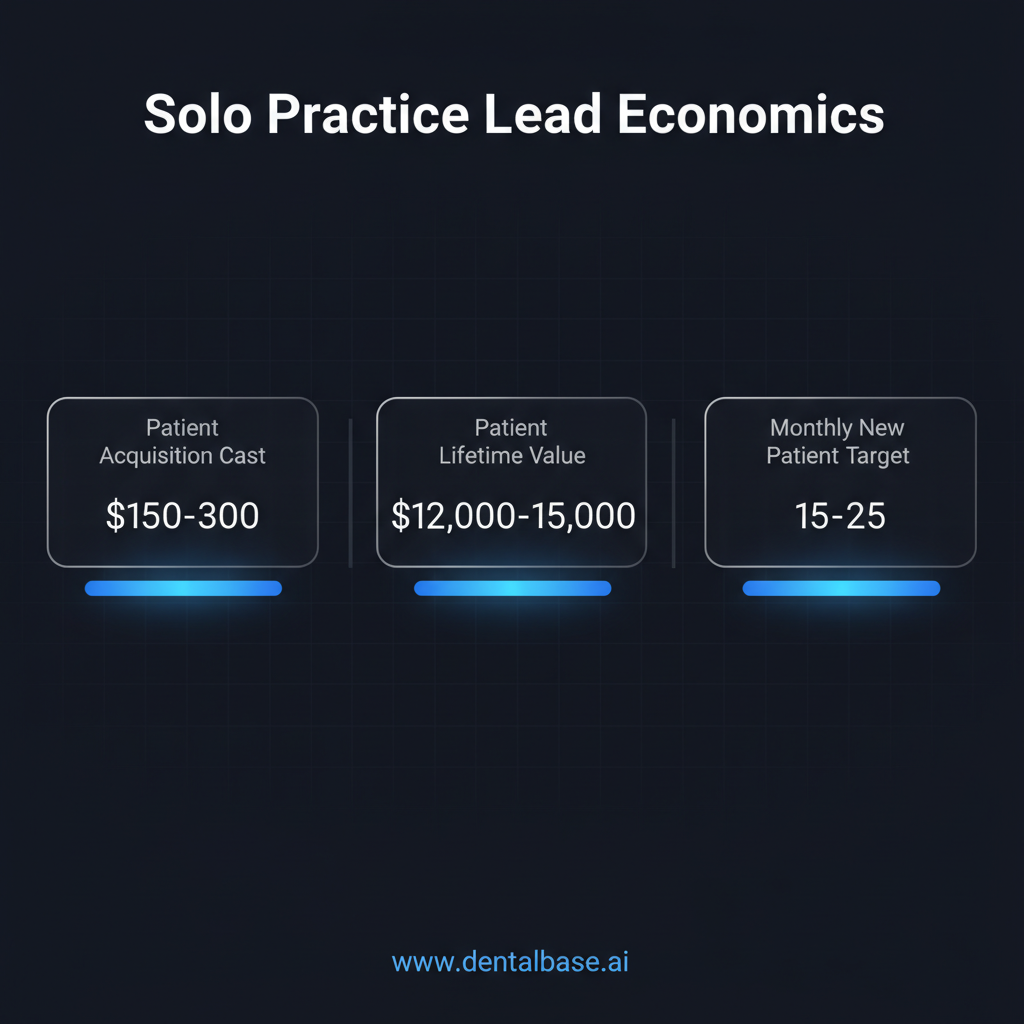
But the math works differently at your scale. A five-location DSO can absorb a $5,000 monthly ad spend across locations. For a single-doctor office generating $800,000 in annual collections, that same budget eats a much bigger percentage of revenue. WordStream data shows the average cost to acquire a new dental patient through digital channels runs $150-$300. At that rate, every lead counts.
The other factor? Capacity. A solo practice with two hygienists and one doctor can realistically handle 15-25 new patients per month. You don't need thousands of leads. You need a predictable flow of 20-30 qualified leads that actually convert to appointments. And according to Dental Economics, the average patient lifetime value for a general dentist is $12,000-$15,000. So even a small improvement in your lead conversion rate can mean six figures in annual revenue.
Start by tracking where your current patients found you. Ask every new patient during intake. If you don't know where your leads come from, you can't know which channels deserve your budget.
Which Marketing Channels Drive the Most Patient Leads?
Not all marketing channels produce equal results for solo dental practices. Local SEO, Google Business Profile, and paid search consistently generate the highest-intent leads for single-doctor offices, while social media plays a longer-term brand awareness role.
The real question isn't which channel is "the best." It's which one fits your budget, timeline, and capacity right now. Here's how the main options compare for a solo practice:
| Channel | Monthly Cost | Time to First Lead | Effort Level |
|---|---|---|---|
| Google Business Profile | Free (your time) | 2-4 weeks | Low |
| Local SEO | $500-$1,500 (agency) | 3-6 months | Medium |
| Google Ads (PPC) | $1,000-$3,000 | 1-2 weeks | High |
| Social Media (organic) | Free (content time) | 3-6 months | Medium |
| Social Media (paid) | $500-$1,500 | 1-4 weeks | Medium |
| Patient Referrals | Incentive cost only | Ongoing | Low |
According to Google, 46% of all searches seek local information. And BrightEdge data shows 68% of online experiences start with a search engine. That means search-based channels, specifically local SEO and PPC, should form the foundation of your lead generation strategy.
Social media builds awareness and trust, but it rarely drives direct appointment bookings for dental practices. A PwC Health study found that 41% of people say social media content impacts their healthcare treatment choice. Notice the word "impacts," though, not "drives." Social is an influencer, not a closer.
If you're starting from scratch with a limited budget, prioritize Google Business Profile optimization first since it's free. Then invest in local SEO. Add PPC only when you need leads faster than organic search can deliver.
Not Sure Where to Start With Dental SEO?
DentalBase builds SEO strategies specifically for dental practices, from Google Business Profile optimization to content that ranks for high-intent patient searches.
Learn About Dental SEO →How Does Local SEO Fill Your Schedule Without Paid Ads?
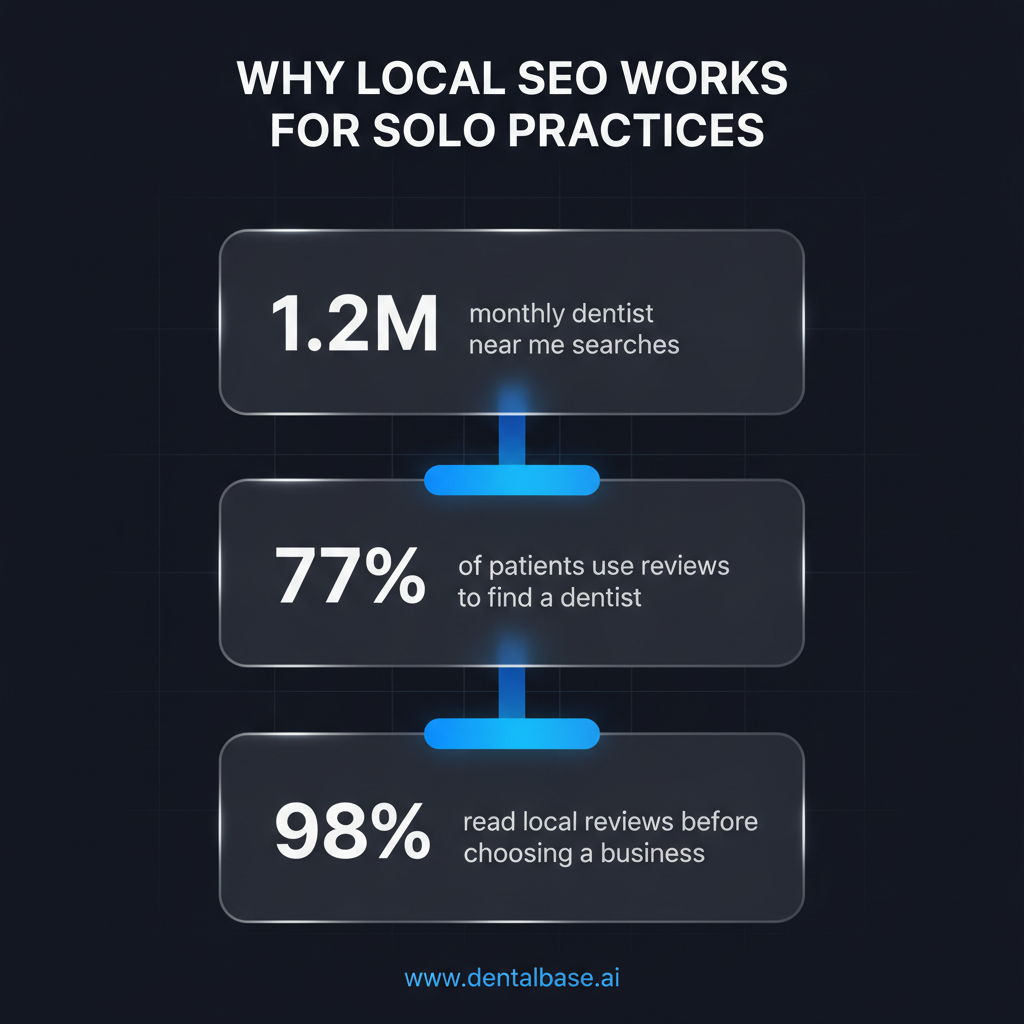
Local SEO positions your practice in Google's Map Pack and organic results for searches like "dentist near me," which generates 1.2 million monthly searches in the US alone according to Google Trends. For solo practices, it's the highest-ROI channel because the traffic is free once you rank.
The mechanics are straightforward. When someone searches "dentist near me" or "family dentist [your city]," Google shows three local results in the Map Pack followed by organic listings. Getting into that top three requires three things: a fully optimized Google Business Profile, consistent reviews, and a website that signals relevance to Google's ranking algorithm.
Reviews matter more than most dentists realize. According to Software Advice, 77% of patients use online reviews when finding a dentist. And BrightLocal's research shows 98% of people read local reviews before choosing a business. A solo practice with 150 five-star reviews will outrank a multi-location group with 40 reviews per location in local search. That's one area where being small actually works in your favor.
Your website content plays a role too. Each service you offer, from cleanings to implants to emergency care, should have its own page with location-specific content. Moz's SEO research confirms that topical depth and local relevance are among the strongest ranking factors for dental practices.
Quick Wins for Google Business Profile
Claim your profile if you haven't already. Post weekly updates. Add photos of your office, team, and results. And ask every satisfied patient for a review, in person, right after their appointment. Not via email three days later. That personal ask converts at 3-5x the rate of automated requests.
Related: Find out which search terms bring the most patients to dental websites. → Top 10 Dental Keywords You Should Be Ranking For
Should a Solo Practice Run Google Ads?
Google Ads can produce leads within days, making it the fastest lead generation channel for solo dental practices. But at $6-$8 per click for dental keywords according to Google Ads benchmarks, a poorly managed campaign burns through your budget before you see a single new patient.
PPC works on a simple equation: you pay for each click, and a percentage of those clicks convert to phone calls or form submissions. WordStream reports the PPC conversion rate for dentists is just under 2%. That means for every 100 clicks at $7 each ($700 spent), you'll get roughly two leads. If your average new patient is worth $12,000-$15,000 in lifetime value, that math can still work out well.
The problem for solo practices isn't PPC itself. It's poor setup. Common mistakes include targeting keywords that are too broad ("dentist" instead of "emergency dentist [your city]"), sending traffic to your homepage instead of a dedicated landing page, and running ads during hours when nobody answers the phone.
That last point matters more than you'd think. If your ads run at 7 PM but your front desk closes at 5 PM, every after-hours click is money burned, unless you have a system answering those calls.
A Practical Starting Point
Set a daily budget of $30-$50 and target three to five high-intent keywords with your city name attached. "Emergency dentist [city]," "dentist accepting new patients [city]," and "dental implants [city]" are strong starting points. Send traffic to a landing page with one clear action: call or book online. Track every lead back to the specific keyword that generated it, so you can cut what isn't converting.
Want Google Ads That Actually Produce Patients?
DentalBase manages PPC campaigns built for dental practices, with transparent reporting that ties every dollar to real patient appointments.
See PPC Services →Why Are Missed Calls the Biggest Lead Leak in a Solo Practice?
Missed calls are the most expensive problem in dental lead generation because you've already paid to generate the lead, whether through SEO, ads, or referrals, and then you lose the patient at the exact moment they're ready to book. According to ADA Practice Transitions, 38% of new patient calls go unanswered during business hours.
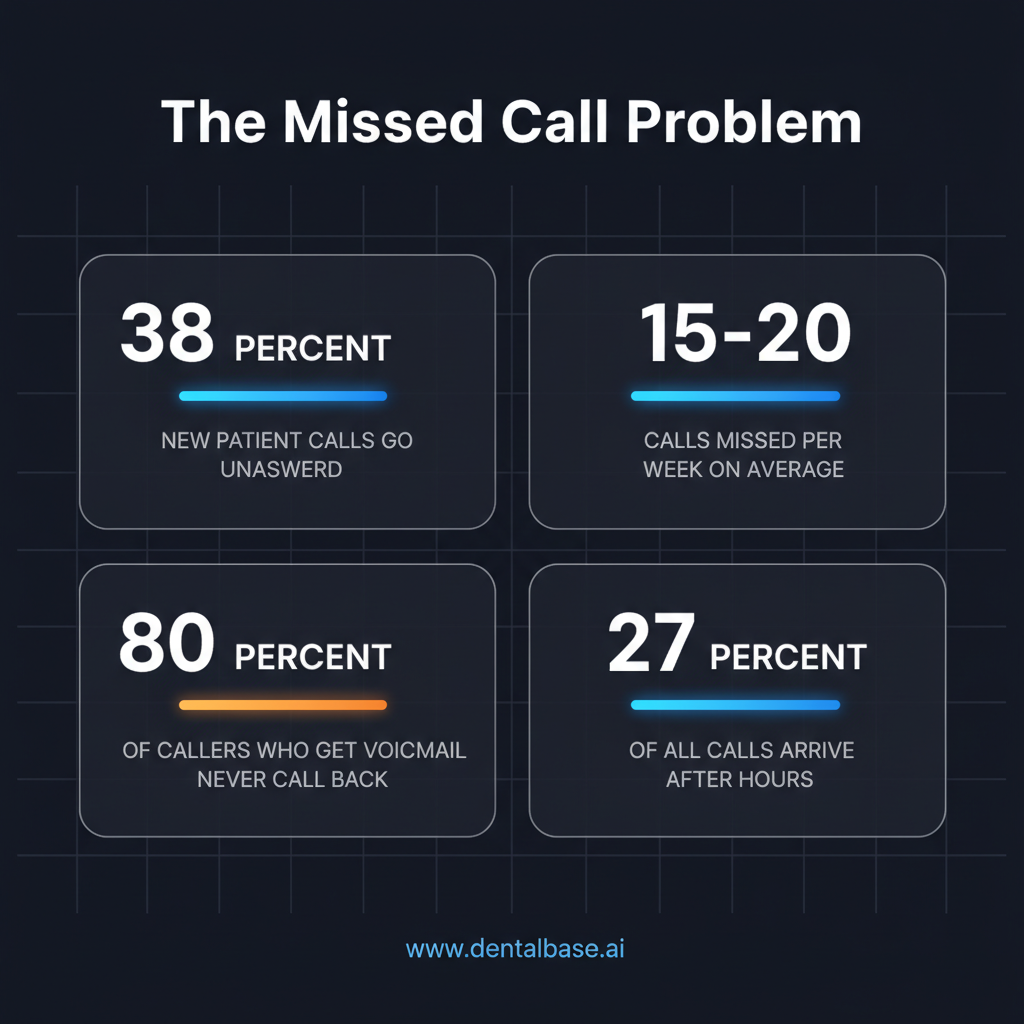
Think about that number. If your practice misses 15-20 calls per week, which Dental Economics reports as the average, and even half are potential new patients, that's 7-10 leads gone every week. At an average lifetime value of $12,000-$15,000, each missed new patient call costs your practice $1,200+ in first-year value alone.
Solo practices are especially vulnerable here. When your front desk person is checking in a patient, verifying insurance, and processing a payment all at once, the phone rings and nobody picks up. Voicemail doesn't solve this either. Forbes reports that 80% of callers who reach voicemail won't leave a message and won't call back. They just call the next practice on their list.
After-hours calls compound the issue. Dental Economics data shows after-hours calls represent 27% of total patient call volume. More than a quarter of your potential leads come in when nobody's there to answer.
How to Fix Your Phone Answer Rate
Audit your missed call rate first. Most VoIP providers track this automatically. If you're missing more than 10% of calls, that's your highest-priority fix, above any new marketing spend. Options include a dedicated front desk hire, an answering service, or an AI receptionist that handles scheduling, emergencies, and patient questions around the clock.
Stop Losing Patients to Missed Calls
DentiVoice AI Receptionist answers every patient call, books appointments directly into your PMS, and handles after-hours inquiries so no lead goes unanswered.
See How DentiVoice Works →How to Build a Lead Generation System for Your Solo Practice
A lead generation system for a solo practice works when it combines organic visibility, paid reach, and automated follow-through into a connected loop. The goal isn't to do everything. It's to connect three or four channels so leads come in and convert without you personally managing every step.
Here's what a functional system looks like in practice:
Layer 1: Visibility. Local SEO and Google Business Profile bring in organic leads. PPC fills gaps when you need volume quickly or want to target specific services like implants or AI-optimized search terms. According to Pew Research, 71% of people run a search before scheduling with a dentist. If you're not visible in that search, you don't exist to those patients.
Layer 2: Conversion. Your website needs online booking, a mobile-friendly design, and clear calls to action. According to Zocdoc, 77% of patients want online booking capability, yet only 26% of practices currently offer it (Dental Economics). Every marketing channel should point to a page that makes booking easy, not your generic homepage. A well-structured front office setup bridges the gap between your website and your schedule.
Layer 3: Capture. Calls need to be answered. Every single one. Whether you use a trained front desk coordinator, an after-hours answering service, or an AI receptionist, the rule is simple: if a lead calls and nobody picks up, you've wasted whatever you spent generating that lead.
Layer 4: Retention. Existing patients are your cheapest source of new leads. Automated recall reminders, review requests, and referral programs keep your schedule full without additional marketing spend. Industry benchmarks consistently show that retaining a patient costs a fraction of acquiring a new one. And Dental Economics reports that automated recall systems increase patient return rates by 25-40%.
You don't need to build all four layers at once. Start with Layer 3 (stop missing calls), then Layer 1 (optimize your Google Business Profile), then add PPC or social media as your budget allows. The practices growing fastest aren't spending the most. They're converting the highest percentage of leads into booked chairs.
Lead generation for solo dental practices comes down to a simple principle: you don't need more leads if you're losing half the ones you already have. Fix your phone answer rate, show up in local search, and make booking easy. That combination alone will outperform most marketing plans with twice the budget.
The solo practices growing steadily in 2026 aren't running the flashiest campaigns or spending the most on ads. They're running tight systems: a Google Business Profile that earns clicks, a website that earns conversions, and a phone line that earns appointments. Pick the channel with the lowest cost and the biggest gap in your current setup, then build from there.
Ready to Build a Lead System for Your Solo Practice?
See how DentalBase helps solo dental practices generate, capture, and convert more patient leads with less manual effort.
Book a Free Demo →Looking for more guides on growing your dental practice?
Browse Resources →Sources & References
Frequently Asked Questions
Most solo practices spend 5-8% of annual collections on marketing. For a practice collecting $800,000 per year, that's roughly $3,300-$5,300 per month across all channels. Start with free options like Google Business Profile and organic social media, then add paid campaigns based on results.
Google Ads generate leads within one to two weeks. Target high-intent keywords with your city name, set a daily budget of $30-$50, and send traffic to a dedicated landing page with online booking or a click-to-call button rather than your homepage.
Most solo practices with one doctor and two hygienists can comfortably onboard 15-25 new patients monthly. Growing beyond that creates scheduling bottlenecks and longer wait times that hurt retention. Scale marketing spend alongside your scheduling capacity.
Social media builds brand awareness and trust but rarely produces direct appointment bookings. About 41% of patients say social content influences their healthcare decisions, but the conversion path is much longer than search-based channels like SEO and Google Ads.
Ask every new patient how they found you during intake. Use call tracking numbers to identify which marketing channels generate phone calls. Google Ads and Google Business Profile both include built-in reporting on clicks, calls, and direction requests.
Organic search converts at about 3.5% for dental practices, while PPC converts at just under 2% according to WordStream. Landing pages built around a single action like booking or calling can reach 10% or higher based on Unbounce benchmarks.
Most dental SEO campaigns take three to six months to produce consistent leads. Google Business Profile optimization can show results in two to four weeks. SEO compounds over time and gradually reduces your dependence on paid advertising channels.
Was this article helpful?
Written by
DentalBase Team
Expert dental industry content from the DentalBase team. We provide insights on practice management, marketing, compliance, and growth strategies for dental professionals.