
Online Marketing for Dentists: What Actually Works in 2026
Online marketing for dentists covers SEO, PPC, social media, and reputation management. Here is what each channel costs and how to pick the right mix.
Share:
Table of contents
Online marketing for dentists isn't optional anymore. According to Pew Research, 71% of people looking for a dentist run a search before they ever pick up the phone. That number keeps climbing.
Your practice could offer the best clinical care in the area. But if patients can't find you when they search "dentist near me," a phrase that pulls 1.2 million Google searches every month in the US, none of that matters. And the cost isn't abstract. Dental Economics data shows that a single missed new patient call costs the average practice $1,200 or more in lifetime value.
This article breaks down the marketing channels that work for dental practices, what each one costs, common mistakes to avoid, and how to measure whether your spend is producing real patients or just reports.
Why Does Online Marketing for Dentists Matter?
Online marketing for dentists matters because patient behavior has shifted from referrals to search. Most people now research providers online before booking, and practices that don't appear in those results lose patients to competitors who do.
The data backs this up. According to a Google Health Study, 86% of users who searched for a dentist contacted one directly from the results. BrightEdge research shows that 68% of all online experiences begin with a search engine. For dental practices specifically, ADA Health Policy Institute data puts the average patient lifetime value between $12,000 and $15,000. That's not per visit. That's over the full relationship, including hygiene recalls, restorative work, and referrals to family members.
So what happens when someone searches and doesn't find you? They find someone else. Simple as that. And with 46% of all Google searches seeking local information, according to Google, dental practices sit in one of the highest-value local search categories.
Here's what makes this urgent. The practices that invested in dental SEO and online visibility years ago are the ones dominating local results now. Rankings don't build overnight. Every month you wait, the gap gets wider. The good news: you don't need to do everything at once. But you do need to know which channels actually produce patients and which just produce noise.
Struggling to Show Up in Local Search?
Dental SEO builds the organic visibility that turns local searches into scheduled patients.
Explore Dental SEO →What Are the Core Digital Marketing Channels for Dental Practices?
The core channels are search engine optimization (SEO), pay-per-click advertising (PPC), social media, reputation management, content marketing, and email. Each one plays a different role in how patients find, evaluate, and choose your practice.
SEO
SEO gets your practice in front of patients who are actively searching. It covers your Google Business Profile, website content, and the foundational ranking factors that determine where you appear in results. Google's own data shows that 46% of all searches have local intent. For a dental practice, that makes SEO one of the highest-return channels available. Results take months to build, but once you rank, traffic flows without a per-click cost.
PPC (Google Ads)
Google Ads put you at the top of search results immediately. You pay for every click, and WordStream data puts the average cost per click for dental keywords at $6-$8. It's effective for new practices or competitive markets where organic rankings haven't caught up yet. The tradeoff: the moment you stop paying, you disappear.
Social Media
Social media marketing builds awareness and trust before patients ever need an appointment. A PwC Health study found that 41% of people say social content influences their choice of healthcare provider. Instagram and Facebook give your practice a way to show personality, clinical results, and team culture. Direct bookings from social are rare, but the trust it builds influences every other channel.
Reputation Management
Your online reviews affect everything. BrightLocal's consumer review survey found that 98% of people read local reviews before choosing a business. And 88% say they're more likely to pick a business where the owner responds to all reviews. This isn't something you set and forget. It takes a system for generating, monitoring, and responding consistently.
Content Marketing and Email
Content marketing means publishing articles and guides that answer the questions your patients are already searching. It feeds your SEO and gives AI search engines material to cite when answering dental queries. Email keeps existing patients engaged. According to HubSpot marketing data, email returns $44 for every $1 spent, which for practices translates to recall reminders, reactivation campaigns, and seasonal promotions.
No single channel does everything. The practices that grow consistently run three or four of these together, with each one reinforcing the others.
Related: Want a deeper look at social strategy specifically? → Social Media Marketing for Dentists: Complete Guide
How Much Should Dentists Spend on Online Marketing?
Most dental practices should allocate 5-10% of gross revenue to marketing, with the majority going to digital channels. A solo practice producing $800,000 annually would budget $40,000-$80,000 per year, split across SEO, PPC, social media, and reputation management.
Those numbers might seem steep. But run the math. WordStream data puts the average cost to acquire a new dental patient at $150-$300 through digital channels. With patient lifetime value sitting at $12,000-$15,000, even a modest budget produces strong returns when it's spent on the right channels.
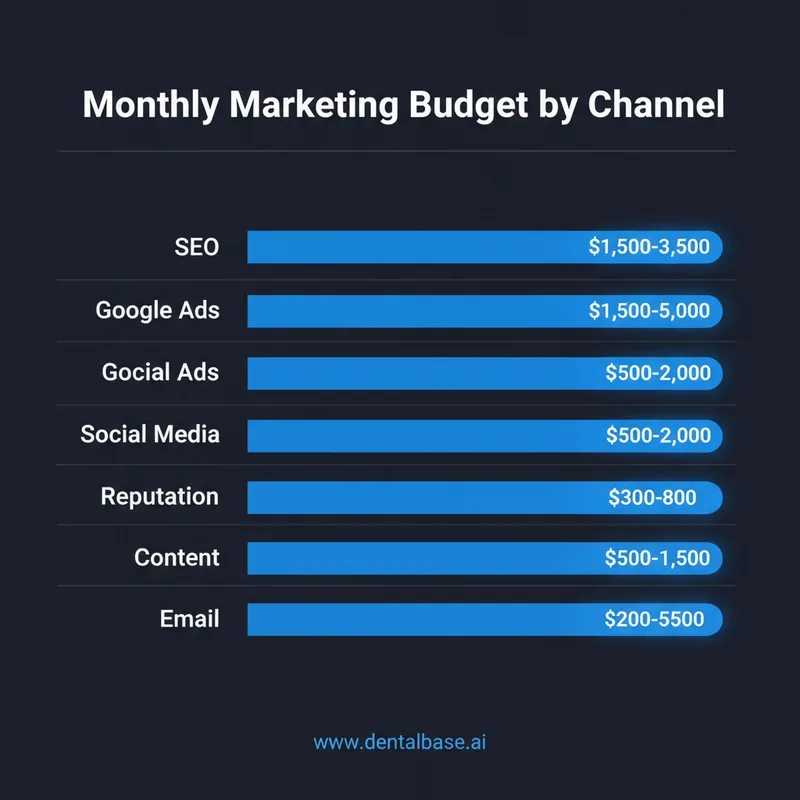
Here's how typical monthly costs break down by channel:
| Channel | Monthly Cost Range | What You Get |
|---|---|---|
| SEO | $1,500-$3,500 | Organic rankings, Google Business Profile, content |
| Google Ads (PPC) | $1,500-$5,000 | Immediate visibility for high-intent searches |
| Social Media | $500-$2,000 | Brand awareness, community engagement, trust building |
| Reputation Management | $300-$800 | Review generation, monitoring, response management |
| Content Marketing | $500-$1,500 | Blog articles, patient resources, AEO optimization |
| Email Marketing | $200-$500 | Patient retention, reactivation, recall campaigns |
A few things worth knowing. New practices need to spend more aggressively in the first 12-18 months to build visibility across multiple channels. Established practices with strong referral networks can start smaller and scale as results justify it. Multi-location groups should expect higher total spend but lower cost per patient as their marketing systems mature.
The biggest mistake isn't spending too little. It's spending without tracking. If you can't connect a marketing dollar to a scheduled appointment, you're guessing. That's where attribution comes in.
Want to See What Your Budget Should Be Producing?
Get a clear breakdown of which channels drive patients and which just drive spend.
Book a Free Demo →Which Channels Drive the Most New Dental Patients?
SEO and Google Ads drive the most new dental patients because they reach people actively looking for a dentist right now. Social media and content marketing play supporting roles by building trust and keeping your practice visible between searches.
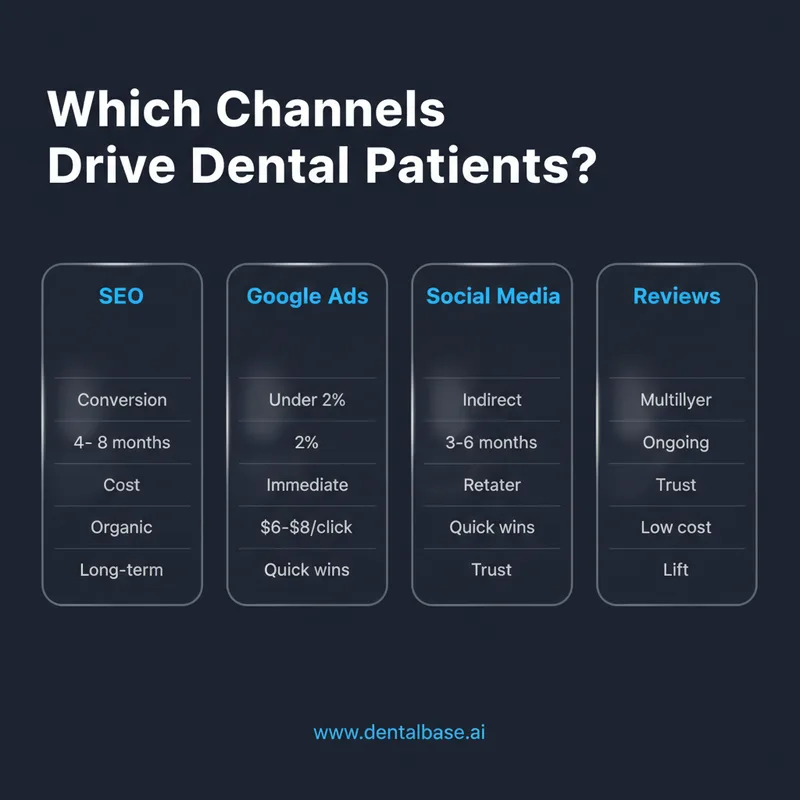
The conversion data tells a clear story. WordStream reports that organic search converts at 3.5% for dental, while paid search converts just under 2%. The gap looks small, but volume makes the difference. SEO sends traffic around the clock at no per-click cost. PPC stops the moment your budget runs out.
Here's how the main channels compare for patient acquisition:
SEO: The Long Game
It takes 4-8 months to see real movement in rankings, but once you're there, new patient inquiries come without paying per click. Practices that invest in targeted local keywords see their cost per acquisition drop steadily over time. That compounding effect is what makes SEO the highest-ROI channel for most practices over a 12-month window.
Google Ads: Fast Results
You can appear at the top of search results within days of launching a campaign. But paid search drives roughly 35% of traffic for dental practices, according to WordStream, and every click costs $6-$8. Without a strong landing page, those clicks don't become patients. PPC works, but only when the full funnel is set up to convert.
Social Media: The Trust Builder
Social media rarely drives direct bookings. Its real value shows up in the consideration phase. When a patient finds your practice through search and then checks your Instagram, they're looking for proof that you're credible, modern, and approachable. That PwC study showing 41% of patients factor social content into their decision? That's the consideration phase doing its job.
Reputation: The Multiplier
Reputation management isn't a channel in the traditional sense. But it affects every other channel's conversion rate. A practice with 4.8 stars and 200 reviews converts search traffic at a higher rate than one with 3.9 stars, regardless of how much each spends on ads. BrightLocal research consistently confirms this pattern across industries.
The smart approach: pair SEO with PPC in the first year, then shift budget from ads to organic as your rankings grow.
What Mistakes Do Practices Make With Their Marketing?
The most common mistakes are spending without tracking results, chasing vanity metrics, hiring the wrong agency, spreading budget across too many channels at once, and ignoring online reviews. Any one of these can drain your budget without producing a single new patient.
No Attribution Tracking
This is the most expensive mistake. If your front desk can't tell you how a new patient found your practice, you're making budget decisions in the dark. Call tracking, UTM parameters, and intake forms that ask "how did you hear about us?" are the starting point. Without them, you can't separate channels that work from channels that burn money.
Vanity Metrics
Impressions, likes, and follower counts don't pay your overhead. A marketing report that leads with "your website got 5,000 visits this month" without mentioning how many visitors called or booked is telling you almost nothing useful. Ask for cost per lead and cost per booked patient instead.
The Wrong Agency
Dental marketing agencies vary widely in quality. Red flags include long-term contracts with no performance benchmarks, agencies that own your website or content so you can't leave, and reporting that highlights metrics disconnected from actual patient numbers. If your agency can't tell you your cost per new patient by channel, that's a problem worth addressing.
Spreading Too Thin
A practice that tries SEO, PPC, social media, email, video, and direct mail all at once with a $3,000 monthly budget won't do any of them well. Pick two or three channels, fund them properly, and add more as results justify the expansion.
Ignoring Reviews
This one costs nothing to fix and has outsized impact. BrightLocal data shows that 88% of consumers are more likely to choose a business where the owner responds to all reviews. That includes negative ones. A thoughtful reply to a one-star review can actually build trust with prospective patients reading it.
Worth asking yourself: do you know, right now, your cost per new patient for each channel you're running?
Looking for Practical Marketing Guidance?
Explore free guides, templates, and tools built for dental practice growth.
Browse Resources →How Do You Track Marketing ROI for a Dental Practice?
You track ROI by measuring the full path from marketing spend to a patient in the chair. That means connecting ad clicks, website visits, and phone calls to actual scheduled appointments, then comparing acquisition cost against what each patient is worth over time.
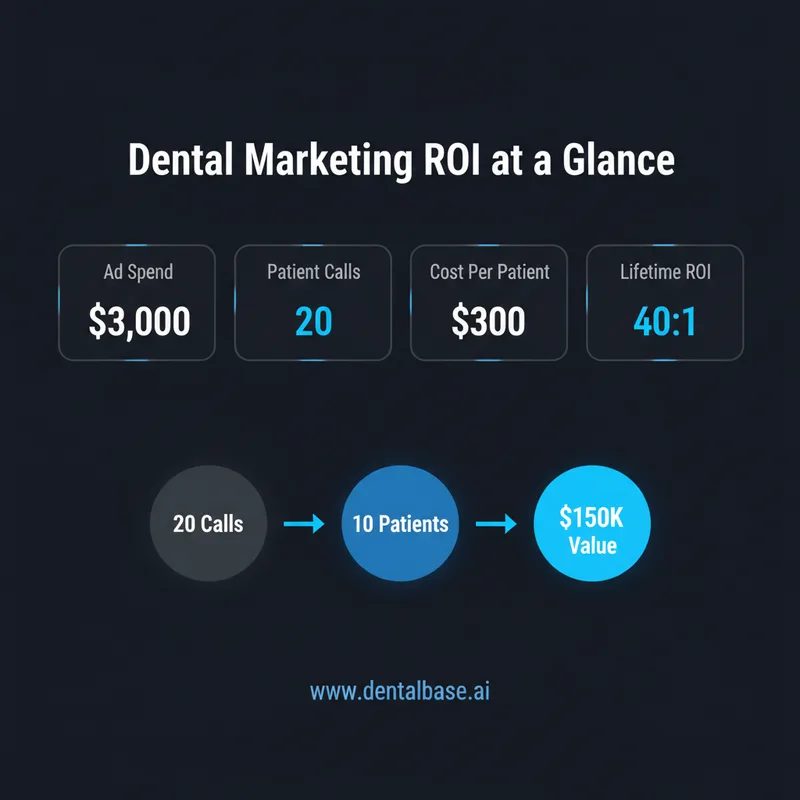
Start with three numbers. Your cost per lead is what you spend to generate one phone call or form submission. Your cost per acquired patient is what it takes to get someone into the chair for a first visit. And patient lifetime value tells you what that relationship is worth across months and years of care.
Here's the math in action. Say you spend $3,000 per month on Google Ads and get 20 new patient calls. Your cost per lead is $150. If 10 of those callers actually schedule and show up, your cost per acquired patient is $300. Against a lifetime value of $12,000-$15,000, that's roughly a 40:1 return. Hard to argue with.
But most practices never reach that level of clarity. The tracking breaks down between the click and the appointment. Someone clicks your ad, calls your office, and then what? If the front desk doesn't log how that patient found you, the data trail ends.
Call tracking fixes part of this. Tools that assign unique phone numbers to each marketing channel show you exactly which source drove each call. Pair that with a front desk intake process that records the lead source in your practice management system, and you've built a closed loop.
On the website side, Google Analytics and Google Ads conversion tracking handle form submissions, click-to-call events, and online booking completions. Connecting that data to actual patient acquisition is what separates practices that know their marketing works from those that hope it does.
If your current reports don't include cost per acquired patient by channel, that's the single most important thing to fix.
Online marketing for dentists comes down to one question: can you trace a dollar spent to a patient in the chair? The practices that answer yes are the ones growing. The ones that can't are spending on faith.
You don't need every channel running at once. Start with the highest-intent sources, track everything, and double down on what works. If your current setup can't show you cost per acquired patient by channel, you're not measuring enough to make real decisions.
The gap between practices that invest in online marketing and those that don't gets wider every quarter. Your next step is specific: pick one channel, set up tracking, and measure for 90 days.
Ready to See What Your Marketing Should Produce?
Get a clear picture of which channels drive patients and which just drive spend. We'll walk you through it.
Book a Free Demo →Want to learn more before committing?
Browse Resources →Sources & References
Frequently Asked Questions
Most dental practices spend $4,000-$12,000 per month on online marketing, covering SEO, PPC, social media, and reputation management. A common benchmark is 5-10% of gross revenue. The exact amount depends on your location, competition level, and growth goals.
SEO and Google Ads drive the most new patients because they reach people actively searching for a dentist. SEO delivers better long-term ROI with a 3.5% conversion rate for dental, while PPC provides immediate visibility. Most practices benefit from running both.
Google Ads can produce patient calls within days of launching. SEO typically takes 4-8 months to show meaningful ranking improvements. Social media and content marketing build trust gradually over 3-6 months. A combined approach delivers both short-term and long-term patient flow.
Social media rarely drives direct bookings, but it influences patient decisions. According to PwC Health, 41% of people say social content affects their healthcare provider choice. It is most effective for building trust, showing clinical results, and supporting other marketing channels.
A reasonable cost per new dental patient through digital channels is $150-$300, based on WordStream benchmarks. Compare this against the average patient lifetime value of $12,000-$15,000 to calculate your actual return. If your cost exceeds $500, review your targeting and landing pages.
Use call tracking to tie phone calls to specific channels, set up Google Analytics conversion tracking for form submissions and click-to-call events, and record lead sources at the front desk. The key metric is cost per acquired patient by channel, compared to lifetime value.
Yes. New practices should invest more aggressively in the first 12-18 months to build online visibility. Start with Google Business Profile optimization, a basic SEO foundation, and targeted Google Ads for high-intent keywords like dentist near me in your service area.
Was this article helpful?
Written by
DentalBase Team
Expert dental industry content from the DentalBase team. We provide insights on practice management, marketing, compliance, and growth strategies for dental professionals.