
Best AI Virtual Receptionist for Booking Appointments
The AI virtual receptionists that book appointments properly, compared on calendar sync, PMS write-back, and how they handle edge cases.
Share:
Table of contents
The phrase best AI virtual receptionist for appointment booking means something different in 2026 than it did 18 months ago. The early generation of voice bots was good enough to answer a call. The current generation books directly into your PMS, handles reschedules mid-conversation, and escalates cleanly to a human when the call gets complicated.
That shift changes how you should evaluate platforms. Three years ago, you were comparing answering services. Today, you're comparing front-desk replacements that overlap heavily with your scheduling software, your phone system, and your marketing analytics. Get the criteria right and the shortlist gets short fast.
This guide gives you the seven evaluation criteria that separate the best AI virtual receptionist for appointment booking from the rest, plus a category map so you know which kind of platform fits which kind of practice. For the broader phone strategy, see our 2026 owner's guide to phone systems for dental offices.
What is the best AI virtual receptionist for appointment booking in 2026?
The right answer here is the platform that books directly into your PMS during the call, holds a natural conversation, escalates cleanly to a human, and integrates with your existing phone and marketing stack. There's no single winner across all practice types. The right choice depends on call volume, specialty, and stack preferences.
What separates 2026 platforms from earlier generations is real-time PMS write-back. The AI doesn't just take a message and email it to your team. It checks your live schedule, books the slot, and writes the appointment with intake notes attached, all during the call. According to ADA practice resources, scheduling friction remains one of the largest unforced revenue leaks in dental practices.
Before evaluating any platform, run the fit test in our AI receptionist pay-off analysis. If your practice profile says human or hybrid wins, no AI shortlist will fix that. If AI fits, then read on.
What 7 criteria should you use to evaluate AI virtual receptionists?
Use seven specific criteria to separate platforms that work in real practices from platforms that demo well but fail in production. PMS integration depth, conversation quality, booking accuracy, escalation handling, HIPAA compliance, attribution and analytics, and pricing transparency. Skip the long feature lists and grade each platform against these seven.
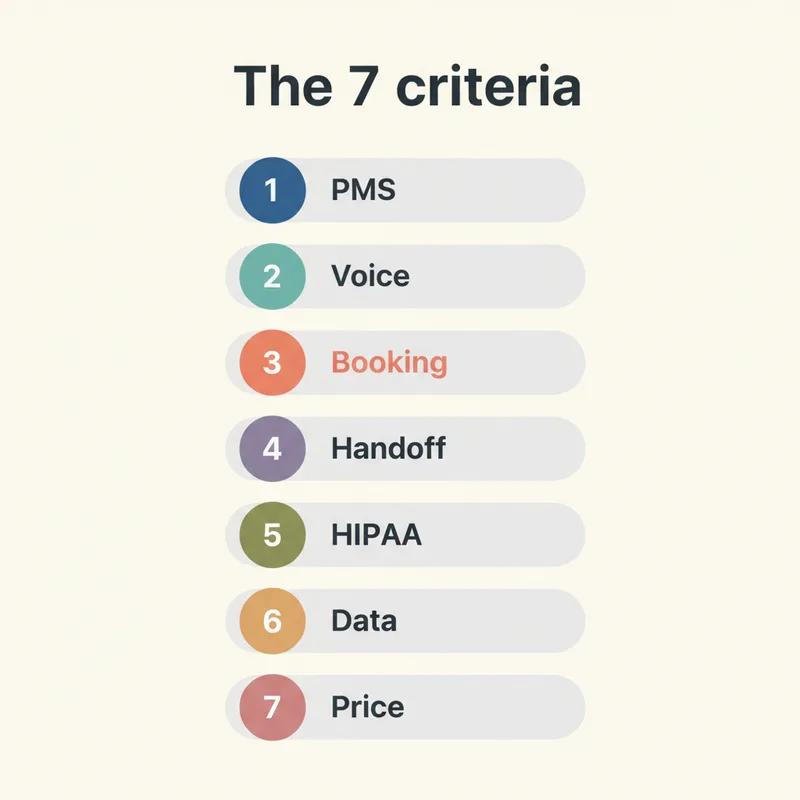
| Criterion | What to verify | Red flag |
|---|---|---|
| PMS integration | Real-time read AND write into Dentrix, Open Dental, Eaglesoft, or Curve | "Read-only" or "manual sync" anywhere in the answer |
| Conversation quality | Natural pacing, handles interruptions, dental-specific vocabulary | Robotic cadence, breaks on accents, scripted-only flow |
| Booking accuracy | Correct appointment type, provider, and time block on first try | Vendor won't share booking-error rate |
| Escalation handling | Mid-call handoff with full context passed to staff | Patient must repeat themselves after transfer |
| HIPAA compliance | Signed BAA, encrypted call recording, US-based data hosting | No BAA available or vague answers about data location |
| Attribution / analytics | Per-call source, conversion rate, and KPI dashboard | Only tracks call count, not source or outcome |
| Pricing transparency | Clear monthly fee + per-minute or per-call cost stated upfront | "Custom pricing" with no published baseline |
One practical tip. Call the demo line yourself, from a number the vendor doesn't recognize, and try to book a complex appointment. Mid-conversation, change your mind. Ask about insurance. Ask a question the script wouldn't anticipate. The platforms that handle that gracefully are the ones worth shortlisting. Per Dental Economics analysis on dental phone handling, even a 5-second hesitation kills booking conversion. Test for that.
See DentiVoice score on all 7 criteria
Walk through real PMS write-back, mid-call escalation, and the analytics dashboard in a 20-minute demo.
Explore the AI Receptionist →Which AI virtual receptionist categories should you consider?
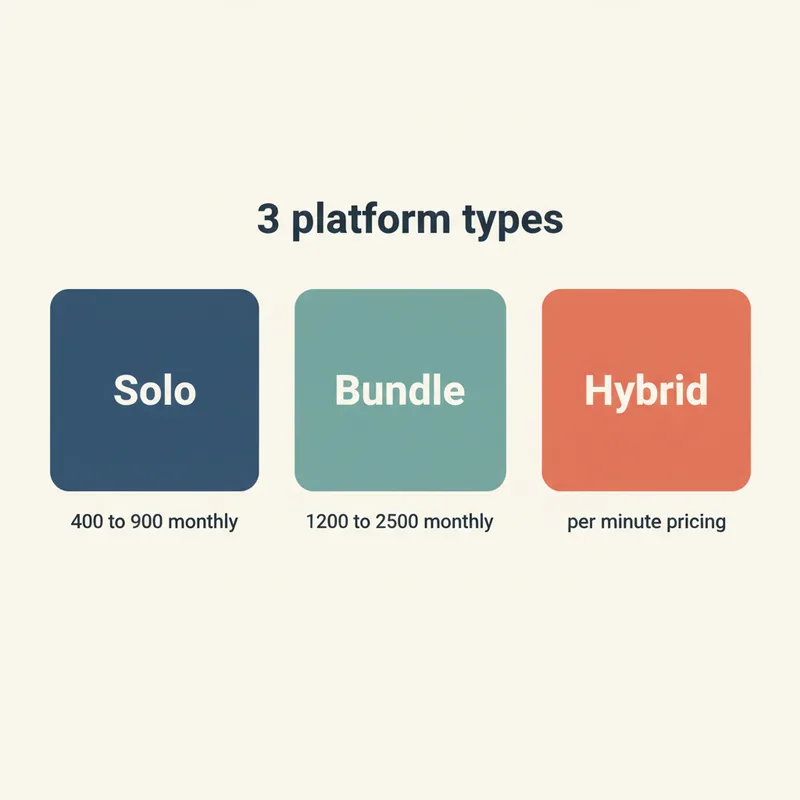
AI virtual receptionists for appointment booking fall into three categories in 2026, each with different fit profiles. Standalone AI phone tools, integrated marketing-plus-AI platforms, and hybrid AI-with-human-overflow services. Pick the category before you pick the vendor. Most rollouts that fail picked the wrong category, not the wrong product.
Standalone AI phone tools
Built specifically for call answering and PMS booking. Lightweight, fast to implement, usually $400 to $900 per month. Best for solo and small practices that already have marketing handled and just need the phone covered. Trade-off: no view of which marketing channel produced the call, so attribution stays in your separate ad reporting.
Marketing-plus-AI platforms
The AI receptionist sits inside a broader marketing stack. Calls connect back to the campaign, ad group, or SEO page that drove them. Best for practices investing meaningful budget in patient acquisition who want closed-loop reporting. Trade-off: monthly cost is higher because you're paying for marketing services too. Read our 2026 dental virtual receptionist cost breakdown for category-specific pricing.
AI-plus-human hybrid services
AI takes the first ring, humans handle the escalations, all under one vendor. Best for high-touch practices (cosmetic, implant, ortho) where the case value justifies a human touch on consult calls. Trade-off: per-minute pricing on human time, which scales fast at high volumes. HubSpot customer service research consistently shows hybrid models score highest on patient satisfaction when configured well.
How does a modern AI receptionist book appointments differently than older tools?
A modern AI receptionist books appointments differently in three ways. It writes to the PMS in real time during the call. It distinguishes appointment types correctly (cleaning, exam, emergency, ortho consult, perio quad). And it captures intake details (insurance, reason for visit, referral source) inline, so staff don't have to chase the patient later.
Older tools failed at any one of these. A 2023-era voice bot might book a "general appointment" without knowing the difference between a 30-minute hygiene visit and a 90-minute crown prep. The result: scheduling chaos, patient frustration, and a front desk that spends Monday morning rebuilding the schedule. Modern platforms read your appointment type rules from the PMS and book into the correct slot type automatically.
Real-time write-back is the bigger leap. When a patient calls at 7 PM and books a cleaning for 9 AM tomorrow, the appointment shows up in your morning schedule before any staff member arrives. Per BrightLocal local consumer research, perceived responsiveness is the single biggest driver of practice choice for new patients shopping online. The AI that books immediately wins those patients before competitors can return their voicemails.
The newer generation also handles edge cases that broke older tools. Mid-call mind changes ("actually, can you make that Thursday instead?"). Two-patient bookings ("I want to schedule my wife and me back to back"). Insurance qualifying questions answered correctly from your in-network roster, not a generic FAQ. These small details separate platforms that work for real patients from platforms that pass a demo but fail in production.
For practices using AI for outbound work too, modern platforms also handle AI dental recall calls and structured patient reactivation outreach from the same dashboard, with full call records and booking outcomes. The math improves significantly when one tool handles inbound and outbound.
How do you test an AI virtual receptionist before committing?
Test an AI receptionist before committing by running a structured pilot rather than relying on vendor demos. Demos show you the polished version. Pilots show you the production version. Run a 30 to 90 day pilot on a narrow scope, measure six KPIs weekly, and define rollback triggers upfront. Most platforms reveal their real strengths inside two weeks.
The five-minute demo audit
Before any pilot, do this audit on every shortlisted platform. Call the demo line from an unknown number, then run through these four tests:
- Try to book an appointment exactly as a real patient would, with realistic insurance and scheduling preferences.
- Change the date mid-conversation. Listen for whether the AI confirms the new date or reverts to the script.
- Ask if the practice accepts a specific insurance plan the AI may or may not have on file. Note how it handles "I don't know" gracefully or awkwardly.
- Mention you have a question for the doctor. A clean platform escalates with full context. A weak one drops the call into voicemail.
The platform that handles all four gracefully earns a pilot slot. The ones that break on any one don't.
The structured pilot
Once you've shortlisted two or three vendors, run a structured pilot with each. Start with low-risk scopes: after-hours calls, recall outbound, missed-call follow-up. Avoid daytime new-patient intake until week 5 at the earliest. Our 30/60/90 day pilot playbook covers the exact phasing, KPI thresholds, and kill-switch protocol so you don't disrupt the office while testing.
What to measure during the pilot
Track six KPIs weekly: answer rate (target above 95%), booking accuracy (target above 90% on first try), escalation rate (15 to 25% is healthy), patient sentiment (zero negative reviews tied to the AI), staff hours saved, and recovered revenue. Dental Economics research on practice operations shows that practices with weekly KPI cadence outperform those reviewing monthly by a significant margin during any technology rollout.
Related: Want the full evaluation framework before you shortlist? → 2026 dental virtual receptionist buyer's guide
What pricing should you expect for AI receptionist platforms in 2026?
Expect pricing in three brackets in 2026. Standalone AI tools run $400 to $900 per month. Marketing-plus-AI platforms run $1,200 to $2,500 per month because they include SEO, ads, and attribution alongside the receptionist. AI-plus-human hybrid services price per minute at $0.50 to $2.00 plus a base fee. Practice volume changes the math more than vendor choice does.
The hidden costs to ask about:
- Setup fees for PMS integration typically run $500 to $1,500 depending on which system you use.
- Onboarding time required from your team. Most rollouts need 5 to 15 hours of internal time in the first month.
- Per-call or per-minute overage charges past a monthly cap. Read the contract before signing.
- Cancellation terms and notice periods. Some vendors auto-renew with 60-day notice requirements buried in the fine print.
ADA Health Policy Institute research on dental practice technology spending consistently shows total cost of ownership runs 30 to 50% higher than headline pricing across most software categories.
Run the ROI math against your specific missed-call exposure before committing. If your practice misses 10 new-patient calls a month at $1,200 first-year value each, that's $12,000 in monthly exposure against $400 to $2,500 in monthly platform cost. The break-even is fast for most practices, but only if the math is real. Pull your phone analytics first. Our missed-call revenue baseline walks through the calculation.
How should you make the final decision between shortlisted platforms?
Make the final decision by combining quantitative pilot results with one qualitative factor: how the vendor handles support during the first 30 days. Pilot KPIs tell you if the AI works. Support response time tells you if the vendor will fix things when something breaks. Both matter. Choose on data, but verify the vendor relationship before signing a 12-month contract.
Decision framework. If two platforms tie on pilot KPIs, pick the one with the cleanest escalation handoff. Patient experience compounds. If pricing is close, pick the one with better integration depth into your specific PMS. PMS migrations are painful, so the AI should adapt to your stack, not the other way around. If support response was uneven during the pilot, walk away regardless of price. The relationship matters more than the demo.
One often-missed factor: contract structure. The strongest vendors offer month-to-month options or short pilot terms before requiring annual commitments. Be skeptical of any vendor pushing a 24-month contract before you've seen 30 days of production data. Ask specifically about cancellation terms, data export rights, and what happens to your call recordings if you switch platforms. These details rarely come up in demos but matter enormously six months in.
Also weigh the team's day-one experience. The platform your front desk hates becomes the platform your front desk works around. Run the final two candidates past two staff members who'll actually use the dashboard. Their feedback often surfaces friction that owners miss. The right AI receptionist platform is the one your team trusts enough to let it run during a busy Monday morning, not the one with the flashiest demo.
The smartest first move isn't to sign anything yet. It's to pull your last two weeks of call analytics this week, identify your three biggest call-pattern problems, and then evaluate platforms against those three problems specifically. Generic shortlists miss the practice-specific test. Your problems are the test. For pricing context across the categories, see our 2026 cost breakdown, and for the full feature checklist, our 2026 features checklist.
Ready to evaluate AI virtual receptionists for your practice?
DentiVoice scores well across all seven criteria, with real-time PMS write-back, clean escalation, and built-in marketing attribution. Book a 20-minute walkthrough.
Book a Free Demo →Want more practice growth resources?
Browse Resources →Sources & References
Frequently Asked Questions
Real-time PMS write-back, natural conversation handling, dental-specific vocabulary, accurate appointment-type routing, mid-call escalation with full context, signed BAA for HIPAA, encrypted call storage, and per-call attribution to marketing source. Anything less is a previous-generation tool.
Standalone AI receptionist tools run $400 to $900 per month. Marketing-plus-AI platforms run $1,200 to $2,500 per month because they bundle SEO and ads. Hybrid AI-plus-human services price per minute at $0.50 to $2.00 plus a base fee. Setup typically adds $500 to $1,500.
Yes. The leading platforms in 2026 integrate with Dentrix, Open Dental, Eaglesoft, and Curve Dental for real-time read and write access. The AI checks live availability, books the slot, and writes intake notes. Verify the vendor offers two-way sync, not just one-way reading, before committing.
A focused evaluation runs 60 to 90 days total. Two weeks for shortlisting and demo audits, two to four weeks of structured pilot per finalist platform, then one week to compare KPI results and make the call. Skipping the pilot phase is the most common reason rollouts fail.
The reputable platforms are. Verify the vendor signs a Business Associate Agreement, encrypts call recordings at rest and in transit, hosts patient data in US data centers, and has SOC 2 Type II certification. A surprising number of consumer-grade AI phone tools operate without a signed BAA, so ask directly.
Picking on demo quality alone. Demos show you the polished version. Production calls expose how the AI handles confused patients, accent variations, mid-call mind changes, and edge cases that didn't appear in the demo. Always pilot before committing to a contract longer than month-to-month.
Usually no. Small practices benefit from standalone AI tools that are fast to set up and affordable. Multi-location groups need cross-site reporting, centralized rule management, and per-location PMS routing. The platforms that excel at one rarely excel at the other. Match the tool to the operational scale.
Was this article helpful?
Written by
DentalBase Team
Expert dental industry content from the DentalBase team. We provide insights on practice management, marketing, compliance, and growth strategies for dental professionals.