Dental Practice Phone Budget: Right-Sized Spend (2026)
Most dental practice phone budgets ignore labor, recall, and after-hours. Real benchmarks (1.5-3% of revenue) and the four layers worth paying for.
Share:
Table of contents
Most dental practice owners answer this question with one number: the monthly VoIP bill. That's $80 or $150, give or take, and the conversation ends there. The dental practice phone budget that actually matters is much bigger and much harder to see. Phone-related labor, missed-call lost revenue, recall outreach time, and any AI or answering-service layer all roll up into the same line item, even when nobody on your team writes it down that way.
Owners who only watch the VoIP invoice tend to under-invest in the parts of the system that actually generate revenue. They also tend to over-spend on the labor side without realizing it, because front-desk salary doing phone work doesn't show up as a "phone cost" in the P&L.
This article reframes the dental practice phone budget as a system, gives you benchmark percentages of revenue, walks through what right-sized spend looks like at different practice sizes, and shows you the line items most owners forget to model. Pull your P&L while you read.
What Is a Reasonable Dental Practice Phone Budget?
A reasonable dental practice phone budget is 1.5% to 3% of gross collections, all-in. That includes VoIP service, front-desk labor allocated to phone work, missed-call recovery tools, after-hours coverage, and recall outreach systems. For a $1M practice, that's $15,000 to $30,000 per year. Most practices spend less on the visible items and far more on the hidden ones.
The 1.5% to 3% range comes from working backward. Personnel costs run 25-30% of collections at the average practice, and front-desk roles typically account for 5-8% of collections inside that. Industry benchmarks consistently put the administrative-staff layer in that 5-8% band, which the ADA Health Policy Institute's Dental Practice Research tracks year over year. Roughly 30-40% of front-desk time goes to phone-related work in a typical practice. Multiply it out and you land in the 1.5-3% band before you've added a single dollar of software.
The exact percentage shifts based on call volume, after-hours strategy, and how aggressively you do recall. A practice that ignores after-hours and does no proactive recall might run 1.0%. A practice with strong recall, after-hours coverage, and call analytics often runs 3-4% and gets paid back many times over in retained patients. Spend isn't the metric. Return on spend is.
What Should Actually Be Counted as Phone Spend?
Phone spend should include six line items: VoIP and phone hardware, front-desk labor allocated to phone work, missed-call recovery (text-back or AI), after-hours coverage, recall outreach time and tools, and call tracking or analytics. Most owners count the first one and miss the other five. The other five are usually 10x bigger than the VoIP bill.

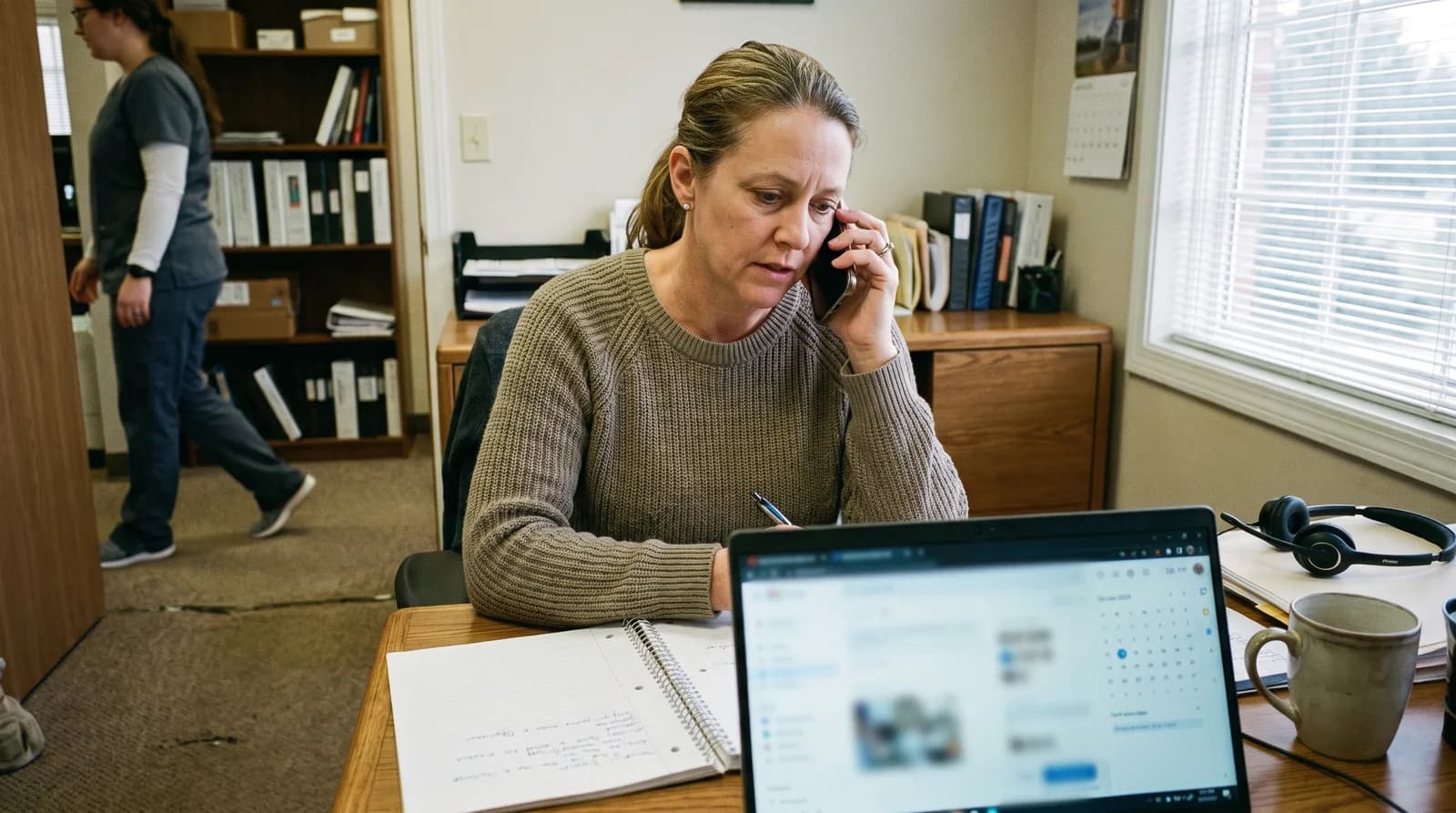
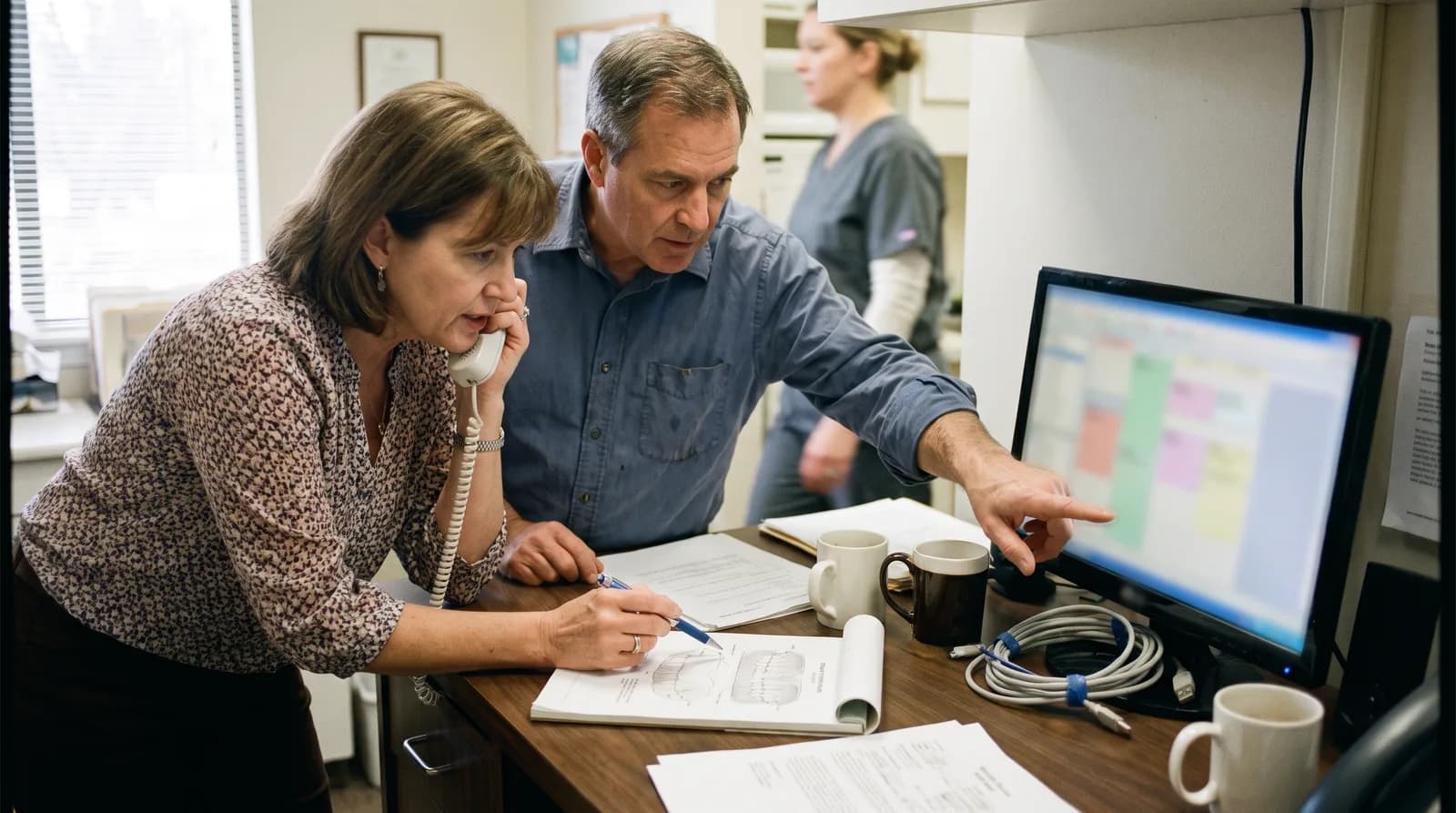
Here's the part that surprises owners. If your front-desk coordinator earns $48,000 fully loaded and spends 35% of her shift on the phone, that's $16,800 in annual phone-related labor right there. Your $1,200 VoIP bill is a rounding error next to that. The math doesn't change because you stop tracking it. Dental Economics' 2024 Salary Report puts front-desk total compensation in a range that confirms this isn't a trivial line item.
The Real Phone Stack
For a typical solo general practice doing $850K in collections.
Two things stand out. First, the actual phone spend is mostly people, not technology. Second, the practice has two visible gaps: nothing answers the phone after 6 PM, and nobody is measuring what's working. Both are unbudgeted because they don't have a line on the P&L. They show up as missed revenue instead.
How Much Should a Solo Practice Spend on the Phone?
A solo dental practice doing $700K-$1M in collections should budget $12,000-$25,000 per year for total phone spend, all-in. That's roughly 1.7-2.5% of revenue. The bulk goes to front-desk labor allocated to phone work. The remainder splits between VoIP, recall outreach tools, and ideally an AI or after-hours layer that catches calls when nobody else can.
Solo practices tend to under-invest in phone systems and over-rely on the front desk to absorb everything. That works until call volume crosses about 150-180 per week, at which point answered call rate starts dropping and recall outreach gets pushed to "later this week." The fix is rarely hiring. It's usually an overflow tool that costs $300-$600 a month, plus a clear weekly review of phone metrics. Burnout at the front desk often shows up here first, and the budget conversation gets it back under control.
For solo practices specifically, three rules of thumb hold up across most situations. First, your VoIP plan should cost less than 0.2% of collections. If it's more, you're either overpaying or you have call-volume pricing you didn't realize was happening. Second, after-hours should not be $0. Even a $400/month answering service or AI catches enough new patients to pay for itself, especially given how many searches happen between 6 PM and 10 PM. The ADA's own guidance on phone calls from prospective patients is to answer every call by the third ring, which solo practices physically cannot do without help. Third, recall is a phone-budget item. The labor your team spends calling lapsed patients sits inside this category whether you track it or not.
The labor cost behind every front-desk phone
Front-desk costs run far past base salary. We broke down the full stack including the line items most owners forget.
Read the Front-Desk Cost Breakdown →How Much Should a Multi-Provider or Multi-Location Group Spend?
Multi-provider practices in the $1.2M-$3M range should budget 2-3.5% of collections for total phone spend, or roughly $24,000-$105,000 per year. Multi-location groups go higher per location because complexity scales faster than revenue. The math also flips: AI receptionists become cheaper than additional human hires above roughly 350 weekly calls per location, which most multi-provider practices already exceed.
The reason the percentage climbs at this size isn't waste. It's that each new provider creates roughly 60-90 additional weekly patient interactions, but the front desk doesn't scale linearly with chair count. Two providers with one front-desk person work fine until peak hours. Three providers with two front-desk people start dropping calls during recall season, hygiene blocks, and lunch. Dental Economics reports that roughly one third of calls to dental offices are missed during business hours, and that's the average. At growing multi-provider practices it routinely runs higher.
For multi-location groups, the central question is whether to centralize phone handling or keep it local. Centralized handling, often with AI as the first point of contact and humans handling judgment calls, lowers per-location cost dramatically. Decentralized handling preserves the hometown feel but multiplies spend. Most groups end up hybrid: AI catches everything, humans handle escalations and treatment plan calls per location. The hire-vs-AI math shifts harder toward AI as you add locations.
The cost picture also reshapes around the operating model itself. Once call handling gets centralized across sites, the line items reshuffle: fewer per-site phone seats, one consolidated answering layer, and a different vendor mix than a solo practice would assemble. We break that down in our guide to a virtual receptionist for multi-location dental groups, including which expenses move up, which move down, and where most groups underbudget in the first six months of a rollout.
Where Are Most Practices Wasting Phone Budget?
Most dental practices waste phone budget in three predictable places: paying for VoIP features they don't use, leaving after-hours uncovered while running paid Google Ads that drive evening calls, and treating recall as a "when there's time" task instead of a budgeted activity. The first wastes hundreds. The other two waste tens of thousands in foregone revenue per year.
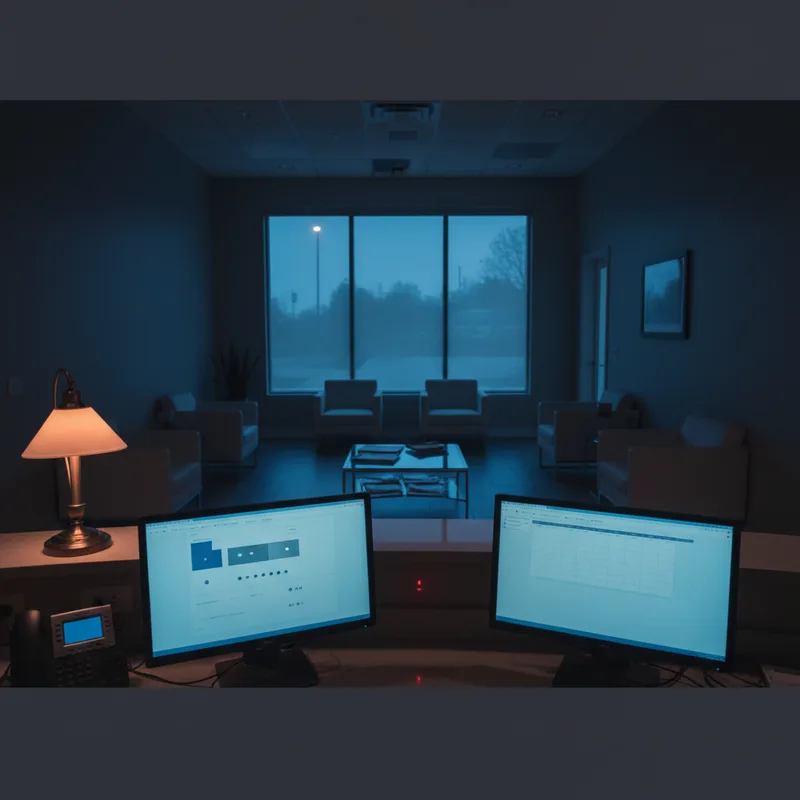
Take the after-hours leak. The ADA explicitly warns that practices lose prospective patients through unsatisfactory management of incoming calls, and the failure mode often happens at the boundary: the caller hangs up because the call wasn't answered, or the caller hangs up rather than wait on hold. After-hours calls are nearly always in the first category. A patient searching "dentist near me" at 8 PM and reaching voicemail almost never calls back the next morning. They scroll to the next result.
Three patterns show up in almost every wasted-budget audit:
Waste pattern 1
Paying for ad clicks that hit voicemail
A $4,000/month Google Ads budget driving 25% of calls into voicemail at 6 PM is burning roughly $1,000/month in directly attributable lost patient acquisition. The fix costs less than the loss.
Waste pattern 2
Recall on the to-do list, not the calendar
Recall outreach that lives as "if there's time" gets done maybe 40% of the time at most practices. The labor is being paid for either way; you're getting partial output for full input.
Waste pattern 3
VoIP plan with features nobody uses
Premium VoIP tiers at $40-50 per user per month often include analytics, recording, and CRM integrations the team never logs into. Downgrading to mid-tier often saves $1,500-3,000 per year with zero workflow impact.
The audit takes about 30 minutes. Pull last month's VoIP invoice, check what features were actually used (most VoIP dashboards show this), then pull your call analytics if you have them, and finally count how many recall calls were scheduled vs. completed last month. The gap between the three is your wasted budget. We've broken down the real cost of a single missed call, and it's an order of magnitude bigger than most owners assume.
What Should You Spend on a Phone System Upgrade?
Plan to spend $400-$1,500 per month on a modern phone system upgrade for a typical solo or small group practice. That covers VoIP service ($30-$150), call tracking and analytics ($50-$200), missed-call text-back or AI overflow ($300-$1,200). Hardware adds $200-$800 in one-time cost per phone. Most practices recoup the upgrade in the first 60-90 days through captured calls alone.
The upgrade math gets clearer once you separate "phone system" from "communication system." A modern phone setup for a dental practice is really four overlapping layers, each with its own pricing tier. Pick the layers that match your actual gaps. Don't pay for layers you won't use. The base layer is the one not to cut corners on: the VoIP reliability features worth paying for, such as an uptime SLA with service credits and PSTN failover, protect every layer above it.
| Layer | What it does | Typical monthly | Skip if |
|---|---|---|---|
| Layer 1: VoIP service | Inbound and outbound calls, hold music, voicemail, basic routing | $30-$150 | You don't have a phone system at all (rare) |
| Layer 2: Call analytics | Tracks answered call rate, hold time, call source attribution | $50-$200 | You're not running paid ads or measuring marketing ROI |
| Layer 3: Missed-call recovery | Auto text-back when calls go unanswered, opens a text thread | $50-$150 | Your missed-call rate is already under 5% |
| Layer 4: AI receptionist or after-hours | Answers calls, books appointments, captures new-patient info | $300-$1,200 | Front desk is consistently underutilized (also rare) |
Most practices already have Layer 1. The fastest ROI usually sits in Layer 4, especially if you're driving evening or weekend search traffic with paid ads. Layer 2 pays for itself quickly if you're spending real money on marketing. Layer 3 is the cheapest insurance against the scenarios where Layer 4 isn't running yet.
Plug a real AI layer onto your phone budget
DentalBase AI Receptionist sits as Layer 4 on top of your existing phone system. Catches overflow, after-hours, and routine bookings, and routes complex calls to your team in real time.
See AI Receptionist →How Do You Know If Your Phone Budget Is Working?
You know your dental practice phone budget is working when three numbers move in the right direction: answered call rate climbs above 90%, average hold time stays under 45 seconds, and recall completion rate hits 95%+ weekly. If those three are healthy, your phone spend is doing its job regardless of total dollar size. If any one of them is sliding, dollar size is the wrong question.
Most owners track production, collections, and case acceptance every week. Almost no one tracks phone metrics weekly, even though the data is sitting in their VoIP dashboard. Five minutes every Friday is enough to catch problems while they're cheap to fix. Owners who run that simple weekly check tend to have phone budgets that pay back. Owners who don't tend to find out months later when a marketing report flags a drop in new-patient bookings. Scoring every patient call takes the habit one level deeper, but the Friday check is the entry point.
Three signals tell you the budget is misallocated, not undersized. First, you're spending real money on Google Ads or local SEO but not on call tracking; you cannot tell which channel converts. Second, your team is consistently working late on recall but missing inbound calls during the day; the labor is in the wrong slot. Third, you have AI on your shopping list but no baseline numbers to evaluate it against; you'll buy the wrong tier or the wrong vendor. Fix the data layer before you change the spending mix.
Final Word: Phone Budget Is a System, Not a Line Item
The dental practice phone budget that grows your practice has a clear shape. It's measured as a percentage of revenue, not a flat dollar number. It includes labor as the largest line. And it has a deliberate plan for after-hours, recall, and analytics rather than treating those as orphans. Practices that frame the budget this way tend to have right-sized spend. Practices that just look at the VoIP invoice tend to over-spend on people and under-spend on the systems that would let those people do better work.
Run the audit this month. Add up the six line items honestly, including the labor allocation. Compare the total to 1.5-3% of your collections. If you're way under, you probably have leaks you haven't measured. If you're way over, you probably have layers you don't need. Either way, the fix isn't about spending more or less. It's about spending in the right places.
If you've never done this exercise, start with one Friday afternoon and last month's P&L. The clarity is worth the hour.
See where your phone budget is leaking and where it's working
Book a free demo. We'll review your call data with you and map it against the four-layer phone-system framework, hour by hour.
Book a Free Demo →More tools and guides for dental practice owners
Browse Resources →Sources & References
Frequently Asked Questions
A normal dental practice phone budget is 1.5% to 3% of gross collections, all-in. That includes VoIP, front-desk labor allocated to phone work, after-hours coverage, recall outreach time, and call analytics. The VoIP bill alone is rarely more than 0.2% of collections, which is why it can't be the whole picture.
VoIP service for a typical 3-line dental office runs $80 to $150 per month. Call analytics adds $50-$200, missed-call text-back adds $50-$150, and AI receptionist or after-hours coverage adds $300-$1,200. A modern stacked setup costs $400-$1,500 per month total, depending on the layers you use.
Yes. Front-desk staff typically spend 30-40% of their shift on phone work, which makes that labor allocation the largest line in any honest dental practice phone budget. For a $48,000 fully-loaded coordinator, that's $14,000-$19,000 per year of phone-attributable labor that most owners never count.
A solo dental practice doing $700K-$1M in collections should budget $12,000-$25,000 per year for total phone spend, or roughly 1.7-2.5% of revenue. Most of that goes to front-desk labor on phones. The remainder splits between VoIP, recall tools, and an after-hours or AI layer to catch evening calls.
AI receptionists at $300-$600/month are usually the cheapest sustainable after-hours coverage for a single-location dental practice. Traditional dental answering services run $400-$1,000/month and require message follow-up the next morning, which slows new-patient conversion compared to AI that books in real time.
Track three numbers weekly: answered call rate (target 90%+), average hold time (target under 45 seconds), and recall completion rate (target 95%+). If those move in the right direction, the budget is sized correctly regardless of total dollars. If they slide, dollar size is the wrong question to ask.
Three patterns: paying for VoIP features the team never uses, leaving after-hours uncovered while spending real money on Google Ads that drive evening calls, and treating recall outreach as a backup task instead of a budgeted activity. The last two cost tens of thousands per year in foregone revenue.
Was this article helpful?
Written by
DentalBase Team
Expert dental industry content from the DentalBase team. We provide insights on practice management, marketing, compliance, and growth strategies for dental professionals.