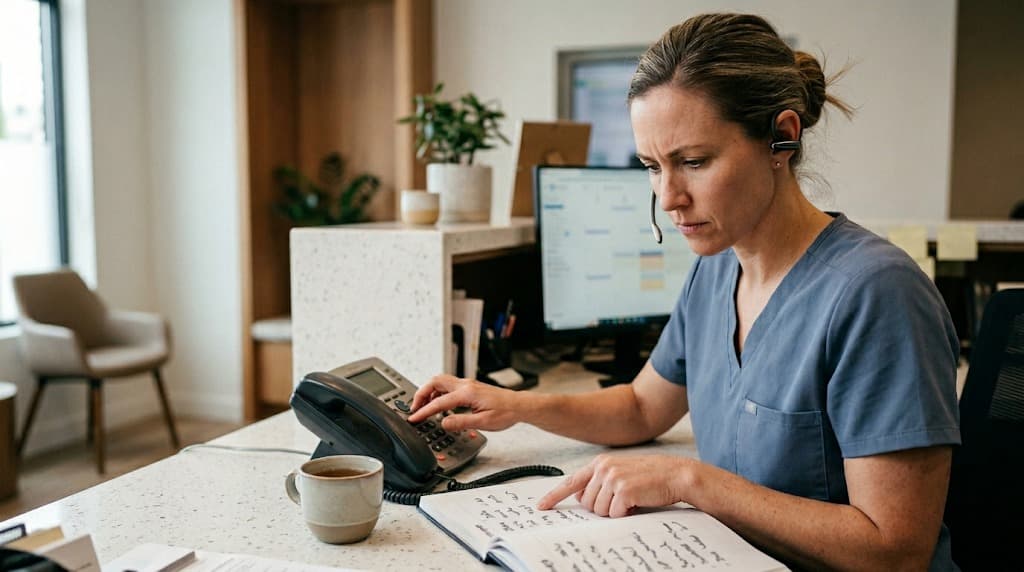
Dental VoIP Reliability: Why Drops Lose You New Patients
Dental VoIP reliability quietly leaks new patients every time a call drops. See why VoIP fails, what to check, and when to switch phone systems.
Share:
Table of contents
Tuesday morning, 9:14 am. A prospective patient in your zip code searches "emergency dental near me," taps your Google listing, and her phone starts to connect before the line goes dead three seconds in. She tries once more. Same thing. She taps the next listing. That's dental VoIP reliability failing in real time, and it's invisible until you look for it.
That call was worth somewhere between $800 and $4,000 in lifetime value, depending on whether it was a cleaning or an implant case. Your front desk never knew it happened.
Phone reliability is the quiet metric that decides whether a practice keeps the new patients it earned with marketing, location, and reputation. When the phone system drops calls, jitters voices into static, or fails during an ISP blip, the gap shows up two weeks later in the schedule. Not as a problem with the phone system. As "a slow month."
This article covers six things: what dental VoIP reliability actually means, how to measure it, what causes drops in a typical dental office, what features to check before signing a contract with a new vendor, how to verify uptime before switching, and how to keep uptime high once you're on a system that works.
What is dental VoIP reliability, and why does it matter?
Dental VoIP reliability is the percentage of business hours that your phone system delivers clear, two-way audio without drops, lag, or call failures. It matters because new-patient acquisition runs through the phone. A practice that drops one of every twenty calls leaks roughly 5% of its growth pipeline before the front desk ever hears it ring.
Most operators think about phone reliability the same way they think about electricity. It either works or it doesn't. VoIP doesn't behave that way. A VoIP system can be "up" on the vendor's status page while still dropping every fifth call inside your office because your router is overloaded, your codec settings are wrong, or your ISP's upstream bandwidth is throttled during peak hours.
The metric that captures all of this is uptime, usually expressed as a percentage of business hours. Enterprise phone vendors quote 99.9% or 99.99% uptime in their SLAs. Sounds tight. It isn't. 99.9% uptime allows for 8 hours and 45 minutes of downtime per year, which is a full business day. 99% uptime allows for 87 hours, more than three full weeks of business hours over twelve months.
For a dental practice, the question isn't whether the line works most of the time. It's whether the line works during the specific 15-minute window when an emergency case in pain calls at 2:47 pm and decides which practice she's giving her name to. ADA Health Policy Institute tracks practice productivity metrics across the industry, and the data consistently puts new-patient phone conversion at the top of operator concerns.
Related: When the line drops in the wrong 15-minute window, after-hours coverage is what salvages the call → after-hours phone coverage without burning out staff
How much does a dropped call actually cost a dental practice?
A dropped call costs a dental practice the full lifetime value of the patient who never called back. For new patients, that's a range of $800 to $4,000 depending on case mix. For existing patients trying to confirm or reschedule, the cost shows up as a no-show, a rescheduled chair gap, or a defected patient.
The math is simple but rarely run. A dental practice that takes 30 new-patient calls per month, drops 8% of them due to VoIP issues, and converts 60% of completed calls into booked appointments loses roughly 1.4 booked new patients each month. At a conservative $1,200 average lifetime value, that's $1,680 monthly, or $20,160 annually, evaporating into a metric most practices never measure.
In dentist forums and Facebook groups, owners consistently report that VoIP drops are invisible until they audit the call log against the appointment book. The numbers don't show up in a daily report. They show up in "slow week" or "must be a seasonal dip." According to BrightLocal's local consumer research, the majority of consumers will move on to the next business within a single failed contact attempt.
The hidden cost of an 8% VoIP drop rate
Based on 30 new-patient calls per month and $1,200 average lifetime value.
2.4
Dropped calls per month
1.4
Lost new patients per month
$20K+
Annual revenue leak
A drop rate this high is common in unmanaged VoIP setups. Most practices never measure it.
That's just new-patient acquisition. Add rescheduled calls, treatment plan follow-ups, and emergency triage that bounced, and the number doubles in most practices. Phone reliability isn't an IT line item. It's a revenue function.
Related: Channel match matters too. Older patients in particular need calls that connect → dental software for elderly patients that calls, not texts
What causes VoIP drops in a dental office?
VoIP drops in a dental office almost always trace to one of five causes: insufficient internet upload bandwidth, a router without quality-of-service (QoS) prioritization for voice traffic, codec settings mismatched to your bandwidth, an ISP outage upstream, or hardware that's exceeded its useful life. Diagnostic order matters.
Each cause has a signature. Choppy audio that turns into a dropped call points to bandwidth or QoS. A clean line that suddenly goes silent points to an ISP issue or a power blip on the router. A call that connects, runs for 8 minutes, and then drops at the same point most days points to a NAT or SIP session timeout setting. Knowing which fingerprint matches which call helps the team escalate the right problem to the right vendor.
| Symptom | Most likely cause | First check |
|---|---|---|
| Choppy audio, robotic voice | Insufficient upload bandwidth | Run a speed test during peak hours |
| Audio fades in and out | No QoS prioritization for voice traffic | Confirm router has SIP and VoIP QoS enabled |
| Call drops at 8 to 12 minute mark | NAT or SIP session timeout | Ask vendor about session refresh interval |
| Dead silence mid-call | ISP outage or upstream packet loss | Check ISP status page and ping vendor edge |
| Inbound calls fail to ring at all | SIP registration issue or DID routing | Vendor portal: check SIP trunk status |
Most practices outsource the diagnostic side to an IT vendor or their phone system reseller. That's fine for execution, but the practice owner should know enough to recognize which symptom they're describing. "The phone is broken" is too vague to fix. "Inbound calls are failing to ring during peak hours" is something a vendor can diagnose in 10 minutes.
Related: Reminder systems show the same drift pattern when settings don't match the underlying schedule → why reminder systems get out of sync with your schedule
Which dental VoIP reliability features matter most when shopping for vendors?
The dental VoIP reliability features that matter most are a documented uptime SLA above 99.99%, automatic failover to a secondary data center, PSTN backup that routes calls to staff cell phones during outages, native call recording for compliance, and direct support escalation to a tier 2 engineer without phone-tree routing.
Sales decks all say "enterprise-grade." That phrase means nothing without checking the underlying specs. Here's what to verify before signing a contract:
- Uptime SLA with financial credits. Above 99.99% is the modern benchmark, but the credit structure matters more than the number. A vendor that owes you 5% of monthly fees for every hour of downtime takes uptime seriously. A vendor with no credit structure has no skin in the game.
- Geographic redundancy. The vendor should have at least two data centers in different regions, with automatic failover between them. Ask which region your account routes to and what happens during a regional outage.
- PSTN failover. If the internet goes down at your office, your inbound calls should route to staff cell phones or a designated backup number. Most modern systems support this. Some require you to enable it manually during setup.
- Native call recording. Important for compliance and for HIPAA-aware coaching of the front desk. Confirm storage retention (12 months minimum) and the pull-on-demand workflow.
- Real support escalation path. A 24/7 number that drops you into a phone tree is not real support. Confirm that a tier 2 engineer can be reached within 30 minutes for outage-class issues. Test this during your evaluation.
- Mobile app failover. Front-desk staff and on-call providers should be able to receive calls on a mobile app when the office line is unavailable. According to BLS data on receptionist roles, hybrid and remote work continues to grow, and phone systems that don't follow the staff are increasingly a liability.
None of these features matter if the vendor can't deliver them in your specific environment. Run a 30-day pilot before signing a multi-year contract. Use both lines (current and new) in parallel for two weeks. Check call quality, dropout rate, and support responsiveness. The same logic applies to intake software that reduces front-desk workload: the system should work where the staff actually are, not where the diagram says they should be.
How do you check dental phone uptime before switching providers?
Check dental phone uptime by auditing your current system's call log for failed and dropped calls over a 30-day window, requesting the prospective vendor's last 90 days of uptime reports, calling vendor references during their business hours, and running a parallel pilot for at least two weeks. Trust verifiable data, not sales-deck promises.
The mistake practice owners make is treating vendor evaluation like a software purchase. Phone systems aren't software. They're a stack of internet, hardware, configuration, and support, and any link in that chain can fail. A real evaluation runs in four stages:
- Audit your current call log. Pull 30 days of data. Count completed calls, failed calls, dropped calls, and average call duration. This is your baseline. Without it, you can't measure improvement.
- Request 90-day uptime reports from each prospective vendor. A reputable vendor will share these without hesitation. One that won't share them is hiding something.
- Call vendor references during their peak hours. Ask "how often does the system drop calls" and "how fast does support respond when it does." Phone the reference, don't email. You're testing the actual phone system in use.
- Run a 14-day pilot in parallel. Use a test DID number routed to a few staff cell phones or a dedicated test line. Make 5 to 10 calls per day in different scenarios. Measure quality, dropout rate, and support responsiveness.
According to HubSpot's customer acquisition research, phone-based conversion rates are several times higher than form-fill conversion rates for service businesses. That's even more true for healthcare, where decisions are time-sensitive and trust is built through voice. Treating the phone system as core infrastructure and not a commodity utility is the practical takeaway. Practices that switch on price alone usually switch again within 18 months.
Related: Phone reliability is one of several front-office systems practices outgrow → how dentists are rethinking their front-office software
How do you maintain dental phone uptime after the switch?
Maintain dental phone uptime by reviewing the vendor's uptime dashboard weekly, monitoring your office's internet quality with a simple speed test, training the front desk to log call quality issues in real time, and keeping a documented escalation path with vendor support direct numbers.
Phone uptime decays. A system that ran clean in month one can start dropping calls in month six because the office added a new server pulling bandwidth, the ISP downgraded a peering relationship, or the router's firmware fell out of date. Active monitoring catches drift before patients do. According to NIDCR research statistics, dental visits remain a primary care touchpoint across adult age groups, which makes the phone the single highest-impact channel a practice operates.
Three practical habits separate the practices that maintain 99.5% real-world uptime from the ones that don't: weekly dashboard review, monthly call-log audit against the appointment book, and a named vendor contact (not a ticket queue) the office manager can text during an outage.
Pre-switch and post-switch checklist
Check each item your practice has confirmed.
Your score: count your checks out of 6
Practices that hit 5 of 6 items on this list rarely have phone-related new-patient leaks. Practices below 3 of 6 leak revenue every week and don't know it. The audit takes a single afternoon to run. The protection it provides lasts for years. The same monitoring habit shows up in how the best dental analytics platforms approach front-office metrics.
Dental VoIP reliability isn't a feature. It's the foundation under every marketing dollar, every new-patient SEO ranking, and every reactivation campaign the practice runs. When the phone drops, all of that work runs into a dead line.
The fix isn't more phone hardware. Treating the phone system as core revenue infrastructure means measuring it weekly, monitoring it against an SLA, and escalating when it drifts. The audit steps in this article are the operator's preventive maintenance.
If you're already running VoIP, the audit is worth a Saturday afternoon. If you're shopping for a new system, the pilot is worth two weeks. And if you're exploring what a modern dental phone platform looks like, DentiVoice handles the call layer and the voice-AI layer in one stack. One vendor. One escalation path.
See dental phone reliability without the integration risk
DentiVoice consolidates inbound calls, an AI receptionist, and front-desk routing on a single uptime-monitored stack. Built for dental practices that depend on the phone for new-patient flow.
Book a Free Demo →Want more on dental practice growth?
Browse Resources →Sources & References
Frequently Asked Questions
Dental VoIP reliability is the percentage of business hours that your phone system delivers clear, two-way audio without drops, lag, or call failures. It combines vendor uptime, internet bandwidth quality, router configuration, and hardware health into one practical metric most dental practices never measure systematically.
99.99% uptime is the modern benchmark for healthcare-grade phone systems, allowing for about 52 minutes of downtime per year. 99.9% allows almost 9 hours. The difference is significant for practices that depend on the phone for new-patient acquisition and emergency triage during business hours.
Audit the call log against the appointment book over 30 days. Look for calls with durations under 10 seconds, calls that never converted, and gaps in inbound call frequency during peak hours. Most dental VoIP reliability problems are invisible without this audit.
Many practices keep one copper landline as a PSTN backup, but most modern VoIP systems offer software-based failover that routes calls to staff cell phones during outages. Confirm the backup mechanism with the vendor and test it before relying on it.
Plan on at least 100 Kbps upload bandwidth per concurrent call, with headroom for other traffic. A four-line dental office should have at least 5 Mbps dedicated upload, more if the practice uses cloud imaging or large file transfers concurrently with calls.
Plan for 4 to 6 weeks end-to-end: 1 to 2 weeks of vendor evaluation, 2 weeks of parallel pilot, and 1 to 2 weeks for full porting of your phone numbers. Number porting from the old carrier is typically the longest single step.
Use the vendor's uptime dashboard weekly, run a third-party call quality monitor or synthetic call probe, and review your internal call log monthly. Dental phone uptime drift is gradual, so monthly checks catch problems before they become patient-facing.
Was this article helpful?
Written by
DentalBase Team
Expert dental industry content from the DentalBase team. We provide insights on practice management, marketing, compliance, and growth strategies for dental professionals.