We Asked 15 Dentists About AI Dental Receptionists. Here's What They Said.
We asked 15 dentists who switched to an AI dental receptionist. Here are their 6 most useful answers on ROI, patient reactions, and what surprised them.
Share:
Table of contents
We asked 15 dentists who already switched to an AI dental receptionist the questions every other dentist is asking before they pull the trigger. Some run solo practices in Texas. Some run 5-chair group practices in Florida. One runs a 3-location DSO in California. All of them switched in the last 12 months. We cover this and more in our complete guide to the DentalBase AI receptionist.
What follows is an interview-style breakdown of the 10 most useful answers we got back. Real quotes. Real numbers. No vendor fluff. If you are considering an AI receptionist for your practice, these are the people who already walked the road.
A note on names. Every dentist quoted here asked to stay anonymous, so we have withheld their names and identifying practice details at their request. The quotes, numbers, and stories are reported exactly as they were shared with us.
What made you choose an AI dental receptionist?
Most dentists chose an AI receptionist after a single moment: pulling a call log and seeing the missed-call number. Across the 15 practices, that number landed between 25 and 40 percent of inbound calls during business hours. Once they saw it, the cost of doing nothing became impossible to ignore.
We asked each dentist to describe the exact moment they decided. The answers were almost identical in shape, even when the practices looked different on paper.
Interview
Q:What was the moment you decided to switch?
A:"I was paying for SEO and Google Ads for two years. Then I pulled a call audit and saw one third of those leads were hitting voicemail. That was the moment."
Dr. M. | 3-provider GP, Texas
The pattern was consistent. A dentist would request a call audit expecting maybe 5 to 10 percent of calls were going unanswered. The actual number was 4 to 6 times worse. According to ADA guidance on prospective patient inquiries, some practices lose 30 to 50 percent of initial new patient contacts to unsatisfactory call management. The patient just calls the next practice on the list.
The 4 most common tipping points
- A call audit revealing 30 percent plus of inbound calls unanswered
- Lost new patient revenue tied directly to missed calls
- Front desk turnover making consistency impossible
- After-hours scheduling demand they had no way to meet
Find out how many calls your practice is missing
Get a free 30-minute audit of your inbound call patterns and see what an AI receptionist would catch.
Book a Free Demo →Did patients refuse to use the AI dental receptionist?
No, not in any meaningful way. Across all 15 practices, under 5 percent of callers asked to speak to a human in the first month. Most callers warmed up after 2 to 3 calls. The patients who did push back early often ended up preferring the AI because it answered on the first ring instead of putting them on hold.
My patients did not care that it was AI. They cared that it answered.
The dentists expected the opposite. Most went in braced for older patients to walk away or younger patients to mock the technology. What actually happened was that callers treated the agent like a quick scheduling tool. They wanted to book, confirm an insurance question, or reschedule. The agent did it in under 90 seconds.
Interview
Q:Did you track patient sentiment?
A:"We tracked sentiment for 60 days. 92 percent of calls ended with zero complaint about the agent. The 8 percent who complained were upset about insurance, not the AI."
Dr. J. | 1-doctor practice, Ohio
Here is what the 15 dentists actually reported in the first 90 days.
| Patient Reaction | Frequency | Resolution |
|---|---|---|
| Booked normally, no comment | 88 to 92 percent | No action needed |
| Asked for a human | Under 5 percent | Escalated, resolved |
| Complex insurance question | 5 to 8 percent | Escalated, resolved |
| Hung up early | Under 2 percent | Follow-up text sent |
How fast does an AI dental receptionist deliver ROI?
Most practices saw measurable ROI within two weeks. The clearest signal was after-hours bookings, which jumped from near zero to real scheduled revenue almost immediately. New patient leads that previously hit voicemail at 7 PM now booked themselves into the next open slot before the practice opened the next morning.
We captured 14 new patient appointments from after-hours calls in month one. Subscription was $479. Payback was less than a week.
The math worked out fast. A Dental Economics reality check on AI in dentistry noted that over 30 percent of dental practice phone calls go unanswered, calling it a revenue problem more than a staffing one. A single new patient case worth $1,200 to $2,500 covers most monthly AI receptionist subscriptions for the entire year.
The fastest ROI signals dentists tracked
- 01After-hours bookings. Went from near zero to 8 to 20 per month.
- 02Answered call rate. Jumped from 60 to 70 percent up to over 95 percent.
- 03New patient conversion rate. Rose 10 to 25 percent.
- 04Voicemail-to-callback rate. Stopped mattering. No more voicemail backlog.
Keep Reading
Currently on Weave or another phone system? How to Switch From Weave to an AI Receptionist in 30 Days →
Which practice metric did the AI receptionist improve most?
Answered call rate. It jumped from 60 to 70 percent on average up to over 95 percent in the first month. No other metric moved that fast or that visibly. Dentists who had spent years trying to fix this with staff training or extra hires saw the gap close in days, not quarters.
Interview
Q:What did your CPA say?
A:"I showed my CPA a before-and-after report. He approved the expansion to two more locations on the spot."
Dr. L. | 3-location DSO, California
This is the one metric most dentists did not realize was broken. They knew calls were missed. They did not know that on a typical Monday, between 25 and 40 percent of all inbound calls were going unanswered. According to HubSpot research, customers who reach voicemail rarely leave a message and most do not call back. In dentistry, the next practice is already in their search results.
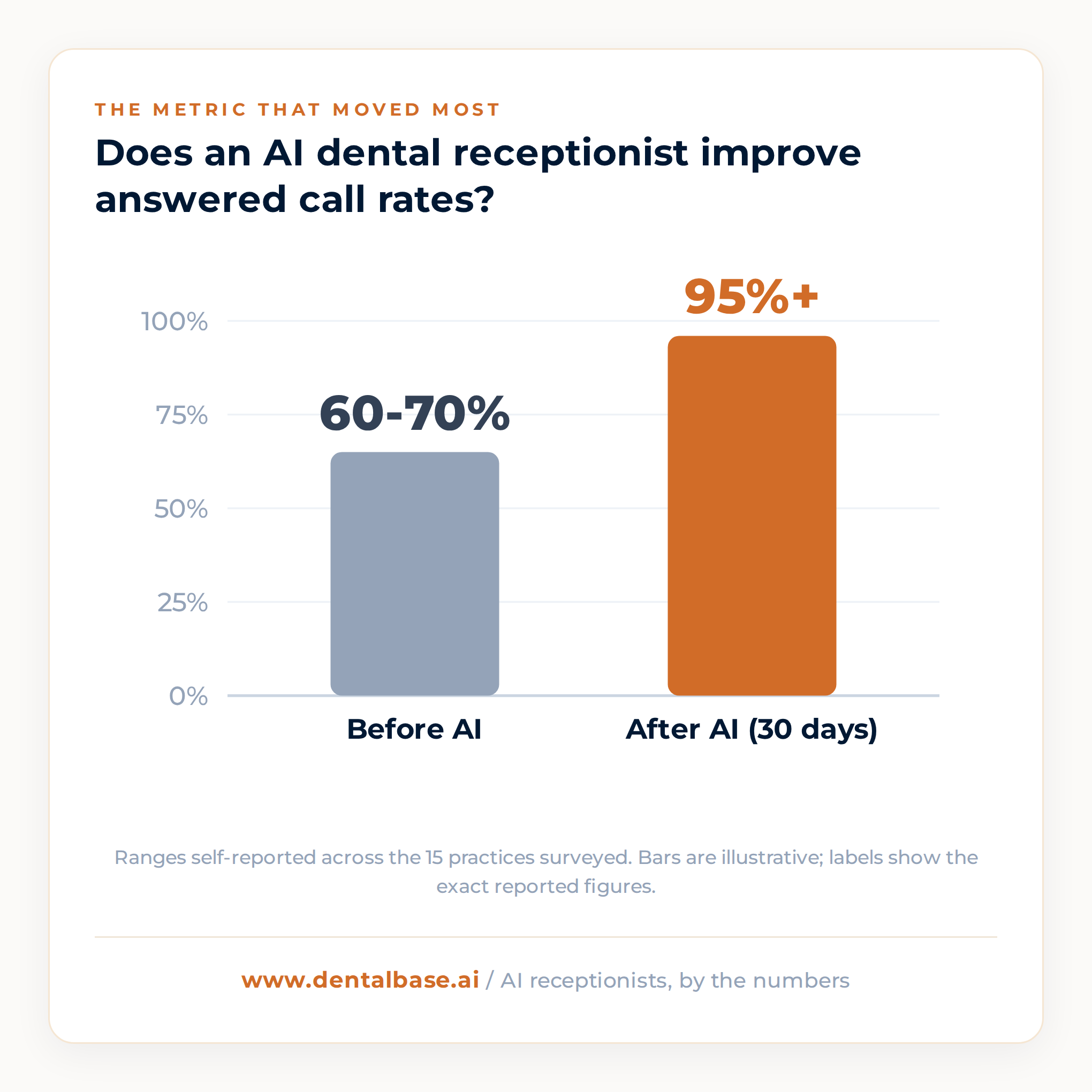
Here is the typical first-month metric shift our 15 dentists reported.
| Metric | Before | After 30 Days |
|---|---|---|
| Answered call rate | 60 to 70 percent | Over 95 percent |
| After-hours bookings | Near zero | 8 to 20 per month |
| Average hold time | 90 to 180 seconds | Under 10 seconds |
| Front desk overtime | 5 to 12 hours per week | Near zero |
See it live
See what DentiVoice sounds like in a real call
Watch a live demo handling a new patient call, an insurance question, and an after-hours booking.
Book a Free Demo →What surprised you most about the AI receptionist?
Front desk morale. Not a financial metric. Almost every dentist in the survey volunteered the same observation: their front desk team got happier within the first two weeks. The phone stopped interrupting every patient interaction at checkout, and the team could finally focus on the person standing in front of them.
My lead front desk had been asking about leaving for three years. Twelve months after the switch, she is still here. That was the surprise.
This was the answer no dentist predicted in pre-implementation surveys. They expected to talk about revenue, conversion rates, or scheduling accuracy. Instead, the first thing most mentioned was that their lead front desk person stopped asking about leaving.
Interview
Q:What did your team start doing with the freed-up time?
A:"With the phone load gone, my team finally had time to do hygiene recall calls. We had a hygiene chair gap for a year. Closed it in a month."
Dr. P. | 5-chair group practice, Georgia
The second surprise was downstream. With phone load gone, front desk staff had time for tasks that had been falling off the list for years: insurance verification, hygiene recall, treatment plan follow-ups, and reactivation. Moz research on local search behavior shows responsiveness and review velocity correlate with ranking, and both of those got easier when the desk had bandwidth.
Keep Reading
See the full task list 100+ Dental Receptionist Duties AI Can Handle in 2026 →
The unexpected wins dentists called out
- Front desk staff stopped asking about quitting
- Hygiene recall calls actually got made
- Insurance verification stopped piling up
- Patients at checkout got full attention, not split focus
- Reviews increased because staff had time to ask for them
How did the front desk team handle the AI receptionist rollout?
Mixed at first, then relieved. The first 3 to 5 days felt unfamiliar to most front desk teams adjusting to an AI dental receptionist. By week two, the same teams who were nervous about being replaced were the ones asking when after-hours coverage could expand. Once they saw the AI take the phone load, the conversation shifted from threat to relief.
Interview
Q:What was day one like on your team?
A:"Tense. My lead was sure I was about to fire her. By Friday she was the one pushing me to flip the agent on during lunch hours too."
Dr. K. | Solo practice, Ohio
Most owners reported the same arc. Anxiety in week one. Curiosity in week two. By week three, the team was suggesting workflow improvements: which call types to route, which questions to escalate, how to handle the rare upset caller. The team stopped fearing the tool and started shaping it.
The team thought it was a threat. Now they call it their teammate that never calls in sick.
The owners who handled the rollout best did one thing in common: they framed the AI as relief for the team, not a replacement. They walked through the call dashboard with the front desk in the first week. They showed the team which calls the AI was catching that used to die in voicemail. That single transparency moment turned skeptics into advocates.
What made the team buy in
- Owners showed the call dashboard openly in week one
- Front desk got to define escalation rules, not the vendor
- The team kept the same headcount and saw overtime drop
- Wins were celebrated out loud: every after-hours booking caught
What should dentists know before buying an AI dental receptionist?
That the first two weeks are tuning, not a finished launch. Every dentist who struggled with the rollout shared the same regret: they expected day-one perfection. The ones who treated weeks one and two as active calibration, with daily check-ins on call logs, hit their stride twice as fast.
Interview
Q:What would you do differently?
A:"I would have spent an extra hour up front recording exact answers to the 20 questions we get every week. The agent was only as good as what I gave it on day one."
Dr. S. | 4-chair practice, Florida
The second most common regret was rushing the integration. A few practices tried to launch with only the main phone line connected. The agent worked, but the practice could not see the full picture. The dentists who connected their PMS, their call logs, and their scheduling rules on day one had a much cleaner first month.
I treated the first launch like a finished product. It is not. It is a starting point. Once I started tuning weekly, the agent got 30 percent better in a month.
Several dentists also said they wished they had tested the agent on real calls themselves, not just demo scenarios. Calling your own practice 5 to 10 times in the first week catches edge cases no vendor scripts can predict.
The 5 things switchers wish they had known
- 01Tuning is the job for weeks 1-2. Plan daily 15-minute reviews of call logs.
- 02Connect everything on day one. PMS, call logs, scheduling rules.
- 03Call your own practice 5 to 10 times. Find edge cases before patients do.
- 04Document your top 20 weekly questions. Give the agent your exact wording.
- 05Start with after-hours only. Add business hours after week 2 if it makes you nervous.
Which calls do AI dental receptionists still struggle with?
Complex insurance verification and emotionally charged calls. Across all 15 practices using an AI dental receptionist, these were the two consistent gaps. Insurance questions involving multiple plans, secondary coverage, or denied claims still needed human escalation. So did angry callers, grieving callers, and anything emotionally heavy.
Interview
Q:Where does the AI receptionist still fall short?
A:"Anything emotional. A patient calling in pain at 11 PM does not want a chipper agent. The handoff to my emergency line was the most important thing we tuned."
Dr. J. | 1-doctor practice, Ohio
The good news is the gap is predictable. The 15 dentists reported that 8 to 15 percent of calls needed human escalation in month one, dropping to 5 to 10 percent by month three after tuning. None of those numbers grew over time. The agent did not get worse; it stayed stable while edge cases got handled better.
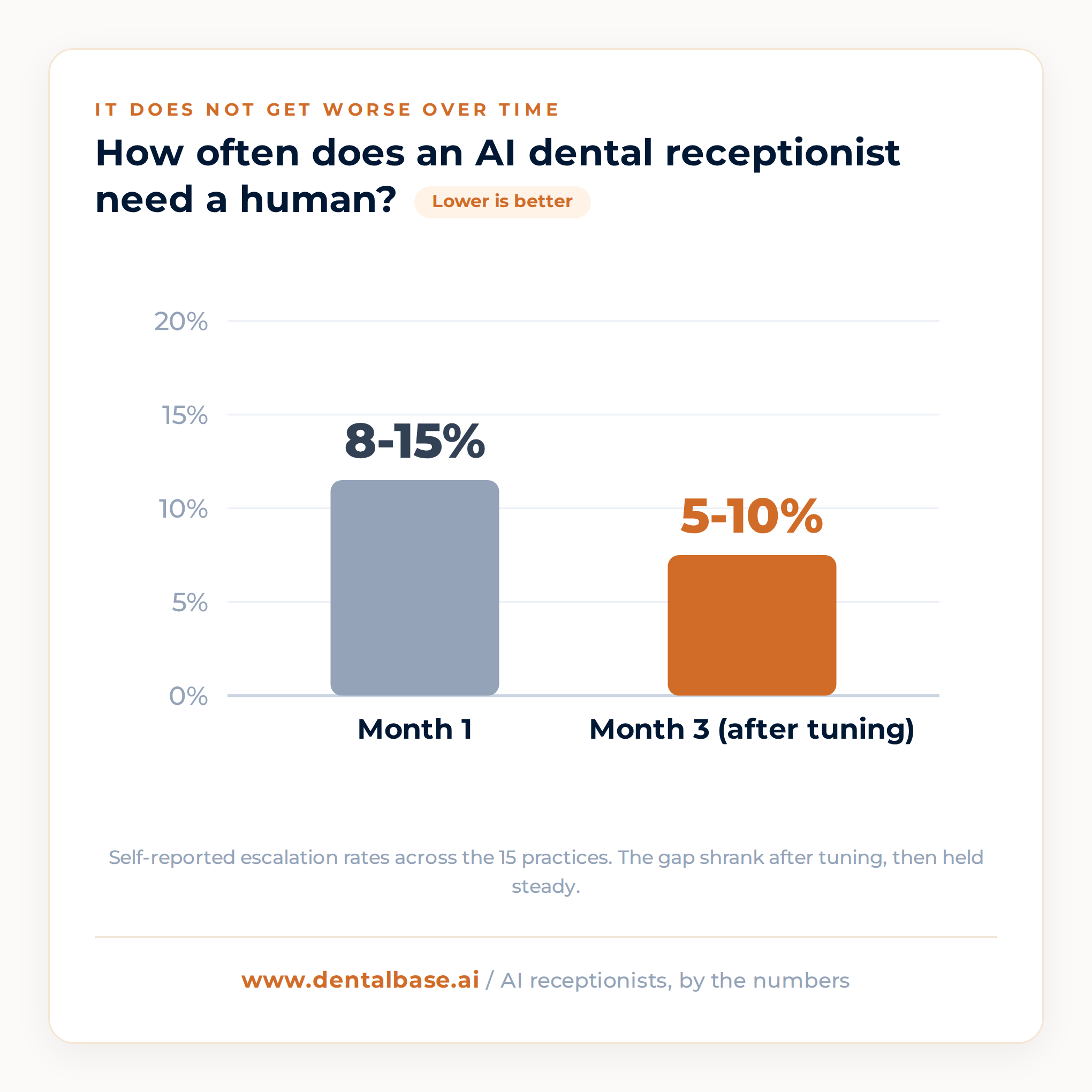
Here is the honest breakdown of where the agent still struggles, based on the 15-practice survey.
| Call Type | Agent Handles Well | Still Needs a Human |
|---|---|---|
| Routine appointment booking | Yes, 95% + | Rarely |
| Insurance basics | Yes, 80% | Multi-plan or denials |
| Emergency triage | Routing only | Clinical judgment |
| Billing disputes | Takes a message | Always |
| Emotional or grieving calls | Routes immediately | Always |
Dentists who set realistic expectations stayed happy. Dentists who expected 100 percent automation hit frustration. The agent is excellent at the 80 percent of calls that drain front desk time. The remaining 20 percent still needs human judgment, and that is not changing soon.
How does an AI dental receptionist handle emergency and after-hours calls?
Every practice in the survey set up explicit emergency routing in the first week. The agent does not diagnose. It listens for trigger phrases like severe pain, broken tooth, swelling, or bleeding, then either routes the call to the doctor on call or sends an instant text alert with the patient's number.
Interview
Q:What does your emergency protocol look like?
A:"Agent listens for pain, swelling, trauma. Texts me the caller's number in under 10 seconds. I call back from my cell. That single workflow paid for the whole subscription."
Dr. A. | 2-provider practice, Arizona
The setup varies by practice. Some route emergencies directly to the doctor's cell phone. Others use an on-call rotation where the agent texts whichever provider is on duty that night. A few use a hybrid: agent texts the caller a callback time window, then alerts the doctor with full call context so the return call is prepared, not blind.
I have not missed an after-hours emergency in 11 months. Before the AI, I was finding voicemails the next morning. That is the difference.
Compliance matters here. The agent does not give medical advice, does not store protected health information improperly, and does not commit to clinical action. It captures the situation, alerts the right person, and reassures the caller that a real human will respond. That clean separation kept every practice in the survey compliant with their state regulations.
The 4 components of an emergency workflow
- Trigger phrase detection for pain, swelling, trauma, bleeding
- Instant SMS alert to the doctor on call with caller details
- Callback time commitment to the caller so they don't keep dialing
- No clinical advice: the agent acknowledges, then escalates
Would you switch back from an AI receptionist?
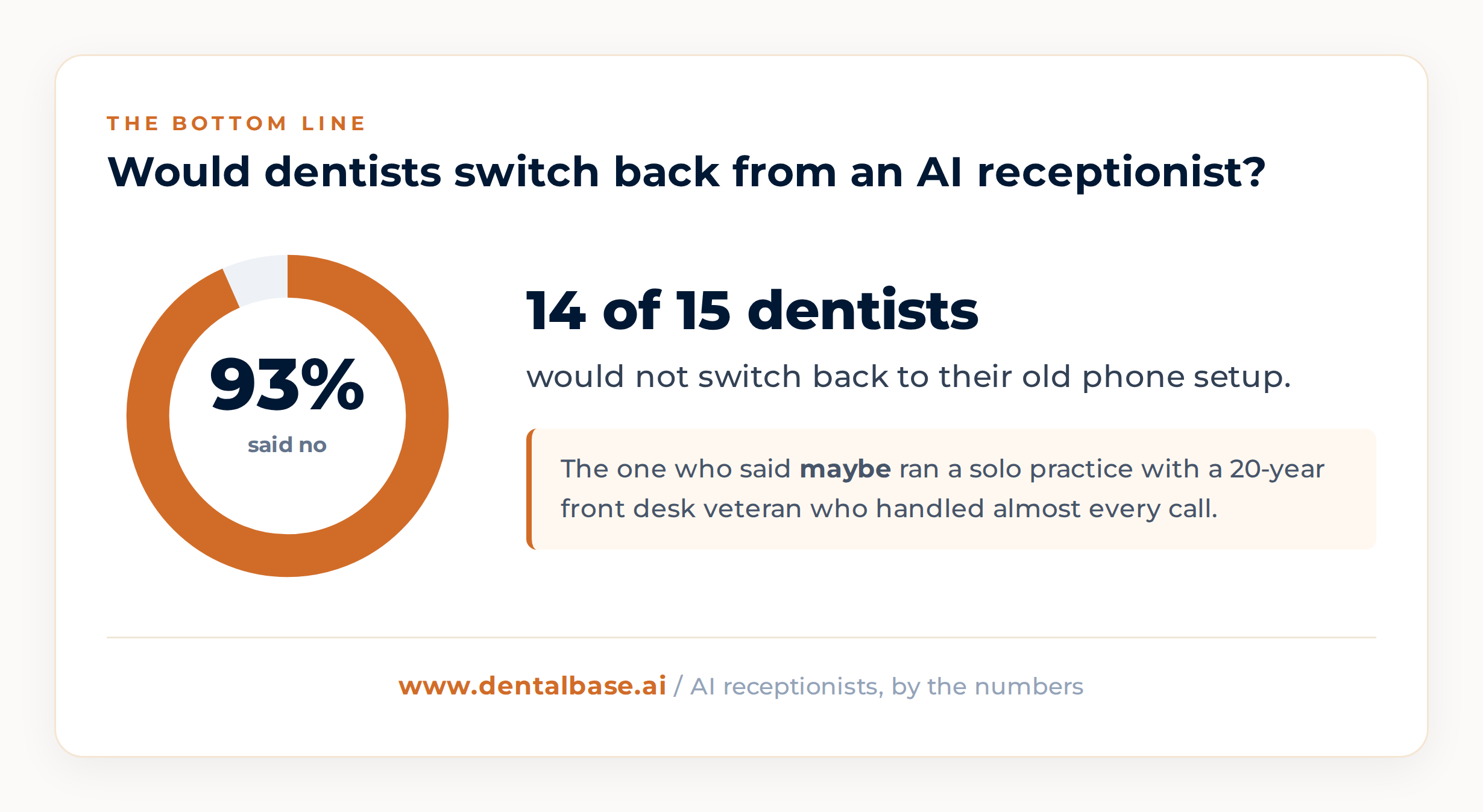
No, almost universally. Of the 15 dentists surveyed, 14 said they would not go back. The single dentist who said maybe was running a 1-doctor practice with a 20-year front desk veteran who handled almost every call. For everyone else, the gap between answered calls and voicemail was too stark to walk back.
I would rather have an AI that catches 95 percent of calls and misses some nuance than a voicemail that catches none. That is the real comparison.
The verdict was not always emotional. Several dentists said the AI agent was not perfect. It occasionally missed nuanced insurance questions. It needed re-training on new providers or hours. None of that was enough to make them switch off. The baseline they were comparing to was a phone system that missed 30 percent of calls and a front desk that was already maxed out.
Interview
Q:Is going back off the table?
A:"Going back is not really an option. Once you see your real answered call rate, you cannot unsee it."
Dr. N. | 6-operatory practice, Washington
The conditions that made the switch stick
- 01The agent integrated with the existing practice management system, not a new one.
- 02The first two weeks were treated as tuning, not a finished launch.
- 03The front desk was trained on escalation handoffs early.
- 04The dentist personally tested 5 to 10 real call scenarios before going live.
- 05A live human backup was always available during business hours for the first month.
Want the full intake software comparison?
See how AI receptionists compare to legacy intake software for reducing front desk load.
Read the Comparison →The Takeaway
What the 15 dentists actually want you to know
If you are considering an AI dental receptionist, the data from these 15 switchers points to one answer: the cost of staying on voicemail is bigger than the cost of switching. The dentists who hesitated longest are the ones who, in hindsight, said they wished they had moved sooner.
Start with a call audit. Find out what your real answered call rate is right now. If it is below 90 percent, you already have your answer. Every missed call is revenue walking to the next listing.
I wish I had done this two years ago. That is the only thing I would change.
The next step is simple. See it handle a real call. Once you hear it, the question stops being whether to switch and becomes how fast you can.
Hear it for yourself
See DentiVoice handle a live call
Watch a 30-minute demo of our AI dental receptionist booking appointments, handling insurance questions, and capturing after-hours leads.
Book a Free Demo →Want to verify what you just read? We can share verified DentiVoice reviews and reference calls from real practices during your demo.
More resources on AI dental receptionists
Browse Resources →Sources & References
Frequently Asked Questions
An AI dental receptionist is software that answers your practice phone, books appointments, and routes calls without human staff. It works 24/7, integrates with practice management systems like Dentrix or Open Dental, and handles the same intake tasks a front desk handles during business hours.
Pricing typically runs $200 to $800 per month depending on call volume and features. Most practices recoup the cost within the first month by capturing after-hours and missed business-hour calls that previously went to voicemail and then to a competing practice.
Most patients accept it after one or two calls. Under 5 percent of callers ask for a human in survey data from practices that switched. Older patients adjust faster than expected because the agent speaks naturally and books appointments quickly.
Most practices go live in 1 to 3 weeks. The work involves connecting to your practice management system, recording your protocols and scheduling rules, and running test calls before pointing your main number to the agent during after-hours first.
No, it absorbs the phone load so your front desk can focus on patients in the operatory and at checkout. Most practices report fewer overtime hours and lower turnover, not staff reductions, after switching.
A well-configured agent escalates to a human, takes a message, or sends a real-time text to a designated team member. The 15 dentists in our survey reported escalation rates between 8 and 15 percent during the first month, dropping after tuning.
Was this article helpful?
Written by
DentalBase Team
Expert dental industry content from the DentalBase team. We provide insights on practice management, marketing, compliance, and growth strategies for dental professionals.