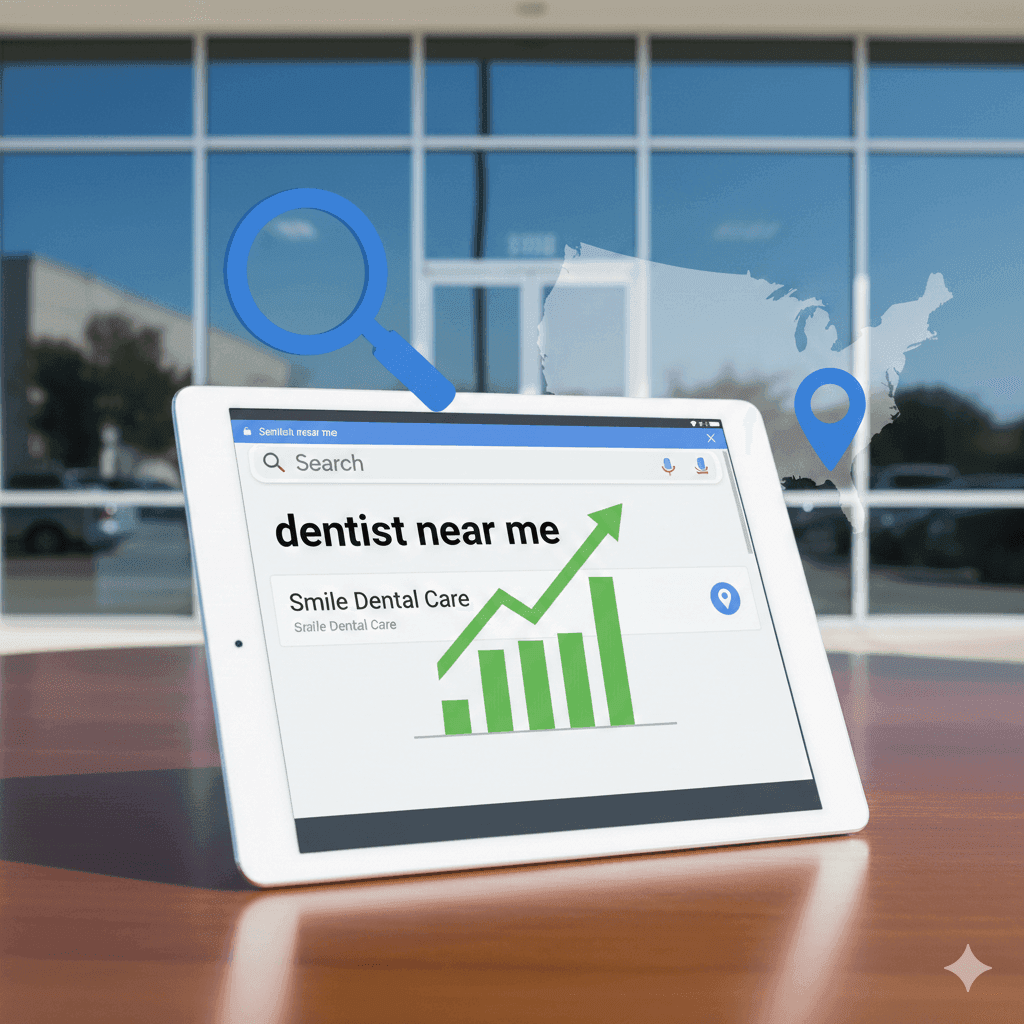
SEO for Dental Practices: Complete How to Guide
Dental SEO built specifically for dentists. Rank locally, get found on Google Maps, and turn searches into booked patients.
Share:
Table of contents
Why SEO for Dental Practices Changed in 2026
Dental SEO is no longer about stuffing "dentist near me" into your homepage and waiting for Google to send patients. Three forces have reshaped how practices get found online, and understanding them is the difference between growing your patient base and watching it shrink.
First, Google's AI Overviews now appear at the top of many dental-related searches, summarizing recommendations before the user clicks a single link. Search impressions for dental practices are up 49% year-over-year, but click-through rates are down 30%, according to DentalScapes research. More people see your listing, but fewer click through unless your content is featured in those AI summaries.
Second, Dental Service Organizations (DSOs) have invested heavily in digital marketing with dedicated teams and larger budgets, making organic search more competitive for independent practices. Third, patients increasingly use AI tools like ChatGPT and Gemini to ask "which dentist should I trust?" before ever opening Google Maps.
This guide covers the complete seo for dental practices playbook for 2026, from Google Business Profile optimization to AI search readiness, with the data and specifics you need to actually implement each step.
How Google Ranks Dental Practices in 2026
Google uses two distinct systems to rank your practice: organic search results (the blue links) and the Local Pack (the map with three listings). Your dental SEO strategy needs to address both because patients interact with them differently.
For the Local Pack, Google weighs three main factors: relevance (does your profile match the search?), distance (how close is your practice to the searcher?), and prominence (how well-known and well-reviewed is your practice?). For organic results, website authority, content depth, backlinks, and technical performance determine your position.
01 - Profile Signals Google Business Profile Primary category selection, profile completeness, photo activity, Q&A content, service listings, and post frequency. | 02 - Website Signals Content and Authority Dedicated service pages, internal linking, quality backlinks, site speed, mobile experience, and geographic keyword relevance. | 03 - Trust Signals Reviews and Entity Data Review quantity, recency, rating, response behavior, and consistent NAP (name, address, phone) across directories. |
These signals do not work in isolation. A strong Google Business Profile cannot compensate for a slow, thin website. And a fast website with great content will not rank locally if your NAP data is inconsistent across the web. Dental search engine optimization requires all three categories working together.
Google Business Profile: Your Most Important Local SEO Asset
Your Google Business Profile (GBP) is the single most influential factor in whether you appear in the Local Pack, which is where the majority of dental patient clicks happen. According to BrightLocal's Local Search Ranking Factors survey, your primary category selection is the top factor influencing Map Pack rankings.
Google Business Profile Optimization Checklist
- Select the most specific primary category (e.g., "Cosmetic Dentist" if that is your focus, not just "Dentist")
- Add 3-4 relevant additional categories. A BrightLocal study found businesses using four additional categories have the highest average map ranking of 5.9.
- Complete every section: hours, services with descriptions, insurance accepted, accessibility features
- Add new photos weekly. Google rewards active profiles with higher visibility.
- Post updates at least twice per month (new services, team highlights, patient education)
- Answer every question in the Q&A section promptly
- Verify your NAP matches exactly across your website, Yelp, Healthgrades, Zocdoc, and all directories
A critical 2026 update: Google now uses AI to detect category misuse. Practices selecting popular but inaccurate categories face ranking penalties or profile suspension. If you are a general dentist, do not claim "Orthodontist" as a category just because you offer Invisalign. Choose categories that honestly represent your core services.
Related: Your online visibility only matters if incoming calls are answered. → 38% of Dental Calls Go Unanswered: The Revenue Impact
On-Page Dental Website Optimization That Drives Rankings
Your website feeds authority into your Google Maps listing. A slow, thin, or poorly structured site caps your local ranking regardless of how optimized your GBP looks. Here is what on-page dental website optimization actually requires.
Build Dedicated Service Pages
One of the most common dental SEO mistakes is listing all services on a single page. Every major treatment your practice offers needs its own dedicated page: dental implants, teeth whitening, Invisalign, root canals, emergency dentistry, pediatric dentistry, and so on. Each page should target a specific keyword with your city name (e.g., "dental implants in Austin").
A dedicated service page should include: what the procedure involves, who it is for, what patients can expect, recovery information, and a clear call-to-action to book. This structure satisfies both patient intent and Google's need for content depth on specific topics.
Title Tags and Meta Descriptions
Your title tag is the clickable headline in search results. Keep it under 60 characters and include your primary keyword and city. For example: "Dental Implants in Austin TX | [Practice Name]". Your meta description (under 160 characters) should explain what the patient gains from clicking. These two elements directly affect your click-through rate, and CTR influences rankings.
Site Speed and Mobile Performance
Over 60% of dental searches happen on mobile devices. A site that takes more than three seconds to load loses patients before they see your homepage. Run your site through Google PageSpeed Insights and address any issues flagged in Core Web Vitals. Compress images, enable caching, and confirm your site renders correctly on all screen sizes.
Schema Markup for Dental Practices
Structured data (schema markup) helps Google understand your practice details and display them in rich results. Implement LocalBusiness schema with your NAP, hours, services, and accepted insurance. Add FAQ schema to your service pages. In 2026, schema markup also influences whether your practice appears in AI Overviews, because AI systems rely on structured data to extract and cite information.
Related: Your website design directly affects conversion rates. → Best Dental Website Designs: 2026 Guide
Dental Keyword Research That Targets Ready-to-Book Patients
Not all dental keywords are equal. The keywords that drive new patient appointments are intent-driven and location-specific. High-intent searches like "emergency dentist near me" convert at 89% higher rates than general terms like "dental care tips," because they indicate someone who is ready to book, not just browsing.
Structure your keyword strategy around three categories:
| Category | Example Keywords | Where to Use | Intent Level |
|---|---|---|---|
| Service + Location | dental implants in [city], teeth whitening [city], emergency dentist [city] | Dedicated service pages | High |
| Near-Me Searches | dentist near me, best dentist near me, family dentist near me | Homepage, GBP | High |
| Question-Based | how much do dental implants cost, does dental insurance cover veneers | Blog posts, FAQ pages | Medium |
| Conversational / AI | what is the best family dentist in [city], which dentist should I trust in [area] | Content, reviews, GBP | High |
The conversational category is new for 2026. Patients now ask AI tools full questions about which dentist to choose. Your content, reviews, and structured data all feed into how AI systems answer those queries. Writing naturally with conversational phrases in your copy and FAQ sections helps your practice surface in these AI-powered results.
Related: Knowing which keywords drive the most value is essential for your content strategy. → Top 10 Dental Keywords You Should Be Ranking For
Local SEO for Dentists: Citations, NAP, and the Map Pack
Local SEO for dentists goes beyond your Google Business Profile. Google cross-references your practice information across the entire web to verify legitimacy and determine prominence. This is where citations and NAP consistency become critical.
A citation is any online mention of your practice name, address, and phone number. These appear on directories like Yelp, Healthgrades, Zocdoc, the Better Business Bureau, and dozens of healthcare-specific platforms. Every citation must match your GBP information exactly. A mismatched phone number on Healthgrades or a different suite number on Yelp sends conflicting signals to Google and weakens your local ranking.
Start by auditing your existing citations. Search your practice name and phone number to find every listing. Correct inconsistencies, claim unclaimed profiles, and remove duplicates. Then build new citations on the directories that matter most for dental practices: Healthgrades, Zocdoc, WebMD, 1-800-Dentist, and your state dental association directory.
Common NAP Mistakes to Avoid
- Using "St." on some listings and "Street" on others
- Old phone numbers on forgotten directory profiles
- Different practice names across platforms (e.g., "Smith Dental" vs. "Smith Family Dentistry")
- Suite or unit numbers missing from some citations
Content Strategy That Builds Dental Practice Visibility
Content serves two purposes in dental SEO strategy. Service pages target high-intent keywords and convert visitors into patients. Blog content builds topical authority that lifts your entire domain over time.
For service pages, depth matters more than length. A page about dental implants should cover the procedure, candidacy, recovery timeline, cost factors, and alternatives. It should answer the questions patients actually ask during consultations. If your implant page is 200 words of marketing copy with a "call us" button, it will not rank against a competitor's 1,200-word page that walks the patient through the full process.
For blog content, focus on questions your patients ask in person. "How long do dental implants last?" "Is teeth whitening safe?" "What happens during a root canal?" These question-based posts capture long-tail search traffic and feed AI systems looking for authoritative answers. They also create internal linking opportunities back to your service pages, which strengthens the ranking power of those pages.
Publish consistently. Two to four quality posts per month is more effective than ten posts followed by three months of silence. Google rewards freshness and consistency, and each new piece of content is another entry point for patients to discover your practice.
Need Help With Dental Content and SEO?
DentalBase SEO services include content marketing, keyword strategy, and local optimization built specifically for dental practices. Every campaign connects marketing activity to booked appointments.
Book a Free Demo →Review Management as a Dental SEO Ranking Factor
Over 90% of patients read online reviews before choosing a dentist. But reviews do more than influence patient decisions. They directly affect where your practice ranks on Google.
Reviews influence roughly one-sixth of Google's local ranking algorithm, according to local SEO ranking factor research. Practices with 50+ Google reviews and a 4.5+ star rating typically outrank competitors with fewer reviews, even when other SEO factors are comparable. Active review management also increases customer spending by an average of 50%, according to BrightLocal data.
What matters is not just the total count and average rating. Recency is on Google's ranking checklist. A practice with 200 reviews but none in the last three months signals a declining business. A practice with 80 reviews and five new ones this week signals an active, growing practice. Build a system that requests reviews after every positive patient interaction, and respond to every review (positive and negative) within 48 hours.
In 2026, Google's AI also scans review text to identify specific services mentioned. A review that says "Dr. Smith did an amazing job on my dental implants" helps your implant service page rank more than a review that just says "great dentist." Encourage patients to mention the specific treatment they received when leaving a review.
AI Search and Generative Engine Optimization for Dental Practices
This is the biggest shift in seo for dental practices since mobile-first indexing. Google's AI Overviews now appear at the top of many search results, synthesizing answers from 3-5 sources before the user sees traditional links. AI Overviews appeared for 10.4% of U.S. desktop keywords as of early 2025 and saw a 119% increase on mobile, according to data from industry tracking. That number is growing.
At the same time, patients are using AI assistants directly. Someone asking ChatGPT "what is the best family dentist in [your city]?" will get an answer pulled from your website content, reviews, and structured data. If your practice lacks these signals, the AI will recommend a competitor.
Generative Engine Optimization (GEO) is the practice of structuring your content so AI systems can extract, cite, and recommend your practice. The good news: the signals that drive GEO overlap heavily with traditional SEO. E-E-A-T (Experience, Expertise, Authoritativeness, Trustworthiness) is now critical for being cited in AI results. Practices with named authors, detailed service descriptions, consistent entity data, and strong reviews are the ones AI systems surface.
GEO Quick Wins for Dental Practices
- Add FAQ schema to every service page with questions patients actually ask
- Implement LocalBusiness schema with complete practice details
- Write in conversational language that mirrors how patients talk to AI assistants
- Include specific data points in your content (costs, timelines, candidacy criteria)
- Maintain consistent entity information (practice name, specialties, location) across the web
Related: AI search optimization is part of a broader shift. → AI Search Optimization for Dentists: 2026 Guide
Dental SEO vs. Google Ads: Where to Invest
This is one of the most common questions practice owners ask, and the answer is not one or the other. They serve different timelines and complement each other when used strategically.
| Factor | Dental SEO | Google Ads (PPC) |
|---|---|---|
| Time to Results | 3-6 months for initial movement, 6-12 for stable rankings | Immediate visibility once campaign is live |
| Cost | $1,000-3,500/month for ongoing services | $7.85 avg CPC, $1,500-5,000+/month ad spend |
| Cost per Lead | Decreases over time as rankings compound | $50-85 per lead (avg), $106-119 for LSAs |
| Longevity | Rankings persist even if you pause spending | Traffic stops immediately when you stop paying |
| Best For | Long-term patient acquisition at lower cost | Filling schedule gaps, new practice launch, high-value services |
The smart approach for most dental practices: run Google Ads during your SEO foundation phase (months 1-6) to maintain patient flow while your organic rankings build. As SEO gains traction, gradually shift budget from paid to organic. Dental Google Ads CPCs have increased 15-20% year over year in most markets, which means the long-term cost advantage of SEO grows every year.
Related: Understanding what your marketing spend produces is essential before allocating budget. → What a Marketing Spend Actually Produces
How Long Does Dental SEO Take to Work?
Be skeptical of any agency promising page-one rankings in 30 days. Dental SEO follows a predictable timeline, and understanding it protects you from unrealistic expectations and premature program termination.
1 | Months 0-3: Foundation Technical fixes, GBP optimization, service page creation, citation cleanup, and initial content publishing. Minimal visible ranking changes during this phase. The work is infrastructure that enables everything that follows. |
2 | Months 3-6: Momentum Rankings begin moving. You start appearing in local results for less competitive keywords. Early patient calls from organic search start coming in. This is when most practices begin to see measurable ROI. |
3 | Months 6-12: Growth Stable rankings for competitive keywords. Consistent patient acquisition from organic search. Your cost per new patient decreases as traffic compounds without proportional cost increases. This is where dental SEO delivers its strongest ROI. |
Practices that quit at month 3 because they do not see results are abandoning the investment right before it starts paying off. The new patient lifetime value in dentistry ranges from $5,000 to $15,000+. Even a modest increase of 5-10 new patients per month from SEO justifies the ongoing investment many times over.
Common Dental SEO Mistakes That Kill Results
Knowing what not to do is as important as knowing the right strategy. These are the mistakes that waste budget and stall results.
Hiring a general SEO agency with no dental experience. Dental SEO is hyper-local and industry-specific. An agency that ranks e-commerce stores does not understand dental patient search behavior, insurance-related queries, or the competitive dynamics of a five-mile service radius. Ask any prospective agency for dental client results before signing a contract.
Ignoring your Google Business Profile after setup. GBP is not a set-it-and-forget-it tool. Google rewards active profiles with higher visibility. If your last post was six months ago and your photos are from 2023, your profile signals inactivity. Treat GBP as a marketing channel that requires weekly attention.
Publishing thin, AI-generated content without editing. Google's helpful content system penalizes pages that exist only to rank rather than help users. A 300-word blog post that reads like it was generated by a template does not build authority. If you use AI tools to assist content creation, every piece must be reviewed, edited, and enriched with practice-specific insights before publishing.
Prioritizing rankings over conversions. Ranking first for "dentist in [city]" means nothing if your website does not convert visitors into phone calls. The average dental website conversion rate is 3-5%, according to PatientGain data. Top-performing sites reach 10%. If your site ranks well but produces few calls, the problem is your website, not your SEO. Make sure every page has a clear path to booking, and test your mobile experience regularly.
What to Look for in a Dental SEO Partner
If you plan to hire an agency or platform to handle your dental SEO, use these criteria to evaluate your options.
First, ask for case studies with dental clients. Not marketing clients. Not healthcare clients. Dental practices with results you can verify. Second, confirm they optimize your Google Business Profile as part of the service, not just your website. Any dental SEO strategy that ignores GBP is incomplete.
Third, ask how they track results. The right answer involves tracking phone calls and booked appointments, not just keyword rankings. Ranking reports without conversion data tell you nothing about patient acquisition. Most marketing agencies generate leads but cannot tell you whether those leads became patients sitting in your chair. The agencies worth hiring connect marketing activity to actual appointments.
Finally, understand the contract terms. SEO requires 6-12 months to produce stable results. Month-to-month agreements are fine, but be realistic about the timeline. And be cautious of agencies charging under $500 per month. At that price point, they cannot dedicate the hours needed for content creation, GBP management, citation building, and technical optimization.
Dental SEO That Connects to Booked Appointments
DentalBase pairs dental SEO with DentiVoice AI reception so every call your SEO generates gets answered and booked. Marketing attribution shows exactly which patients came from organic search.
Book a Free Demo →Build a Dental SEO Strategy That Compounds Over Time
Seo for dental practices is not a one-time project. It is a system that, when maintained, produces compounding returns. Every service page you publish, every review you earn, every citation you build, and every month of consistent effort adds to your practice's digital authority. Unlike paid ads, where traffic disappears the moment you stop spending, organic rankings persist and grow.
The practices winning in 2026 are the ones treating SEO as a core business function, not an afterthought. They optimize their Google Business Profile weekly. They publish content that answers real patient questions. They collect reviews systematically. And they are already preparing for AI search by structuring their content for machines as well as humans.
Start with the fundamentals: claim and complete your GBP, build dedicated service pages, fix your NAP consistency, and create a review collection system. Then invest in the long game of content, backlinks, and AI readiness. The compound effect of dental SEO is the closest thing to a guaranteed marketing channel in dentistry. The only requirement is consistency.
Your Dental SEO Action Plan
- Claim, verify, and fully optimize your Google Business Profile with accurate categories and weekly updates
- Build dedicated service pages for every treatment you offer, each targeting [service] + [city] keywords
- Audit and fix NAP consistency across all directories and citation sources
- Implement LocalBusiness and FAQ schema markup on your website
- Create a systematic review collection process and respond to all reviews within 48 hours
- Publish 2-4 blog posts per month answering real patient questions
- Monitor rankings, traffic, and phone calls monthly to track ROI
Rank Higher. Answer Every Call. Book More Patients.
DentalBase combines dental SEO with DentiVoice AI reception so your practice ranks on Google and converts every call into a booked appointment.
Book a Free Demo →Explore more guides and tools for dental practice growth.
Browse ResourcesSources & References
Frequently Asked Questions
SEO helps dental practices attract more patients by improving their visibility in search results when potential patients search for dental services. By optimizing their website with relevant keywords, local search optimization, and quality content, dental practices can appear higher in search rankings. This increased visibility leads to more website visits, phone calls, and appointment bookings from patients actively seeking dental care in their area.
Yes, local SEO is crucial for dentists because dental care is inherently location-based. Patients typically search for dentists within their geographic area using terms like 'dentist near me' or 'dentist in [city name].' Local SEO helps dental practices appear in Google Maps results, local pack listings, and location-based searches, making it easier for nearby patients to find and contact them for appointments.
Online reviews significantly impact dental SEO by influencing both search rankings and patient decision-making. Google considers review quantity, quality, and recency as ranking factors for local search results. Positive reviews improve a practice's visibility in search results and Google My Business listings. Additionally, reviews provide fresh, user-generated content that search engines value, while also building trust and credibility with potential patients.
Dental SEO (search engine optimization) is the process of optimizing your dental website so it ranks higher on Google and attracts more patients searching for dental services online. DentalBase’s dental SEO services focus on keyword strategy, local search optimization, and content planning to boost visibility and patient discovery.
DentalBase tracks key performance metrics such as search rankings, organic traffic growth, and patient inquiries from search engines. Improvements in these areas help show the real impact of SEO on your patient acquisition
Was this article helpful?
Written by
DentalBase Team
The DentalBase Team is a collective of dental marketing experts, AI developers, and practice management consultants dedicated to helping dental practices thrive in the digital age.