After-Hours Dental Revenue: The Calls You're Paying For and Missing
A third of dental marketing calls happen after hours. Most are booking-ready patients. Here is the revenue you are losing and how DentiVoice captures it
Share:
Table of contents
Your Google Ads run 24 hours a day. Your website is live 24 hours a day. A patient searches "dental implant consultation near me" at 8:45 PM, finds your practice, and calls.
Nobody answers. The call goes to voicemail. The patient hangs up and calls the next practice on the list.
You paid for that click. You paid for that call. And it disappeared into voicemail because your office closed at 5.
This is the after-hours revenue problem, and it's bigger than most practice owners realize. Not because after-hours emergencies are a goldmine (the original framing most people use), but because 25 to 35% of all marketing-generated calls arrive outside business hours, and most of them are routine scheduling calls from patients who searched when it was convenient for them: evenings, lunch breaks, and weekends.
Most After-Hours Calls Aren't Emergencies
This is the key insight most practices miss. When owners think of "after-hours calls," they picture a patient with a broken tooth calling at midnight. That happens, but it's a small percentage of the total after-hours volume.
The majority of after-hours calls are:
New patient scheduling. Someone searched for a dentist after dinner, liked your reviews, and called. They want to book a cleaning, a consultation, or a specific procedure. They don't need a dentist on the phone. They need someone to check the schedule and book an appointment.
Existing patient rescheduling. A patient remembered during their evening routine that they need to move their Thursday appointment. They call to reschedule. Voicemail. They'll try to remember to call tomorrow, but they might not.
Questions about hours, insurance, or location. Quick informational calls that take 60 seconds to answer. These callers are often in the final stage of deciding whether to book. If they reach voicemail, the decision stalls.
Ad-driven calls. Your Google Ads and Facebook Ads generate clicks around the clock. A significant portion of those clicks happens between 6 PM and 10 PM, when patients are off work and browsing on their phones. The ad worked. The click happened. The call was made. Then the voicemail answered.
The financial impact isn't about emergency premiums or after-hours surcharges. It's about new patient acquisition. Every after-hours call that goes to voicemail is a patient your marketing paid to attract who never made it onto your schedule.
How much after-hours revenue are you leaving behind?
Use the free Missed Call Impact Calculator to estimate it.
The Math on After-Hours Revenue
Let's put numbers to it. These are based on the industry data we've referenced across our missed calls research and marketing funnel analysis:
| Metric | Typical Practice |
|---|---|
| Monthly inbound calls | 250 |
| Calls arriving after hours (est. 30%) | 75 |
| New patient calls after hours (est. 40%) | 30 |
| Patients who leave voicemail (14%) | 4 |
| Patients lost entirely | 26 |
| Average first-year patient value | $900 |
| Monthly after-hours revenue lost | $23,400 |
| Annual after-hours revenue lost | $280,800 |
That's nearly $24,000/month in new patient revenue from calls that happened after 5 PM, not because the marketing failed, but because nobody answered the phone.
And that table only counts new patients. It doesn't include existing patients who called to reschedule, confirm, or ask a question and couldn't get through. Those missed interactions increase no-show rates, delay rebookings, and erode patient satisfaction over time.
When the Calls Actually Arrive
After-hours isn't just "after midnight." It's any time your office is closed, which for most practices includes:
| Time Window | What's Happening |
|---|---|
| 5:00 to 7:00 PM weekdays | Patients get off work, search on their phones, and call. The highest after-hours volume window. |
| 7:00 to 9:00 PM weekdays | Evening browsing. Ad clicks convert to calls. Second-highest window. |
| Saturday morning | Patients who meant to call during the week finally get around to it. |
| Sunday evening | Planning the week ahead. Searching for appointments to book on Monday. |
| Lunch breaks (12:00 to 1:00 PM) | Technically, business hours, but your front desk may be on break or overwhelmed. |
The 5:00 to 9:00 PM weekday window alone represents the majority of after-hours call volume. These are not random calls. They correlate directly with ad spend. Your campaigns are generating interest, and patients are calling when they have time to call, not when your office happens to be open.
Why Voicemail Doesn't Capture This Revenue
The typical practice response is: "They'll leave a voicemail and we'll call back in the morning." Here's why that fails:
1.86% don't leave a message. They hang up. New patients have no relationship with your practice. They have no reason to wait for a callback when the next dentist is one Google search away.
2. For the 14% who do leave a message, your front desk calls back the next morning. The patient is at work and can't talk. You leave a message. They call back during your lunch rush. You missed the call. Phone tag continues until someone gives up.
3. The conversion rate on callbacks is a fraction of live calls. A patient who calls ready to book and gets a live response books at 40 to 75%. A patient who left a voicemail and gets a callback 14 hours later books at a much lower rate because the urgency has passed, they've already called elsewhere, or they simply forgot.
Voicemail doesn't capture after-hours revenue. It just makes the loss invisible.
Your ads don't stop at 5 PM. Your phones shouldn't either.
Book a free DentalBase demo.
How DentiVoice Captures After-Hours Revenue
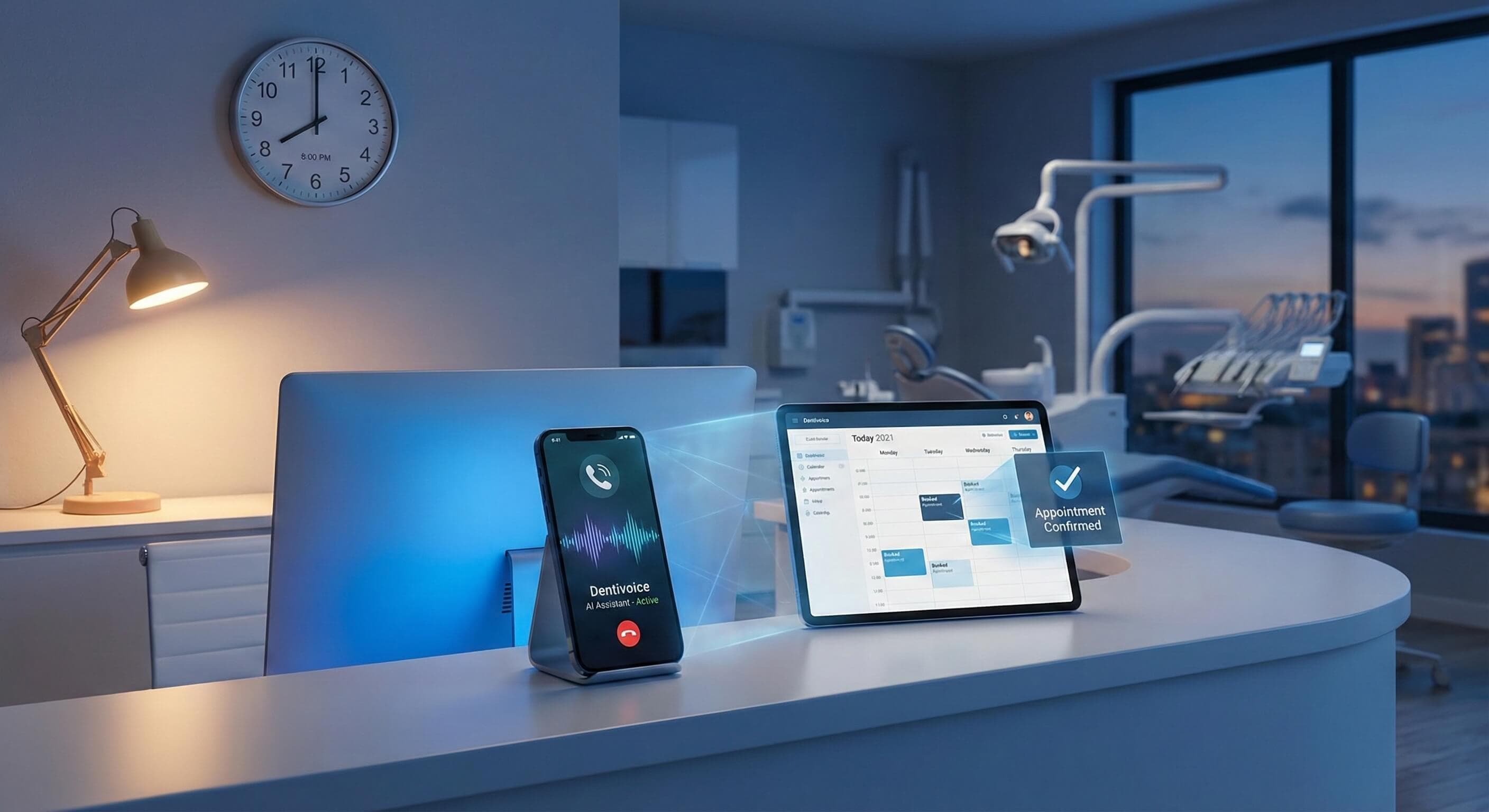
DentiVoice answers every after-hours call the same way your front desk would during business hours, except it never goes home. When a patient calls after 5 PM, DentiVoice:
Answers immediately. No voicemail, no hold music, no "please call back during business hours." The patient reaches a live AI receptionist trained on dental terminology.
Book the appointment in real time. DentiVoice checks your PMS (Dentrix, Eaglesoft, Open Dental, or Curve) for live schedule availability, offers time slots, and confirms the booking. The patient hangs up with a confirmed appointment and a text confirmation.
Tags the marketing source. If the call came from a Google Ad at 8:47 PM, DentiVoice logs it: "Google Ads, implant campaign, keyword: dental implant consultation [city]." That attribution follows the patient from call to appointment to revenue, so you know exactly which campaigns are producing after-hours results.
Handles non-scheduling calls too. Questions about insurance acceptance, office hours, location, or parking? DentiVoice answers them. The caller gets the information they need to decide, and many of those informational calls convert to bookings on the spot.
Flag emergencies for your team. If a patient describes a broken tooth, severe pain, or post-surgical complication, DentiVoice doesn't try to handle it clinically. It takes detailed notes and flags for an urgent callback, so your on-call team can prioritize real emergencies without wading through routine scheduling voicemails.
The Before and After
Here's what the numbers look like for a practice receiving 250 calls/month, before and after DentiVoice:
| Metric | Before DentiVoice | With DentiVoice |
|---|---|---|
| After-hours calls answered | 0 | 75 |
| After-hours new patient calls captured | 0 | 30 |
| After-hours appointments booked | 0 | 18 |
| After-hours new patient revenue/month | $0 | $16,200 |
| After-hours new patient revenue/year | $0 | $194,400 |
No additional marketing spend. No extended office hours. No on-call dentist. Just an AI receptionist that answers the phone after 5 PM and books the appointments your marketing already paid to generate.
"Practice owners look at the after-hours booking numbers in their first month and their reaction is always the same," says Jordan, DentalBase's Head of Sales. "They can't believe these patients were calling all along and nobody was picking up."
Comparing AI receptionist options?
Download the free AI Dental Receptionist Buyers Guide.
What Changes When You Can See the Data
Once DentiVoice is running after hours, the DentalBase dashboard shows you something you've never had before: a complete picture of when patients call and what they want.
You'll see which campaigns produce after-hours calls. If your implant campaign generates 60% of its calls after 5 PM while your cleaning campaign generates most calls during business hours, that changes how you schedule ad delivery and allocate budget.
You'll see what time windows produce the most bookings. Maybe your 6 to 8 PM calls convert at a higher rate than your 8 to 10 PM calls. That tells you something about patient intent at different times, and it informs when to run your heaviest ad spend.
You'll discover demand you never knew existed. Most practices have no idea how many calls come in on Saturday mornings or Sunday evenings because those calls went straight to voicemail and 86% left no trace. DentiVoice makes the invisible visible.
This data doesn't just recover after-hours revenue. It makes your entire marketing operation smarter because you can finally see the full picture of when and how patients respond to your campaigns.
Your Marketing Runs 24/7. Now Your Phone Does Too.
The after-hours revenue problem isn't about emergency dentistry. It's about phone coverage.
Your marketing generates demand around the clock. Patients search in the evening, browse on weekends, and call when they're ready, not when your office happens to be open. Every one of those calls represents a patient you paid to attract. When those calls go to voicemail, the money you spent to generate them is wasted.
DentiVoice closes the gap. It answers after-hours calls, books appointments into your live PMS schedule, tags the marketing source, and gives you a dashboard that shows the full picture of patient demand. No extended office hours. No on-call staff. No voicemail. Just the revenue your practice was already earning but never capturing.
Ready to capture your after-hours revenue?Book a free DentalBase demo.
Frequently Asked Questions
After-hours revenue in healthcare refers to income generated from patient care services provided outside standard business hours, typically evenings, weekends, and holidays. This includes urgent care visits, telehealth consultations, emergency calls, and extended appointment slots. Many practices miss this revenue opportunity by not offering services when patients need them most, leading to lost income and patients seeking care elsewhere.
Practices can lose 15-25% of potential revenue by not offering after-hours services. A typical family practice might miss $150,000-$300,000 annually in after-hours revenue. Emergency visits that could be handled in-office generate $200-$400 per visit, while urgent care centers capture this revenue instead. The exact amount varies by practice size, patient demographics, and local healthcare market competition.
After-hours care must comply with the same healthcare regulations as regular hours, including HIPAA privacy requirements, state licensing laws, and Medicare/Medicaid billing standards. Telemedicine after-hours care has additional state-specific regulations regarding cross-state practice and prescription protocols. Practices must ensure proper documentation, secure communication platforms, and appropriate medical supervision even during extended hours to maintain compliance.
Practices can use several technologies to capture after-hours revenue. AI-powered answering services can screen calls, answer basic questions, and schedule urgent appointments. Teledentistry platforms allow for virtual emergency consultations, which can be billed. Secure patient communication portals also let patients send messages and photos, allowing dentists to triage issues remotely and determine if an in-person visit is necessary.
To prevent staff burnout, practices can implement a rotating on-call schedule shared among dentists, ensuring no single person is always responsible. Another strategy is to partner with a third-party teledentistry service or a specialized dental answering service to handle initial patient contact. This filters non-urgent calls and provides professional triage, so dentists are only contacted for true emergencies. Offering premium pay or time-in-lieu for on-call hours also helps compensate staff fairly.
Was this article helpful?
Written by
DentalBase Team
The DentalBase Team is a collective of dental marketing experts, AI developers, and practice management consultants dedicated to helping dental practices thrive in the digital age.