
AI Medical Receptionist: How It Works in 2026
An AI medical receptionist answers patient calls, books appointments, and handles inquiries 24/7. Here is how it works and what to evaluate in 2026.
Share:
Table of contents
An AI medical receptionist answers patient calls, books appointments, and handles routine questions around the clock. For practices losing patients to unanswered phones, it's a direct fix for a measurable problem.
How measurable? ADA data shows that 38% of new patient calls go unanswered during business hours. And 80% of callers who reach voicemail don't leave a message and won't try again. Each of those missed calls represents $1,200 or more in patient lifetime value, according to Dental Economics. That's not a rounding error. That's revenue walking out the door every week.
This article explains how AI medical receptionist technology actually works, which types of platforms are worth evaluating in 2026, what they cost, and the specific features that separate useful tools from expensive experiments.
What Is an AI Medical Receptionist?
An AI medical receptionist is software that answers patient phone calls using conversational artificial intelligence. It handles scheduling, answers common questions, captures new patient information, and triages urgent calls, all operating 24/7 without hold times or voicemail.
Think of it as a layer between your patients and your front desk. Not a replacement. A filter. The AI picks up routine calls that would otherwise stack during peak hours, freeing your staff to handle patients who are standing right in front of them.
This isn't an interactive voice response system that forces callers through a phone tree. Modern AI receptionists use natural language processing to have actual conversations. A patient can say "I need to reschedule my cleaning next Thursday" and the system understands the intent, checks the schedule, and offers alternatives. No button pressing. No "press 1 for appointments."
It also isn't a traditional answering service where human agents read from scripts. Those services cost more per call, operate on limited hours, and can't access your practice management system in real time. An AI receptionist connects directly to platforms like Dentrix and Open Dental, booking appointments while the patient is still on the line.
Dental Economics reports that the average practice misses 15-20 calls per week. At $1,200 or more in lifetime value per missed new patient, the math adds up fast. That's the gap this technology was built to close.
Every Missed Call Is a Missed Patient
See how an AI receptionist answers calls, books appointments, and captures new patients around the clock.
Explore AI Reception →How Does an AI Receptionist Handle Patient Calls?
The AI answers incoming calls within one or two rings, greets the patient by name if their number is on file, identifies what they need through natural conversation, and either resolves the request or routes it to a staff member with full context.
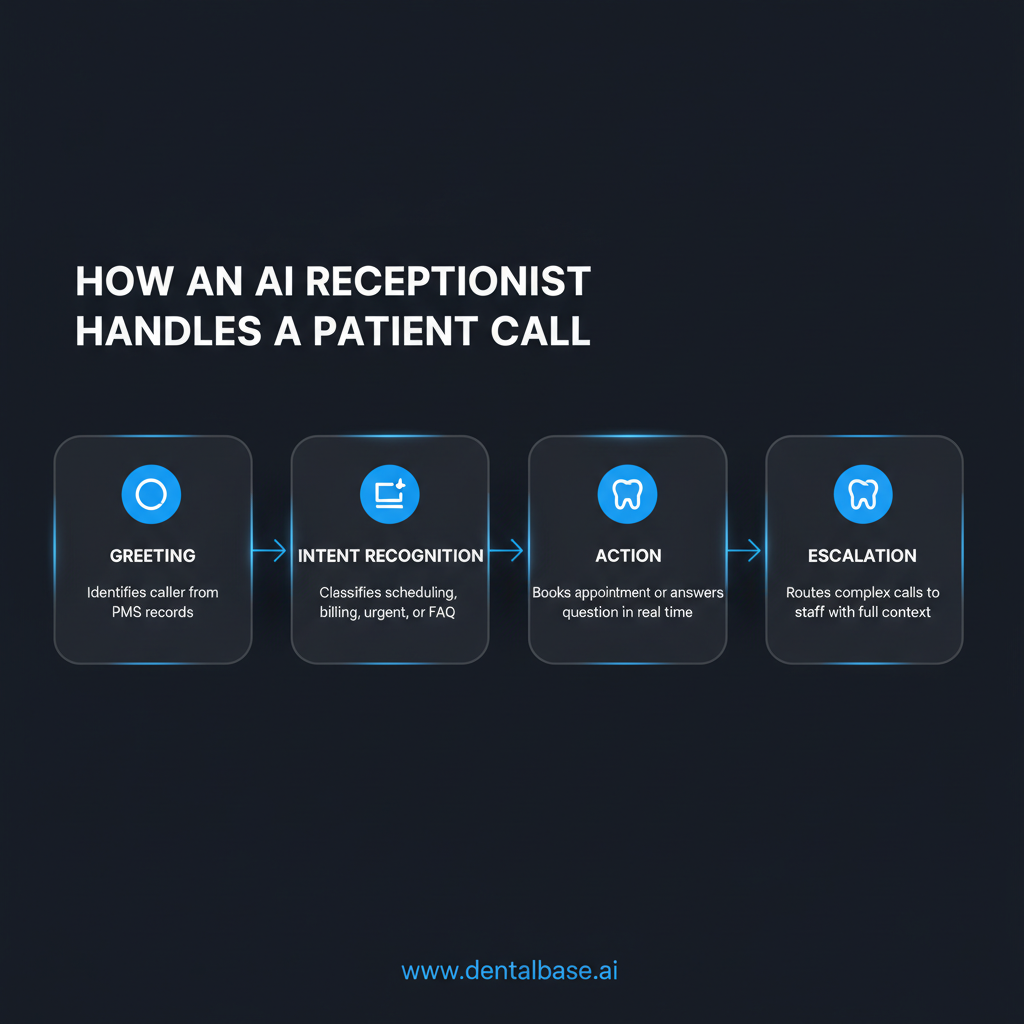
Step 1: Greeting and Identification
The system picks up and delivers a natural greeting customized to your practice. If the caller's number matches a patient record in your PMS, the AI already knows who's calling. "Hi Sarah, thanks for calling. How can I help you today?" No hold music. No menu tree.
Step 2: Intent Recognition
The patient states their reason for calling. The AI uses natural language understanding to classify the intent: scheduling, rescheduling, cancellation, billing question, new patient inquiry, or urgent issue. It doesn't rely on keywords alone. It understands context, phrasing variations, and even mid-sentence corrections.
Step 3: Action
For scheduling requests, the AI checks real-time availability in your practice management system, offers open slots, and confirms the booking. For new patients, it collects name, contact info, insurance details, and reason for visit. For common questions about hours, location, or accepted plans, it responds from a knowledge base you configure. All of this happens in the same call. No callbacks needed.
Step 4: Escalation
When a call falls outside the AI's scope, like a patient describing an emergency or requesting a specific clinical answer, the system routes the call to your team with full context. No cold transfer. Your staff sees what the patient asked before they pick up. That context saves time and avoids the patient repeating themselves.
After-hours calls follow the same flow. The AI books appointments, answers questions, and flags anything that needs morning follow-up. Dental Economics data shows that after-hours calls represent 27% of total patient call volume. That's a quarter of your calls handled without adding a single hour to your payroll.
Related: Want the full breakdown of how DentiVoice handles dental calls? → DentalBase AI Receptionist: Complete Guide
Which AI Receptionist Platforms Lead the Market in 2026?
The market splits into three categories: dental-specific platforms built for dental workflows, multi-specialty platforms designed for broader healthcare, and general AI phone agents that serve any industry. The right choice depends on your practice type and what integrations you need.
Here's how the categories compare:
| Feature | Dental-Specific | Multi-Specialty | General AI Agents |
|---|---|---|---|
| PMS Integration | Native (Dentrix, Open Dental) | EHR/EMR focused | Requires custom setup |
| HIPAA Compliance | Built-in, BAA included | Built-in, BAA included | Varies by vendor |
| Dental Workflow Support | Full (terminology, codes, scheduling) | Partial | Minimal |
| Setup Time | Days | 1-2 weeks | 2-4 weeks |
| Typical Monthly Cost | $300-$1,000 | $500-$1,500 | $200-$800 |
Dental-Specific Platforms
These are purpose-built for dental practices. They integrate with dental PMS systems, understand dental terminology and procedure codes, and handle dental-specific scheduling logic like operatory assignments and provider preferences. DentiVoice is one example, managing inbound calls, outbound follow-up calls, and direct PMS appointment booking.
Multi-Specialty Healthcare Platforms
These serve medical practices across specialties: primary care, dermatology, orthopedics, dental, and more. They're broader in scope but often lack the dental-specific depth of a purpose-built tool. If you run a dental practice, the integration and workflow gaps can slow things down.
General AI Phone Agents
These aren't healthcare-specific. They handle calls for any business type and can be configured for medical use. The tradeoff: less healthcare-specific compliance out of the box, no PMS integration by default, and significantly more setup work.
For dental practices specifically, a dental-specific platform almost always makes more sense. The integration depth and workflow understanding save weeks of configuration and reduce scheduling errors.
Want to See How AI Reception Works for Your Practice?
Get a live walkthrough of how the AI handles calls, books appointments, and integrates with your PMS.
Book a Free Demo →How Much Does an AI Medical Receptionist Cost?
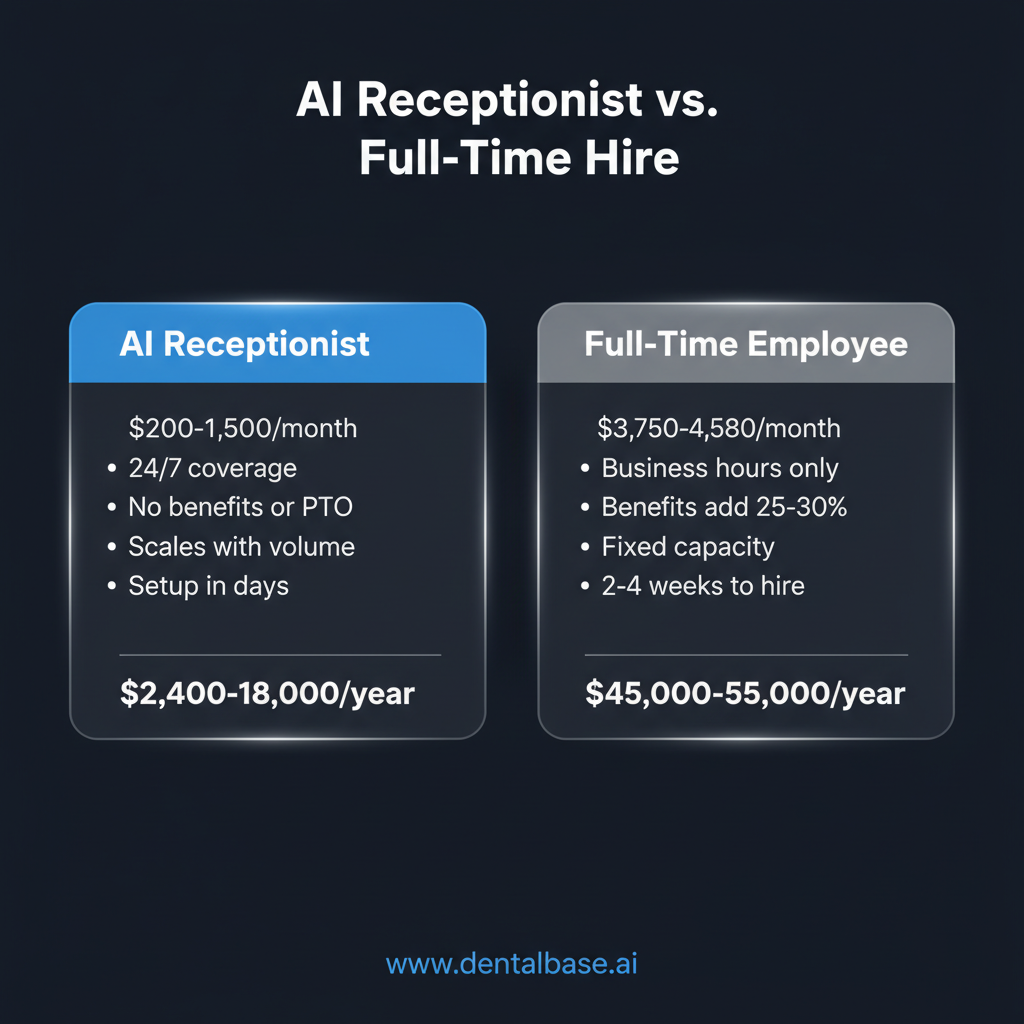
Most AI medical receptionist platforms charge between $200 and $1,500 per month depending on call volume, features, and practice size. That's significantly less than hiring another front desk employee, which runs $45,000-$55,000 per year when you factor in salary, benefits, and overhead.
Pricing models vary across the market:
| Pricing Model | How It Works | Typical Range | Best For |
|---|---|---|---|
| Per-Call | Charged per call handled | $1-$3 per call | Low-volume practices |
| Per-Minute | Charged by talk time | $0.50-$1.50 per minute | Variable call lengths |
| Flat Monthly | Fixed fee regardless of volume | $300-$1,500/month | Predictable budgets |
| Hybrid | Base fee + per-call overage | Varies | Growing practices |
Compare that to staffing costs. According to Bureau of Labor Statistics data, the median annual wage for medical receptionists is around $37,000. Add benefits, training, PTO, and management overhead, and you're looking at $45,000-$55,000 per year. An AI receptionist covers after-hours, weekends, holidays, and lunch breaks. Your staff member doesn't.
But cost isn't just about what you spend. It's about what you recover. If your practice misses 15 calls per week and even 5 of those are new patients, that's $6,000 or more per week in lifetime value walking out the door. A $500/month AI receptionist that captures half of those calls pays for itself many times over.
The practices getting the most value pair the AI with their existing team. AI handles overflow and after-hours. Staff handles everything that requires judgment or presence. That hybrid model stretches your labor budget without sacrificing the patient experience.
What Should You Look for When Choosing a Platform?
The most important factors are practice management system integration, HIPAA compliance, call handling depth, escalation logic, and contract flexibility. A platform that checks these five boxes will handle the majority of your calls reliably from day one.
PMS Integration
This is non-negotiable for dental practices. The AI needs to read and write to your schedule in real time. If it can't check availability and book directly, you're getting a fancy answering machine. Ask which specific PMS platforms are supported and whether the integration is native or runs through a third-party connector.
HIPAA Compliance
Any platform handling patient information needs to be HIPAA compliant. That means encrypted data transmission, secure storage, signed Business Associate Agreements (BAAs), and audit logging. HHS provides detailed HIPAA compliance guidance for technology vendors. Don't take a vendor's word for it. Ask for the BAA and the SOC 2 report.
Call Handling Depth
Some platforms only handle scheduling. Others manage insurance verification, new patient intake, prescription refill requests, and post-visit follow-up calls. Map your most common call types and verify the platform covers them. If 30% of your calls are insurance questions and the AI can't answer those, you haven't actually solved the problem.
Escalation Logic
When the AI can't handle a call, what happens next? Good platforms transfer with full context. Bad ones drop the call or send it to voicemail. Test the escalation path before you sign anything. Call the demo line yourself and try to confuse it. That tells you more than any sales deck.
Reporting and Analytics
You should be able to see call volume by hour, call type distribution, booking rates, escalation rates, and average handle time. This data tells you whether the AI is working and where to adjust. If the platform doesn't offer reporting, move on.
Contract Terms
Avoid long-term contracts until you've run a 30-60 day pilot. Any vendor confident in their product will let you test it before committing to 12 months. Watch for early termination fees and data portability clauses too.
Need Help Evaluating Your Options?
Explore guides, checklists, and comparison tools built for dental practice decision-makers.
Browse Resources →Can an AI Receptionist Replace Your Front Desk Staff?
Not entirely, and it shouldn't try. An AI receptionist handles routine calls at scale, but complex patient interactions, in-person check-ins, insurance disputes, and clinical coordination still need a human. The goal is augmentation, not replacement.
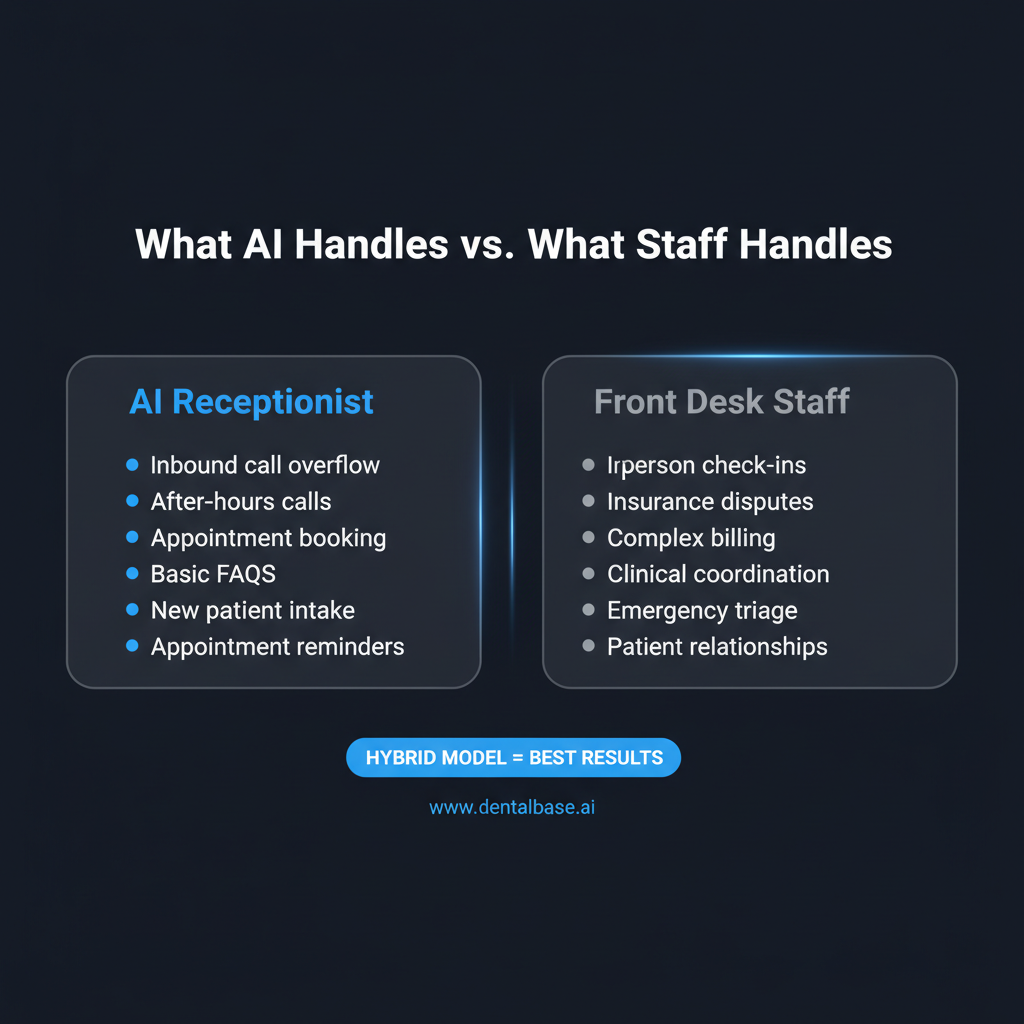
Think about what your front desk actually does. They answer phones, sure. But they also greet patients at the door, verify insurance at the chair, handle billing face to face, coordinate with clinical staff, manage emergencies in real time, and keep the office running. No AI does all of that. Not today.
What AI does well: answering the 15th call that comes in while your team is already juggling three patients at the desk and two on hold. That's the call that goes to voicemail today. That's the new patient who tries the practice down the street instead.
The hybrid model works. AI handles inbound overflow, after-hours calls, appointment reminders, and basic FAQs. Your staff handles everything that requires judgment, empathy, or physical presence. ADA research shows that 72% of patients say convenience is a top factor when choosing a provider. Answering every call, every time, is exactly that.
Practices that adopt this approach report fewer missed calls, lower front desk stress, and more consistent patient experience across hours. The AI isn't competing with your team. It's giving them room to do the parts of their job that genuinely require a human being.
An AI medical receptionist won't fix a broken practice. But if your biggest gap is calls going unanswered while your team is stretched thin, it closes that gap immediately. The technology is mature enough to handle real conversations, book real appointments, and escalate what it can't resolve.
The question isn't whether AI reception works. It does. The question is which platform fits your practice, your PMS, and your patient volume. Start with a 30-day pilot alongside your current staff. Measure missed calls before and after. The data will make the decision for you.
Ready to Stop Missing Patient Calls?
See how an AI receptionist handles your calls, books appointments, and integrates with your PMS. Live demo, no commitment.
Book a Free Demo →Want to explore more before deciding?
Browse Resources →Sources & References
Frequently Asked Questions
An AI medical receptionist is software that answers patient phone calls using conversational artificial intelligence. It handles appointment scheduling, answers common questions, captures new patient information, and routes urgent calls to staff, all without hold times or voicemail.
Most platforms charge $200-$1,500 per month depending on call volume and features. Pricing models include per-call, per-minute, and flat monthly rates. This is significantly less than hiring a full-time receptionist at $45,000-$55,000 per year.
Reputable platforms are HIPAA compliant with encrypted data, secure storage, and signed Business Associate Agreements. Always ask for the BAA and SOC 2 report before signing. Not all AI phone tools meet healthcare compliance standards.
Yes. Dental-specific platforms integrate with systems like Dentrix and Open Dental to check real-time availability and book appointments during the call. Multi-specialty and general platforms may require additional setup.
No. AI receptionists handle routine calls, after-hours inquiries, and overflow during busy periods. Front desk staff still manage in-person check-ins, complex billing, insurance disputes, and clinical coordination. The hybrid model works best.
When a caller describes an emergency or the AI detects urgency, it transfers the call to your team with full context. Staff sees what the patient asked before picking up. Good platforms never leave an emergency caller in a loop.
Prioritize PMS integration, HIPAA compliance, call handling depth, escalation logic, reporting capabilities, and flexible contract terms. Run a 30-day pilot before committing long-term. Any confident vendor will offer a trial period.
Was this article helpful?
Written by
DentalBase Team
Expert dental industry content from the DentalBase team. We provide insights on practice management, marketing, compliance, and growth strategies for dental professionals.