Zaha AI vs DentalBase (2026): Which Fits Your Practice?
Zaha AI (mConsent) vs DentalBase: which AI dental receptionist fits your practice? Compare features, PMS integration, pricing, and marketing tools.
Share:
Table of contents
Updated May 2026. Refreshed with expanded pricing structure, real-world review patterns, and a side-by-side alternatives table. Voice and pricing details verified against publicly available information; no specific dollar amounts are quoted here because both vendors price modularly.
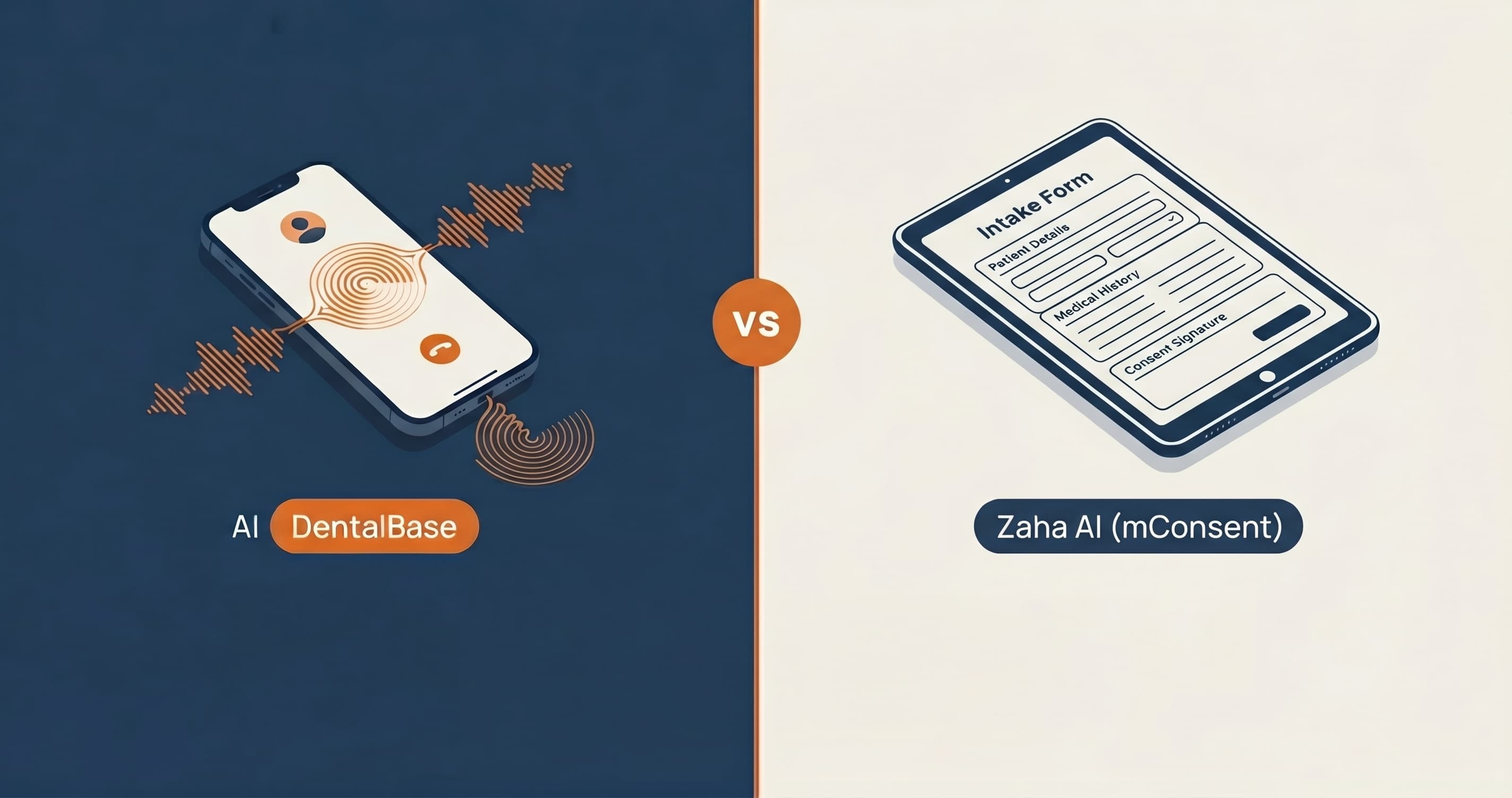
If you are weighing Zaha AI vs DentalBase for your dental practice, you are comparing two platforms that approach AI reception from very different angles. Zaha AI, built by mConsent, started as a digital forms and patient intake company and added AI calling features to its existing product. DentalBase built DentiVoice as a dental-specific AI receptionist from the ground up, paired with a full marketing platform. This article walks through the practical differences so you can decide which one fits your workflow.
The stakes are not small. According to Dental Economics, the average dental practice misses 15-20 calls per week, and each missed new patient call costs $1,200+ in lifetime value. Both platforms promise to fix that. But the features behind the promise, and what you get beyond call answering, vary significantly between Zaha AI vs DentalBase.
Zaha AI vs DentalBase: Side-by-Side Summary
| Feature | DentalBase (DentiVoice) | Zaha AI (mConsent) |
|---|---|---|
| Primary product focus | AI receptionist + dental marketing platform | Patient intake forms + AI calling add-on |
| Inbound AI calls | Yes, 24/7 with dental-specific triage | Yes, 24/7 |
| Outbound AI calls | Yes (reactivation, recall, follow-up) | Limited |
| Real-time PMS booking | Yes (Dentrix, Open Dental, Eaglesoft, Curve) | PMS integration focused on forms/intake |
| Digital patient intake forms | Not a primary feature | Yes, core product strength |
| Marketing services | SEO, PPC, social media, websites, reputation | No |
| Call-level marketing attribution | Yes | No |
| Treatment plan presentation | No | Yes, core product strength |
| Pricing model | Bundled (AI reception + marketing in one subscription) | Modular (mConsent base + Zaha AI add-on) |
What Are the Core Differences Between DentalBase and Zaha AI?
DentalBase is an AI-powered dental marketing and patient communication platform. Its AI receptionist, DentiVoice, handles inbound and outbound calls, books directly into your PMS, and ties every call back to the marketing campaign that generated it. Zaha AI is an add-on product within mConsent's patient engagement suite, which centers on digital forms, treatment consent, and patient intake workflows.
That origin story matters more than you'd think. mConsent built its reputation on paperless intake forms, insurance verification, and treatment plan presentations. Zaha AI extends that product into phone handling and appointment booking. But the core platform was not designed around phone conversations or marketing attribution. It was designed around in-office patient workflows.
DentalBase took the opposite path. The platform was built to answer one question: what happens between a patient seeing your ad and sitting in your chair? DentiVoice handles 24/7 inbound calls, runs outbound campaigns for patient reactivation, missed appointment follow-up, and recall reminders, and reports which marketing channel drove each booked appointment. That is a fundamentally different product scope than an intake platform that added a phone feature.
DentalBase vs Zaha AI: Pros and Cons
| DentalBase (DentiVoice) | Zaha AI (mConsent) |
|---|---|
Strengths
| Strengths
|
See How DentiVoice Handles Real Dental Calls
DentiVoice answers, books, reschedules, and follows up with patients automatically, all connected to your PMS.
Learn About DentiVoice →How Does Call Handling Compare Between DentalBase and Zaha AI?
DentiVoice is purpose-built for dental phone conversations, handling everything from insurance questions to emergency triage to multi-provider scheduling. Zaha AI offers AI-powered call answering as part of mConsent's broader patient engagement tools, with a focus on appointment booking and basic call routing.
The depth of call handling is where the gap between these two platforms shows up most clearly. DentiVoice does not just answer and book. It understands dental-specific scenarios. A patient calling about a broken crown at 9 PM gets triaged as potentially urgent, while a whitening inquiry gets scheduled for a consultation during normal hours. That clinical context comes from training exclusively on dental call data, not from bolting a general-purpose AI onto an existing forms product.
Outbound calling is another area where the platforms diverge. DentiVoice proactively calls patients who missed appointments, have not visited in over a year, or are due for recall. That is a revenue recovery engine running in the background without your front desk making a single dial. Zaha AI's strengths lean toward the intake side: sending digital forms before appointments, collecting insurance info, and presenting treatment plans. Useful features, but they do not recover lapsed patients or fill empty chair time the way outbound AI calls do.
After-Hours Performance
After-hours calls represent 27% of total patient call volume, and both platforms can answer outside business hours. But DentiVoice books appointments directly into your PMS during those after-hours calls, so your morning schedule is accurate before your team walks in. If the competing platform captures a lead that your staff needs to manually process the next day, you have introduced a delay where that patient might call somewhere else. Calls that go to voicemail rarely come back.
Which Platform Offers Better PMS and Software Integrations?
DentalBase integrates with Dentrix, Open Dental, Eaglesoft, and Curve Dental for real-time appointment booking. mConsent's platform also connects with major dental PMS systems, primarily through its forms and intake workflow rather than voice-initiated scheduling.
Here's the thing. PMS integration means different things depending on what is being integrated. mConsent's integration strength is forms: pushing completed patient intake forms, insurance cards, and consent documents into your PMS before the patient arrives. That is genuinely valuable for reducing front desk paperwork. But it is a different integration than what DentiVoice does, which is reading your live schedule during a phone call, finding the next available slot with the right provider, and writing the appointment directly into the system.
Real-time write-back during calls is the detail that separates an AI receptionist from a lead capture tool. When a patient calls at 7:30 PM and DentiVoice books them for a 10 AM cleaning, that appointment exists in Dentrix or Open Dental within seconds. No morning reconciliation. No double-bookings. No manual entry by your staff. For a fuller picture of what dental front desk software actually does day to day, see this overview of dental receptionist duties AI can handle.
Does DentalBase vs Zaha AI Give You Marketing Attribution?
DentalBase connects every patient call to the marketing channel that generated it, whether it came from a Google Ads click, an organic search, a social media post, or a direct referral. Zaha AI does not offer marketing attribution because mConsent is a patient engagement platform, not a marketing platform.
This is the most consequential difference for practices that spend on advertising. Picture a two-provider office investing $3,500 per month in Google Ads and another $1,500 in SEO. Without call-level attribution, you can see clicks and maybe total call volume. But you cannot trace which calls became booked appointments and which campaigns produced them. You are making $5,000 monthly decisions based on incomplete data.
DentalBase closes that loop. You can see that your "emergency dentist near me" keyword generated 9 calls this month, DentiVoice answered all 9, and 6 became same-day appointments. Now you know exactly what that keyword is worth and whether to increase the bid. According to ADA Practice Transitions, 38% of new patient calls go unanswered during business hours. If your marketing reports do not show whether those calls were answered and converted, they are only telling half the story.
Why Does Attribution Change Budget Decisions?
Without attribution, most practices rely on the marketing agency's click reports and hope the phone rings. With closed-loop reporting, you can shift budget from channels that generate clicks but not appointments to channels that actually fill chairs. That distinction is worth thousands per month for practices with meaningful ad spend. mConsent and Zaha AI simply do not operate in this space. They handle what happens after the patient contacts you, not what drove the contact in the first place. Compare this approach to other dental analytics platforms for a wider view of how attribution fits into a practice's reporting stack.
Want to See the Full Marketing + AI Reception Stack?
Book a free demo to see how DentiVoice, SEO, PPC, and call attribution work together for your practice.
Book a Free Demo →How Do Patients Experience Each Platform?
Both platforms aim to reduce hold times and catch calls that would otherwise go to voicemail. DentiVoice uses conversational AI trained on dental interactions, so patients talk to an agent that understands dental terminology, insurance questions, and clinical urgency. Zaha AI's phone experience is newer and sits within mConsent's broader patient communication tools.
Patient experience differences show up in edge cases. What happens when someone calls about pain after a root canal? Does the AI recognize that as potentially urgent and route it to an on-call provider, or does it offer a standard booking? DentiVoice is trained to differentiate between clinical urgency levels. A broken tooth at 11 PM gets triaged as a potential same-day emergency, while a whitening inquiry gets a consultation slot during regular hours.
Multilingual support is another consideration. DentiVoice handles conversations in multiple languages, which is increasingly relevant in metro areas where 20-30% of patients may prefer speaking Spanish, Mandarin, or Vietnamese. Mobile is also a factor: Google reports that mobile accounts for 62% of all dental-related searches, which means many of the calls each AI receptionist handles will start from a patient on their phone. Being able to speak with an AI in your preferred language is a real convenience differentiator that affects whether a new patient books or calls the next practice on the list.
How Much Does Zaha AI Cost Compared to DentalBase?
Neither Zaha AI nor DentalBase publishes a flat price list, so direct dollar comparisons are not possible without a quote from each vendor. The difference shows up in how each platform structures pricing, not in a single number.
Zaha AI is sold as an add-on inside the mConsent ecosystem. mConsent prices modularly: the base intake and consent platform is one line item, and Zaha AI sits on top of it as additional cost. Your total subscription depends on how many mConsent modules you bundle (digital forms, insurance verification, treatment plan presentation, Zaha AI calling) and your practice size. Single-location offices pay less than multi-location groups, and not every mConsent customer needs the AI calling layer.
DentalBase prices as a bundled platform. The subscription includes DentiVoice AI reception plus marketing services (SEO, PPC, social media, website, reputation management) and the underlying attribution platform that ties everything together. Total monthly cost is higher than a standalone AI phone tool, but it replaces separate line items for marketing agency, AI receptionist, and call tracking software. For practices currently paying three or four vendors, the bundled model is sometimes lower in total spend than the visible per-vendor list would suggest.
The honest framing: if you want only AI phone coverage and already have a marketing setup that works, Zaha AI plus a standalone marketing vendor may be cheaper on a sticker basis. If you are evaluating multiple marketing tools and an AI receptionist at the same time, the bundled approach is usually worth pricing out before committing to separate contracts. For context on how vendors structure pricing across the broader category, this dental pricing review walks through a similar evaluation.
What Do Real Practices Say About Zaha AI vs DentalBase?
Both platforms have customer testimonials on their own websites, but practice owners evaluating either tool should look beyond marketing pages. Independent review patterns and conversations with current users reveal more about day-to-day performance than vendor case studies.
For Zaha AI, the recurring praise centers on intake workflow efficiency: paperless forms cutting front desk paperwork, insurance verification before the visit, and treatment plan presentations that patients can review on a tablet. These are the strengths of mConsent's original product, and the integration with Zaha's AI calling reinforces that workflow. The trade-off practices mention is that Zaha's conversational quality on phone calls is newer relative to dental-specific AI receptionists that focused exclusively on voice from day one. Some users report calls that feel less natural during complex insurance or scheduling exchanges.
For DentalBase, the recurring praise centers on the consolidation of marketing and AI reception under one vendor with attribution between them. Practices mention seeing for the first time which marketing channels actually produce booked appointments, and the outbound recall engine bringing back inactive patients. The trade-off practices mention is that the bundled model is not the right fit for offices that already have a marketing team or agency they want to keep and only need a phone tool. For more on what to watch for when evaluating any AI receptionist, see this checklist of seven questions to ask in an AI dental receptionist demo. According to BrightLocal's Local Consumer Review Survey, 98% of people read local reviews before choosing a business, so spending time on third-party review patterns rather than vendor-curated case studies is worth the effort.
Which Zaha AI Alternatives Should You Consider?
Zaha AI and DentalBase are not the only options. If you are still weighing decisions, three other AI dental receptionist platforms come up most often in practice owner conversations: Arini, Weave, and TrueLark. Each fits a different practice profile.
Arini is a dental-specific AI receptionist with deep PMS integrations and strong inbound call handling. It is often compared head-to-head with DentiVoice on voice quality and clinical context. Like Zaha AI, Arini focuses on call handling rather than marketing, so practices choosing between Arini and DentalBase are usually deciding between a focused phone tool and a bundled marketing-plus-reception platform.
Weave is a broader patient communication platform that added AI calling to its existing texting, phone, and review tools. Weave's strengths are in patient communication breadth (SMS reminders, payments, reviews); its AI receptionist capabilities are newer. Practices that already use Weave for messaging sometimes add Zaha-style AI calling rather than switch platforms. For practices reconsidering Weave specifically, this guide on Weave alternatives for dental practices covers the broader landscape.
TrueLark is an enterprise-tier AI receptionist designed for multi-location groups and DSOs. Pricing is custom and contracts are typically annual. Single-location practices usually find TrueLark heavier than they need; DSO operators sometimes prefer it for the consolidated reporting across sites.
The pattern across all five (DentalBase, Zaha AI, Arini, Weave, TrueLark) is that each one optimizes for a different bottleneck. There is no single correct answer; there is the correct answer for your specific practice, which depends on what you are trying to fix first. If your bottleneck is paperwork and intake, Zaha AI fits. If it is missed calls and marketing waste, DentalBase fits. If it is voice quality alone in a single-location office, Arini may fit. If it is broader patient communication and you already use SMS heavily, Weave fits. If it is multi-location consolidation, TrueLark fits.
One trend worth noting as you compare: AI search itself is changing how dental tools get evaluated. According to Search Engine Land, AI Overviews now appear in over 60% of all Google searches. That means a patient researching "AI receptionist for my dental practice" may see an AI-generated summary before ever clicking a vendor's site. Vendors that publish detailed comparison content (like this article) tend to surface in those summaries; vendors that rely on gated case studies often do not. The platform you pick will be evaluated by patients and prospective hires through this lens too.
Which Platform Should Your Practice Choose?
The Zaha AI vs DentalBase decision depends on what problem you are primarily trying to solve. If your biggest pain point is in-office paperwork, treatment plan presentations, and patient intake efficiency, mConsent's core product addresses that directly. If your biggest problem is missed calls, disconnected marketing spend, and inactive patients who have not been contacted in months, DentalBase solves all three with one platform.
Most practices need both categories of tools eventually. But they rarely need them from the same vendor, and the order you tackle them matters. A practice that is missing 15-20 calls per week and spending $4,000 on Google Ads with no attribution is losing more revenue from unanswered phones than from slow patient intake. Fix the bigger leak first.
Choosing the Right Fit by Practice Type
| If your practice looks like this | The closer fit is |
|---|---|
| Going fully paperless. Biggest leak is intake forms, insurance verification, and consent paperwork at the front desk. | Zaha AI (mConsent) |
| Spending meaningfully on ads (Google, Meta, SEO) but cannot tell which channels produce booked appointments. | DentalBase |
| Missing 15+ calls per week, especially after hours, and the front desk is over capacity during the day. | DentalBase |
| Sitting on a large inactive patient list (more than 200 patients overdue for recall) that nobody has time to call. | DentalBase |
| Treatment plan acceptance is the bottleneck; patients leave the office without committing. | Zaha AI (mConsent) |
| Multi-location group or DSO that wants standardized AI reception and consolidated reporting across offices. | DentalBase (or TrueLark for enterprise scope) |
For multi-location groups and DSOs, DentalBase's consolidated model is particularly relevant. Standardizing AI call handling and marketing attribution across all locations means you can benchmark performance, compare cost per acquisition, and identify which offices need operational support. You cannot do that when call handling, marketing, and patient engagement tools are all from different vendors with separate dashboards.
This comparison really comes down to scope. mConsent built a strong intake product and added AI calling. DentalBase built an AI receptionist inside a marketing platform that generates demand and measures results. Most dental marketing companies drive leads but do not manage the phone. Most patient engagement tools manage the phone but do not drive demand. DentalBase does both, and for practices that want one vendor handling the full patient acquisition cycle, that is the key differentiator.
See How DentalBase Drives and Answers Patient Calls
Book a free demo to see DentiVoice, marketing attribution, and outbound campaigns working together for your practice.
Book a Free Demo →Sources & References
- Dental Economics: Missed Call and Practice Operations Data
- ADA Practice Transitions: Patient Call Statistics
- BrightLocal: Local Consumer Review Survey
- DentalBase: AI Dental Receptionist 100+ Front Desk Tasks
- DentalBase: Dental Analytics Platforms Compared
- DentalBase: AI Dental Receptionist Demo Questions
- DentalBase: Weave Alternatives for Dental Practices
Frequently Asked Questions
Zaha AI is the AI calling feature built by mConsent, a dental patient engagement company known for digital intake forms, insurance verification, and treatment plan presentations. Zaha AI extends mConsent's platform into phone-based appointment booking and call handling.
Zaha AI is sold as an add-on to mConsent's core intake and consent platform. mConsent prices modularly, so your monthly cost depends on which modules you bundle (digital forms, insurance verification, treatment plan presentation, Zaha AI calling) and your practice size. Neither vendor publishes a flat price list, so a quote is the only way to get a real number.
Yes. mConsent integrates with major dental PMS systems including Dentrix and Open Dental, primarily for forms and intake workflows. DentalBase also integrates with Dentrix and Open Dental, with the difference being that DentiVoice writes appointments back into the PMS in real time during a phone call.
DentalBase's DentiVoice handles outbound calls for missed appointment follow-up, patient reactivation, post-treatment check-ins, and recall reminders. Zaha AI's outbound calling capabilities are limited compared to its inbound and intake-focused features.
Yes. DentalBase provides call-level marketing attribution that traces each patient call back to the specific Google Ad, organic keyword, social post, or referral source that generated it. This lets you measure cost per booked appointment by channel. Zaha AI does not offer this.
No. Zaha AI and mConsent focus on patient engagement tools including digital forms, treatment consent, and AI call answering. Marketing services like SEO, PPC, social media management, and reputation management are not part of the mConsent platform.
mConsent is stronger for in-office paperwork reduction because its core product handles digital patient intake forms, insurance card capture, and treatment plan presentations. DentalBase focuses on phone-based AI reception and marketing, not in-office intake workflows.
Yes. DentiVoice is trained to triage dental emergencies by urgency level. A patient calling about a broken tooth at 11 PM gets flagged as potentially urgent and routed appropriately, while routine inquiries are scheduled for normal business hours.
Aside from DentalBase, the most commonly evaluated alternatives are Arini (dental-focused AI receptionist with strong voice quality), Weave (broader patient communication platform with newer AI calling), and TrueLark (enterprise-tier AI receptionist for DSOs and multi-location groups). Each fits a different practice profile.
Zaha AI makes the most sense for small practices that already want mConsent's intake forms and consent tools and would benefit from AI call coverage as an extension of that workflow. Small practices whose primary problem is missed calls or marketing waste tend to get more value from a dedicated AI receptionist or a bundled marketing platform.
Arini and Weave both compete more directly with the AI calling side of Zaha AI. Arini is a dental-specific AI receptionist focused exclusively on voice. Weave is a broader patient communication platform whose AI calling is newer than its texting and reminder tools. Zaha AI differs from both in that it lives inside an intake forms and consent management platform.
Both platforms log AI-handled calls. DentalBase pairs call logs with marketing attribution data so you can see which channel generated each call alongside the transcript. Zaha AI logs calls within the mConsent dashboard alongside the intake forms and consent records for each patient.
Was this article helpful?
Written by
Dentalbase Team
The Dentalbase Team is a collective of dental marketing experts, AI developers, and practice management consultants dedicated to helping dental practices thrive in the digital age.