What Happens When Phone, Marketing, and AI Share One Brain (2026)
See what changes when your dental practice phone, marketing, and AI receptionist share one patient timeline. Four real scenarios showing the difference.
Share:
Table of contents
A patient clicks your Facebook ad for a $99 cleaning special. Fills out a form with her name, phone number, and insurance carrier. Within a minute, DentiVoice calls her back. It already knows the promotion she clicked. It already knows the insurance carrier she entered. It confirms the offer, books the correct appointment type at the $99 rate, and sends a text confirmation. She hasn't repeated a single piece of information.
Two days later, she calls to reschedule. DentiVoice recognizes her number, surfaces her full history, and says: "I can see you have a cleaning scheduled for Thursday under the $99 special. Would you like to find a new time?" Reschedule done in two minutes. No hold music. No "what promotion were you under?"
This is what happens when every tool in your practice shares the same patient context. Most practices run phone, marketing, scheduling, and patient records as separate systems. Each one knows a fragment of the patient. None of them talk to each other. The result: repeated questions, wrong appointment types, attribution that disappears at booking, and follow-ups that depend on someone remembering to check the right app.
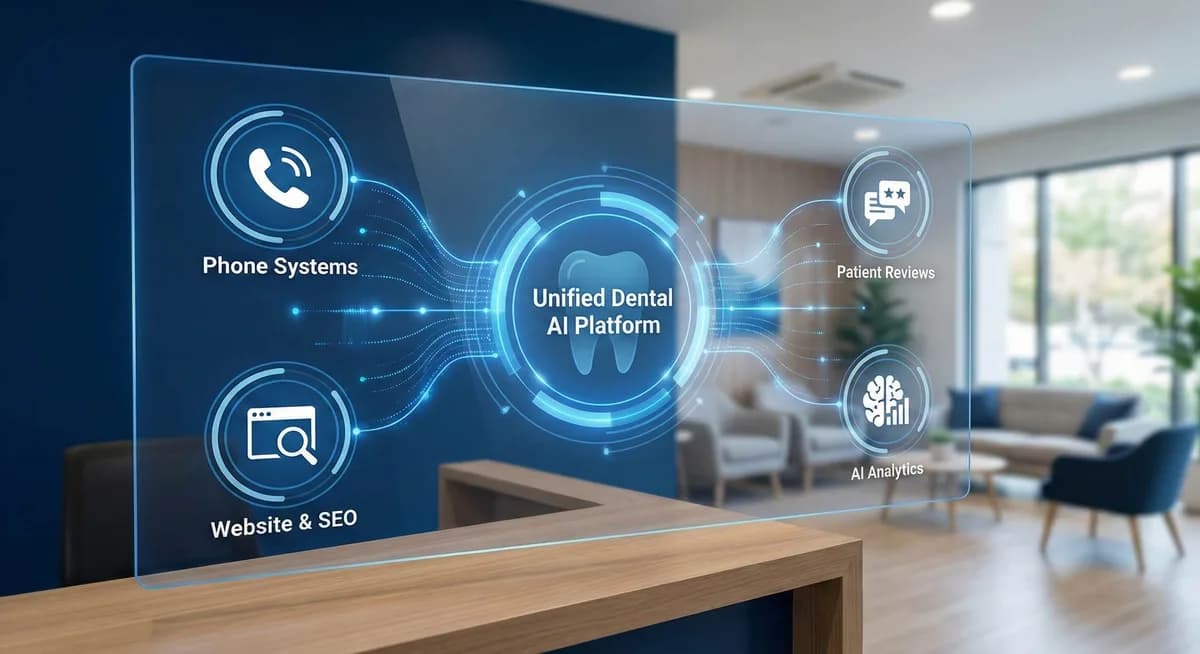
DentalBase is built on a different architecture. One patient timeline that every channel reads from and writes to. We call it the Shared Brain.
What Does the Shared Brain in a Dental AI Platform Track?
The Shared Brain is a single, centralized context layer that maintains one continuously updated patient timeline across every channel. It tracks five things:
These five data objects are what make everything below possible. Without all five shared in real time, each scenario reverts to its disconnected version.
Jordan, DentalBase's Head of Sales, puts it simply: "Every practice has the same data. The difference is whether it's in five places that don't talk to each other or one place that does. That's the entire product."
See the Shared Brain in action
Book a free demo and we'll show you how one patient timeline changes everything from ad click to booked appointment.
Book a Free Demo →Scenario 1: The Ad Click That Becomes a Booked Appointment
Your patient clicks a Facebook ad for a $99 cleaning special. She fills out the landing page form with her name, phone, and insurance carrier.
Disconnected Stack
Form lands in a CRM. Staff sees it tomorrow morning. By then, she may have called other practices. Even if they reach her, they don't know which promotion she clicked. Insurance details are in the form, not visible on the call. They book a standard cleaning at full rate. She arrives and disputes the fee at check-in.
DentalBase (Shared Brain)
DentiVoice calls her back within minutes. It knows she came from the $99 cleaning ad and has her insurance carrier. Confirms the offer, books the correct type and fee, sends a confirmation text. She hasn't repeated anything. Every downstream interaction starts with correct context.
"The number of practices where the front desk doesn't know what ad the patient clicked is almost all of them," says Jordan. "The patient shows up expecting $99 and gets quoted $200. That's not a communication problem. That's a data problem. The information existed. It just wasn't connected."
Scenario 2: The Reschedule That Remembers Everything
Two days later, she calls to reschedule. It's only her second call to the practice.
Disconnected Stack
Staff pulls up her name. "What promotion were you under?" She can't remember. The $99 fee has to be manually verified. Insurance info is in the CRM, not the PMS. Promotional context re-established from scratch every time she calls.
DentalBase (Shared Brain)
DentiVoice recognizes her number instantly. Full timeline surfaces: the Facebook ad, the $99 promo, insurance, original appointment. "I can see you have a cleaning for Thursday under the $99 special. Would you like a new time?" Done in two minutes. PMS updated.
Related: For the full breakdown of what fragmented tools cost your practice in staff time and missed opportunities, see our → Dental Practice Software: Why 6 Disconnected Apps Are Costing You
Scenario 3: The After-Hours Call That Doesn't Stay Missed
A different patient calls at 9:15 PM. He has a toothache and wants to know if anything is available tomorrow morning before 10.
Disconnected Stack
Voicemail. Generic message asks him to call back during business hours. He calls the practice two miles away at 9:16 PM. They answer. Your practice finds the voicemail at 9 AM and calls a number that doesn't pick up.
DentalBase (Shared Brain)
DentiVoice answers immediately. Recognizes active patient. Captures intent: dental discomfort, next-day morning appointment. Checks PMS, proposes an opening, confirms the booking, sends a text. Creates a flagged task for the morning team with symptoms and the booked appointment.
"Practice owners ask me how many after-hours calls they're missing," says Jordan. "I tell them: you don't know, because nobody was there to count them. That's the whole point. DentiVoice makes the invisible visible."
Related: For a complete breakdown of how after-hours calls translate to revenue, see our → Your Ads Run at 9 PM. Your Phone Doesn't.
Scenario 4: The Reactivation That Converts Because It's Specific
A patient had a cleaning and X-rays eight months ago. No appointment since. She's overdue by your recall schedule.
Disconnected Stack
Mass email: "We miss you!" Goes to 600 patients. She deletes it. If she calls, front desk doesn't know what she's due for or which outreach she's responding to. If she books, nobody knows which message drove it.
DentalBase (Shared Brain)
System knows she's due for a cleaning. Message is specific: appointment type, timing, context. When she calls, DentiVoice has her full history. Booking handled in one interaction. Attribution automatic: which message, which campaign, what it produced.
"Generic recall messages get a 2-3% response rate," says Jordan. "Specific messages that reference the patient's actual situation get 8-12%. That's not a copy problem. It's a data problem. You can't write a specific message if you don't have specific data."
See how connected reactivation works
DentalBase combines AI call handling with marketing attribution so every reactivation message connects to a booked outcome.
Explore DentalBase Services →What Breaks in a Dental AI Platform Without the Shared Brain?
| What Breaks | Disconnected Stack | DentalBase (Shared Brain) |
|---|---|---|
| Attribution | Ad click tracked, booking not tied to source | Ad to booking to revenue, attributable by campaign |
| Patient context on return calls | Staff starts from blank slate every time | Full timeline surfaces on every call |
| Appointment type accuracy | Staff guesses or asks, errors show up at check-in | Correct type set at intake, confirmed before arrival |
| Reactivation relevance | Generic message sent to all lapsed patients | Personalized by appointment type and timing |
| After-hours capture | Voicemail, patient calls elsewhere by morning | DentiVoice books in real time, context delivered to morning team |
| Handoff quality | Name and callback number, no context | Who called, why, what was said, what was booked |
Related: See how all 10 AI dental receptionist platforms handle integration and shared data differently. → AI Dental Receptionist Comparison: 10 Platforms (2026)
What Does the Connected Dental AI Platform Look Like Day to Day?
When phone, marketing, and AI share one brain, the daily rhythm changes:
Morning
Front desk opens to a DentiVoice activity log: every after-hours call handled, every appointment booked overnight, flagged items needing human follow-up. No voicemail backlog.
During the Day
Every call starts with context loaded. Staff don't re-ask questions. DentiVoice handles overflow. Everything writes to the same timeline.
End of Day
Dashboard shows today's call volume, answer rate, conversion rate, and which campaigns produced booked appointments. Not next quarter. Today.
End of Month
You know which campaigns to scale, which to cut, and how many patients DentiVoice booked that would have gone to voicemail. Decisions based on data, not guesswork.
"When I show practice owners the end-of-month dashboard for the first time," says Jordan, "the reaction is always the same. They say: I've been spending $4,000 a month on marketing for three years and I've never seen numbers like this. That's not because the numbers didn't exist. It's because no system was connecting them."
Related: Ready to audit your current tools and find consolidation opportunities? Start here. → The Real Price of Your Dental Tech Stack: Owner's Audit Guide
Ready to Connect Your Practice?
Book a free demo. We'll show you how the Shared Brain works with your PMS, your marketing, and your real patient calls.
Book a Free Demo →Explore more guides and tools for dental practice growth.
Browse Resources →Frequently Asked Questions
The Shared Brain is a single patient timeline that every DentalBase channel reads from and writes to in real time. It tracks five things: who the patient is (identity matching across phone, email, and web), what they wanted (booking, cancellation, insurance question), what happened (every call, text, and form submission), where they came from (which campaign or ad), and what should happen next (follow-up tasks and reminders). This shared context is what makes DentiVoice recognize returning callers, book with the correct promotion, and deliver full handoffs to staff.
A CRM stores contact records. The Shared Brain connects live interactions across channels in real time. When a patient calls, DentiVoice doesn't just look up a record. It surfaces the ad they clicked, the form they filled out, the texts they received, and the appointments they've booked or cancelled, all before the first sentence of the call. A CRM might have some of that data, but it's not feeding it to the AI that answers the phone.
No. Your PMS (Dentrix, Eaglesoft, Open Dental, Curve) handles clinical charting, billing, and scheduling. DentalBase layers on top of it, handling the communication, marketing, AI call answering, and attribution that your PMS wasn't built for. DentiVoice writes appointments directly into your PMS via real-time read/write integration.
DentiVoice answers after-hours calls in real time, just like during business hours. It identifies the patient, captures their intent, checks PMS availability, and books the appointment. It sends a confirmation text to the patient and creates a flagged task for the morning team with a summary of the call, symptoms reported, and the appointment that was booked.
Was this article helpful?
Written by
DentalBase Team
The DentalBase Team is a collective of dental marketing experts, AI developers, and practice management consultants dedicated to helping dental practices thrive in the digital age.