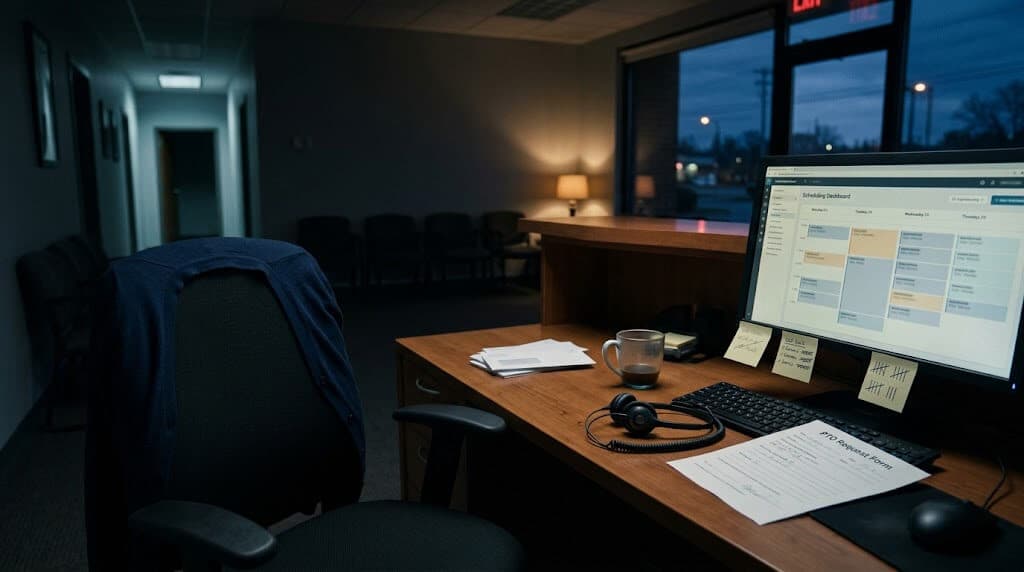
Dental Front Desk Burnout: Spot It and Fix It (2026)
Dental front desk burnout shows up in your numbers before your team. Learn the warning signs, root causes, and the structural fixes that actually work.
Share:
Table of contents
You can usually see it before anyone says it. The veteran front-desk coordinator who used to greet every patient by name now stares at the monitor when they walk in. Voicemails sit unreturned for days. Insurance verifications pile up. The phone rings five times before someone grabs it, sometimes more. That pattern has a name: dental front desk burnout, and it's costing your practice more than you think.
Most owners catch it too late, after the resignation email, after a bad Google review mentions long hold times, after the schedule has visible holes. The symptoms are predictable if you know what to look for. The fix is rarely "give them a vacation."
This article walks through what dental front desk burnout actually looks like in a practice, why it happens, the leading indicators that show up in your numbers before they show up in your team, and the structural changes that work. Hint: more pep talks aren't on the list.
What Is Dental Front Desk Burnout, Exactly?
Dental front desk burnout is chronic emotional and physical exhaustion in front-office staff caused by sustained call volume, multitasking pressure, and unmanaged conflict between patient demands and clinical scheduling. It's not a bad mood. It's a measurable productivity collapse that shows up in answered call rate, booking conversion, and turnover within 6-12 weeks of onset.
The clinical definition matters because owners often dismiss the early signs as "she's just having a rough week" or "they need to push through." Burnout, as defined by the World Health Organization in ICD-11, is an occupational syndrome with three dimensions: exhaustion, cynicism, and reduced professional efficacy. All three show up at the front desk in specific, observable ways.
And here's the part most owners miss. Front-desk burnout isn't an HR issue. It's an operations issue dressed up as an HR issue. The real cause is almost always a workflow problem: too many calls per person, too few decision-making boundaries, no buffer for the unexpected. Fix the workflow and the people get better. Fix the people and you'll be hiring again in 14 months. Dental Economics put the all-in turnover cost at 30-50% of annual salary, which is why this matters financially, not just culturally.
What Are the Warning Signs of Front Desk Burnout?
The warning signs of front-desk burnout cluster into three groups: behavior changes (shorter conversations, less eye contact, flat tone on calls), output drops (more voicemails, slower verifications, missed recall outreach), and physical tells (frequent sick days, late arrivals, longer bathroom breaks). When two or more groups show up in the same week, you have a burnout problem, not a personality problem.
Most owners only notice the late-stage tells. By the time a coordinator is calling out sick on Mondays or visibly snapping at patients, you've missed the early window where intervention is cheap. The leading indicators are quieter and they show up in the data first.
⚠️ THE EARLY-WARNING DASHBOARD
If three or more of these are trending the wrong way for two weeks straight, your front desk is in stage 1 burnout. Pull the data this week and look:
You don't need fancy software to track these. A weekly tally on a whiteboard works. The point isn't precision. The point is making the invisible visible before someone quits or a patient writes the review that costs you ten new patients.
Why Does Burnout Happen at the Dental Front Desk Specifically?
Front desk burnout happens because the role compounds three pressures most jobs only have one of: high-volume customer service (live calls), regulated administrative work (insurance and HIPAA), and emotional labor (managing patient anxiety and pain). When call volume rises, all three get squeezed simultaneously. There is no slow lane to retreat into.

A typical dental front-desk coordinator handles 80-120 patient interactions per shift across phone, in-person, and digital channels. 38% of new patient calls go unanswered at the average practice during business hours, which doesn't mean the team isn't trying. It means the math doesn't work. BLS data on receptionist roles shows median tenure under two years across the broader category, and dental specifically tends to run shorter when the workflow stays broken. Two human ears and ten human fingers cannot cover six rings, two patients at the counter, and an insurance hold all at once.
Three structural pressures drive almost every case of front-desk burnout we see:
Concurrent demands
Phone, in-person check-in, and clinical interruptions all compete for the same person at the same second. Task-switching cost compounds.
No off-ramp
Manufacturing has a takt time. Restaurants have a slow hour. The dental front desk has none of that. Calls and walk-ins keep arriving regardless.
Asymmetric blame
When a patient is upset, the front desk catches it first. When the practice succeeds, the credit usually goes to the clinical team. That math is corrosive.
Notice none of those is "the person isn't tough enough." The role is structurally hard. Hire someone with a perfect resume and you'll burn them out in 18 months if the workflow doesn't change. The mistake most owners make is treating burnout as a hiring problem. It's a system problem.
The hidden cost layer behind burnout
Burnout-driven turnover is one line on a longer ledger. We broke down every front-desk cost owners forget to model.
Read the Front-Desk Cost Breakdown →How Do You Measure Burnout Before Someone Quits?
Measure front-desk burnout with three weekly numbers: answered call rate, average hold time, and same-week recall completion rate. These three move together when burnout is forming, weeks before a resignation letter or a bad review. If all three slide for two consecutive weeks, you have time to intervene. If you only watch turnover, you're already too late.

Most practice management software exposes these numbers in a few clicks, but almost no one looks at them weekly. That's the actual gap. Owners review production. They review collections. They review case acceptance. The phone metrics that predict burnout sit untouched in the same dashboard. Forbes reported that 80% of callers who reach voicemail never leave a message, which means every unanswered call your team feels guilty about is a lost patient and a compounding stressor. 73% of dental practices plan to adopt AI tools by 2027, partly because the data is finally getting easier to surface.
The 5-Minute Friday Check
Set a recurring 5-minute slot every Friday at 4pm. Pull three numbers from your phone system or PMS:
- Answered call rate this week (target: 90%+)
- Average hold time (target: under 45 seconds)
- Recall calls completed vs. recall calls scheduled (target: 100%)
Write the three numbers on a sticky note. Put it in your morning huddle folder. Compare next Friday. That's it. Nothing fancy. The act of looking changes outcomes more than any specific intervention. Scoring every patient call takes that habit one level deeper, but the Friday check is the entry point.
What Actually Fixes Front Desk Burnout (and What Doesn't)?
What actually fixes burnout at the front desk is structural relief: fewer concurrent demands per person, defined task boundaries, and predictable schedules. What doesn't fix it: pizza parties, motivational posters, "communicate better" coaching, or telling the team to "push through the busy season." The first set treats the cause; the second set treats the symptom and resets the burnout clock for another 90 days.
Below is the symptom-to-fix matrix we walk through with practice owners. Find the symptom you're seeing. The root cause and the actual fix sit next to it. Most owners try the wrong column first and wonder why nothing changes.
Symptom → Root Cause → Real Fix
Snapping at patients on the phone
Cause: 40+ calls/day with no buffer time
Fix: Cap concurrent calls per person; add overflow capacity (AI or hire)
Recall outreach falling behind
Cause: Reactive work crowding out proactive work
Fix: Carve out a 90-minute "no-inbound" recall block per day
Insurance verifications backed up
Cause: Same person doing intake and billing tasks
Fix: Split the role; verifications belong with billing, not phones
Frequent Monday sick calls
Cause: Recovery time from week is no longer enough
Fix: Reduce inbound load on Mondays; deploy AI for after-hours weekend backlog
Voicemails sitting 24+ hours
Cause: No system for triaging voicemail vs. live call
Fix: Missed-call text-back to convert voicemail to text thread
One pattern repeats: most fixes involve removing inbound noise so the human can do the work that needs a human. That's the through-line in every successful intervention I've watched. Why most practices miss calls usually traces back to this exact bottleneck.
What About Just Hiring Another Person?
Hiring helps when the bottleneck is hours-of-coverage. It doesn't help when the bottleneck is concurrent demands during peak hours, which is most cases. Adding a second person to a 9am-11am rush gives you two stressed people instead of one, because the new hire is also fielding the same patient interruptions. The fix is changing the workflow, not adding another body to the same broken workflow. When to hire vs. add AI walks through the call-volume threshold where each option actually wins.
How AI Receptionists Reduce Front Desk Burnout
AI receptionists reduce dental front desk burnout by absorbing the predictable 60-70% of call volume, including overflow during peak hours, after-hours coverage, and routine bookings. The human team keeps the calls that actually need human judgment: treatment plan presentations, insurance escalations, sensitive financial conversations. That redistribution alone often fixes burnout within 60 days, no other intervention required.
The mechanism is simple. Burnout comes from too many concurrent demands per person. AI lowers the per-person demand without lowering coverage. The phone keeps getting answered. The team stops getting interrupted every two minutes. That's the entire model. AI receptionists reduce missed calls and voicemails at the same time, which means recall and outreach work stops getting pushed to "later this week."
Two practical guardrails matter. First, AI shouldn't replace the front desk's relationship with regulars; it should handle the volume that prevents that relationship from happening. Second, escalation paths matter. The AI catches the call. The human catches the conversation that converts the call. Get those two right and burnout drops because the role becomes doable again. Owners often report the team is happier within the first month, before anyone formally measures retention or productivity.
Take the inbound pressure off your front desk
DentalBase AI Receptionist absorbs overflow, after-hours, and routine bookings so your team can focus on the calls that need a human. Most practices see burnout indicators improve within 60 days.
See AI Receptionist →The Owner's 30-Day Burnout Recovery Plan
Recovering from front-desk burnout takes about 30 days of consistent structural change. Week 1: measure the three weekly numbers. Week 2: split task ownership so phones and verifications aren't the same person. Week 3: deploy AI or overflow coverage for peak hours and after-hours. Week 4: review the same three numbers and adjust. The plan only fails when owners skip week 1 and start with week 3.
The order matters. Most owners want to jump straight to a tool because it feels like action. But without baseline numbers, you can't tell if the tool is working, and you can't tell which symptom you actually solved. The measurement week is the boring foundation that makes everything after it work.
Run this on yourself, not on your team. Burnout recovery is structural, which means it's an owner-led change. The team can't fix the workflow they're stuck inside. That's your job. The good news: the structural fix usually takes weeks, not quarters, and the productivity rebound is fast once the inbound pressure drops.
Final Word: Dental Front Desk Burnout Is a Leading Indicator
Front-desk burnout is rarely about the people. It's about the workload structure, and it's the earliest visible sign that your practice is leaking patients, missing recall, and quietly compounding turnover cost. The team feels it first. The numbers follow. The Google reviews come last.
Owners who treat burnout as a workflow signal instead of a personnel signal usually fix it inside a quarter, often without losing anyone. Owners who treat it as "we need tougher hires" replay the same cycle every 14-18 months. The difference between those two outcomes is usually a single decision: are you willing to look at the numbers this Friday?
If you've been seeing the early-warning signs above, start there. Pull the data this week. The fix gets cheaper the earlier you catch it.
See exactly where your front-desk pressure is highest
Book a free demo. We'll review your call data with you and show where AI relieves the pressure that's driving burnout, hour by hour.
Book a Free Demo →More tools and guides for dental practice owners
Browse Resources →Sources & References
Frequently Asked Questions
Dental front desk burnout is chronic emotional and physical exhaustion in front-office staff caused by sustained call volume, multitasking pressure, and emotional labor. It shows up as dropping answered call rate, longer hold times, and falling recall completion, usually weeks before resignation or visible team conflict.
Track three weekly numbers: answered call rate, average hold time, and recall completion. If two or more slide for two consecutive weeks, you have stage 1 burnout. Behavioral signs (snapping, flat tone, frequent sick days) come later. Catch it in the data first, then confirm with conversations.
Three structural pressures cause most cases: concurrent demands (phone, in-person, clinical interruptions all at once), no off-ramp during peak hours, and asymmetric blame when things go wrong. Burnout is rarely a hiring problem; it's a workflow problem dressed up as one. Fix the workflow first.
Prevent dental front desk burnout by capping concurrent demands per person, splitting phones and verifications across roles, carving out daily proactive-work blocks, and adding overflow coverage (AI or hire) for peak hours. Pizza parties don't work; structural workflow changes do, usually within 60 days.
Yes. Dental Economics estimates the all-in cost of front-desk turnover at 30-50% of annual salary, plus the lost revenue from missed calls and poor recall during the burnout window. A single burned-out coordinator who quits at 18 months can cost $25,000-$40,000 once you stack everything up.
An AI receptionist reduces front-desk burnout by absorbing 60-70% of routine calls including overflow, after-hours, and standard bookings. The human team keeps judgment work like treatment plans and insurance escalations. Most practices report burnout indicators improving within 60 days of deployment.
Structural recovery takes about 30 days when you measure first, then change workflow. Week 1 is baseline data. Week 2 is task split. Week 3 is overflow coverage. Week 4 is review. The plan only fails when owners skip the measurement week and start with the tool.
Was this article helpful?
Written by
DentalBase Team
Expert dental industry content from the DentalBase team. We provide insights on practice management, marketing, compliance, and growth strategies for dental professionals.