
Dental Marketing Software: How to Evaluate and Buy in 2026
Dental marketing software connects campaigns, patient communication, and attribution. See what it does, what it costs, and how to pick the right one.
Share:
Table of contents
Dental marketing software is the layer that turns scattered marketing activities into a system you can actually measure. Most practices have bits and pieces already. A Google Ads account here. A social scheduler there. Maybe an email tool nobody logs into. The problem is that none of it talks to your practice management system, so you cannot tell which $3,000 in spend last month produced the 18 new patients and which produced the nine no-shows.
This guide walks through what these platforms actually do, the five categories you need to understand before you buy, honest pricing ranges, and the six questions that tell you whether a vendor is selling you capability or fluff. You will finish with a shortlist approach you can run this week.
What Is Dental Marketing Software?
Dental marketing software is a category of tools that helps dental practices acquire, nurture, and retain patients through automated campaigns, patient communication, reviews, and analytics. The strongest platforms connect directly to your practice management system so you can attribute new appointments and revenue back to the marketing channel that produced them.
The category has expanded quickly since 2022. What used to be "send email blasts" now includes recall automation, AI-driven review requests, call tracking with transcription, paid media management, and unified reporting that pulls from your PMS, Google Business Profile, and ad accounts into one dashboard. Industry reporting from Dental Economics shows that 73% of dental practices plan to adopt AI tools by 2027, and most of that adoption is happening in marketing and patient communication first.
The reason this matters: 68% of all online experiences start with a search engine, according to BrightEdge, and the average cost to acquire a new dental patient through digital channels runs $150 to $300. If your software cannot tell you which channel produced which patient, you are optimizing blind. That is how practices end up spending $60,000 a year on marketing and still cannot say if it was worth it.
What Does the Category Actually Cover?
The software handles five functional areas: campaign management, patient communication, reputation management, analytics and attribution, and integrations. Most vendors cover two or three areas well and outsource the rest. Practices that buy without understanding which areas they actually need end up with overlapping tools and dead features.
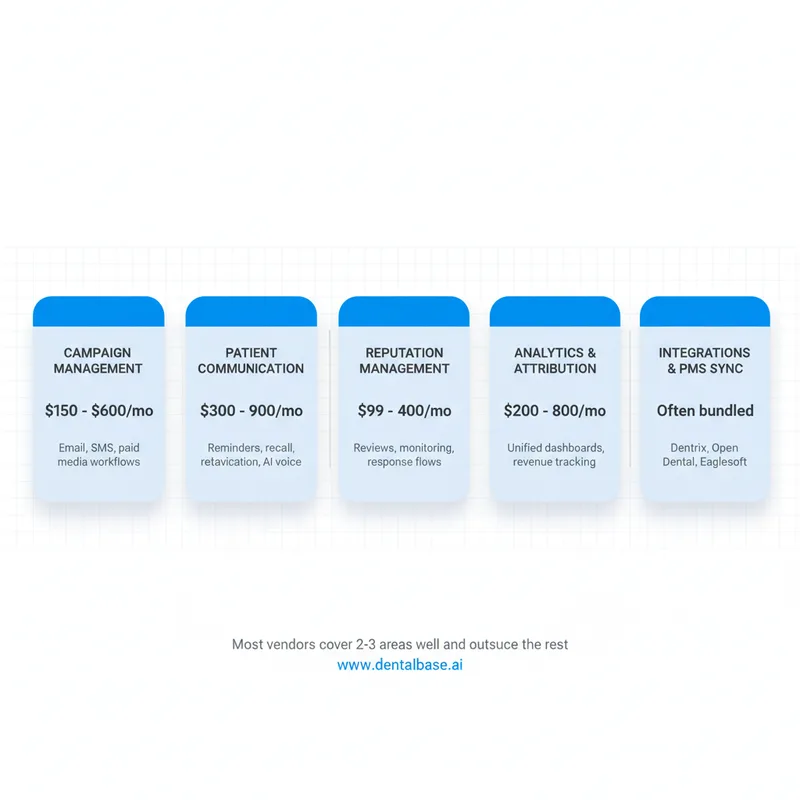
Campaign management covers email, SMS, and sometimes paid media workflows. Patient communication handles appointment reminders, recall, reactivation, and two-way texting. Reputation management requests reviews, monitors mentions, and flags negatives before they post. Analytics pulls data from multiple sources to show what is actually working. Integrations connect to your PMS, Google Business Profile, and phone system.
| Functional Area | What It Does | Typical Monthly Cost |
|---|---|---|
| Campaign management | Email, SMS, and paid media workflows with segmentation and automation | $150 - $600 |
| Patient communication | Reminders, recall, reactivation, two-way texting, AI call answering | $300 - $900 |
| Reputation management | Review requests, monitoring, response workflows, negative deflection | $99 - $400 |
| Analytics and attribution | Unified dashboards, call tracking, revenue attribution by channel | $200 - $800 |
| Integrations and PMS sync | Two-way data sync with Dentrix, Open Dental, Eaglesoft, or Curve | Often bundled |
The practices that get the most out of a marketing platform pick one tool that owns patient communication and analytics, then add specialists for paid media and SEO if those are not strong in the core platform. Trying to run everything through a single "all in one" tool usually means mediocre execution across all five areas.
See dental marketing software in action.
DentalBase combines AI patient communication, attribution, and campaign management in one platform. Walk through a tailored demo with your practice's numbers.
Book a Free Demo →How Do You Know When Your Practice Needs a Platform?
Your practice needs a marketing platform when spreadsheets, manual reminders, and disconnected tools start costing you more in staff time and missed revenue than the software would cost to run. The trigger point varies, but there are five clear signals. Hit three or more and the math already works.
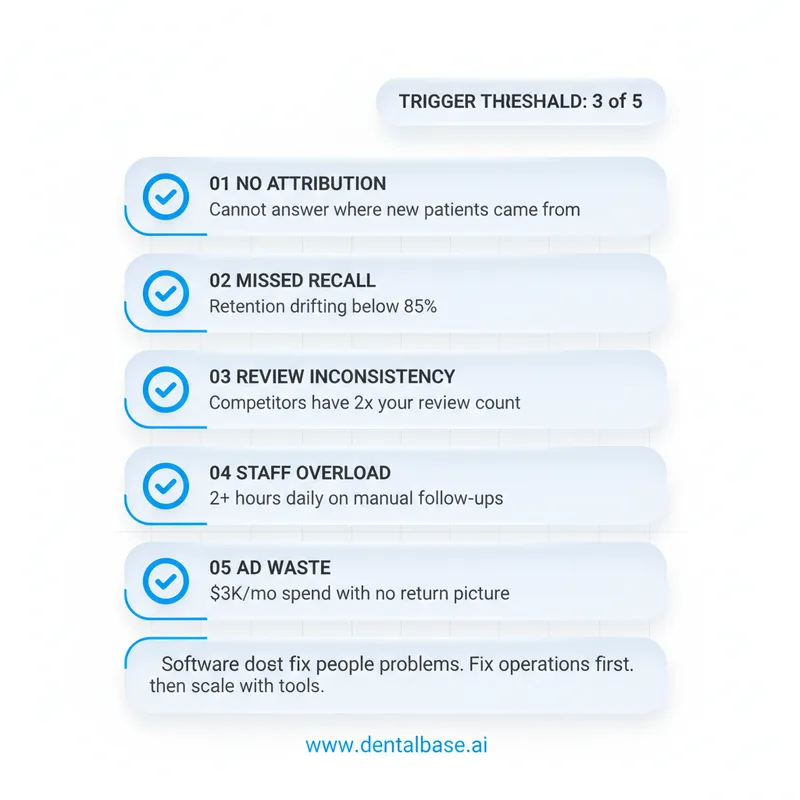
The first is no attribution. You cannot answer "where did last month's new patients come from?" with specifics. The second is missed recall. Patients overdue for hygiene are not being contacted systematically, and your patient retention rate has drifted below 85%. The third is review inconsistency. Reviews come in sporadically, you forget to ask, and competitors down the street have twice as many. According to BrightLocal, 98% of people read local reviews before choosing a business, so review gaps compound fast. Consistent social media posting is another workflow that collapses without automation.
The fourth signal is staff overload. Your front desk is spending two hours a day on text follow-ups that could be automated. The fifth is ad waste. You are spending $3,000 a month on Google Ads with no clear picture of return, and you have no written marketing ROI framework to judge it against. According to ADA Practice Transitions, 38% of new patient calls go unanswered during business hours, which means most practices are losing pipeline before software even enters the conversation. Industry analysis from Search Engine Land also shows AI Overviews now appear in 60%+ of all searches, which changes how paid and organic channels should be budgeted. That gap alone justifies platform investment for most practices.
When software is not the answer
Software does not solve people problems. If your front desk is undertrained, your marketing is directionless, or your clinical capacity is already full, buying a platform will amplify the existing issues rather than fix them. In those cases, fix operations first, then layer on software to scale what works. A written marketing plan also needs to exist before the software buy, or you end up paying for features that map to no real goal. Pair that plan with a strong reputation management workflow so your software has something consistent to automate.
Not sure which platform fits your practice?
See how DentalBase replaces disconnected tools with one system for calls, campaigns, and attribution. Walk through it with your practice's real numbers.
Book a Free Demo →What Should You Look For in Dental Marketing Software?
Look for dental marketing software with deep PMS integration, native call tracking, unified attribution, responsive support, and pricing that scales with your practice rather than with seats. These five filters eliminate most of the mid-tier vendors and leave you with platforms that actually move the numbers that matter.
PMS integration is the foundation. If the software cannot write data back to Dentrix, Open Dental, Eaglesoft, or Curve, you will end up manually syncing appointments and patient status changes. That defeats the point. Ask specifically whether the integration is real time, one way, or batch, and whether it supports your exact PMS version. According to ADA Health Policy Institute, 77% of patients want online booking capability but only 26% of practices currently offer it, and PMS sync is what makes online booking actually work.
The six questions to ask every vendor
- Which PMS versions do you integrate with? Not "we integrate with Dentrix," but which modules, which version, and whether the sync is bidirectional.
- Do you do call tracking natively or through a third party? Native is better. Third-party adds latency, data loss, and a second bill.
- Can I see a live attribution report for a comparable practice? Redacted is fine. If they cannot show one, the reports do not exist yet.
- What happens to my data if I cancel? Contracts should include export rights. No export equals a hostage situation.
- How is support handled and what is the response SLA? A three-day ticket queue kills momentum. Same-day phone or chat support is the benchmark.
- What is the total cost including setup, per-location fees, and any per-message charges? Many vendors advertise $299 a month and bill $900 after SMS overages and per-location surcharges.
Walk away from any vendor that hedges on these questions or asks you to sign before a demo with your actual numbers. Good platforms welcome scrutiny. Weak ones deflect with marketing language about "enterprise solutions" and "scalable architecture."
Related: Marketing software is only part of the stack. Here's how to evaluate any dental software before you buy. → How to Evaluate Dental Software Before You Buy (2026)
How Much Does Dental Marketing Software Cost?
Dental marketing software ranges from $99 a month for single-function review tools to $2,500 a month for full-stack platforms with AI voice, paid media management, and multi-location support. Most solo practices spend $400 to $900 a month all in, and multi-location groups spend $1,200 to $3,500 per location depending on bundled services.
Pricing usually follows one of three models. Per-seat pricing charges by user and makes sense if your front desk is small. Per-location pricing fits multi-site groups but penalizes growth. Usage-based pricing tied to patient volume or message count is the most predictable but watch for overage fees. Ask for pricing at 2x your current volume so you can see where the cliff is.
Compare this to alternatives. Hiring an in-house marketing coordinator runs $55,000 to $75,000 a year loaded. A full-service dental marketing company runs $2,500 to $8,000 a month. Software is typically the highest-return starting point because it captures value across every patient interaction, not just the marketing ones. The average patient lifetime value of $12,000 to $15,000 means a platform that prevents even two dropped patients a month pays for itself.
What to negotiate
Setup fees are negotiable. Annual contracts are negotiable. Per-message SMS rates are negotiable. Training hours are negotiable. What is rarely negotiable is the base platform price, because vendors know switching costs keep customers locked in. Push on the soft costs, accept the hard ones, and get everything in writing.
Related: For the broader context on where software fits into practice growth, see our pillar guide. → Complete Guide to Dental Marketing for US Practices
Stop paying for features you don't use.
DentalBase replaces three to five disconnected tools with one platform that handles calls, campaigns, and attribution. See how it compares to your current stack.
Explore the Platform →How Do You Evaluate a Vendor Without Getting Sold?
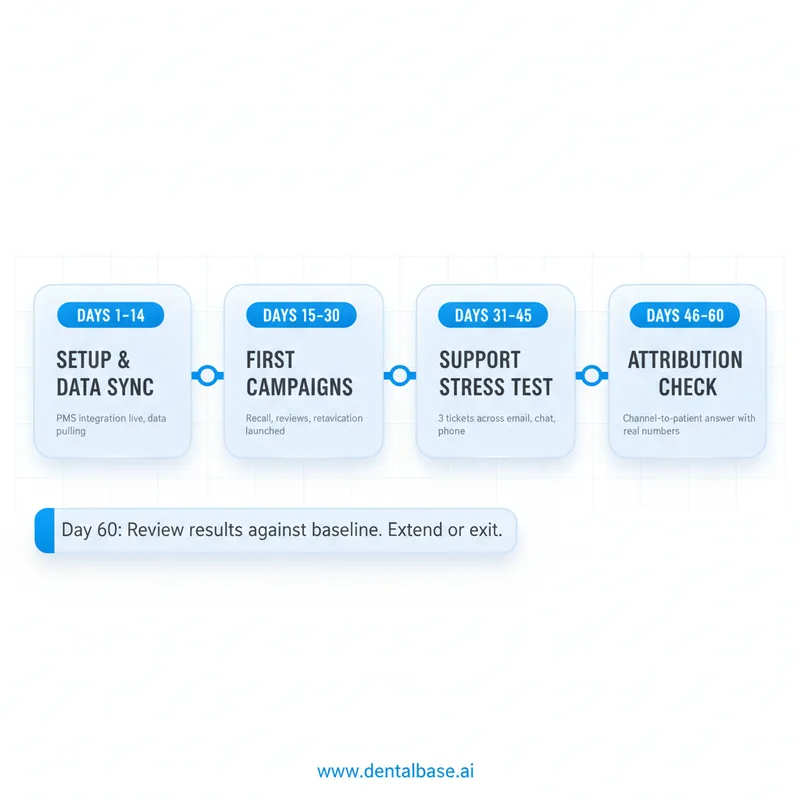
Evaluate dental marketing software by running a structured trial with real data, measuring against a pre-set baseline, and refusing to sign an annual contract before 60 days of use. Vendors who push hard for a 12-month commitment on day one are optimizing for their churn rate, not your success.
Start with a baseline snapshot. Document your current new patient volume, recall rate, review count and score, cost per new patient, and front desk time spent on manual follow-ups. Without this, you cannot measure lift. According to HubSpot, the average marketing stack now contains 12 tools, and most organizations cannot articulate what each one is producing. Your goal is the opposite: know what every dollar does.
The 60-day evaluation framework
- Days 1-14: Setup and data sync. The integration should be live and pulling PMS data within two weeks. If it takes longer, you are seeing a preview of how every future issue will be handled.
- Days 15-30: First campaigns run. Launch recall, review request, and reactivation automations. Measure open, click, and appointment conversion rates.
- Days 31-45: Support stress test. Submit three support tickets across email, chat, and phone. Track response time and resolution quality. This tells you what year two will look like.
- Days 46-60: Attribution check. Can you now answer "which channel produced last month's new patients" with real numbers? If not, the platform is not delivering on its core promise.
At day 60, sit down with the vendor and review results against the baseline. If the numbers moved, extend the contract. If they did not, ask why, and expect a concrete diagnosis, not excuses. Practices that run this evaluation consistently report 25 to 40% better outcomes with marketing software than practices that sign blind. The framework forces accountability on both sides.
Good dental marketing software is not about features. It is about the measurable lift in new patients, recall compliance, review velocity, and revenue per chair. If your vendor cannot tell you which of those numbers they expect to move and by how much, keep looking.
Build a shortlist of three to five candidates. Run the six-question screen above. Score each on PMS integration depth, attribution clarity, support quality, and real pricing at your volume. The winner is almost never the cheapest or the flashiest. It is the one that shows you their work in a live demo with your data and commits to measurable outcomes in the first 60 days.
That is the difference between buying dental marketing software and buying dental marketing software that pays for itself.
See attribution, calls, and campaigns in one dashboard.
DentalBase connects your PMS, phone system, and marketing channels so you finally know which dollar produced which patient. Book a tailored demo with your practice's numbers.
Book a Free Demo →More guides on dental marketing and growth.
Browse Resources →Sources & References
Frequently Asked Questions
Dental marketing software handles campaign management, patient communication, reputation management, analytics and attribution, and PMS integrations. Most platforms automate email, SMS, recall, and review requests while tracking which marketing channel produced each new patient and the revenue each channel returned over time.
Dental marketing software ranges from $99 a month for single-function review tools to $2,500 a month for full-stack platforms with AI voice and multi-location support. Most solo practices spend $400 to $900 a month all in, and multi-location groups spend $1,200 to $3,500 per location.
Usually yes. Agencies run campaigns on your behalf but often cannot see inside your practice management system, which limits attribution and recall workflows. Software fills that gap, giving both you and the agency the data to connect marketing spend to actual booked appointments and revenue.
Open Dental integrates with most major marketing platforms through its HL7 and FHIR interfaces. Confirm with each vendor whether the sync is bidirectional and real time, which Open Dental version they support, and whether appointment updates flow both ways without manual intervention from your front desk.
A CRM tracks patient contact data and relationship history. Dental marketing software adds campaign automation, review workflows, multi-channel communication, and attribution reporting on top of that data. Most modern dental platforms bundle CRM functionality, but a standalone CRM rarely has the marketing execution features practices need.
Dental marketing software can replace the manual execution work a coordinator does but not the strategic thinking, creative direction, or agency relationship management. Most practices that buy software also keep one part-time marketing owner on staff or work with an external strategist for campaign direction and measurement.
A well-run implementation takes two to four weeks for solo practices and four to eight weeks for multi-location groups. The PMS integration typically completes in week one, followed by template setup, staff training, and the first automated campaigns. Beyond eight weeks usually signals a vendor with weak onboarding processes.
Was this article helpful?
Written by
DentalBase Team
Expert dental industry content from the DentalBase team. We provide insights on practice management, marketing, compliance, and growth strategies for dental professionals.