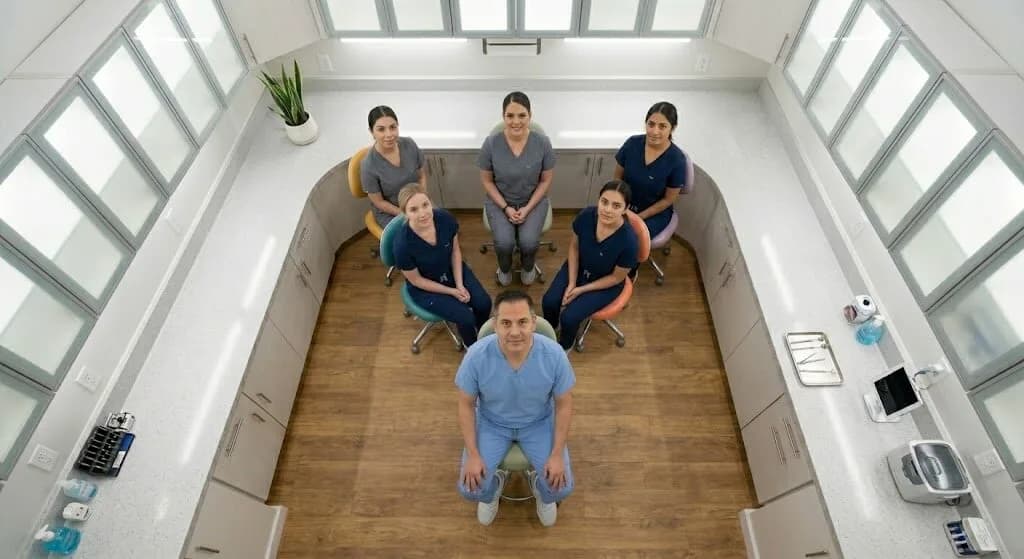
Dental Office Culture: Build a Team That Runs Itself
Learn how to build a dental office culture where your team takes ownership. Covers trust, accountability, hiring for fit, and daily leadership habits.
Share:
Table of contents
Dental office culture isn't a mission statement framed in the break room. It's how your assistant reacts when the schedule falls apart at 2pm. It's whether your front desk coordinator flags a billing error or lets it slide. Strong dental office culture means your team handles problems without waiting for permission. It's the difference between a team that solves issues without pulling you out of the operatory and one that waits for you to make every decision. The ADA Health Policy Institute ranks workplace environment among the top three factors in dental staff satisfaction, ahead of benefits and schedule flexibility.
Most practice owners want a self-directed team but build the opposite through micromanagement, unclear standards, and inconsistent follow-through. You can't inspire ownership in people you don't trust, and you can't build trust without systems. This guide covers how to create a dental office culture where your team takes initiative, holds each other accountable, and doesn't need you hovering over every task.
Why Does Culture Matter More Than Policy in a Dental Office?
Policies tell people what to do. Culture determines whether they actually do it when nobody's watching. You can write the most detailed employee handbook in dentistry and still have a team that ignores half of it if the culture doesn't reinforce the standards.
Here's a scenario most owners recognize. You write a policy that says "all new patient forms must be verified before the appointment." Your front desk coordinator follows it for two weeks, then starts skipping it during busy mornings because nobody noticed when she didn't. By month three, verification only happens when you personally ask about it. The policy didn't fail. The culture around that policy failed, because there was no accountability loop and no consequence for drifting.
According to Dental Economics, dental practices with clearly defined cultural norms and consistent enforcement report measurably lower turnover than practices relying on policy manuals alone. That's because culture is self-reinforcing. Once "how we do things here" is established, the team polices itself. New hires absorb the norms quickly. Existing staff correct deviations before you have to.
Practices with structured follow-up programs retain 15% more patients annually, according to industry data. That retention advantage doesn't come from technology alone. It comes from a team culture where follow-through is the default, not the exception.
Related: Culture starts with how you lead. See what dental school didn't teach you → Leadership for Dentists: What Dental School Never Taught You
What Are the Building Blocks of a Self-Directed Dental Team?
A self-directed dental team is built on three things: clear expectations, documented systems, and consistent accountability. Remove any one of those and micromanagement fills the gap by default.
Clear expectations for every role
Every person on your team should know exactly what "good" looks like for their position. Not a vague job description. Specific, measurable standards. Your front desk coordinator should know that "answering the phone within three rings" is the standard, not "answer the phone promptly." Your hygienist should know that a complete perio chart is required at every new patient visit, not "do perio charting when appropriate."
Write these standards down. Review them during onboarding. Reference them during performance reviews. When everyone knows what's expected, they don't need to ask you. And when they fall short, the conversation is about the standard, not about your personal frustration. That distinction matters enormously for team morale.
Documented systems for repeatable tasks
Every task your team does more than twice a week should have a written protocol. How to process a new patient call. How to handle a same-day emergency request. How to prepare an operatory for a crown prep versus a prophy. How to close out the day's deposit. These aren't bureaucratic exercises. They're the infrastructure that lets people work independently.
A practice with documented protocols for 80-90% of its repeatable tasks needs dramatically less owner involvement in daily decisions. When the protocol exists, the answer to "What should I do?" is "Check the protocol." That's not cold. It's clarifying. And it frees you to spend your clinical hours producing instead of answering operational questions between patients.
Consistent accountability without micromanaging
Accountability and micromanagement look similar from a distance but feel completely different to your team. Micromanagement is checking someone's work before they've finished it. Accountability is reviewing outcomes at agreed-upon intervals and having honest conversations about gaps.
Monthly one-on-ones, weekly huddles, and quarterly performance reviews create the accountability structure. Your team knows their work will be seen. They know feedback is coming. That awareness drives self-correction without you standing over anyone's shoulder. The HubSpot workplace engagement research consistently shows that employees who receive regular feedback perform better than those who receive annual reviews alone.
Systems That Run While You're in the Operatory
DentiVoice handles patient calls, scheduling, and follow-ups automatically, so your team has one less thing to juggle and one more reason to stay focused.
Learn About DentiVoice →How Do You Hire for Culture Without Sacrificing Skills?
Hiring for dental office culture doesn't mean picking the friendliest person and hoping they can learn the job. It means evaluating cultural fit alongside technical skills so you don't hire someone great on paper who poisons the team dynamic within a month.
The skills-versus-fit question has a clear answer in small-team environments: a moderate-skill hire who fits the culture outperforms a high-skill hire who doesn't. That's because in a 6-person dental practice, one disruptive personality affects every patient interaction, every team communication, and every morning huddle. You can train a dental assistant to use your imaging software. You can't train someone to stop gossiping about coworkers.
Interview questions that reveal cultural fit
- "Describe a time a coworker did something that frustrated you. How did you handle it?" You're listening for whether they addressed it directly, went to a manager, or gossiped. Each answer tells you something different about how they'll operate in your practice.
- "What does a good day at work look like for you?" Answers reveal what motivates them. If they describe quiet, independent work and your practice requires constant collaboration, it's a mismatch regardless of their clinical skills.
- "Tell me about a mistake you made at your last job. What happened after?" Ownership of the mistake matters more than the mistake itself. People who deflect blame don't take accountability in team settings.
Reference checks should include one specific question: "How did this person handle conflict with coworkers?" Technical references tell you about skill. This question tells you about character.
Related: Build a full hiring process that screens for both skill and fit → How to Hire Dental Staff That Actually Stays (2026 Guide)
What Daily Habits Shape Dental Office Culture the Most?
Culture isn't built in annual retreats. It's built in the five minutes before the first patient and the ten minutes after the last one leaves. Small daily habits, repeated consistently, define your dental office culture more than any initiative or program.
The morning huddle sets the tone
A 10-minute morning huddle where the team reviews the day's schedule, flags potential challenges, and shares one recognition from yesterday sets a collaborative tone before the first patient walks in. Skip it, and everyone operates in their own silo all day. Consistent huddles build a shared awareness that replaces the need for constant check-ins throughout the day.
How you handle mistakes defines everything
A dental assistant breaks a temporary crown during removal. How the dentist reacts in that moment teaches the entire team what this practice is really about. If the reaction is frustration and blame, the lesson is "hide your mistakes." If the reaction is "Let's fix this. What happened?" the lesson is "we solve problems together." That second response builds the kind of culture where people flag issues early instead of covering them up, which saves you money and protects patients.
The average dental practice misses 15-20 calls per week according to Dental Economics. When a missed call happens, does the front desk coordinator report it or hope nobody notices? That behavior is a direct reflection of whether your culture treats mistakes as data or as failures. Big difference.
Recognition is more powerful than correction
Correction tells people what not to do. Recognition tells them what to repeat. A practice where the owner says "Great job handling that anxious patient, Emily. The way you explained the procedure step by step kept her calm" twice a week will outperform a practice where the only feedback is about mistakes. That's not a soft observation. It's behavioral psychology applied to team management. People repeat behaviors that get noticed and appreciated.
| Culture-Building Habit | Time Cost | Impact | What It Replaces |
|---|---|---|---|
| Daily morning huddle | 10 min/day | Shared awareness, fewer surprises | Constant ad-hoc check-ins throughout the day |
| Specific recognition (2x/week) | 30 sec each | Reinforces desired behaviors | Correction-only feedback loop |
| Addressing issues within 48 hours | 5-10 min | Prevents resentment buildup | Months of silent frustration ending in blowups |
| Post-incident debrief ("What happened?") | 5 min | Problem-solving culture, early error reporting | Blame culture that hides mistakes |
| Monthly one-on-ones | 15 min/person | Catches frustrations before resignations | Surprise departures and exit interview regrets |
Give Your Team the Bandwidth to Build Culture
When your front desk isn't drowning in calls, they have the mental space to deliver great patient experiences. DentalBase automates patient calls, scheduling, and follow-ups.
See All Services →How Do You Know If Your Dental Office Culture Is Working?
Culture is invisible until you measure its effects. You can't put a number on "how the team feels," but you can track the outcomes that healthy culture produces and spot problems before they become resignations.
Metrics that reflect culture health
Retention rate. Target 85%+ annually. If you're below 75%, your culture has a problem regardless of what your team says in meetings. People vote with their feet.
90-day survival rate. Track what percentage of new hires make it past their first 90 days. Low survival rates point to onboarding gaps or a culture shock: what you described in the interview doesn't match the daily reality.
Unsolicited problem-solving. This one's qualitative but telling. How often does a team member fix something without being asked? If your hygienist reorganizes the supply closet because it was inefficient, or your front desk coordinator creates a patient callback template on her own, those are signs of ownership. If nobody does anything beyond their job description, that's a culture of compliance, not commitment.
Patient feedback. Online reviews often mention staff by name. "The front desk was so friendly" and "everyone seemed to work well together" are culture signals. So are "the office felt chaotic" and "I felt like nobody was on the same page." According to ADA practice management resources, patient satisfaction correlates strongly with staff satisfaction. Happy teams produce happy patients. That's not a cliche. It's measurable.
77% of patients use online reviews when choosing a dentist, and 88% are likely to pick a practice where the owner responds to all reviews. Those review patterns are downstream effects of culture. A team that cares about the practice generates the kind of patient experiences that turn into five-star reviews organically.
Related: Retention and satisfaction metrics belong on your monthly KPI dashboard → Dental Practice KPIs: 12 Numbers Every Owner Should Track Monthly
Your dental office culture is the one thing competitors can't copy. They can match your fee schedule. They can buy the same equipment. They can even hire away your staff. But they can't replicate the specific combination of expectations, habits, trust, and accountability that you build inside your practice. That's your moat.
The work of building that culture starts with you. Not with a consultant. Not with a retreat. With the way you show up tomorrow morning: running the huddle, recognizing one person, addressing one issue you've been avoiding, and trusting your team to handle the rest. Those small acts, repeated daily, compound into a practice where people want to work and patients want to stay. And you won't need to micromanage any of it.
Build a Practice Culture Patients Can Feel
See how DentalBase supports practice owners with tools that reduce admin pressure and let teams focus on delivering exceptional care.
Book a Free Demo →More guides for dental practice owners
Browse Resources →Sources & References
Frequently Asked Questions
Dental office culture is the set of behaviors, communication patterns, and unwritten rules that define how your team works together daily. It shows up in how staff talk to each other during stressful moments, how problems get escalated, and whether people take initiative or wait to be told. It's not a poster on the wall. It's what happens when you're in the operatory.
Start by identifying the specific behaviors causing the toxicity: gossip, passive aggression, clique formation, or inconsistent rule enforcement. Address the worst behavior first with a private, direct conversation. Set a clear standard publicly. Then enforce it consistently for everyone, including long-tenured staff. Culture shifts slowly, usually over 3-6 months of sustained effort.
Small teams actually build culture faster because every interaction matters more. With 5 people, one toxic dynamic poisons everything. But one strong norm, like always debriefing after a difficult patient, can anchor the whole team's behavior. Small teams don't need formal programs. They need consistent leadership and clear expectations.
Patients feel your culture the moment they walk in. A team that communicates well, respects each other visibly, and operates with confidence creates a calm, trustworthy environment. Patients notice when staff seem stressed, when handoffs are sloppy, or when the front desk and clinical team clearly aren't aligned. Culture leaks into every patient interaction.
The owner sets the ceiling. A team will never outperform the standards the owner models and enforces. If the owner is late, the team will be late. If the owner avoids conflict, conflict festers. If the owner gives specific recognition, the team mirrors that. Culture starts with leadership behavior, not HR policies.
Expect 3-6 months of consistent effort before you see a noticeable shift. Some quick wins happen in weeks: a morning huddle, a recognition habit, or addressing one toxic behavior. But deep cultural change requires sustained repetition. The team needs to see that the new standards are permanent, not a temporary mood from the owner.
Yes, if coaching and clear expectations haven't changed the behavior after 60-90 days. One person who undermines the culture you're building can undo months of progress. The rest of the team watches how you handle it. Keeping a culture-killer signals that the values you're promoting don't actually matter when they're inconvenient.
Was this article helpful?
Written by
DentalBase Team
Expert dental industry content from the DentalBase team. We provide insights on practice management, marketing, compliance, and growth strategies for dental professionals.