AI Receptionist for Dental Insurance Calls: Is It Worth It?
How an AI receptionist for dental insurance calls cuts hours from your front desk: time math, opportunity cost, and where to start in 2026.
Share:
Table of contents
An AI receptionist for dental insurance calls sounds like a solved problem until you actually do the math on what your front desk handles each week. Then it gets interesting. The number of insurance calls passing through a 2 to 3-provider general practice is higher than most owners think, and the time those calls consume is rarely accounted for in any payroll line.
This article walks through the numbers honestly. How many insurance calls hit the front desk in a typical week. How long each one takes. What it costs in missed new patient bookings while staff are on hold with an insurer. Where AI actually saves hours, and where it doesn't.
The answer to "is it worth it" depends on the math, not the marketing. It's specifically about which insurance call types AI handles cleanly, which stay human, and what front desk capacity opens up if you split the work the right way.
What Counts as an "Insurance Phone Call" at the Front Desk?
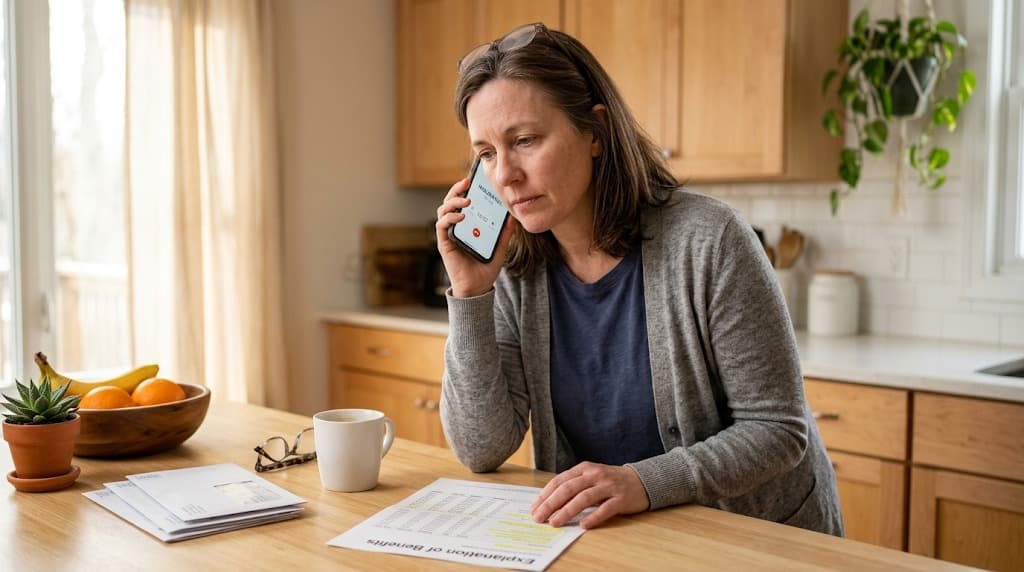
An "insurance phone call" at a dental front desk is any inbound or outbound call related to a patient's benefits, claims, or coverage. There are four main types: patient coverage questions, outbound verification calls to insurers, claim status follow-ups, and EOB or billing explainers after the visit. Most owners count only the second.
The receptionist sitting on hold with a payer for 18 minutes is impossible to miss. The other three call types blend into normal phone traffic and rarely get measured. That's where the time disappears without anyone noticing.
Here's the breakdown most practices undercount:
- Patient coverage questions. "Is my cleaning covered?" "What's my deductible this year?" "Do I need a referral?" These are the highest-volume, lowest-complexity calls. They average 4 to 8 minutes each.
- Outbound verification. Manual eligibility lookups when portal data is stale or coordination of benefits gets murky. 12 to 18 minutes each.
- Claim status follow-ups. Calling payers to check on aged claims, request status updates, or push appeals. 10 to 20 minutes.
- EOB and billing explainers. Patient calls after the visit asking what their statement means, why they owe a balance, or what the insurance paid. 5 to 12 minutes.
Each category needs a different handling strategy. Lumping them together is why time audits underdeliver. Per the CDC's oral health program, dental visits remain among the most common healthcare interactions in the US, which is why insurance touchpoints add up so quickly.
Tag your inbound and outbound calls by type for one week before deciding what to fix. The mix varies more than you'd think between practices. Heavy PPO offices see a different ratio than fee-for-service offices, and the right intervention follows the mix.
How Many Hours Per Week Do These Calls Actually Take?
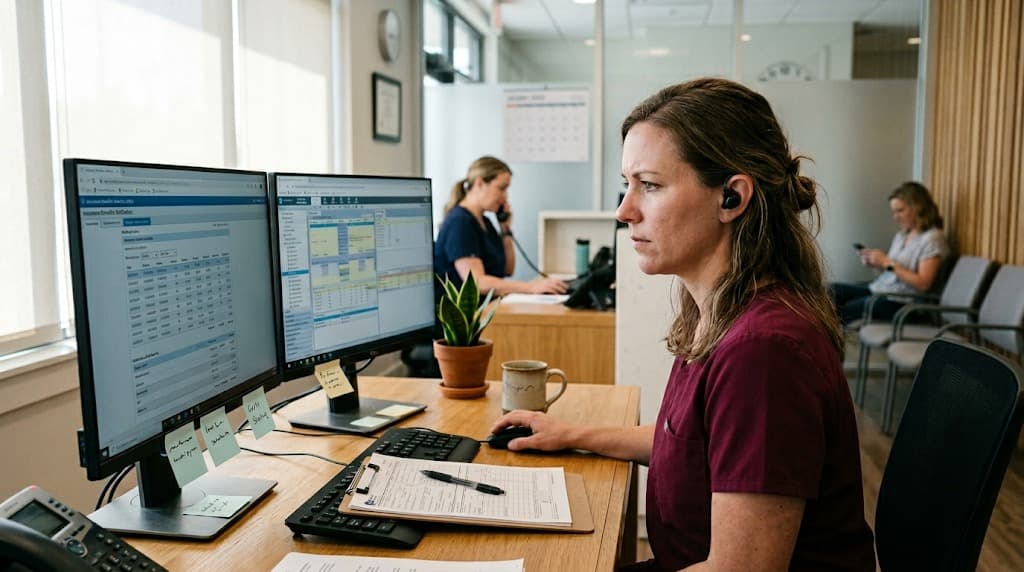
For a 2- to 3-provider general practice, insurance calls take up 9.5 to 15 hours per week across the front desk team. That's roughly 30% of one full-time employee's hours spent on the phone with insurers or fielding patient coverage questions. The number scales linearly with active patient count.
Front Desk Insurance Time: Weekly Math
Typical numbers for a 2 to 3 provider general practice with ~1,500 active patients.
| Call type | Per week | Avg time | Hours |
|---|---|---|---|
| Patient coverage Qs | 20 to 30 | 6 min | 2.0 to 3.0 |
| Outbound verification | 15 to 25 | 15 min | 3.75 to 6.25 |
| Claim status follow-ups | 10 to 15 | 15 min | 2.5 to 3.75 |
| EOB / billing explainers | 10 to 15 | 8 min | 1.3 to 2.0 |
| Weekly total | 55 to 85 calls | to | 9.5 to 15 hrs |
Add 30 to 60 minutes of hold time for outbound verification across the week. Scales linearly with active patient count.
The math is straightforward once you tag calls by type. A general practice with 1,500 active patients receives about 80 to 120 inbound calls per week. Roughly 40% of those touch insurance in some form. Outbound verification adds another 15 to 25 calls per week, depending on how many new patients you're seeing and how often portals lag.
According to Dental Economics tracking, the average dental practice misses 15 to 20 calls per week. Most of those misses happen while staff are already on the phone with insurers. The hours go somewhere, and the front desk feels it even when the payroll line doesn't change.
Front desk roles are a growing share of dental practice employment, per Bureau of Labor Statistics projections. But the work intensifies faster than headcount, which is why time-per-call matters more than total hires.
Run a baseline measurement before evaluating any solution. Without your own numbers, every vendor pitch sounds equally good. With your numbers, you can spot which solution actually moves your specific bottleneck. Worth combining this with your phone system audit if you haven't done one recently.
Run your own numbers against ours
DentiVoice handles the scriptable side of insurance calls so your front desk gets its hours back. See how the deflection works in a 20-minute walkthrough.
See DentiVoice in Action →What's the Opportunity Cost in Missed New Patient Bookings?
The opportunity cost is the new patient calls that hit voicemail while the staff are tied up on insurance work. Each missed new patient call costs the practice $1,200 or more in lifetime value, according to Dental Economics. Five missed calls per week translates to roughly $312,000 a year in unrealized lifetime value.
From Blocked Phone Line to Lost Lifetime Value
Each step compounds the cost of an insurance call that blocks a new patient call.
Step 1. Front desk is on a 15-minute call with an insurer. Phones are blocked.
↓
Step 2. A new patient call comes in. 38% of these hit voicemail during business hours.
↓
Step 3. 80% of voicemail callers don't leave a message. They call the next practice on the list.
↓
Step 4. One lost new patient = $1,200+ in lifetime value. 5 lost per week = $312,000 per year.
This is where the math turns from interesting to alarming. ADA Practice Transitions research found 38% of new patient calls go unanswered during business hours. Forbes data shows 80% of callers who reach voicemail don't leave a message and don't call back. The math compounds: most missed new patient calls become permanent losses.
When you overlay that with insurance call volume, the connection is direct. Staff on hold with a payer can't answer the next ring. The phone system either dumps to voicemail or holds the caller until they hang up. Average hold time before a patient hangs up is 90 seconds, according to Marchex.
Not every missed call was going to convert. But the order of magnitude is real. Most owners underestimate the loss because they're calculating per-call revenue instead of patient lifetime value. The right number to watch is missed calls per week, not missed appointments.
Pull two numbers from your phone system this week: total missed calls and abandoned calls during business hours. Map them against your verification call log. The overlap is where capacity opens up first.
Which Insurance Calls Can an AI Receptionist for Dental Insurance Calls Take Over?
An AI receptionist for dental insurance calls reliably handles three call types: inbound patient coverage questions, basic eligibility lookups against real-time payer data, and appointment scheduling tied to a patient's insurance plan. These are high-volume, scriptable, low-stakes calls. They make up 60 to 70% of front desk insurance phone time in most practices.
| AI Handles Cleanly | Stays Human |
|---|---|
| "Is my cleaning covered?" Coverage questions | Coordination of benefits disputes |
| Basic eligibility lookups via clearinghouse | Billing escalations on unexpected balances |
| Deductible and annual maximum questions | Claim appeals to payers |
| "Do you take my plan?" network confirmation | Payer verification when portal data conflicts |
| Appointment booking with insurance estimate | Any call where the patient is frustrated |
| After-hours overflow calls | Treatment plan financial conversations |
The pattern across deflection is simple: AI handles repetitive, structured calls with clear answers. Anything that requires judgment, dispute resolution, or context across multiple systems stays with staff.
The calls AI handles cleanly:
- Coverage questions. "Is my cleaning covered?" "What's my deductible?" AI pulls current eligibility from clearinghouse data and answers in seconds. No hold time, no transfer.
- Basic eligibility. When a new patient calls to book and asks if you take their plan. AI checks network participation against the patient's payer and confirms.
- Appointment plus insurance combos. "I need to book a crown, and I want to know if it's covered before I commit." AI books the appointment, runs the breakdown, and texts the estimate.
- After-hours overflow. The 27% of calls come outside business hours, per Dental Economics. AI handles them in the moment instead of pushing to voicemail. More details in our after-hours coverage guide.
That coverage maps to most of the high-volume noise. According to Dental Economics, 73% of dental practices plan to adopt AI tools by 2027, specifically because the deflection math works.
For the outbound verification process specifically, the workflow is more involved than coverage Q&A. The mechanics of how AI handles eligibility checks against payer portals and clearinghouse APIs are covered in our deep dive on AI-handled dental insurance verification. The short version: it's possible but requires tighter integration than simple inbound deflection.
Take the scriptable calls off the queue
DentiVoice picks up coverage questions, eligibility lookups, and after-hours overflow with real-time payer data, and routes complex calls back to your team with full context.
Explore the AI Receptionist →What Should an AI Receptionist for Dental Insurance Calls NOT Try to Do?
An AI receptionist for dental insurance calls should not handle complex coordination of benefits disputes, billing escalations, claim appeals, payer-side verification when portal data conflicts with real eligibility, or any call where the patient is upset. These conversations require judgment, empathy, and improvisation that AI doesn't reliably deliver in 2026.
Honest scope sets honest expectations. Pretending AI can do everything is how implementations fail and how staff lose trust in the tool.
What stays human:
- Coordination of benefits disputes. When primary versus secondary order is unclear or the patient changed jobs mid-treatment, the call requires interpretation. AI confuses the patient more often than it resolves the question.
- Billing escalations. A patient calling about a $1,400 statement they weren't expecting needs a human. AI handling this poorly is the fastest way to lose the patient and pick up a one-star review.
- Claim appeals to payers. Even when AI can pull denial codes, the appeal narrative requires clinical context. Outsourced billing or an in-house biller handles this better.
- Payer verification when data conflicts. If the portal says inactive but the patient swears the plan is active, only a human can work the call to a payer rep and untangle it.
The pattern across these is that each involves dispute, judgment, or a frustrated person. Pushing them to AI saves time on the wrong axis. According to the BrightLocal local consumer review survey, 88% of consumers say they're more likely to use a business when the owner responds to all reviews. The cost of an escalation handled badly shows up in your review profile within weeks.
Audit your call recordings before deploying anything. Pull 20 random calls and tag them as "clear script" or "requires judgment." That mix is your AI ceiling. Anyone promising 100% deflection is selling something that breaks on day three.
Related: Insurance phone calls are one slice of a wider operational problem. → See the full 2026 dental insurance front desk guide
How Much Front Desk Time Does Deflection Actually Recover?
Realistic deflection recovers 8 to 15 hours per week of front desk time in a 2 to 3-provider general practice. The range depends on the call mix and how aggressively you set the AI handoff thresholds. PPO-heavy practices recover at the high end. Fee-for-service practices recover less because they get fewer routine insurance calls.
The recovery shows up in three places. First, the hours staff used to spend answering coverage questions now go to claims work, treatment plan conversations, or recall outreach. Second, fewer new patient calls hit voicemail because phones aren't blocked by insurance traffic. Third, after-hours coverage absorbs the 27% of calls that previously went unanswered entirely.
A practice at the high end of recovery (15 hours per week) gets back roughly two and a half full days of front desk capacity. That's enough to add a structured treatment plan follow-up program, run a weekly recall blast, and still cover lunch breaks without overtime. The hours don't disappear into idle time when there's a plan for them. They get redirected to work that grows the practice.
Patient demand for dental visits is steady but increasingly cost-sensitive, per NIDCR data, which makes treatment plan follow-up conversations the highest-impact use of recovered hours. Worth pricing the deflection against in-house labor as part of the decision: our AI receptionist pricing breakdown walks through the typical cost ranges.
Measure recovery on a 30-60-90 schedule. At 30 days, baseline call mix and tag the AI-handled calls. At 60, run a side-by-side hour comparison against your pre-deployment baseline. At 90, score the broader operational impact: missed call rate, new patient conversion rate, A/R days.
"Is It Worth It?" ROI Check
All three conditions need to hold. Score yourself before the demo.
3 of 3 checked: deflection ROI is defensible. 2 of 3: borderline, pilot before committing. 1 of 3: fix the underlying issue first.
The honest answer to "is it worth it" is yes when three conditions hold: your call mix is at least 60% scriptable coverage questions, your front desk currently misses more than 10% of new patient calls, and you have a plan for what the recovered hours will do. Without all three, ROI is harder to defend.
The decision on an AI receptionist for dental insurance calls comes down to whether the call mix and the missed-call rate justify the investment. The math is honest in either direction. Practices with high coverage-question volume and an obvious missed-call problem get back hours that translate directly into bookings and collections. Practices with low call volume or strong existing phone coverage may see softer ROI.
Run the audit before reading any vendor demo. Tag a week of calls. Multiply the time by your fully-loaded front desk hourly rate. Compare it to the deployment cost. The answer falls out of the spreadsheet, not the sales pitch.
The right question isn't whether the technology works. It's whether your specific call mix makes the technology pay.
Get the hours back, then decide what to do with them
Book a free walkthrough to see how DentiVoice deflects scriptable insurance calls and what your front desk team gets to do instead.
Book a Free Demo →More front desk and AI guides for practice owners
Browse Resources →Sources & References
Frequently Asked Questions
An AI receptionist for dental insurance calls handles inbound coverage questions, basic eligibility checks, and insurance-related scheduling with real-time payer data. It routes complex calls (disputes, appeals, escalations) to staff. Most practices deploy it to deflect the 60 to 70% of insurance calls that are repetitive and scriptable.
Realistic deflection recovers 8 to 15 hours per week in a typical 2 to 3 provider general practice. PPO-heavy offices recover at the upper end because they take more coverage questions. Fee-for-service practices recover less because their patients have fewer routine insurance calls.
Tag one week of insurance calls by type. Multiply each by your fully-loaded front desk hourly rate. Compare against AI deployment cost plus any missed new patient revenue your call data shows. The math falls out of the spreadsheet, not the demo.
AI struggles with coordination of benefits disputes, billing escalations, claim appeals, and any conversation with a frustrated patient. These require judgment, empathy, and context across systems. Push them to AI and review-profile damage shows up within weeks.
For inbound coverage questions, AI pulls real-time eligibility from clearinghouse data. For outbound verification to payers, the workflow is more involved and requires tighter integration. Most practices start with inbound deflection and graduate to outbound verification once the team trusts the tool.
Recovered hours grow the practice only when redirected to specific work: structured treatment plan follow-up, recall outreach, or new patient nurture. Hours that drift into idle time don't pay back the deployment. Plan the redirect before activating the tool.
According to Dental Economics, 73% of dental practices plan to adopt AI tools by 2027. Most starting points are inbound call deflection because the implementation is lower-risk than outbound clinical or billing automation.
Patient satisfaction depends on the script and escalation logic, not on whether AI answered the call. Patients accept AI for routine coverage questions if the AI is accurate and offers a fast handoff to staff for anything complex. Bad implementations show up in reviews fast.
Was this article helpful?
Written by
DentalBase Team
Expert dental industry content from the DentalBase team. We provide insights on practice management, marketing, compliance, and growth strategies for dental professionals.