Dental Office Employee Handbook: What to Include (2026)
Build a dental office employee handbook that protects your practice. Covers policies, compliance, compensation, conduct, and a rollout checklist.
Share:
Table of contents
A dental office employee handbook is the single most referenced document your team never thinks about until something goes wrong. It spells out how your practice operates, what you expect from every role, and what happens when things don't go as planned. According to the American Dental Association, workforce management is one of the top operational challenges facing practice owners, and most of those challenges trace back to unclear or undocumented policies.
Without a handbook, you're operating on verbal agreements and assumptions. That works until an employee disputes a termination, files an unemployment claim, or violates a HIPAA protocol they were never formally trained on. This guide covers every section your handbook needs, why each one matters, and how to structure the whole thing so people actually use it.
Why Does Every Dental Practice Need a Written Employee Handbook?
A written handbook protects your practice legally, reduces workplace disputes, and gives every team member a clear reference for policies and expectations. It's not optional if you want to run a practice that scales beyond a handful of employees.
Think about the last time you had a disagreement with a team member over PTO, schedule changes, or dress code. If the policy wasn't written down, you were arguing from memory. So were they. And memories don't hold up in front of a labor board. A documented handbook gives you a defensible position in wrongful termination claims, unemployment hearings, and harassment complaints. It shifts the conversation from "I didn't know" to "you signed the acknowledgment on page 32."
There's also a management benefit that doesn't show up in legal filings. A handbook forces you to think through your policies before a crisis. What's your social media policy? What happens when an assistant is 15 minutes late for the third time? How do you handle a team member who refuses a flu shot? Without a handbook, you're making these decisions in the moment, inconsistently, and that inconsistency creates resentment.
The Dental Economics editorial team has noted repeatedly that practices with documented HR policies experience fewer staff conflicts and lower turnover. That's not surprising. People perform better when they know the rules.
Related: Your handbook is part of the bigger management picture. See the full owner's framework → Dental Practice Business Management: Complete Owner Guide
What Employment Policies Should a Dental Office Employee Handbook Cover?
Your handbook's employment policies section establishes the legal foundation of every working relationship in your practice. At minimum, it needs an at-will statement, equal opportunity language, and clear hiring and termination procedures.
At-will employment statement
Most U.S. states operate under at-will employment, meaning either side can end the relationship at any time for any lawful reason. But you need to say it explicitly in your handbook. Without written at-will language, a terminated employee could argue that your handbook's progressive discipline policy created an implied contract, meaning you had to follow every step before firing them. Courts have sided with employees on this more than you'd expect.
Equal opportunity and anti-discrimination
Include a clear statement that your practice doesn't discriminate based on race, gender, age, disability, religion, national origin, or any other protected category. This isn't just ethical. Federal laws like Title VII (for practices with 15+ employees) and state-level equivalents require it. Over 30 states have additional anti-discrimination protections beyond the federal baseline. Even if your practice is below the federal threshold, state laws may still apply.
Hiring, classification, and separation
Define how you classify employees: full-time, part-time, temporary, exempt, and non-exempt. These classifications affect overtime eligibility, benefits access, and tax reporting. Get them wrong and you're looking at back-pay claims. Your separation section should cover voluntary resignation (how much notice you expect), involuntary termination, and what happens to final paychecks, benefits, and practice property. According to the U.S. Department of Labor, final paycheck timing varies by state, so check yours.
Running a Practice Takes More Than Clinical Skills
DentalBase helps dental practices manage operations, automate patient communication, and focus on what matters.
See All Services →How Should You Document Compensation, Benefits, and Time-Off Policies?
The compensation section of your dental office employee handbook should leave zero room for ambiguity. Spell out pay periods, overtime rules, bonus structures, and exactly how benefits work for each employee classification.
Pay structure and overtime
State when and how employees get paid: weekly, biweekly, or semi-monthly. Define overtime eligibility. Non-exempt employees (most dental assistants, front desk staff, and hygienists paid hourly) must receive overtime pay at 1.5x their regular rate for hours exceeding 40 in a workweek. Some states, like California, also require daily overtime after 8 hours. Don't assume your team understands this. Write it down.
Benefits eligibility
List every benefit you offer and who qualifies. Health insurance, dental coverage (yes, your own team needs it too), retirement contributions, CE stipends, and PTO. Include waiting periods. If a new hire doesn't become eligible for health insurance until day 60, that needs to be in writing. According to Dental Economics surveys, benefits are a top-three factor in dental staff retention, right behind compensation and workplace culture.
PTO, sick leave, and holiday schedule
Define how PTO accrues, when employees can start using it, carryover limits, and the request process. Many states now mandate paid sick leave with specific accrual rates. Your handbook needs to match or exceed those minimums. List your paid holidays by name. "Standard holidays" means different things to different people. Spell it out: New Year's Day, Memorial Day, Independence Day, Labor Day, Thanksgiving, day after Thanksgiving, Christmas Eve, Christmas Day. No ambiguity.
Staff costs typically run 25-30% of collections in a healthy practice. Your compensation and benefits section is where that number gets defined, so it connects directly to your overhead targets and profitability.
Related: See how staff compensation fits into your overall financial picture → Dental Practice Profit Margins: What Is Normal and How to Improve Yours
What Workplace Conduct and HR Policies Belong in a Dental Handbook?
Workplace conduct policies set behavioral expectations for every person in your practice. They cover everything from attendance to harassment, and they're the sections you'll reference most during employee disputes.
Attendance and punctuality
Define what "on time" means. In a dental practice, five minutes late can cascade through the entire morning schedule. A single provider running 30 minutes behind costs roughly $500-$1,000 in lost production depending on the procedure mix. Specify how employees should report absences, how far in advance they need to request time off, and what happens after repeated tardiness. A common structure: verbal warning on the first occurrence, written warning on the second, final warning on the third, and termination on the fourth. Whatever you choose, follow it consistently.
Dress code and appearance
Dental practices have clinical dress requirements beyond typical office standards. Scrubs for clinical staff, closed-toe shoes, no dangling jewelry near patients. Spell it out. Include front desk standards too. If you expect business casual, define what that means in your practice, because "business casual" is the most argued-over dress code phrase in every industry.
Harassment and complaint procedures
Your anti-harassment section needs teeth. Define prohibited behavior with examples. Explain the reporting process: who do employees report to, what if the complaint involves the practice owner, and what's the investigation timeline? The U.S. Department of Health and Human Services and state labor agencies have documentation requirements here. An employment attorney should review this section carefully.
Social media and confidentiality
This one catches practices off guard. An assistant posts a photo of a cool case on Instagram, and suddenly you have a HIPAA violation. Your social media policy should clearly state: no patient photos without written consent, no discussions of patient cases online (even anonymously), and no posts that could identify your practice negatively. Many practices ban personal phone use in clinical areas entirely.
Keep Your Front Desk Focused on Patients
DentiVoice handles calls, scheduling, and follow-ups so your team can stay on task without phone interruptions.
Learn About DentiVoice →Which Clinical and Compliance Sections Does a Dental Handbook Require?
Clinical protocol and compliance sections are what make a dental office employee handbook different from a generic small-business handbook. These sections cover HIPAA, OSHA, infection control, and emergency procedures specific to dental workflows.
HIPAA privacy and security
Every dental practice that transmits health information electronically (which is virtually all of them) must comply with HIPAA. Your handbook should explain what protected health information (PHI) is, who can access it, how to handle patient records, and what to do if a breach occurs. Include your designated Privacy Officer's name and contact information. HIPAA violations carry fines from $100 to $50,000 per incident, with annual maximums reaching $1.5 million for willful neglect. Between 2019 and 2024, HHS settled over 130 HIPAA enforcement actions across healthcare.
OSHA and infection control
The Occupational Safety and Health Administration requires dental offices to maintain an Exposure Control Plan, provide hepatitis B vaccinations to at-risk employees, train staff on bloodborne pathogen protocols, and maintain sharps disposal procedures. Your handbook should reference your Exposure Control Plan and state where the full document is kept. The CDC's infection prevention guidelines for dental settings provide the clinical standards your protocols should follow.
Radiograph and sedation safety
If your practice takes radiographs (and nearly all do), document who is authorized to operate imaging equipment, required certifications by state, and radiation safety protocols including dosimeter use and lead apron requirements. Practices offering sedation need additional protocols covering monitoring responsibilities, emergency drug access, and staff certification requirements. These aren't optional. State dental boards audit for this.
Emergency procedures
Cover medical emergencies (patient syncope, allergic reactions, cardiac events), fire evacuation routes, and severe weather protocols. Define who does what. In a medical emergency during a procedure, the dentist manages the patient while the assistant calls 911 and the front desk clears the hallway. Write it out so nobody freezes trying to decide their role in the moment.
Related: Tracking compliance metrics matters. See which KPIs you should review monthly → Dental Practice KPIs: 12 Numbers Every Owner Should Track Monthly
How Do You Roll Out and Maintain Your Dental Office Employee Handbook?
Writing the handbook is half the job. The other half is distributing it properly, getting acknowledgments, and keeping it current. A handbook that sits in a drawer unread protects nobody.
The acknowledgment page
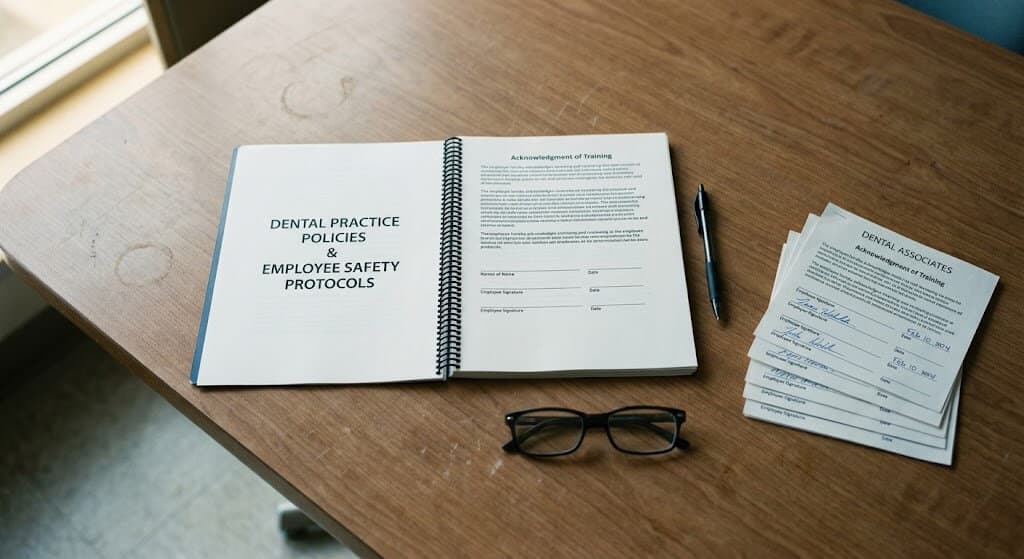
Every employee, including existing team members, must sign an acknowledgment page stating they received the handbook, had the opportunity to read it, and agree to follow its policies. Keep signed copies in each employee's personnel file. This single page is your strongest evidence in any future dispute. Without it, an employee can claim they never saw the policy you're enforcing.
Distribution and accessibility
Give every new hire a physical or digital copy during their first week. Many practices now maintain a digital version in a shared drive or practice management system so employees can reference it anytime. If you use a digital version, keep a printed backup in the break room. The goal is zero excuses for not knowing a policy.
Annual review process
Labor laws change. Your practice evolves. Your handbook needs to keep up. Set a calendar reminder to review every section annually, ideally with your office manager and your employment attorney. Common triggers for mid-year updates include new state minimum wage laws, changes to PTO mandates, new OSHA guidelines, or an incident that exposed a policy gap. Every time you update the handbook, redistribute it and collect new acknowledgment signatures.
| Handbook Section | Review Frequency | Who Reviews |
|---|---|---|
| Employment policies and at-will language | Annually | Employment attorney |
| Compensation, benefits, and PTO | Annually + when benefits change | Owner + office manager |
| HIPAA and privacy policies | Annually + after any breach | Privacy Officer + attorney |
| OSHA and infection control | Annually + when CDC updates guidelines | Clinical lead + safety officer |
| Conduct, harassment, and social media | Annually + after incidents | Owner + attorney |
Dental Office Employee Handbook Section Checklist
Verify your handbook includes each of these sections before distributing.
Your score: count your checks out of 17
Your employee handbook isn't a document you write once and forget. It's a living part of your dental staff management system. The practices that keep theirs current spend less time in disputes, less money on legal fees, and less energy explaining policies that should already be on paper. If you don't have a handbook yet, start with the sections outlined above and get an attorney review before distributing it. If you already have one, pull it out and check the last revision date. If it's older than 12 months, it's time for an update.
Your next step: download a template, customize it section by section using this guide, and schedule your attorney review. One focused weekend of work gives your practice a document that protects it for years.
Build a Practice That Runs on Systems, Not Guesswork
See how DentalBase helps dental practices manage team workflows, patient communication, and daily operations.
Book a Free Demo →More guides for dental practice owners
Browse Resources →Sources & References
Frequently Asked Questions
No federal law requires a dental practice to have an employee handbook. But several states mandate written policies on topics like harassment, leave, and pay. Beyond legal requirements, a handbook protects you in disputes and unemployment claims by documenting that policies were communicated clearly.
Most dental office handbooks run 20-40 pages. Shorter practices with 5-8 employees can stay closer to 20 pages. Larger groups or DSOs with complex benefits and multi-location policies often need 40 or more. The goal is complete coverage without unnecessary filler that nobody reads.
Yes. An employment attorney familiar with your state's labor laws should review your handbook before distribution. Laws on at-will employment, paid leave, overtime, and harassment vary by state. A legal review typically costs $500-$1,500 and prevents far more expensive disputes later.
Review your handbook annually, at minimum. Update it whenever state or federal employment laws change, when you add new benefits or policies, or after an incident reveals a policy gap. Distribute updated versions and collect new signed acknowledgment pages from every team member.
An at-will statement clarifies that either the employer or employee can end the employment relationship at any time, for any lawful reason, with or without notice. Most states default to at-will employment, but your handbook must include this language explicitly to avoid implied contract claims.
Free templates are a starting point, not a finished product. They rarely account for state-specific laws, dental-specific protocols like OSHA bloodborne pathogen standards, or your practice's unique policies. Use a template for structure, then customize it and have an attorney review the final version.
New hires typically look for compensation details, PTO policies, dress code, and schedule expectations first. Put these sections near the front of your handbook. Compliance and legal sections matter for protection but are less likely to be read voluntarily, which is why the signed acknowledgment page is critical.
Was this article helpful?
Written by
DentalBase Team
The DentalBase Team is a collective of dental marketing experts, AI developers, and practice management consultants dedicated to helping dental practices thrive in the digital age.