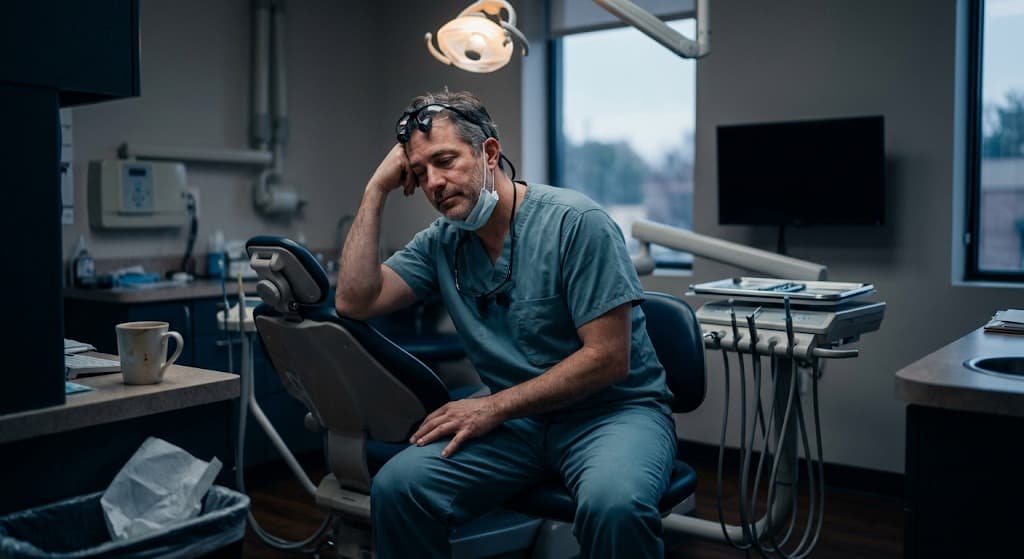
Dentist Burnout: The Business Decisions Behind It (2026)
Dentist burnout is usually a business problem in disguise, not a willpower failure. See the operational roots and the structural fixes that actually work.
Share:
Table of contents
Dentist burnout gets talked about as a personal failing, something you fix with better sleep, a yoga app, and more willpower. I don't buy it anymore. After years in my own practice in Peterborough, New Hampshire, and a lot of conversations with other dentists, I've come to think most burnout is a business decision in disguise, made years earlier, by the dentist who is now exhausted.
That sounds harsh. It's actually good news. A personality flaw is hard to fix. A badly designed operation is fixable, and the fix is mechanical, not motivational. You don't need more grit. You need a schedule, a team, and a structure that don't quietly grind you down every week.
This article looks at dentist burnout the way an operator would: the difference between being tired and being structurally trapped, the operational roots most owners never name, and the structural fixes that actually work. This is about the business mechanics. For the personal and clinical side, talk to your physician and lean on people you trust.
Why do dentists really burn out?
Dentists burn out mostly because of how their practice is built, not because they lack resilience. The long days, the financial pressure, the feeling that everything depends on you, those are usually symptoms of an operation that was never designed to run without grinding down the person at the center of it.
The standard advice treats burnout as a wellness problem. Get more rest, set boundaries, practice self-care. None of that is wrong, but it's treating the smoke and ignoring the fire. If your practice cannot function for a day without you, no amount of weekend recovery fixes the Monday that's waiting. The exhaustion comes back because the structure that creates it is still there. I spent years adding wellness habits on top of a broken operation and wondering why I still dreaded Mondays. The habits weren't the problem, and they weren't the cure.
So the honest question isn't "how do I cope better?" It's "what about my operation guarantees that I'll be exhausted?" That reframe moves burnout out of the self-help aisle and into the place an owner can actually do something about it: the design of the business. Dentistry is a large, stable field, with US dental care spending topping $124 billion a year by ADA Health Policy Institute figures and employment projected to grow about 4% through 2032 per the Bureau of Labor Statistics, so the problem isn't a shortage of demand. It's how that demand gets absorbed by the people delivering it.
Are you tired, or are you structurally trapped?
There's a real difference between being tired and being structurally trapped, and it determines the fix. Tired is a hard stretch that rest resolves: a brutal week, a staff member out, a run of complex cases. Structurally trapped is when the operation itself guarantees exhaustion; no amount of rest can cure.
Tired
A hard stretch. A break helps and holds. The team handles most decisions. Rest resolves it.
Structurally trapped
You can't step away without the practice stalling. Everything routes to you. Exhaustion returns by Monday.
Tired says "I need a break." Structurally trapped says "I can't take one." If you can't be away from the practice for a few days without production stopping, decisions stalling, and problems piling up for your return, you're not tired. You're the single point of failure in a system that was built to depend on you completely. Rest doesn't fix that, because the trap is waiting when you get back.
This distinction matters because the two need opposite responses. Tired needs recovery. Trapped needs the operation rebuilt so it doesn't require your constant presence. Most dentists who feel burned out are quietly in the second category and keep applying the first category's solution, which is why the relief never lasts.
| Signal | Tired | Structurally trapped |
|---|---|---|
| Time off | A break helps and holds | You can't take one without the practice stalling |
| Decisions | The team handles most | Everything routes back to you |
| Recovery | Rest resolves it | Exhaustion returns by Monday |
| Root cause | A temporary load | The operation's design |
What are the operational roots of dentist burnout?
The operational roots of dentist burnout are consistent: owner dependency, bad schedule design, chronic under-hiring, and admin overload. Almost every burned-out dentist I've talked to can trace their exhaustion to one or more of these four, and none of them is a character flaw. They're all design choices that can be changed.
Not character flaws. Design choices, and they compound each other.
Each one grinds in its own way:
- Owner dependency: the practice runs through you for every decision, approval, and problem, so you can never fully step away. This is the deepest trap and the one most owners build by accident.
- Bad schedule design: back-to-back high-stress production with no buffer, so a single late patient or emergency cascades through the whole day and you eat the stress.
- Chronic under-hiring: running too lean to protect overhead, so you and your team absorb work that a missing hire should be doing.
- Admin overload: the dentist or a skeleton front desk drowning in insurance, billing, and phones, doing low-value work that crowds out recovery and real dentistry.
Notice these compound. Under-hiring creates admin overload. Admin overload deepens owner dependency because no one else can absorb the work. A bad schedule makes all of it feel worse. Burnout is rarely one cause; it's usually the four reinforcing each other. The underlying demand isn't going anywhere either, with the CDC and the National Institute of Dental and Craniofacial Research both publishing data on steady, ongoing dental use, so the answer is never to wish for fewer patients. It's to build an operation that can serve them without consuming you.
Related: The personal signs and emotional side of owner burnout deserve their own honest treatment. Dental Practice Owner Burnout: Signs, Causes, and Fixes →
How do schedule and staffing design cause burnout?
Schedule and staffing design cause burnout by removing every buffer between you and the day's stress. A schedule packed wall to wall with no catch-up time means one complication puts you behind for hours, and you carry that pressure home. Under-staffing means there's no one to hand the overflow to, so it lands on you.
The under-hiring trap is especially worth naming, because it hides as good financial discipline. Owners run lean to keep the overhead percentage down, not realizing they're paying for it in their own exhaustion and in lost production. The math often favors the hire: a well-placed team member frees you to do the dentistry only you can do, and the relief shows up in both your week and your numbers. Before you decide you can't afford help, it's worth understanding how your overhead percentage actually behaves, because under-hiring to protect it is often a false economy.
Staffing is also where owner dependency gets solved or entrenched. If every decision needs you, you haven't hired the people or built the roles that let the practice run without you in the room. A strong operating layer is what turns a practice from a trap into a business, which is the whole case for hiring a real office manager rather than a senior scheduler. It protects more than your sanity: a frazzled, understaffed front desk handles patients worse, and since BrightLocal research shows about 98% of people read reviews before choosing a practice, the way an overstretched team treats patients eventually shows up in your reputation too.
See where your week is actually going.
DentalBase shows owners where front-desk hours, missed calls, and schedule gaps pile up, so you can fix the operation instead of absorbing it.
Book a free demo →What structural fixes actually reduce dentist burnout?
The fixes that actually reduce dentist burnout are structural, not motivational. You change the operation so it stops manufacturing exhaustion, then the recovery sticks. None of these require you to be tougher; they require you to redesign how the practice runs around you.
Symptom fix
More rest, boundaries, self-care. Helps for a week, but the broken operation is waiting on Monday.
Structural fix
Remove yourself as the bottleneck, redesign the schedule, hire ahead, off-load admin. The recovery sticks.
Start with the changes that remove you as the bottleneck:
- De-risk owner dependency: hand real authority to an operator who can run the day without you, so stepping away stops being impossible. This is the single highest-impact fix.
- Redesign the schedule: build in buffer time, cluster complex cases, and stop packing the day so tightly that one delay wrecks it. Protect recovery inside the workday, not just after it.
- Hire ahead of the breaking point: add the team member or the associate before you're underwater, treating it as an investment in capacity rather than a cost to avoid.
- Off-load admin: get insurance, billing, and phone work off the dentist and the overloaded front desk, since billing and front-desk tasks quietly eat the hours you need back. After-hours call handling can take the evening phone burden off your team, too.
And sometimes the honest fix is simply fewer clinical days, not more grit. If the numbers allow it, working four well-run days can beat five frantic ones, for your well-being and often for production per day. Reducing after-hours phone pressure on your team is part of the same principle: stop the operation from demanding more hours than the people in it can sustainably give.
Burnout is common and fixable, so start with the operation
Dentist burnout is common, and that's worth saying plainly: if you feel it, you are not weak and you are not alone. Dentistry is demanding work in a demanding business. But common does not mean inevitable, and treating it as a fixed cost of the profession is the mistake that keeps people stuck.
Start with the operation. Ask whether you're tired or structurally trapped, name which of the four roots apply to you, and pick the one structural fix that would change your week the most. Then make it, and measure whether your days get better. The business mechanics are where an owner has the most control over burnout, far more than any wellness habit. You can't meditate your way out of a schedule that's built to break you, but you can redesign the schedule.
The personal side matters too, and it deserves real support, not a blog post: if burnout is affecting your health or wellbeing, talk to your physician and lean on people you trust. But don't let "self-care" become the thing you do instead of fixing the operation that's burning you out. Rebuild the structure, and the recovery finally has somewhere to land.
Fix the operation, not just the symptoms
DentalBase gives owners visibility into the schedule gaps, missed calls, and admin load that quietly drive burnout, so you can change the structure.
Book a free demo →More operator guides for practice owners
Practical, numbers-first guidance on running a profitable practice. No fluff.
Browse resources →Sources & References
Frequently Asked Questions
Mostly because of how the practice is built, not a lack of resilience. Owner dependency, packed schedules, chronic under-hiring, and admin overload create exhaustion by design, which is why self-care alone rarely resolves it.
Tired is a hard stretch that rest resolves. Burnout from being structurally trapped is when the operation guarantees exhaustion no rest can cure, like a practice that cannot run for a day without you. The two need opposite fixes.
Treat it as an operational problem. Remove yourself as the bottleneck by delegating real authority, redesign the schedule with buffer time, hire before the breaking point, and off-load admin. Structural change makes recovery stick.
Often, yes. Running lean to protect the overhead percentage shifts work onto the dentist and team, deepening exhaustion and admin overload. The math frequently favors the hire once you count lost production and your own time.
Sometimes that is the honest fix. If the numbers allow, four well-run days can beat five frantic ones for both wellbeing and production per day. It works best alongside structural changes, not as a substitute for them.
Yes, dentistry is demanding work in a demanding business, so burnout is common. But common is not inevitable. Treating it as a fixed cost of the profession is the mistake that keeps owners stuck instead of fixing the operation.
Was this article helpful?

Written by
Dr. Muhammad Abdel-rahim DMD
Muhammad Abdel-rahim, DMD, is a dentist and implantologist at Peterborough Family Dental & Implant Center with a passion for blending clinical excellence, leadership, and innovation. He believes dentistry extends beyond restoring smiles to building trust, confidence, and sustainable systems that help patients and teams thrive. With experience leading and scaling dental practices, Dr. Abdel-rahim brings a strategic mindset to patient care and practice growth. He is particularly interested in communication, critical thinking, and the thoughtful application of artificial intelligence to improve clinical outcomes, workflows, and the overall patient experience.