The End of "How Did You Hear About Us?" Dental Practice Automation
The end of "how did you hear about us?" is here. Learn how automated attribution transforms dental practice marketing with precise patient journey tracking in 2026.
Share:
Table of contents
Every dental practice in America asks some version of this question. It's on the intake form. The front desk asks it on the phone. The new patient coordinator checks the box in the PMS.
"How did you hear about us?"
And every dental practice in America makes marketing decisions based on the answers — even though those answers are wrong most of the time.
This article isn't about attribution models or marketing theory. It's about why that one question fails, what it costs you when it does, and what replaces it when the system that handles the call already knows the answer.
Why the Answers Are Almost Always Wrong
Patients aren't lying. They're just bad at remembering how they found you — because the real answer is complicated, and the question demands a simple one.
They say "Google" when they mean five different things. "Google" could mean they clicked a paid ad. It could mean they found you in the local map pack. It could mean they searched your name after a friend mentioned you. It could mean they Googled "dentist near me" three weeks ago, browsed five websites, forgot about it, and then saw your retargeting ad on Facebook last night. All of those are "Google" to the patient. They're wildly different marketing channels to you.
They credit the last thing they remember. A patient might have first seen your practice on Instagram, then read your Google reviews, then visited your website twice, and then called after getting a recall text. When asked, they say "I got a text." The text gets the credit. Instagram, Google, and your website — which built the trust that made the text work — get nothing.
They give a polite answer or skip the question entirely. If a friend mentioned your practice and the patient also saw your ad, they'll say "a friend referred me" because it feels more personal. Referral programs get inflated. Paid campaigns get undercounted. And during busy periods, the front desk skips the question altogether — after-hours callers never get asked at all. The data set is incomplete before anyone even analyzes it.
What if you never had to ask?Book a free DentalBase demo — we'll show you how DentiVoice tags every call with the campaign source automatically, before the patient says a word.
What Bad Attribution Data Actually Costs You
When your marketing decisions are based on patient guesses, two things happen — and both waste money:
You overfund what patients say and underfund what actually works. If patients say "referral" more than "Google Ads," you might cut your ad budget. But if those "referral" patients actually found you through an ad first and then heard your name from a friend (which confirmed their decision), the ad deserves credit too. Cut the ads, and the referrals might dry up — because the awareness channel that fed them is gone.
You can't tell which campaigns to scale. If your Google Ads implant campaign and your Google Ads whitening campaign both show up as "Google" on intake forms, you have no idea which one is producing patients. You can't scale the winner or cut the loser because the data doesn't distinguish between them. You're flying blind with a $3,000–$5,000 monthly budget.
The budget math gets ugly fast. Say you spend $4,000/month across four campaigns. Intake forms say patients came from "Google" and "referrals," so you split the budget evenly. But automated attribution reveals Campaign A produces 10 patients at $100 each while Campaign C produces 1 at $1,000. Over a year, that misallocation costs you dozens of patients for the same total spend.
Here's what the same data looks like under both methods:
| What the Patient Says | What Actually Happened | Budget Impact of Bad Data |
|---|---|---|
| "Google" | Clicked implant Google Ad at 9 PM, called next day | Implant campaign gets no specific credit |
| "A friend told me" | Saw Facebook ad → Googled practice → friend confirmed → called | Facebook and Google get zero credit |
| "I got a text" | Was inactive 14 months, recall text prompted call | Recall campaign works but gets attributed to "text" generically |
| "Your website" | Found via organic search for "emergency dentist" | SEO value invisible — looks like direct traffic |
| (Left blank) | Called after hours from Google Maps listing | No data at all — patient never asked |
Every row is a marketing dollar misattributed or untracked. Multiply that across every new patient, every month, and the cumulative budget distortion is significant.
Why Automated Attribution Changes the Game
Manual attribution gives you a rough category. Automated attribution gives you a decision-making tool. The difference matters because dental marketing isn't cheap, and every dollar allocated on bad data could have gone somewhere more productive.
You can calculate real cost per patient by campaign. Not "cost per patient from Google" — cost per patient from your implant campaign vs. your emergency campaign vs. your recall texts. When you know implant patients cost $140 to acquire and generate $4,200 in production, while emergency patients cost $95 and generate $350, your budget writes itself.
You can measure what happens after hours. Most practices have no idea how much revenue their marketing generates between 6 PM and 8 AM — those calls went to voicemail and nobody tracked the source. Automated attribution captures every call, every hour, with the source attached. When you discover 30% of ad-generated calls arrive outside business hours, you stop wondering why your marketing "underperforms."
You stop spending on what feels right and start spending on what works. Automated attribution replaces gut feelings with numbers — and the numbers often surprise people.
For a deeper look at funnel math, see What a $3,000/Month Marketing Spend Actually Produces.
What Replaces the Question
The question fails because it relies on human memory at the wrong moment. The patient is being asked to reconstruct their journey after the fact — while they're filling out forms, answering insurance questions, and sitting in an unfamiliar waiting room.
The replacement: tag the source at the moment of first contact, automatically, before anyone asks anything.
This is the specific reason DentiVoice exists. Most call tracking tools tell you which campaign generated a call — but can't tell you whether it became a booked appointment or what revenue it produced, because the tracker and the PMS are separate systems. DentiVoice does both: it answers the call and books the appointment into your PMS, with the campaign source attached the entire way through. The attribution isn't bolted on after the fact — it's built into the call itself.
When a patient calls your practice, DentiVoice already knows where they came from. The call arrived through a tracked number tied to a specific campaign, or the patient clicked a tracked link before calling, or the call came from a recall text with a tagged source. DentiVoice captures this at the call level — not on an intake form, not from the front desk, not from the patient's memory.
Here's what that looks like in practice:
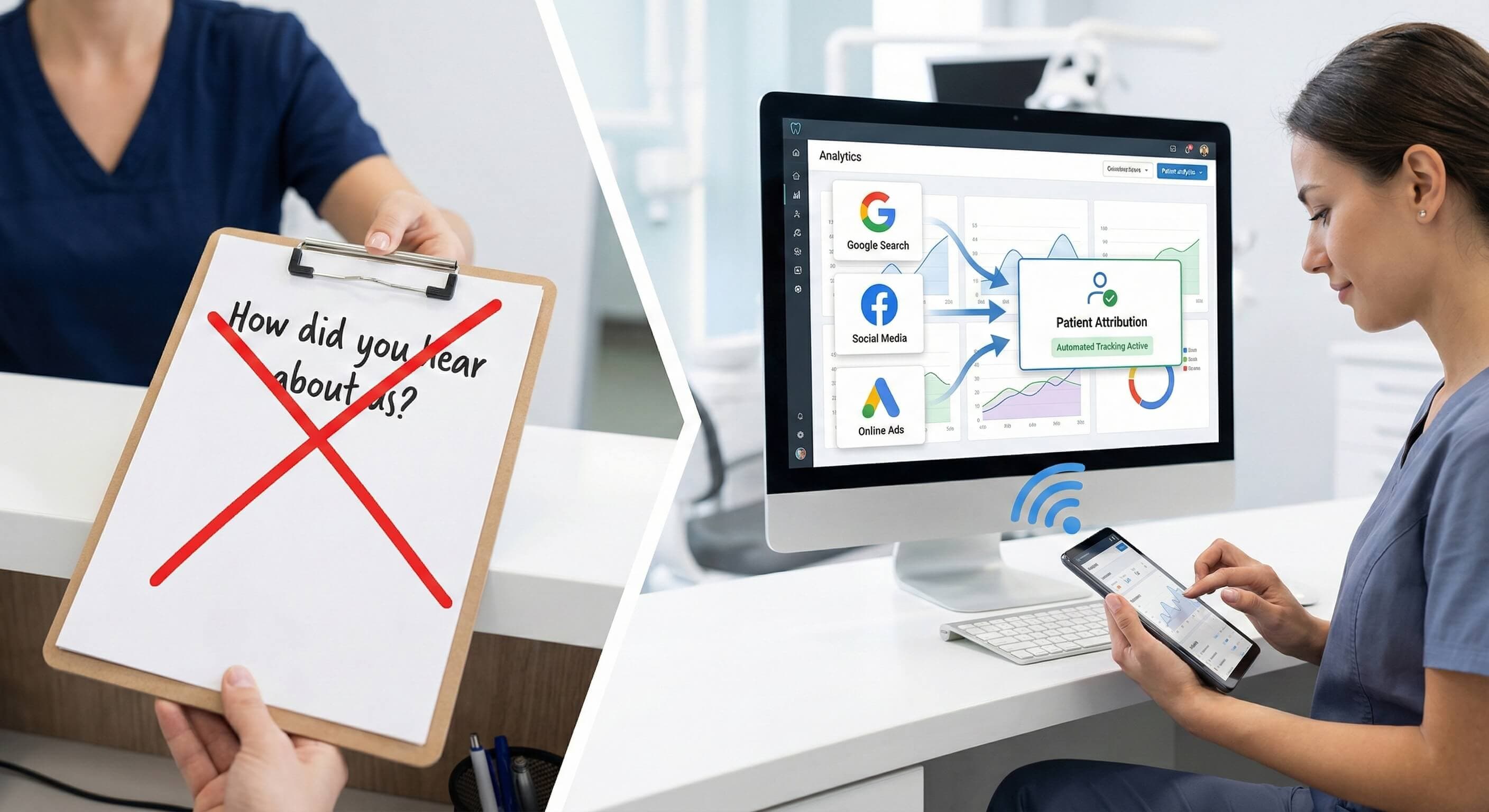
Before (manual attribution): Patient calls → front desk asks "how did you hear about us?" → patient says "Google" → PMS records "Google" → month-end report says "14 from Google" → nobody knows which campaign, keyword, or ad
After (DentiVoice automated attribution): Patient calls → DentiVoice answers → source already tagged (Google Ads – implant campaign – keyword: "dental implant consultation [city]") → appointment books into PMS with source attached → month-end report: "6 from implant campaign ($25,200 revenue), 4 from emergency campaign ($1,400), 3 from organic ($2,800), 1 from recall text ($950)"
Same 14 patients. Completely different level of insight. And nobody had to ask anyone anything.
See the difference between "14 from Google" and "6 from implant campaign at $25,200."Book a free DentalBase demo →
What Your Front Desk Does Instead
Removing "how did you hear about us?" doesn't remove your front desk from the process. It removes the one task they were worst at — collecting accurate marketing data during a high-pressure patient interaction.
With DentiVoice handling source attribution automatically, your front desk focuses on what they're good at: welcoming the patient, verifying insurance, and making the experience personal. They can even use the attribution data — if the DentalBase dashboard shows the patient came through an implant campaign, the front desk knows what brought them in without asking.
For after-hours and overflow calls, the question was never being asked anyway. Voicemail doesn't collect attribution data. DentiVoice handles these calls, books the appointment, and tags the source — all in a single interaction.
Free your front desk from bad data collection.Book a free DentalBase demo and see how automated attribution works alongside your existing team.
The Report Changes Too
When you stop relying on patient-reported sources and start using automatic attribution, your monthly marketing report transforms. For a detailed breakdown of what that report should include, see Why Your Marketing Reports Aren't Telling the Truth.
The DentalBase dashboard replaces "14 patients from Google" with:
| Source | Patients | Appointments Booked | Revenue | Cost | ROI |
|---|---|---|---|---|---|
| Google Ads – implant campaign | 6 | 6 | $25,200 | $840 | 30x |
| Google Ads – emergency campaign | 4 | 5 | $1,400 | $620 | 2.3x |
| Organic search | 3 | 3 | $2,800 | $400 (SEO) | 7x |
| Recall text campaign | 1 | 1 | $950 | $12 | 79x |
That table tells you exactly where to put your next marketing dollar. The old "14 from Google" told you nothing.
"The first time a practice owner sees their patients broken out by actual campaign instead of 'Google,' they realize how many budget decisions they made on guesswork," says Jordan, DentalBase's Head of Sales. "It's usually the single biggest unlock in their marketing."
For a complete walkthrough of how this attribution connects from ad click to revenue, see From Google Ad to Filled Chair.
What the First 30 Days Reveal
Practices that switch from intake-form attribution to DentiVoice automated tagging consistently discover three things in the first month:
After-hours calls are bigger than anyone realized. When "how did you hear about us?" was the only method, after-hours callers were invisible — they hit voicemail and never got asked. With DentiVoice answering and tagging those calls, practices typically find 25–35% of marketing-generated calls come outside business hours.
"Referral" is smaller than the forms suggested. When automatic attribution tracks the digital touchpoint that preceded the call, the referral category shrinks and paid/organic channels grow — which changes budget allocation.
One or two campaigns carry the entire ROI. With campaign-level attribution instead of "Google" as one bucket, most practices find that one specific campaign produces the majority of their revenue. That campaign was invisible inside "14 from Google." Now it's visible and scalable.
Stop Asking. Start Knowing.
"How did you hear about us?" was the best tool available when every call was answered by a human. It was never accurate, but it was all we had.
Now there's a system that knows the answer before the patient says a word — because the platform that handles the call also tracks the source, books the appointment, and connects it to revenue. That system is DentalBase.
Ready to retire the question? Book a free DentalBase demo and Explore all DentalBase services →
Frequently Asked Questions
The major trend in dentistry for 2026 is the shift from manual patient tracking methods like "How did you hear about us?" surveys to automated attribution systems. Dental practices are adopting sophisticated analytics platforms that automatically track the complete patient journey across multiple touchpoints, providing more accurate marketing insights and enabling data-driven decision making for practice growth.
Dentistry will become increasingly data-driven and digitally integrated. Practices will rely on automated systems to understand patient acquisition, optimize marketing spend, and improve operational efficiency. The patient experience will be more personalized through better journey mapping, while compliance with data privacy regulations will become standard practice. Technology will handle routine tracking tasks, allowing staff to focus more on patient care.
Automated attribution captures the complete patient journey across multiple touchpoints, while manual surveys only capture the last remembered interaction. Patients often forget earlier touchpoints or provide inaccurate information. Automated systems track every click, search, and interaction in real-time, providing dental practices with precise data to optimize their marketing investments and understand true patient acquisition costs.
Dental practices need integrated analytics platforms like Google Analytics 4, marketing automation tools, and CRM systems that can track patient interactions from first contact to appointment booking. Call tracking software, UTM parameters, and conversion pixels are essential components. Many practices also benefit from specialized dental marketing platforms that combine these tools into user-friendly dashboards.
Automated attribution shows exactly which marketing channels generate the most valuable patients, allowing practices to eliminate wasteful spending on ineffective campaigns. By understanding the true cost per acquisition and lifetime value of patients from different sources, practices can reallocate budgets to high-performing channels and optimize their marketing ROI significantly.
Was this article helpful?
Written by
DentalBase Team
The DentalBase Team is a collective of dental marketing experts, AI developers, and practice management consultants dedicated to helping dental practices thrive in the digital age.