How to Build a Dental Marketing Content Plan in One Day
Learn how to create a dental marketing content plan for your practice in a single session. A step-by-step guide with content types, scheduling, and.
Share:
Table of contents
Most dental practices know they should be posting on social media, sending emails, and updating their blog. Few actually do it consistently. The reason is not a lack of ideas. It is a lack of structure. Without a dental marketing content plan, your team ends up scrambling for something to post on Tuesday morning, recycling the same generic graphic, or going silent for weeks.
That pattern costs you visibility and consistency. Search remains one of the main ways patients discover local providers online, and practices that rarely publish or update content often struggle to stay visible in search results. A single focused planning session can fix this. Here is how to map out an entire month of content in one sitting, so your marketing runs with intention instead of as an afterthought.
What Is a Dental Marketing Content Plan and Why Do You Need One?
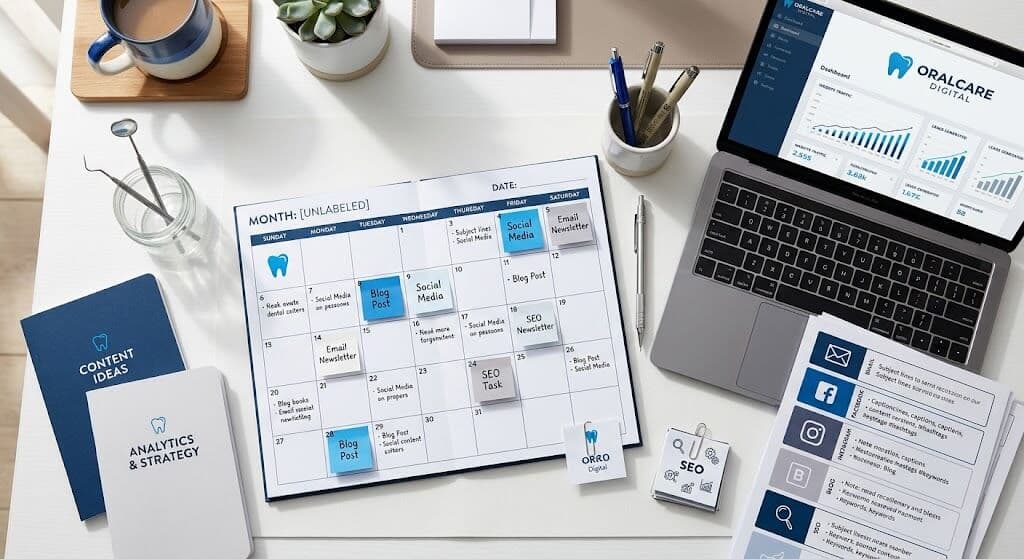
A dental marketing content plan is a pre-built calendar that maps every blog post, social update, email, and campaign to specific dates, channels, and goals for your practice. It replaces reactive posting with a system that supports patient acquisition, retention, and better use of your team’s time.
Think of it this way. A growing practice might publish several social posts each week, send a monthly newsletter, and post one or two blogs each month. Without a plan, each piece gets created in isolation. The Instagram post on Monday does not support the blog published on Wednesday, which does not connect to the email sent on Friday.
The result is scattered messaging and wasted effort. A strong dental marketing content plan connects each piece to a monthly theme, a target topic, and a measurable business goal. It also makes delegation easier, because your office manager or marketing coordinator can work from a clear roadmap instead of guessing what to create next.
Your content plan does not need to be complicated. It needs to exist. Even a simple spreadsheet with dates, topics, channels, and owners will outperform improvisation almost every time.
Related: Get a deeper look at building a full marketing strategy for your practice → How to Market a Dental Practice: A 2026 Strategy Guide
How Should You Prepare Before Your Content Planning Session?
Before you sit down to plan, gather four things: your practice’s current analytics, a list of services you want to promote, your existing content inventory, and a calendar of upcoming events or seasonal trends. Spending a short block of time on preparation saves hours of guesswork during the actual planning session.
Start with analytics. Review your Google Business Profile activity, website traffic from the last 60 to 90 days, and social media engagement. You are looking for patterns. Which blog posts brought in traffic? Which social posts earned comments, shares, or saves? What pages do patients visit most before booking?
Next, list the services that matter most to your revenue. Not every service deserves equal content attention. Implants, cosmetic dentistry, clear aligners, and higher-value procedures usually deserve more strategic coverage than routine updates alone. Your dental marketing content plan should weight topics toward services that support your growth goals.
Build Your Seasonal Context
Dental content is not one-size-fits-all year round. January often brings insurance reset conversations. Spring can support graduation smile messaging. Back-to-school season can drive pediatric checkups. Map these ideas to your calendar before assigning specific topics. Also note any local events, practice milestones, or awareness months that give you timely hooks.
Finally, audit what you already have. You may discover a blog post from several months ago that performed well but was never repurposed for email or social media. Repurposing existing content is one of the fastest wins in a practical content strategy.
Need Help With Your Dental Content Strategy?
DentalBase builds SEO-driven content calendars for dental practices, so you get consistent publishing without the guesswork.
Explore Dental SEO →How Do You Choose Topics That Actually Drive Patient Calls?
The best topics sit at the intersection of what patients search for, what your practice wants to promote, and what your competitors are not covering clearly in your market. Choosing topics based on gut feeling often leads to content that gets ignored, while better topic selection gives your dental marketing content plan a real chance to drive traffic and appointments.
Here is where many practices go wrong. They write about what feels interesting clinically, not what patients are actively searching. A post written for peers may sound impressive, but it will not help much if it does not match patient intent. A patient-friendly topic like “How Long Do Dental Implants Last?” is far more likely to attract useful traffic than a highly technical headline.
Use search suggestions, People Also Ask results, your front desk’s most common patient questions, and your service pages to build topics that reflect real demand. This keeps your dental marketing content plan grounded in what patients actually want to know.
Related: Use smarter topic ideas with AI prompts built for dental teams → AI Prompts for Dentists Guide
Mapping Topics to the Patient Journey
Not all content serves the same purpose. Organize your topics into three categories:
- Awareness content targets people who do not know they need your help yet. Blog posts like “Signs You Might Need a Root Canal” or “What Causes Bleeding Gums” can attract people researching symptoms or concerns.
- Consideration content helps people compare options. Think “Invisalign vs. Traditional Braces” or “How to Choose a Family Dentist.”
- Decision content helps convert interest into action. This includes patient FAQs, first-visit pages, financing information, and insurance guides.
A strong monthly plan includes topics from all three stages. If you only publish awareness content, you may attract visitors who are not ready to book. If you only publish decision content, you may not bring enough new people into the funnel.
Related: Learn how to turn your blog into a patient acquisition channel → How to Start a Dental Blog That Attracts Patients
What Does a One-Sitting Content Planning Session Look Like?
A productive content planning session usually takes two to three hours and follows a simple sequence: set monthly themes, assign topics to channels, draft headlines and outlines, schedule publish dates, and assign owners. Trying to figure it out as you go is exactly how teams end up with empty calendars by week two.
Block the time on your calendar like a real appointment. Close your email. Here is the sequence that works:
Step 1: Set Your Monthly Theme
Pick one or two focus areas for the month. Maybe it is implant awareness, pediatric back-to-school visits, or cosmetic consultations. Every piece of content should support that theme from a different angle. That is what gives your dental marketing content plan consistency.
Step 2: Fill Your Channel Grid
Create a simple grid. Rows are weeks. Columns are your channels, such as blog, email, Instagram, Facebook, and Google Business Profile. Fill in each cell with a specific topic and format. For example:
| Week | Blog | Social Media | |
|---|---|---|---|
| Week 1 | “5 Signs You May Need Dental Implants” | Monthly newsletter with implant FAQ | Educational carousel and patient Q&A reel |
| Week 2 | Promote Week 1 blog | Implant cost explainer email | Myth-buster post and team insight |
| Week 3 | “Dental Implant Recovery: What to Expect” | None | Testimonial clip and educational tip |
| Week 4 | Promote Week 3 blog | Recall or reactivation reminder | Office culture post with consult CTA |
Step 3: Draft Headlines and Outlines
Do not write the full posts yet. Write the headline and three to five key points for each piece of content. This is the step that makes execution faster later. A clear outline means your writer, coordinator, or internal team can turn ideas into finished drafts much more efficiently.
Step 4: Assign Owners and Deadlines
Every content piece needs an owner and a due date that lands before the publish date. No owner means no accountability. No buffer usually means rushed execution. A dental marketing content plan only works when responsibilities are clear.
Let AI Handle Your Phones While Your Team Handles Content
DentiVoice AI Receptionist answers patient calls 24/7, so your front desk can focus on in-office tasks and marketing execution.
Learn About DentiVoice →Which Content Formats Work Best for Dental Practices?
Blog posts, short-form video, email newsletters, and Google Business Profile updates are among the most practical formats for most dental practices. The ideal mix depends on your team’s capacity and your audience, but nearly every dental marketing content plan should prioritize at least two or three of these channels each month.
Not all formats require equal effort. A long-form blog post may take several hours to produce. A short video answering a common patient question may take only a fraction of that time. Both can support patient acquisition when they are tied to the right topic and offer.
Blog Posts
Blogs are your long game. They build relevance over time as search engines index and rank your content. Two well-optimized posts per month is a solid starting point for many practices. You do not need to publish constantly. You need to publish consistently and strategically.
Social Media
Social media helps reinforce trust and keeps your practice visible between appointments. Educational carousels, short videos, team credibility posts, and patient-friendly FAQs usually outperform random promotional graphics. Your dental marketing content plan should include repeatable content formats your team can realistically sustain.
Email is still one of the most useful channels for patient communication and reactivation. A monthly newsletter paired with one focused campaign, such as recall reminders, new service announcements, or seasonal promotions, is often a manageable cadence for busy teams.
Google Business Profile Posts
These are fast to create and support local visibility. Post regularly. Share offers, events, blog links, or quick tips. Many competitors still underuse this channel, which makes it a practical opportunity for consistent local marketing.
Related: Build a social posting rhythm that does not burn out your team → How to Build a Monthly Social Media Calendar for Your Dental Practice
How Do You Measure Whether Your Dental Marketing Content Plan Is Working?
Track three things monthly: website traffic from organic search, new patient inquiries tied to content, and engagement across your social channels. A dental marketing content plan that is not measured can quickly become a task list with no real learning behind it.
Organic traffic shows whether your blog and SEO efforts are expanding your visibility. Inquiries and booked appointments show whether that visibility is turning into business outcomes. Social engagement tells you whether your messaging and format choices resonate with your existing audience.
Set a monthly review checkpoint. Spend a short block of time at the start of each planning session reviewing the previous month’s results. Drop what did not work. Double down on what did. Your dental marketing content plan should be a living document, not a static file.
See What’s Working and What Isn’t
DentalBase connects your marketing channels to patient outcomes, giving you clearer attribution across SEO, ads, social, and calls.
View All Services →What Are the Biggest Mistakes Practices Make With Content Planning?
The most common mistakes are planning without a goal, creating content for algorithms instead of patients, and building a calendar that is too ambitious for the team’s actual capacity. Any one of these can weaken a dental marketing content plan within the first few weeks.
Planning without a goal is one of the biggest issues. “Post more on social media” is not a useful goal. “Publish two blog posts this month focused on implant-related searches to support more consultation requests” is much clearer. Specificity shapes topic selection, format choice, and measurement.
Writing for algorithms instead of people is another trap. Keywords matter, but readability, usefulness, and clarity matter more. If your blog sounds robotic or stuffed with repeated phrases, patients lose interest and performance usually suffers with them.
The Capacity Problem
This is where many plans fall apart. A busy front desk team handling check-ins, insurance verification, and phones cannot usually produce high-quality content at an unrealistic volume every week. Be honest about your bandwidth. Two strong blog posts per month are better than a full calendar of rushed, forgettable content.
One more mistake worth flagging is failing to repurpose content. A single blog post can become several social posts, one email section, a Google Business Profile update, and a short video script. If you create everything from scratch every time, you are making the workload heavier than it needs to be. A smart dental marketing content plan should make one idea work across multiple channels.
Related: Avoid costly missteps that drain your marketing budget → How to Avoid Common Dental Marketing Mistakes That Cost You
The single most important thing about a dental marketing content plan is not the template or the tool. It is the commitment to plan once, then execute consistently. Practices that publish regularly, refine what they create, and measure performance tend to outperform practices that post sporadically. Your next step is simple: block time on your calendar this week, gather your analytics, choose your monthly focus, and build your grid. If you want a team that can support the content creation and SEO strategy behind it, that option exists too. Either way, stop improvising and start planning.
Ready to Build a Content Plan That Drives Patient Growth?
See how DentalBase helps practices plan, publish, and measure marketing content that brings in new patients every month.
Book a Free Demo →Explore More Guides for Growing Your Practice
Browse Resources →Sources & References
- BrightEdge Research: Organic Search Channel Share
- BrightLocal: Local Consumer Review Survey
- Pew Research Center: Internet and Technology
- WordStream: Dental Marketing Benchmarks
- Hootsuite: Social Media Trends Research
- Search Engine Land: AI Overviews and Search
- ADA: Practice Management Resources
- Google Trends
Frequently Asked Questions
A focused planning session takes two to three hours. This covers setting a monthly theme, selecting topics, mapping them to channels, drafting outlines, and assigning deadlines. Preparation like pulling analytics and listing services adds another 30 minutes beforehand.
Two well-optimized blog posts per month is a strong baseline for most practices. Consistency matters more than volume. According to WordStream, organic search converts at 3.5% for dental, so two quality posts targeting the right keywords can generate meaningful traffic over time.
A complete plan includes a monthly theme, specific topics for each channel (blog, social, email, GBP), content formats, publish dates, assigned owners, and due dates. Each topic should map to a patient journey stage: awareness, consideration, or decision.
Use Google's People Also Ask boxes and search suggestions to find questions real patients ask. Focus on topics that align with high-value services like implants or cosmetic dentistry. Avoid clinical jargon that patients don't search for.
Facebook remains the most used platform among dentists, with 97% reporting it as their main channel according to Dental Economics. However, Instagram and short-form video are gaining ground because video posts generate 48% more engagement than static images on dental accounts.
Track three metrics monthly: organic website traffic, new patient calls attributed to content, and social media engagement rates. Use call tracking to connect specific blog posts or pages to appointment bookings. Review and adjust at the start of each month's planning session.
Yes, but be realistic about capacity. A small team can handle two blog posts, eight to ten social posts, and one email per month. Repurposing blog content across channels reduces workload. If that still exceeds bandwidth, outsourcing content creation while keeping strategy in-house is a practical middle ground.
Was this article helpful?
Written by
DentalBase Team
The DentalBase Team is a collective of dental marketing experts, AI developers, and practice management consultants dedicated to helping dental practices thrive in the digital age.