How to Respond to Negative Dental Reviews (+ Templates)
Learn how to respond to negative dental reviews with HIPAA-safe templates, timing rules, and a 5-step framework that protects your practice's reputation.
Share:
Table of contents
Knowing how to respond to negative dental reviews is one of the highest-impact skills a practice owner can build, and most teams figure it out the hard way. There's a phone call that goes sideways at the front desk, a billing surprise, or a treatment outcome that didn't match the conversation in the chair. Then it shows up on Google, in public, with three sentences that future patients will read for the next year.
The reply isn't really for the reviewer. It's for the next 200 people reading the thread before they decide whether to book. A clear public response can pull future bookings back from the brink, while silence quietly drains them.
This guide covers the timing, the HIPAA limits, a 5-step response framework, six ready-to-use templates for the most common scenarios, and when Google will actually remove a review. By the end, your designated responder will have a system that protects the practice's reputation without making things worse.
Why do negative dental reviews matter so much for your practice?

Negative dental reviews shape booking decisions because prospective patients trust reviews almost as much as personal recommendations, and one bad review can deter dozens of potential first visits. The damage compounds when the practice doesn't respond, because silence reads as confirmation.
The math is unforgiving. According to BrightLocal's Local Consumer Review Survey, 98% of people read local reviews before choosing a business, and 88% are more likely to use a business if the owner responds to all reviews. That second number is the lever. Future patients aren't just judging your past mistakes. They're judging how you handle them in public.
Here's the thing. The average lifetime value of a general dentistry patient sits between $12,000 and $15,000, per Dental Economics. A single negative review that scares off five prospective patients in a year costs the practice up to $75,000 in lost lifetime value. That's before counting insurance write-offs, referrals those patients would have made, or hygiene production.
Reviews also feed AI search results. When someone asks ChatGPT or Google's AI Overviews for a dentist in your area, the model weights recent review content and response patterns heavily. Practices that don't respond get summarized as "mixed reviews, no follow-up from the office." That summary lives in the search result whether you see it or not. If you haven't claimed and optimized your listing yet, start with adding your practice to Google Maps before worrying about review responses.
How fast should you respond to a negative dental review?

Respond within 24-48 hours of the review going live. Faster is fine. Slower starts costing you. Speed signals to future readers that the practice pays attention; silence signals indifference, regardless of how strong your written response eventually is.
Set up Google Business Profile notifications and any review monitoring tool to alert you the moment a new review posts. HubSpot notes that consumers expect businesses to be responsive online, and reviews spread quickly across mobile devices during evenings and weekends. A complaint posted Friday at 7 pm and answered Monday at 10 am has already been seen by hundreds of local searchers.
That said, fast doesn't mean reactive. A two-minute response written while you're angry causes more damage than a three-hour delay. The right cadence is this: see the review within the hour, draft the response, let one other person on the team read it before it goes live, then post. Worth noting: most practices struggle to hit this cadence because the front desk is buried with patient calls, which is its own separate problem.
More reputation resources for dental practices
Templates, scripts, and guides for every patient touchpoint that ends up on Google.
Browse Resources →What can you legally say in a dental review response? (HIPAA rules)
You cannot confirm that the reviewer is or was a patient. You cannot reference any clinical details, treatment plans, billing specifics, or appointment history. HIPAA treats acknowledging the treatment relationship as a disclosure of protected health information, even when the patient brought it up first publicly.
This is the single most expensive mistake practices make. A reviewer writes "Dr. Smith botched my root canal." The dentist replies "We performed the root canal exactly per protocol, and the X-rays show no issue." That reply just confirmed the person was a patient and disclosed treatment details. The American Dental Association has documented multiple state-level enforcement actions against practices that responded this way, with fines reaching six figures.
What you can say in public:
- General statements about the practice's approach to care or scheduling
- Apologies for the experience the person describes, without confirming the experience occurred at your office
- An invitation to discuss any concerns privately
- Your office phone number and a named team member to ask for
What you cannot say in public:
- "Thank you for being a patient" or "We're sorry your visit was disappointing"
- Anything about the specific treatment, diagnosis, or financial transaction
- Defensive corrections of facts the reviewer got wrong
- Any reference to insurance, billing codes, or appointment dates
The safest framing uses conditional language: "If you visited our practice..." rather than "When you visited our practice..." This protects PHI even if the reviewer is fabricating the visit entirely. Specialists, including orthodontists, follow the same HIPAA rules; for a specialty-specific walkthrough, see our guide for orthodontists responding to Google reviews.
The 5-step framework for responding to a negative dental review
Every effective response follows the same pattern: acknowledge the feedback, apologize generally, empathize with the experience, invite the conversation offline, and offer a specific next step. The framework keeps responses calm, HIPAA-safe, and useful to future readers no matter how unreasonable the original complaint.
The order matters. Skipping a step or rearranging them makes responses sound either robotic or defensive. Here's how each piece works.
1. Acknowledge the feedback
One sentence that confirms you've read what was written. Avoid "we appreciate your feedback," which sounds canned. Try "Thank you for taking the time to share this." This positions you as listening, not bracing for a fight.
2. Apologize generally
Apologize for the experience the person describes, never for an event you'd have to confirm happened. "We're sorry to hear about an experience that didn't meet expectations" is HIPAA-safe. "We're sorry your appointment ran long" is not, because it confirms there was an appointment.
3. Empathize
One sentence that validates the emotion without validating contested facts. "Frustration with billing or wait times is completely understandable." You're agreeing with the feeling, not the specific accusation.
4. Invite offline
This is the most important step. Move the conversation to a phone call. Use a specific name and direct number, not "please call our office." Naming a person signals accountability and lowers the friction for the reviewer to actually engage. If your front desk can't reliably answer that incoming call, the offline invitation backfires. Train the team using a structured phone call script so the follow-up conversation is as professional as the written response.
5. Offer a next step
End with what happens if they call. "We'd like the chance to learn more and make this right." Not a refund promise. Not a defensive explanation. Just a stated willingness to listen.
Most negative reviews start with a frustrating phone call
See how DentiVoice handles new patient calls, after-hours questions, and billing follow-ups with a consistent tone, so fewer experiences end up on Google in the first place.
Book a Free Demo →Negative dental review response templates (6 scenarios)

These templates apply the 5-step framework to the six most common complaint types: billing disputes, wait times, treatment outcomes, staff interactions, insurance frustrations, and suspected fake or competitor reviews. Adapt the language, but keep the structure and the HIPAA-safe framing.
Each template is written to be copied, customized with one specific contact name, and posted. Replace [PRACTICE NAME], [MANAGER NAME], and [PHONE] before publishing. Don't add anything that confirms the treatment relationship.
| Scenario | Template |
|---|---|
| Billing dispute | Thank you for taking the time to share this. We're sorry to hear about an experience that didn't meet expectations. Frustration around billing is completely understandable, and we take concerns like this seriously. We'd like the chance to look into this with you directly. Please call [MANAGER NAME] at [PHONE] so we can learn more and make this right. |
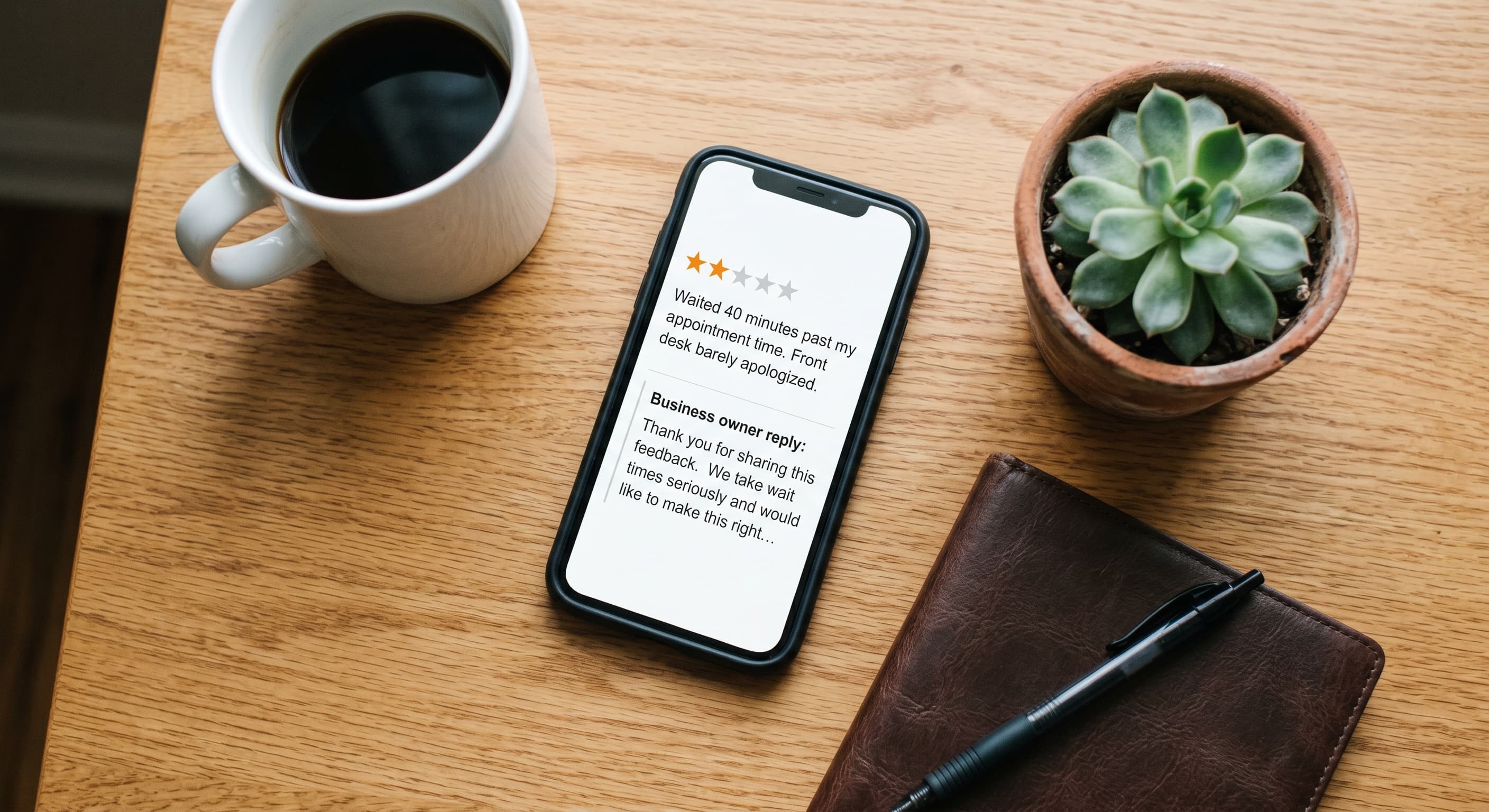
| Long wait time | Thank you for sharing this feedback. We're sorry that the experience described didn't reflect the timely care we work to deliver. Waiting longer than expected is frustrating for anyone. We'd appreciate the opportunity to learn more about what happened. Please reach out to [MANAGER NAME] directly at [PHONE]. |
| Treatment outcome | Thank you for taking the time to write. We're sorry to hear about an experience that fell short of expectations. Concerns about care are important to us, and we take every one seriously. Please call [MANAGER NAME] at [PHONE] so we can have a confidential conversation and address this properly. |
| Staff complaint | Thank you for sharing this. We're sorry that the experience described didn't reflect the welcoming environment our team works hard to provide. Feeling unheard or rushed isn't the impression we want anyone to leave with. Please contact [MANAGER NAME] at [PHONE] so we can listen and improve. |
| Insurance issue | Thank you for the feedback. We're sorry to hear about a confusing or frustrating experience. Insurance can be complicated, and we know that adds stress on top of an already difficult situation. Please call [MANAGER NAME] at [PHONE] and we'll walk through anything that needs clarification. |
| Suspected fake or competitor review | We don't have a record matching the experience described in this review. If you'd like to share more details, please contact [MANAGER NAME] directly at [PHONE]. We take all feedback seriously and want the opportunity to address any genuine concerns. |
The fake-review template is deliberately different. It signals to readers that you've checked and can't verify the claim, without accusing the reviewer of lying. That tone is the right one even when you're 95% sure the review came from a competitor.
Related: Negative reviews often start with phone calls that should never have been missed in the first place → The real cost of a missed call at a dental practice
When (and how) to ask Google to remove a fake dental review

Google removes reviews that violate its content policies, including profanity, hate speech, off-topic content, conflicts of interest, and impersonation. Google does not remove reviews just because the practice disagrees with the patient's account or believes the review is unfair. Knowing which side a review falls on saves you time.
The flagging process runs through Google Business Profile. Open the review, click the three-dot menu, and select "Report review." Google then asks which policy was violated. HubSpot's guide to responding to Google reviews breaks down each policy category, and matching your flag to the right category meaningfully improves removal odds.
Reviews that typically get removed:
- Contain profanity, slurs, or graphic language
- Reference a competitor's practice or include promotional content for another business
- Were posted by someone with a clear conflict of interest, like a former employee
- Are visibly part of a coordinated attack (multiple fake reviews in a short window)
- Discuss something off-topic, like politics or general healthcare opinions
Reviews that typically don't get removed:
- One-star ratings with no text
- Vague complaints about cost or wait time
- Strongly negative opinions about the dentist's bedside manner
- Disputes the practice believes are factually wrong
If a review is genuinely defamatory, meaning it makes false statements of fact (not opinion) that damage your professional reputation, consult a healthcare attorney before posting anything publicly. Legal removal routes exist but are slow, expensive, and only work for narrow categories of clearly false claims. The faster reputation defense is almost always a strong public response plus a steady stream of fresh positive reviews from satisfied patients. Reviews also feed directly into ranking signals; the 2026 Google local SEO updates increased the weight of review velocity and response rate for healthcare categories.
The reality is most fake reviews don't get removed on the first try. Flag them anyway, respond professionally in the meantime, and focus on building review volume so any single negative review carries less weight in the overall average.
Knowing how to respond to negative dental reviews is one of the highest-impact marketing skills a practice owner can develop, because every response is read by hundreds of future patients deciding whether to book. The response, not the original review, is what shapes their decision.
Pick one person on the team to own this. Give them the templates above, a clear 24-48 hour response window, and the authority to post replies without waiting for the dentist's approval on every wording change. Then add a 15-minute weekly review of new feedback to spot operational patterns before they show up on Google again.
The single next step: audit your last 12 months of Google reviews this week. Count how many you responded to, how fast you responded, and how many followed the 5-step framework. That number is your starting baseline. From there, the DentalBase platform can help you tie those reviews back to specific calls, patient experiences, and marketing channels.
Stop bad calls from becoming bad reviews
See how DentalBase helps practices answer every call professionally, log every patient interaction, and prevent the front-desk frustrations that turn into one-star reviews.
Book a Free Demo →Want more reputation and growth playbooks for your practice?
Browse Resources →Sources & References
Frequently Asked Questions
Respond within 24-48 hours. Most prospective patients reading a negative review also check whether the practice replied and how quickly. A same-week response signals attentiveness; a delayed response or silence signals indifference, even if the original complaint was unfair.
No. HIPAA prohibits confirming that someone is a patient or referencing any clinical details, even if the reviewer disclosed them first. Acknowledging the treatment relationship is itself a disclosure. Keep responses general and move specifics to a private phone conversation.
Yes, respond publicly even if you suspect the review is fake. A measured, professional reply protects your reputation with readers who weren't involved. Then flag the review through Google's removal process if it violates platform policies, like containing profanity or being clearly off-topic.
Getting defensive in writing. Public arguments make the practice look worse than the original review, regardless of who's right. The goal of a public response is to show future patients how you handle conflict, not to win the dispute with the reviewer.
Designate one trained person, usually the office manager or marketing lead, to draft responses using approved templates. The dentist reviews and approves before posting. This keeps tone consistent and prevents emotional replies written in the moment.
Google removes reviews that violate its content policies, including profanity, hate speech, conflicts of interest, or off-topic content. Google does not remove reviews just because the practice disagrees with the patient's experience. Flag policy violations through Google Business Profile.
There's no fixed threshold, but reviewers and AI search tools weight recent reviews more heavily. A pattern of similar complaints in the last 90 days signals a real operational issue. Track themes across reviews, not just star counts, to spot fixable problems.
Indirectly, yes. Google considers review velocity, review response rate, and review content as ranking signals for local search. Practices that respond to every review tend to outrank similar practices with comparable star ratings that ignore their reviews.
Was this article helpful?
Written by
DentalBase Team
Expert dental industry content from the DentalBase team. We provide insights on practice management, marketing, compliance, and growth strategies for dental professionals.