
How to Attract Your First Dental Patients: A 2026 Playbook
How to attract first dental patients in 2026. A startup-stage playbook covering Google Business Profile, local SEO, paid ads, referrals, and intake.
Share:
Table of contents
Knowing how to attract first dental patients is the single biggest hurdle a new practice faces, and most owners underestimate it by months. You have a beautiful office, a hygienist on payroll, and an empty schedule. The clock is loud.
The reality is that a startup practice has none of the assets that mature offices rely on. No reviews. No domain authority. No referrals from happy patients. You are starting from zero across every channel at once, and your costs are running whether the chairs are full or not.
This guide covers the nine levers that actually move the needle in your first 90 days, sequenced from fastest payback to longest. Skip the levers, skip the patients.
How long does it take a new dental practice to get its first patients?
Most new practices book their first patient within two weeks of opening if Google Ads are live, and reach 100 active patients in 60 to 90 days with active marketing. Practices that wait for word of mouth alone can take 12 to 18 months to fill the schedule.
The reason for the gap is research behavior. According to BrightLocal's local consumer review research, 98% of consumers read online reviews before choosing a local business. New practices have none. So the first patients come from people who are searching with high intent and willing to take a small risk on a fresh face, usually because they had a bad experience at their last office, just moved, or have an urgent issue.
That tells you who to target and how. Focus your early spend on emergency keywords ("emergency dentist near me"), insurance-friendly searches (your top three accepted plans), and new mover lists. Forget cosmetic patients in month one. They want long Google profiles with hundreds of reviews. You do not have those yet.
Set a 90 day target of 80 to 120 booked new patient visits. Anything below 50 means a lever is broken, usually unanswered phones or a slow ad approval.
Why is your Google Business Profile the single most important asset before opening day?
Your Google Business Profile is the highest leverage asset a new dental practice has, because it can rank in the local map pack within weeks while your website needs months of authority. HubSpot's local SEO guide highlights that profile completeness, primary category match, and proximity drive map pack rankings far more than domain age, which is exactly what a startup practice can control on day one.
Set up the profile a minimum of 30 days before your doors open. The verification postcard alone takes 7 to 14 days, and Google Maps needs time to index your hours, services, and photos. Treat it like a mini website.
Build out every field, not just the required ones
Most new practices fill in the basics and stop. Big mistake. Google rewards completeness. You want primary category set to "Dentist," every secondary category that matches your services (Cosmetic Dentist, Pediatric Dentist, Dental Implants Periodontist if applicable), every service you offer with a 1 to 2 sentence description, hours including holiday hours, parking notes, accessibility details, and at least 20 photos before launch. Interior, exterior, team headshots, and operatory shots all count.
Post weekly Google Updates from week one
Google Posts (Updates, Offers, and Events) sit directly inside your Business Profile and appear in your map listing for 7 days. Most new practices ignore them entirely. Post twice a week from opening day: a new patient offer, a treatment spotlight, a team intro, a community event. Posts feed Google fresh signals about activity, which the algorithm reads as a live, engaged business. They also let you target keywords your category fields cannot.
Related: Google rolled out major changes to local rankings this year. Read the full breakdown â Google's 2026 Local SEO Updates for Dental Practices
What does a "patient-ready" website look like in the first 90 days?
A patient-ready dental website needs only six elements to convert in your first 90 days: a clear hero with location, online booking above the fold, an accepted insurance list, a doctor bio with credentials, mobile load time under 3 seconds, and visible NAP details. Skip the rest until you have patients.
The temptation when launching is to build a 30 page site with service pages for every procedure. Skip it. A startup site is a conversion tool, not an SEO project. Most of your early traffic will come from your Google Business Profile and paid ads, and those visitors land with high intent. They are checking three things: are you legit, do you take their insurance, can they book today.
The startup six
Here is the minimum spec that consistently converts:
| Element | What it does | Common mistake |
|---|---|---|
| Hero with city + service | Confirms in 2 seconds that visitor is in the right place | Generic "We Care About Smiles" tagline |
| Online booking button | Captures after-hours and weekend traffic | Buried in nav, opens a contact form instead |
| Accepted insurance list | Filters out wrong-fit leads, builds trust | Vague "We accept most insurance" line |
| Doctor bio with credentials | Builds E-E-A-T for Google and trust for patients | Stock photo, no school or year |
| Mobile speed under 3s | Prevents bounce on paid ad clicks | Auto-playing video hero on mobile |
| Visible NAP block | Reinforces local SEO consistency signal | Phone hidden in footer only |
Look at a real working dental website example if you want to see this in practice. The pattern is consistent across every site that converts above 8%.
Already have a site that's not converting?
Most startup websites carry conversion blockers their owners cannot see. Here is the audit checklist we run on every new client site.
Read the Conversion Audit âThe local SEO foundation: rank for "dentist near me" without years of authority
Local SEO for a brand new practice is realistic in 90 days for the map pack and 6 to 9 months for organic rankings. The trick is to focus on the three local ranking factors that compound fastest: NAP consistency, review velocity, and proximity-relevant content.
According to Moz local ranking factor research, on-page signals, links, and Google Business Profile signals dominate the algorithm. The good news for new practices is that two of those three are heavily within your control on day one.
Citations and NAP consistency
Submit your name, address, and phone number to the major data aggregators in week one: Yelp, Apple Maps, Bing Places, Healthgrades, Zocdoc, and your state dental association directory. The number must be identical character for character across all of them. A missing suite number on one listing will quietly suppress your map pack visibility for months. This is unsexy work. Do it anyway.
Local content, not blog content
For your first 90 days, skip the generic "What is a Dental Implant" blog posts. Write five city specific pages instead: "Dentist in [Your City]," "Emergency Dentist [Neighborhood]," "Family Dentist Near [Major Landmark]," and so on. Mention nearby streets, schools, and businesses naturally. Google's algorithm rewards proximity context, not word count.
Schema markup
Add LocalBusiness and Dentist schema to your homepage and contact page. Most templates miss this. It tells Google your hours, services, geo coordinates, and accepted payment methods in machine-readable form, which feeds rich results and AI Overview citations.
Should a new practice run Google Ads before it ranks organically?
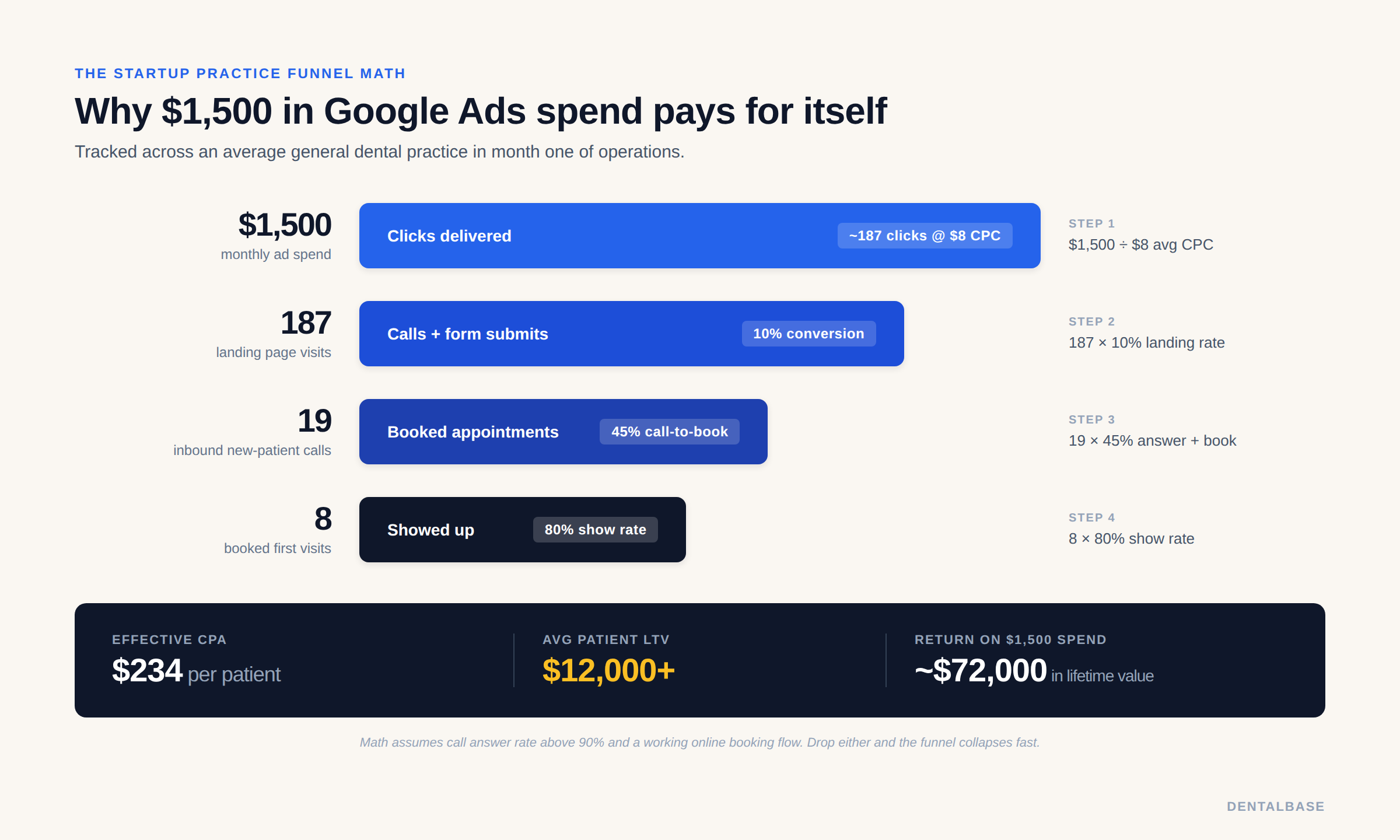
Yes. A new dental practice should run Google Ads from day one, because organic rankings take 6 to 9 months to mature and you cannot wait that long with overhead running. Plan for $1,500 to $3,000 monthly in your first 90 days, focused on emergency and high-intent keywords.
The math works because dental keywords convert. Cost per click for branded service terms typically runs $6 to $12, and a well-built landing page converts 8 to 12% of clicks into booked calls. That puts your cost per acquisition in the $150 to $300 range, which is reasonable against an average general dental patient lifetime value north of $12,000. Bureau of Labor Statistics data on dentists shows steady industry employment growth, which means competition for those high-intent searches is climbing every year.
What to bid on in month one
Skip cosmetic and Invisalign keywords for now. Those carry $25+ CPCs and long research cycles. Bid on:
- Emergency keywords: "emergency dentist [city]", "dentist open Saturday [city]", "tooth pain dentist near me." High intent, willing to try a new provider.
- Insurance keywords: "[insurance name] dentist [city]" for your top three accepted plans. Lower competition, qualified leads.
- New patient specials: A $99 new patient exam offer can pull in price-sensitive searchers, then you upgrade them to comprehensive care.
- Branded competitor terms: Bid on competitor practice names in your immediate radius if budget allows. Aggressive but effective.
Set up call tracking before the first dollar of spend
Most new practices waste their first month of ad spend because they cannot tell which calls came from ads versus organic versus walk-ins. Use a unique tracking number on your ads and route it to your main line. Without this, you will have no idea which keywords actually paid for themselves.
Stop losing the patients you paid to get
A startup practice that misses 30% of new patient calls is paying for ads twice. DentiVoice answers every call, books appointments, and shows you which marketing channel each one came from.
See How DentiVoice Works âReviews from zero: how to get the first 25 Google reviews ethically
Reviews compound faster than any other ranking factor for a new practice, and the goal in your first 90 days should be 25 Google reviews minimum. Most patients will leave one if asked at the right moment, with a direct link, the same day as their visit. Our guide to Google reviews for dentists walks through the exact automation and team training that makes this consistent.
The volume target matters because Google's local algorithm weights review count alongside rating. A 4.9 star practice with 8 reviews will rank below a 4.6 star practice with 80, all else equal. You need critical mass before quality matters.
The four-step ask that actually works
This sequence consistently produces a 30 to 40% conversion rate from each request:
- At checkout, the front desk says: "If you had a good experience today, would you mind leaving us a quick Google review? It really helps us reach other patients in [your city]."
- Hand them a card with a QR code linking directly to your Google review form. Not your website. The actual form.
- Send a text the same day with the same link, two hours after they leave. Same-day conversion is roughly 5x higher than next-day.
- Reply to every review within 48 hours, positive or negative. ADA Health Policy Institute research on patient choice consistently shows that visible practice engagement, including responsiveness to feedback, materially affects which provider new patients pick.
What not to do
Do not offer discounts or gifts in exchange for reviews. That violates Google's policies and can get your profile suspended at the worst possible moment. Do not write reviews from staff accounts, family accounts, or anyone connected to the practice. Google's filters catch this and the penalty is harsh.
If your first reviews are slow, ask anyway. Most practices give up at request three or four because they feel awkward. The script gets easier. Train every clinical and front desk team member.
What offline tactics still work for attracting first dental patients?
Direct mail, opening events, employer partnerships, and new mover lists still work for new dental practices, especially in suburban markets where digital competition is heavy. Plan for offline tactics to deliver 20 to 30% of your first 100 patients, with most coming in months two and three.
Offline matters more than most digital-first marketers will admit. People still drive past your sign every day. People still read mailers when they are deciding whether to switch providers. The point is not to choose digital or offline. It is to make them feed each other.
Direct mail that converts
Send a postcard to every household within a 3 mile radius of your practice. Two waves, four weeks apart. Lead with a specific offer ("$99 New Patient Exam, X-Rays, and Cleaning") rather than generic branding. Include your Google Business Profile QR code so recipients can read reviews before calling. Expect a 0.5 to 1.5% response rate at $0.40 to $0.60 per piece.
New mover lists
People who just moved are 3x more likely to switch dentists in their first 90 days at a new address. Buy a new mover list from your local data provider, send a welcome offer, and follow up with a second mailer at day 30. This single tactic fills more startup chairs than most opening events combined.
Opening events and employer partnerships
Skip the ribbon cutting. Run a "free hygiene exam" event for one local employer instead. Offer the company HR team 25 free comprehensive exams in your first month, in exchange for a 30-minute lunch presentation to their staff. Conversion to paying patients runs 40 to 60% because you have already met them in person.
Tracking the funnel: what to measure in your first 90 days
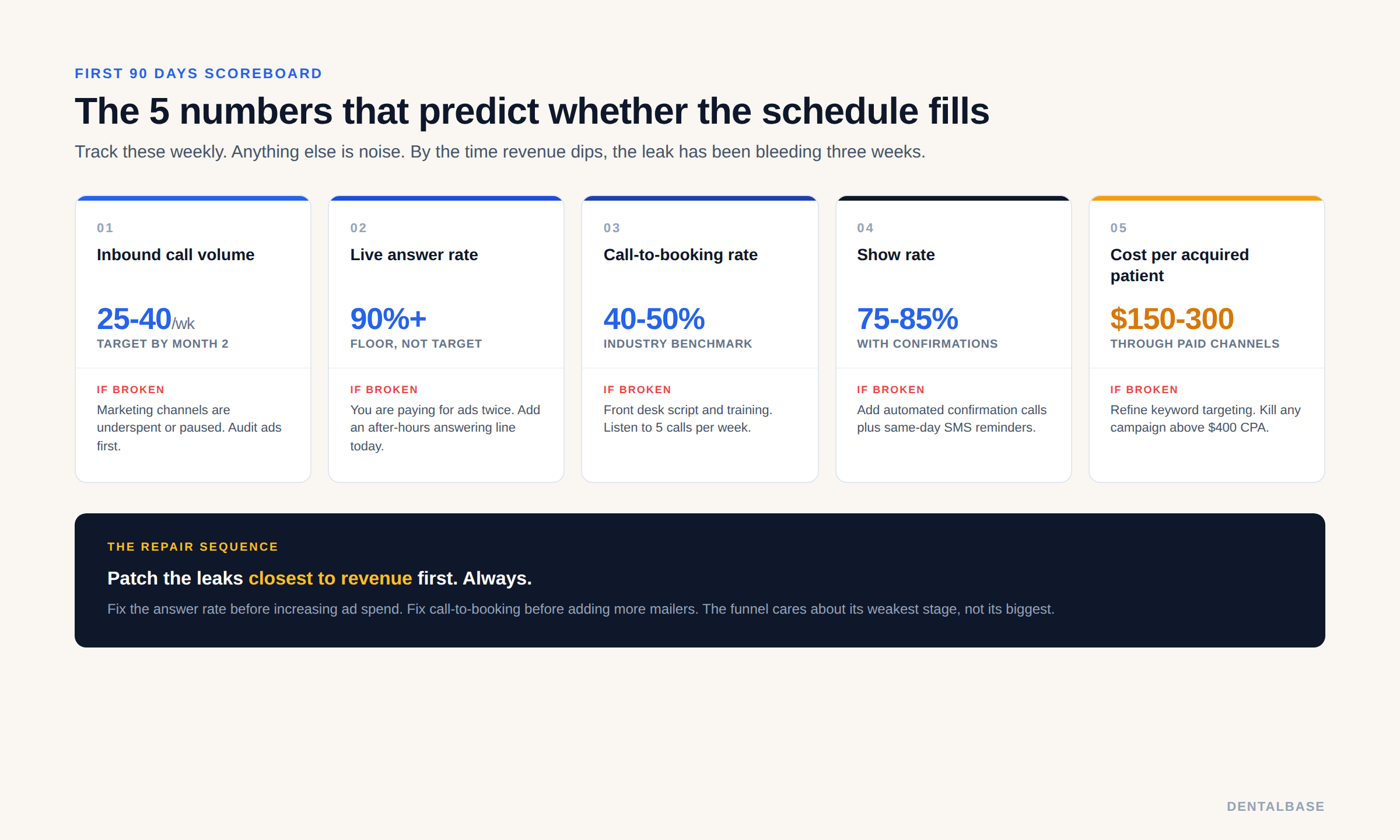
The five metrics that matter for a new dental practice are: total inbound calls, call answer rate, calls to booked appointments, appointment show rate, and cost per acquired patient. Track them weekly. Anything else is noise in your first 90 days.
Most startup practices track revenue and chair fill rate and miss the upstream metrics that actually predict the next month. By the time revenue dips, the leak has already been bleeding for three weeks. The funnel metrics catch it earlier.
The five numbers, defined
- Inbound call volume: Total calls received per week, by source. If this drops, marketing is the issue.
- Answer rate: Percentage of inbound calls answered live. Below 90% means you are paying twice for every patient. Train every front desk team member with a new patient phone script and audit a sample of recordings weekly.
- Call to booking rate: Percentage of answered new patient calls that convert to a booked appointment. Industry benchmark is 40 to 50%. See the full 2026 dental call to booking conversion benchmarks.
- Show rate: Percentage of booked first appointments that show up. New patient show rates run 75 to 85% with confirmation calls and SMS reminders, and drop to 50 to 60% without.
- Cost per acquired patient: Total marketing spend divided by new patients who actually showed and started treatment. This is the real number, not the cost per lead.
If your call answer rate is below 90%, fix that before increasing ad spend. If your call to booking rate is below 35%, fix the phone training before adding new mailers. Patch the leaks closest to the revenue first. Always.
How to attract first dental patients: the 90 day priority sequence
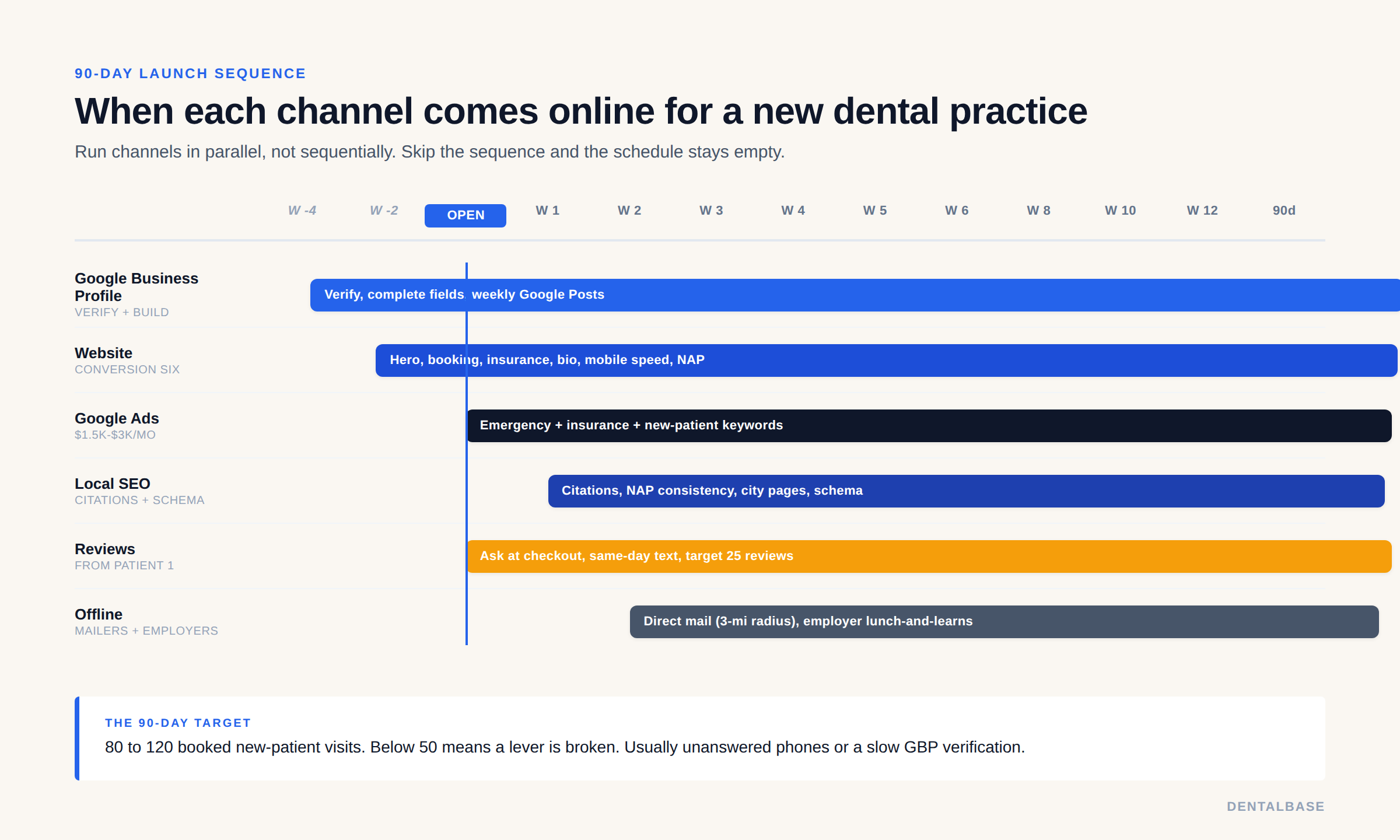
The single biggest mistake new practice owners make is running every channel at half capacity instead of running three channels well. Knowing how to attract first dental patients is less about clever tactics and more about ruthless sequencing. The five things that matter most happen before opening day.
Start with Google Business Profile in week minus 4. Launch the website with the six conversion essentials in week minus 2. Turn on Google Ads in week one. Begin asking for reviews from your first patient. Track the five funnel metrics from day one. Everything else, social media calendars, blog posts, branded merchandise, can wait until month four.
The practices that reach 100 active patients in 90 days are not smarter or better funded. They just refuse to skip steps.
Get your first 100 patients without dropping a single call
DentalBase combines a startup-ready website, local SEO, paid ads, and an AI receptionist that answers every call 24/7. See how it works in a 15-minute demo.
Book a Free Demo âMore guides for new practice owners
Browse the DentalBase Resources Library âSources & References
Frequently Asked Questions
Most new practices book their first patient within two weeks of running ads and reach 100 active patients in 60 to 90 days. Speed depends on Google Business Profile readiness, ad spend, and how quickly inbound calls are answered. Slower openings usually trace back to delayed GBP verification.
Plan for 5 to 8% of projected first year revenue, typically $4,000 to $7,000 per month split across Google Ads, local SEO, and basic content. Expect a cost per acquisition of $150 to $300 per new patient through paid channels, dropping as organic rankings build.
Run both. Google Ads delivers patients in week one but stops the moment you pause spend. SEO delivers compounding traffic but takes 6 to 9 months to mature. A startup practice needs both running in parallel to fill the schedule and build long term equity.
Ask every patient at checkout, send a follow up text with a direct review link the same day, and make sure your team knows the script. Most practices reach 25 reviews within 60 days at a 30 to 40% conversion rate from each ask.
Google Business Profile is the best first marketing channel for a new dental practice because it ranks in the local map pack within weeks. Build it 30 days before opening day with full categories, services, hours, photos, and weekly Google Posts that match real patient searches.
Most general dental practices need 25 to 40 new patients per month to break even on overhead in year one, depending on case mix and insurance. Focus on production per new patient, not raw count, since 10 implant cases can outweigh 50 routine exams.
Was this article helpful?
Written by
DentalBase Team
Expert dental industry content from the DentalBase team. We provide insights on practice management, marketing, compliance, and growth strategies for dental professionals.