
Dental Marketing Techniques That Actually Works (2026)
Proven dental marketing techniques ranked by ROI, budget, and time to results. Local SEO, PPC, content, retention, and how to prioritize them.
Share:
Table of contents
Most dental marketing techniques sound great on paper. Run Google Ads. Post on Instagram. Start a blog. But when a three-provider practice with a $3,000 monthly budget tries to do all of them at once, the result is usually the same: scattered spending, no clear attribution, and a vague sense that "marketing isn't working."
rThe problem isn't the techniques themselves. It's the lack of a framework for deciding which ones deserve your money right now. A 2024 ADA practice management report found that 71% of people looking for a dentist run a search before scheduling. That means the opportunity is real. But capturing it requires matching the right technique to your practice's stage, budget, and patient goals.
rThis guide breaks down the dental marketing techniques that consistently produce measurable results, explains why each one works, and gives you a realistic way to prioritize them based on what you can actually afford to execute well.
rWhat Makes a Dental Marketing Technique Actually Work?
rAn effective dental marketing technique does three things: it reaches people who are actively looking for dental care, it produces results you can measure, and it generates a return that justifies the cost. Not every popular channel checks all three boxes.
r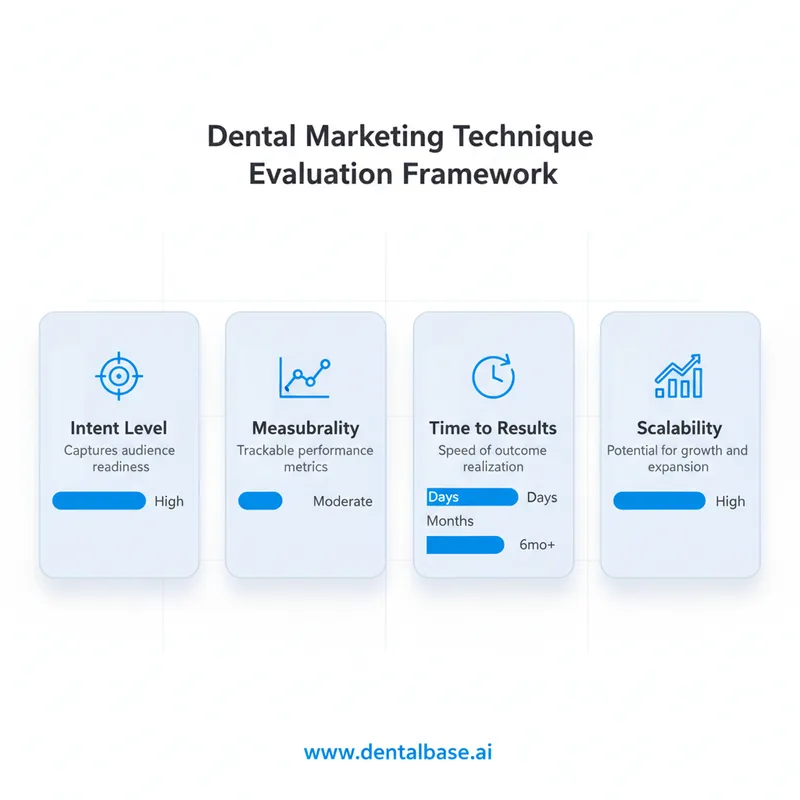 r
r The distinction matters more than most practice owners realize. A billboard on the highway creates visibility, but you can't track how many patients it brought in. A Google Ads campaign targeting "dental implants near me" reaches someone with immediate intent, and you can tie every click to a phone call or form submission. Same marketing budget, completely different accountability.
rHere's a practical filter to run any dental marketing technique through before committing budget:
r- r
- Intent level: Does this channel reach people who already want dental care, or does it try to create demand from scratch? High-intent channels (search, maps, review sites) convert faster than low-intent ones (social media awareness posts, display ads). r
- Measurability: Can you track the path from ad spend to booked appointment? If you can't, you're guessing. r
- Time to results: PPC delivers leads within days. SEO takes 4-6 months. Both work, but your cash flow situation determines which to prioritize first. r
- Scalability: Can you spend more to get proportionally more results, or does the channel cap out quickly? r
Every technique in this article passes that filter. Some are faster. Some are cheaper. The right mix depends on where your practice sits today.
rWhich Local Search Techniques Drive the Most Appointments?
rLocal search techniques, including Google Business Profile optimization and local SEO, consistently produce the highest-intent patient traffic for dental practices. When someone searches "dentist near me," they're usually ready to book.
rThe numbers back this up. According to BrightLocal's Local Consumer Review Survey, 98% of people read local reviews before choosing a business. And 46% of all Google searches seek local information, which means nearly half of Google's traffic is looking for something nearby. For dentists, that's the core of your patient acquisition funnel.
rGoogle Business Profile: Your Most Valuable Free Asset
rYour Google Business Profile (GBP) controls what patients see in the Map Pack, the three-listing box that appears above organic results for local searches. Practices in the Map Pack receive significantly more clicks and calls than those below it. Dental practices using Google Business Profile posts see 35% more website clicks, according to BrightLocal research.
rOptimizing your GBP isn't a one-time task. You need fresh photos monthly, responses to every review within 48 hours, and regular posts about services or seasonal promotions. Practices that treat GBP like a living channel, not a set-it-and-forget-it listing, consistently outrank competitors with better websites but neglected profiles.
rLocal SEO Beyond the Profile
rGBP gets you into the Map Pack. But local SEO is what keeps you there and helps you rank in organic results too. That means building location-specific service pages ("dental implants in [city]"), earning citations on dental directories, and making sure your name, address, and phone number are identical everywhere they appear online.
rFor a deeper breakdown of how dental marketing SEO works, including technical setup and content strategy, we cover the full process in our SEO guide.
rWant Your Practice to Show Up First on Google?
rOur dental SEO service handles local rankings, Google Business Profile management, and on-page optimization so you can focus on patients.
r Learn About Dental SEO u0026rarr;How Do Paid Advertising Techniques Compare for Dental Practices?
rPaid advertising gives you the fastest path from budget to booked appointments. Google Search Ads and Facebook Ads are the two dominant channels for dentists, but they serve different purposes and perform best at different price points.
r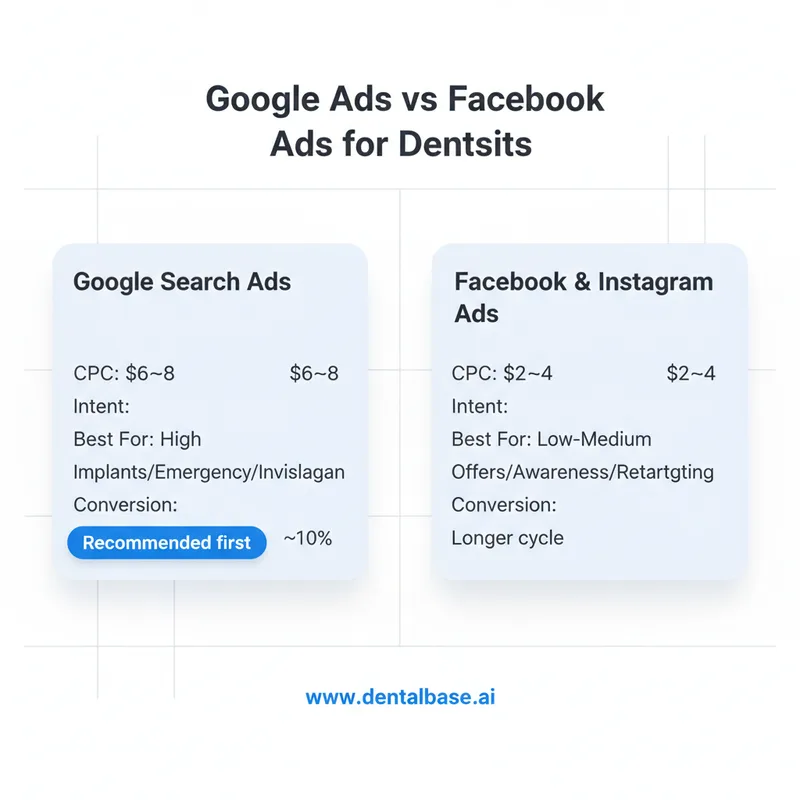 r
r The average cost per click for dental keywords runs $6-$8 according to Google Ads benchmark data from WordStream. That sounds expensive until you consider that paid search drives 35% of traffic for dentists, and the conversion rate for dental landing pages averages around 10%, per HubSpot and Unbounce data. A $2,000 monthly budget can realistically generate 25-40 leads when campaigns are properly optimized.
rGoogle Search Ads vs. Facebook Ads
rGoogle Search Ads capture high-intent patients who are actively searching for a dentist or a specific procedure. They're your best option for emergency dental care, implants, Invisalign, and other searches where the patient already knows what they want.
rFacebook and Instagram Ads work differently. They interrupt a scroll, which means they're better for building awareness, promoting special offers, and retargeting people who already visited your website. The cost per lead is usually lower than Google, but the conversion to actual appointments takes longer because the intent isn't there yet.
rMost practices with budgets above $2,000 per month benefit from running both. Below that threshold, start with Google Search Ads targeting your highest-value procedures.
rNeed Help Running Dental Google Ads?
rWe manage PPC campaigns for dental practices with full conversion tracking, dedicated landing pages, and monthly performance reviews.
r See PPC Ad Management u0026rarr;What Role Does Content Play in a Dental Marketing Strategy?
rContent marketing builds organic traffic and trust over time. It doesn't replace paid channels, but it reduces your long-term dependence on them by creating pages that rank in Google and answer patient questions before they ever pick up the phone.
rWebsites that publish consistent blog content generate significantly more organic traffic than those that don't. For dental practices, this shows up as ranking for long-tail searches: "how much do dental implants cost," "is Invisalign worth it," "what to expect during a root canal." These aren't vanity keywords. They're searches from real patients in the research phase, and the practice that answers best usually gets the appointment.
rBlogging and Educational Content
rThe most effective dental blog posts answer a specific question in 1,500-2,500 words, include real data or clinical context, and link to a relevant service page. Generic 300-word posts about "the importance of flossing" don't rank and don't convert. Specificity wins. AI writing tools can help dental teams produce this kind of content at the right depth, but only when prompts include your clinical perspective and local details. Our guide on AI blog writing for dentists covers the prompting and editing workflow that keeps AI output from sounding generic.
rGood content also feeds your other dental marketing techniques. A blog post about teeth whitening options becomes a social media carousel, an email newsletter topic, and a landing page for a Facebook Ad. One piece of content, four channels.
rSocial Media as a Trust Signal
rSocial media for dentists works best as a credibility check, not a patient acquisition channel. According to a Dental Economics survey, 97% of dentists surveyed use Facebook as their main social platform. But video posts get 48% more engagement than static posts on dental social accounts.
rThe practices getting real value from social media aren't posting stock photos with motivational quotes. They're sharing short-form video of procedures (with consent), behind-the-scenes content of the team, and patient testimonials that build confidence. For a full breakdown of what's working, see our guide on social media marketing for dentists.
rRelated: Building a marketing plan that organizes all these techniques into a monthly calendar? u0026rarr; How to Build a Dental Office Marketing Plan
rWhich Retention Techniques Keep Patients Coming Back?
rPatient retention marketing costs a fraction of new patient acquisition and produces more predictable revenue. Reactivating an existing patient costs 5-7x less than acquiring a new one, according to research cited by the Harvard Business Review. Yet most practices invest almost nothing in it.
rThe math is simple. The average patient lifetime value for a general dentist runs $12,000-$15,000, according to Dental Economics. Losing 20-30% of patients within 18 months to inactivity, which the ADA reports as typical for practices without structured follow-up, isn't just an inconvenience. It's a six-figure revenue leak.
rEmail and SMS Campaigns
rEmail marketing returns $44 for every $1 spent, and welcome emails have an 82% open rate, per industry benchmarks. For dental practices, email and SMS work best for three things: appointment reminders (SMS reminders reduce no-show rates by 38%), hygiene recall sequences, and reactivation campaigns for patients who haven't visited in 12+ months.
rThe key is automation. Manual follow-up doesn't scale past a solo practice. Automated systems that trigger messages based on last-visit date, treatment status, or appointment gaps keep your schedule full without adding front desk workload.
rReview Requests and Reputation Management
rAsking for reviews immediately after a positive appointment is one of the simplest dental marketing techniques with the highest ROI. According to BrightLocal, 88% of people are likely to use a business if the owner responds to all reviews. And Google factors review velocity and volume into local rankings, so reputation management feeds back into your SEO results too.
rLosing Patients to Missed Calls and No Follow-Up?
rDentiVoice AI Receptionist handles after-hours calls, appointment reminders, and patient reactivation automatically, so no patient slips through the cracks.
r See How DentiVoice Works u0026rarr;How Should You Prioritize Dental Marketing Techniques by Budget?
rThe right dental marketing techniques for your practice depend on your monthly budget, your current patient volume, and whether you need new patients fast or want to build long-term organic growth. Here's how the math typically works at three common budget tiers.
r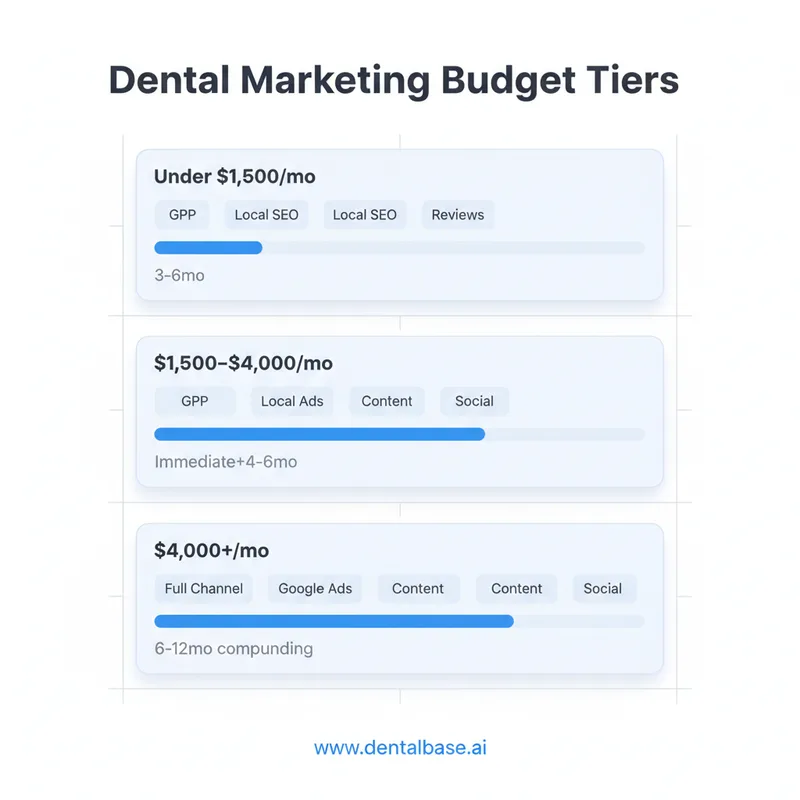 r
r | Monthly Budget | rPriority Techniques | rExpected Timeline | r
|---|---|---|
| Under $1,500 | rGoogle Business Profile, local SEO, review generation, basic email/SMS reminders | r3-6 months for consistent organic growth | r
| $1,500-$4,000 | rAdd Google Search Ads for top procedures, content marketing, social media management | rImmediate leads from PPC, organic builds over 4-6 months | r
| $4,000+ | rFull-channel: SEO, PPC, content, social, email automation, reputation management, retargeting | rCompounding results across all channels within 6-12 months | r
A common mistake is spreading a small budget across too many techniques. A practice spending $1,500 per month on Google Ads, social media management, SEO, and email marketing is spending $375 per channel, which isn't enough to move the needle on any of them. Better to dominate one or two channels first, prove the ROI, and then expand. Our cost and ROI breakdown for every dental marketing service shows the monthly range each channel needs before it can move anything.
rThe average cost to acquire a new dental patient through digital channels runs $150-$300, per WordStream. Against a patient lifetime value of $12,000-$15,000, even modest marketing investments can return 40-100x over the patient relationship. The question isn't whether to invest. It's where to invest first.
rIf you're evaluating whether to hire an agency or handle marketing in-house, our guide on how to choose a dental marketing company covers the criteria that matter most. And for a broader view of how all these techniques fit together, see our complete guide to dental marketing.
rThe dental marketing techniques that grow practices aren't secrets. They're local SEO, paid search, content, retention campaigns, and reputation management, executed consistently and measured rigorously. What separates the practices that grow from those that stall isn't which techniques they use. It's whether they commit to doing fewer things well instead of everything poorly.
rPick the two or three techniques that match your budget and patient goals today. Build measurement into everything from day one. Then expand only when your current channels are producing predictable, trackable results.
rReady to Put These Techniques to Work?
rSee how DentalBase helps practices run SEO, PPC, and patient communication from one platform. Book a free walkthrough.
r Book a Free Demo u0026rarr;Explore more guides and tools for dental practice growth.
r Browse Resources u0026rarr;Sources & References
Frequently Asked Questions
New practices should prioritize Google Business Profile optimization, local SEO, and Google Search Ads targeting high-value procedures. These three techniques generate patient demand fastest. Once you have steady flow from search, add content marketing and retention campaigns to build long-term growth.
Most dental practices spend $1,500-$4,000 per month on marketing. The average cost to acquire a new patient through digital channels is $150-$300, so budget depends on how many new patients you need monthly. Start focused on one or two channels rather than spreading thin.
Local SEO and Google Business Profile optimization typically deliver the highest long-term ROI because organic traffic is free once you rank. For immediate results, Google Search Ads produce the fastest return, with dental landing pages converting at roughly 10% on average.
Yes. Small practices often see proportionally better results because they can dominate local search in less competitive areas. A solo practice investing $1,000 per month in local SEO and review generation can outrank larger competitors who neglect their Google Business Profile.
Google Ads produce leads within days of launching. Local SEO improvements show within 2-4 months. Content marketing and organic SEO take 4-6 months for meaningful traffic growth. Retention campaigns like email and SMS show impact within the first billing cycle.
It depends on your budget and team capacity. Practices spending under $2,000 per month can often manage GBP, social media, and email in-house. Above that, a specialized dental marketing agency typically delivers better ROI because they bring expertise in PPC optimization and SEO strategy.
Was this article helpful?
Written by
Dentalbase Team
The Dentalbase Team is a collective of dental marketing experts, AI developers, and practice management consultants dedicated to helping dental practices thrive in the digital age.