
Dental Marketing: The Complete 2026 Guide for US Practices
Complete dental marketing guide for US practices: SEO, PPC, social media, reviews, AI reception, budgets, ROI tracking, and compliance for practice owners.
Share:
Table of contents
This dental marketing guide US practices need in 2026 is a complete map of what works now, what's changed, and where to spend first. The ground has shifted. Google's AI Overviews now appear on more than 60% of searches, review velocity has become a ranking signal nearly equal to traditional SEO, short-form video outperforms every other social format, and paid ad costs in most metros are up 30-50% since 2023. Practices still running their 2020 playbook are paying more for less, not because the playbook was wrong, but because everyone adopted it and the platforms evolved around them.
You don't need more tactics. You need a sequenced plan. The practices growing fastest right now do three things differently: they fix conversion infrastructure before scaling traffic, they measure cost per booked appointment, not clicks, and they treat every channel as one patient journey instead of running seven disconnected campaigns. According to BrightLocal's 2024 survey, 98% of consumers now read reviews before choosing a local business. This dental marketing guide US practices should actually follow walks through the full stack in the order it should be built, then points to the deeper playbook for each piece.
Before the sequence below, it helps to see the full picture: DentalBase's services page outlines every channel this guide covers, from AI reception to SEO to paid ads, if you want the shortcut version first.
What Foundation Must Every Dental Marketing Strategy Have?
Before you spend a dollar on traffic, three things have to work: a website that converts visitors into booked appointments, phone coverage that actually picks up, and a review profile that makes you the obvious local choice. Get these wrong, and every marketing dollar after that funds your competitors.
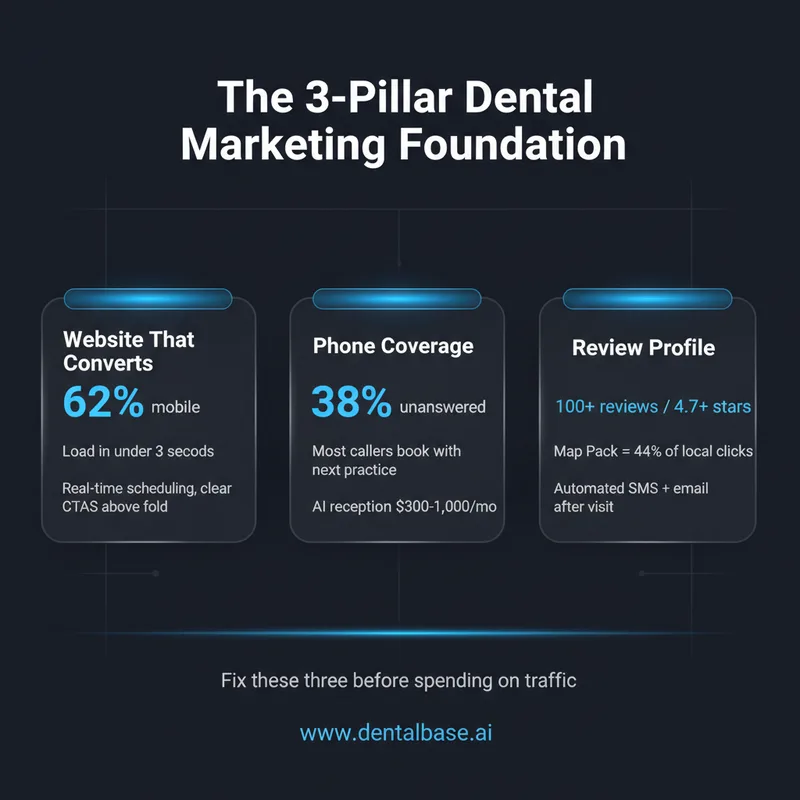
The conversion math is unforgiving. If your website converts at 2% and your competitor's converts at 5%, they need 60% less ad spend to book the same number of patients. That gap compounds every month. Mobile accounts for 62% of dental-related searches, according to Google, and Google's own data shows consumers expect a site to load in under three seconds. If it doesn't, they bounce before your CTA ever renders. Pair a fast site with real-time online scheduling, still missing from 74% of practices, and clear calls to action above the fold.
Phone coverage is the second leak. Thirty-eight percent of new-patient calls go unanswered during business hours, and most of those callers book with the next practice on the list. AI reception answers every call 24/7, handles scheduling and insurance questions, and writes directly to your PMS. At $300-1,000 per month, it produces the fastest ROI of any marketing investment because it converts demand you're already paying to generate. See the full picture in our missed calls solution guide.
Reviews are the third. Practices with 100+ Google reviews and 4.7+ stars appear in the Map Pack that captures 44% of local clicks. Build the system: automated SMS and email requests after every visit, a 100% response rate within 48 hours, and compliance with Google's review policies. Our dental reputation management guide walks through the full review playbook from end to end.
Build your marketing foundation in one platform
DentalBase ships website, AI reception, and automated review collection as a single conversion stack. One login, one dashboard, one monthly number.
Book a Free Demo →Which Traffic Channels Should US Dental Practices Invest In?
Four channels drive patient volume for US dental practices in 2026: local SEO, Google Ads (PPC), social media, and patient reactivation. Each serves a different job and pays off on a different timeline. Running all four from day one is how you end up overspending on all of them and mastering none. Sequence them.
| Channel | Monthly Budget | Time to ROI | Cost Per New Patient |
|---|---|---|---|
| Local SEO | $1,000-3,000 | 3-6 months | Drops over time |
| Google Ads (PPC) | $1,500-5,000 | 1-2 weeks | $150-300 |
| Social media | $500-2,000 | 2-4 months | Indirect, lifts other channels |
| Patient reactivation | $300-800 | 2-4 weeks | $5-15 |
Local SEO: the compounding asset
Local SEO optimizes your site and Google Business Profile to show up for "dentist near me" style searches and in the Map Pack. It takes 3-6 months to build momentum, but a blog post ranking for "dental implants [your city]" can generate 5-15 inquiries every month for years with no ongoing spend. Our local SEO Map Pack guide covers citations, service pages, and the review signals that move the needle fastest.
Google Ads: instant patient flow
PPC puts you at the top of search results this week, not next quarter. Dental clicks cost $5-50 depending on the keyword and market, with implant and cosmetic keywords at the high end because they produce high-revenue patients. Every campaign needs its own landing page tied to the exact offer. Run PPC with SEO, not instead of it, then rotate budget toward SEO as organic positions mature for the same keywords.
Social media: trust that converts other channels
Instagram and Facebook rarely generate direct bookings on their own. Their job is to lift conversion rates among patients who also saw you in search or in a friend's post. Video outperforms static content. Hootsuite data shows video gets 48% more engagement on healthcare accounts. Pair organic content with a modest paid Meta spend for local targeting. Find the full playbook in our social media marketing guide.
Patient reactivation: the ROI winner nobody runs
Every practice has 200-500 inactive patients sitting in the PMS. Reactivating them costs $5-15 each versus $150-300 to acquire a new patient. This is the highest-ROI channel in dental marketing, and almost nobody runs it consistently. See our reactivation campaigns guide for the exact scripts and segmentation.
Deeper dives: Compare DIY vs. agency in our DIY vs. agency breakdown, or see what actually works in online marketing for dentists in 2026.
How Do You Build a Marketing Plan Sequenced for Your Practice?
A dental marketing plan is not a list of channels. It's an ordered sequence of investments tied to the growth stage you're actually in. A new practice with 15 patients a week has a different first move than an established practice with a full schedule trying to add a second operatory. Treat this as phases, not tactics.
In months 1-2, the job is the foundation: website speed, AI reception, and a review system. Months 3-4 add traffic: local SEO setup and a small Google Ads budget. Months 5-6 layer on amplification: social media cadence and reactivation campaigns. By month 6, you're running a full stack where every channel feeds the next. Our marketing plan template gives you the 90-day version with specific milestones.
Watch out for
Practices that start with PPC and end with reviews pay 2-3x more per patient than those that reverse the sequence. Reviews and site conversion come first because they multiply everything that follows.
If you're solo, our lead generation guide for solo practices adjusts the sequence for small teams with limited front-desk bandwidth. Two more pieces belong here: brand and content. A clear brand identity cuts ad fatigue and lifts recall across every channel. Start with our dental branding company guide. For organic traffic that compounds, our content marketing guide shows which article types actually rank and book patients.
How Do Retention and Recall Fit Into the Marketing Strategy?
Retention is marketing. A patient who visits twice a year for hygiene generates $600-1,200 in recurring production, plus any treatment found during exams. Losing that patient to lapsed recall means paying the full acquisition cost again to replace them. Most marketing conversations skip this entirely, which is why the math on "new patients" looks worse than it should.
| Recall approach | Compliance rate | Annual recovery (1,500-patient practice) |
|---|---|---|
| Basic reminders | 40-55% | Baseline |
| AI automated recall | 65-80% | $60-120K |
Automated hygiene recall connects to your PMS, identifies patients approaching or past their recall date, and sends multichannel outreach through SMS, email, and AI calls until they book. Practices running automated recall hit 65-80% compliance versus 40-55% with basic reminders. Our recall system guide and patient retention benchmarks cover the exact metrics to track. For the content itself, this dental newsletter idea and template collection covers what to send between recall visits.
Reactivation is the sister campaign. Warm patients, inactive for 6-9 months, convert at 20-30% off a well-timed SMS. Cold patients, inactive for 15-24 months, respond better to AI phone calls at 18-28%. The average practice has $100,000-500,000 in recoverable production sitting in lapsed patient records. Add our retention marketing strategies and the first-visit return rate playbook to close the loop at the top of the funnel too.
Turn reactivation into your highest-ROI channel
DentalBase uses AI calls, texts, and emails to reach your inactive patients until they book, integrated with your PMS and measured against a single CPA target.
See It in Action →Should You Hire an Agency, a Consultant, or Run It In-House?
This is the most common strategic question practice owners ask, and the answer depends on three variables: your budget, your bandwidth, and the complexity of your market. There's no universal right answer, but there are clearly wrong ones. Hiring a generalist agency for a specialist market, or trying to DIY a channel you can't measure, both destroy budget fast.
| Option | Best for | What to know |
|---|---|---|
| Agency | Multichannel execution | When your time is worth more in the operatory. Vet for dental-specific expertise. |
| Consultant | Strategy and accountability | $2,000-5,000/mo. Works if you already have someone to execute internally. |
| In-house | Both ends of the scale | Small enough for one person, or large enough to justify a full-time hire. |
Agencies make sense when you need multiple channels executed well and your time is better spent in the operatory. The catch: not every agency understands dental economics. A company that sells the same playbook to plumbers and pediatric dentists is not a true dental marketing partner. Our best dental marketing companies guide and what to look for in dental marketing experts walk through how to vet them.
A consultant fits practices that have some in-house capacity but need strategy and accountability. Good consultants set the plan, train your team, and audit execution monthly. See our dental marketing consultant guide. For solo practices, our doctor marketing strategies guide covers the shortest path. The software and tooling question gets its own playbook in dental marketing software evaluation.
What Compliance Rules Apply to Dental Marketing in the US?
US dental marketing operates under four regulatory frameworks. Getting any of them wrong costs more than any ROI you'd gain from bending the rules. The good news is that compliance is not complicated if you set it up once and do not improvise.
| Framework | Covers | What it means for you |
|---|---|---|
| HIPAA | Patient data and consent | No names, photos, or testimonials without written consent. Signed BAA with every platform. Fines can reach up to $50,000 per violation. |
| TCPA | Automated calls and texts | Prior express consent is required. Opt-out instructions must appear in every message. Penalties range from $500-1,500 per unsolicited message. |
| FTC | Honest marketing | No fake reviews. No misleading before-and-after claims. Testimonials must reflect real patient experiences. |
| State Board | Varies by state | Specialty claims, fee advertising, and words like "painless" or "best" are often restricted. Check your state board first. |
Read each framework from the source of truth: HIPAA guidance, the TCPA, and the FTC endorsement guidelines. State rules change often, so verify with your board before launching any new campaign.
How Do You Budget and Measure Dental Marketing ROI?
The only metric that matters for a dental marketing guide US practices actually follow is cost per booked appointment, broken out by channel. Impressions, clicks, followers, and open rates are all inputs. Cost per booked appointment is the output. If you cannot produce that number in under 60 seconds, your attribution is broken.
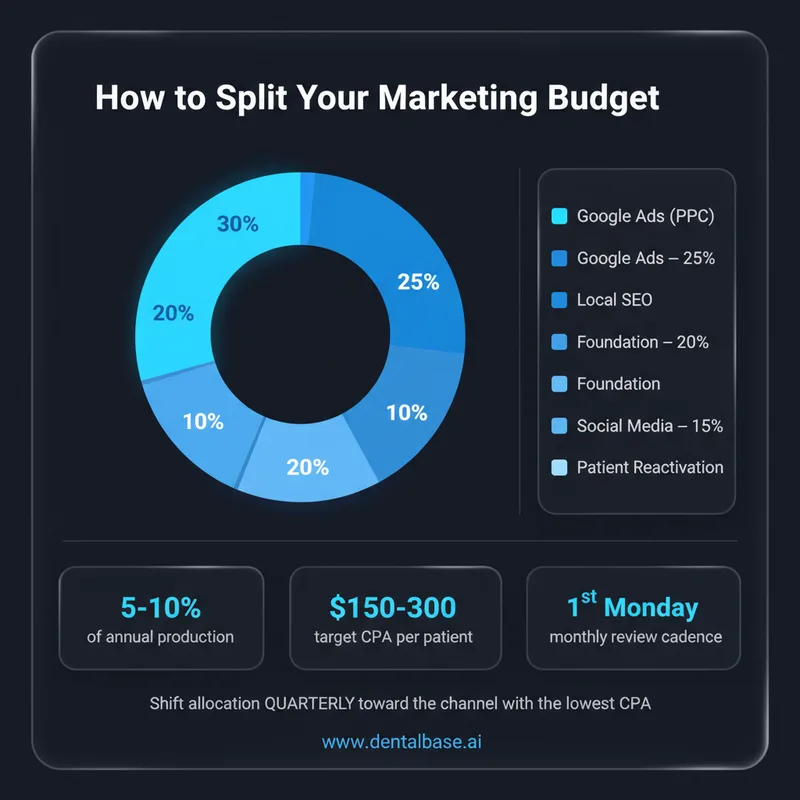
- Total budget: 5-10% of production for growth-mode practices. A $1M practice spends $50,000-100,000 a year, or $4,200-8,300 per month, across every channel combined.
- Cost per new patient target: $150-300 blended across channels. Track each channel separately with GA4, UTM parameters, call tracking, and PMS source fields.
- Allocation: Foundation 15-25%, SEO 20-30%, PPC 25-35%, social 10-15%, reactivation 5-10%. Shift quarterly based on the lowest CPA, not personal preference. Competitive metros lean more toward PPC, while suburban markets often get faster SEO lift.
- Monthly review: First Monday of every month. Pull CPA by channel, identify the worst performer, test one fix, and measure for 30 days. That's the whole optimization loop.
Measurement only works if you trust your tech stack. If you're still pulling reports from three separate dashboards and stitching them together in a spreadsheet, your data is not reliable enough to make decisions on. Our PMS reporting guide, tech stack audit, and technology ROI calculator cover what to keep, cut, and consolidate.
What Are the Best Dental Marketing Ideas for 2026?
The best dental marketing ideas for 2026 are the ones tied to a booked appointment, not a vanity metric. Win the Map Pack, run short-form video, automate review requests, and reactivate lapsed patients before chasing new ones. Cheap to test. Fast to measure.
Here's the thing about "ideas." Most lists hand you 50 tactics with no order and no math. That's how budgets vanish. Below are the creative dental marketing ideas that actually move cost per booked appointment, ranked by how quickly they pay back, so you can pick two or three and run them properly instead of dabbling in all of them.
| Idea | Effort | Why it works now |
|---|---|---|
| Weekly Google Business Profile posts | Low | Profiles that post regularly see 35% more website clicks. |
| Short-form "meet the team" video | Medium | Video earns 48% more engagement than static posts. |
| Automated post-visit review requests | Low | 98% of people read reviews before choosing a dentist. |
| Lapsed-patient reactivation texts | Low | Costs 5-7x less than acquiring a brand-new patient. |
| Service-specific landing pages | Medium | Dental landing pages convert at roughly 10% when focused. |
Notice what's missing. No billboards, no mascot, no $400 logo refresh. Creative does matter, but a clever campaign on a slow website with an unanswered phone is just expensive noise. According to BrightLocal, practices whose owners respond to every review are far more likely to win the click, so the highest-leverage "idea" is often a system you run weekly, not a one-off stunt. Start with one acquisition idea and one retention idea. Measure both against cost per booked appointment for 30 days. Keep the winner.
Stop guessing which ideas pay back
DentalBase runs reviews, video distribution, and reactivation from one dashboard, each tracked against a single cost-per-appointment number.
Book a Free Demo →Which Dental Marketing Tools Actually Matter?
The dental marketing tools that matter cover four jobs: capturing demand, converting it, measuring it, and keeping it. You need an AI phone and review system, a fast website, an attribution layer like GA4 with call tracking, and PMS-connected recall. Everything else is optional.
Tool sprawl is real. The average practice pays for software it forgot it bought, and three dashboards that don't talk to each other. The fix is not more tools. It's the right four, integrated, so one number flows end to end. Map every tool to a job, and if a tool doesn't map to one of these four, question why you're paying for it.
- Capture: An AI receptionist that answers 24/7 and a review-collection engine. This is where most demand leaks, since 38% of new-patient calls already go unanswered.
- Convert: A fast, mobile-first website with online scheduling. Mobile drives 62% of dental searches, so load time is a conversion tool, not a vanity metric.
- Measure: GA4, UTM tagging, and call tracking feeding a single cost-per-appointment view. Without this, every other tool is flying blind.
- Keep: PMS-connected recall and reactivation. Automated recall lifts compliance from 40-55% up to 65-80%.
One caution on AI tools specifically. The category is crowded, and not every product is built for dental workflows or HIPAA. Before you sign anything, read our 15 AI receptionist red flags and the honest answers in AI dental receptionist concerns. Dental Economics reports 73% of practices plan to adopt AI tools by 2027, which means the buyers who pick well now will have a measurement head start on the ones who wait. When you're ready to consolidate, our guide to evaluating dental marketing software walks the buying process step by step.
What Are the Dental Marketing Trends for 2026?
The defining dental marketing trends for 2026 are AI search, review velocity as a ranking signal, short-form video dominance, and rising ad costs. AI Overviews now appear on most searches, which rewards clear, citable content and punishes thin pages. Adapt the format, not just the budget.
Trends are easy to name and hard to act on. So here's what each one actually changes about where your money and attention should go this year, with the data behind it.
First, AI search rewrote the rules of organic. Search Engine Land reports AI Overviews now surface on more than 60% of searches, and they pull from content structured as clear, self-contained answers. Long, rambling pages get skipped. The practices winning AI citations write the way this guide does: a direct answer first, then the detail. Our site structure guide shows how page architecture feeds that visibility.
Second, reviews became a near-equal ranking signal. Velocity matters as much as volume now, so a steady drip of fresh reviews beats a one-time burst. Third, short-form video pulled ahead of every other social format, earning 48% more engagement than static posts. And fourth, paid costs keep climbing, up 30-50% in many metros since 2023, which makes owned channels like SEO, recall, and reputation more valuable by comparison. The strategic read is simple. Shift weight toward assets you own. Treat paid as the accelerant, not the engine.
Related: Rising click costs make paid search harder to run profitably, so vet your provider carefully → How to choose a dental PPC company
What Is Full-Service Dental Marketing, and Is It Right for Your Practice?
Full-service dental marketing means one partner runs every channel together: SEO, paid ads, social, reputation, website, and front-desk conversion, under a single strategy and one report. It suits practices that want growth without managing four vendors, and it works best when the provider attributes every channel to booked appointments.
The appeal is coordination. When separate vendors own SEO, ads, and social, no one is accountable for the whole patient journey, and the channels often compete for the same budget. A full service dental marketing setup puts strategy, execution, and measurement in one place, so a change in one channel is weighed against the others instead of optimized in a silo.
It is not the right fit for everyone. A practice with a strong in-house marketer and a tight budget may get more from buying individual services and keeping control. The trade-off is real: you save the bundle premium but take on the coordination work yourself. Full-service earns its keep when your team has no bandwidth to run campaigns and you would rather own outcomes than tactics.
One question separates good full-service providers from repackaged agencies: can they show cost per new patient across every channel, in one dashboard? If the answer is a stack of disconnected channel reports, you are paying bundle pricing for siloed work. Tie the engagement to patient acquisition numbers, the same standard you would apply to any single service.
What Are the Best Dental Marketing Resources for Your Practice?
The best dental marketing resources pair dental-specific guidance with general marketing craft, because generic small-business advice skips the advertising compliance and trust-based buying decision unique to healthcare. Combine association guidance, a practice-focused playbook library, and one or two paid tools matched to an actual gap, not to hype.
Most practice owners collect these resources the wrong way: a folder of bookmarked articles with no order and no owner. The lists below split them into free and paid, then show how to turn either into something you actually use.
Free Resources Worth Bookmarking
Start with material built or vetted for dental practices before adding general marketing content into the mix.
- DentalBase's own resources hub, with playbooks, templates, and channel guides written for practice owners rather than marketing generalists.
- American Dental Association guidance on advertising and patient communication, useful for staying inside the rules discussed in the compliance section above.
- Our channel-by-channel online marketing guide, which ranks tactics by payback speed instead of listing fifty ideas with no order.
- Our SEO ranking guide, for the free tools and steps behind Map Pack visibility.
- Moz's Local Search Ranking Factors study, for the broader local-SEO signals behind Map Pack visibility.
How Do You Build a Dental Marketing Resource Stack That Sticks?
A resource stack only earns its keep if it changes what you do Monday morning, not just what you know.
- Audit your current channels against the four-part foundation (website, AI reception, reviews, recall) before buying any course or tool.
- Pick one paid resource per identified gap, not five at once, so you finish what you start instead of collecting unused logins.
- Set a 90-day review date for each subscription and keep or cancel it based on booked appointments, not enthusiasm.
- Assign one person to own the resource stack so updates and renewals don't fall through the cracks between vendors.
Want a resource stack built for your practice instead of a generic list?
See how DentalBase's platform and playbooks fit into the marketing plan you already have.
Explore DentalBase Services →How Does Marketing for Dental Office Chains Differ From Single-Location Practices?
Marketing for dental office chains differs from single-location marketing because a group needs one centralized brand voice paired with location-specific local SEO, review management, and call tracking, while a single practice can run one unified campaign around one Google Business Profile and one phone number.
Group practices and DSOs are a growing share of the market, and the marketing mistakes are predictable: a single generic website trying to rank every location, review requests that funnel to one account, or a call-tracking setup that can't say which office booked the appointment.
Centralized Brand, Local Execution
The brand voice, review-response templates, and ad creative can live at the group level. Everything a patient actually searches for, the Google Business Profile, the location page, the local reviews, has to be built and ranked per address. Our guide to marketing a dental practice for more new patients covers the single-location version of this playbook, and the same fundamentals apply per site inside a group.
What Changes When You Add a Second Location?
Budget allocation gets harder before it gets easier. Each new location needs its own local SEO runway and its own review base, which means a site added mid-year rarely performs like the flagship office in month one. Track cost per booked appointment by location, not in aggregate, or an underperforming new office will hide inside a healthy blended number.
Deeper Reads: The Full Dental Marketing Playbook
This guide is the map. The articles below are the turn-by-turn directions for each leg of the journey, grouped by the job they do in your marketing stack. Bookmark the ones that match your next move.
Website and conversion
Your site is the conversion engine every other channel feeds. Start with how to choose a dental website design company, then decide between a rebuild and a refresh in our website redesign guide. Because mobile drives most searches, website speed optimization directly affects how many visitors book, and a HIPAA-compliant website keeps you on the right side of patient-data rules.
Paid search and budget
For instant patient flow, our practical guide to PPC for dentists covers the fundamentals, and choosing a dental PPC company helps you vet a partner. Set the numbers first with the 15 questions in our dental marketing budget breakdown.
Phone, front desk, and capture
Demand you already paid for leaks at the phone. See why in dental office phone systems and dental VoIP reliability, then weigh automation with our dental virtual receptionist guide and the case for an AI receptionist for insurance calls. The after-hours answering service guide covers the 27% of calls that arrive when you're closed.
Retention and case acceptance
Keeping patients is cheaper than replacing them. Our 15 retention strategies set the foundation, while case-acceptance playbooks turn consults into treatment: implant case acceptance, orthodontic case acceptance, and periodontal case acceptance. For elective demand, see Invisalign marketing.
Operations and tooling
A clean back office makes every campaign measurable. Audit your stack with switching dental software, watch for hidden software fees, reclaim front-desk hours with billing automation, and fix the insurance friction explained in why patients get frustrated by insurance calls and our front-desk insurance guide.
Sources & References
Frequently Asked Questions
Three foundation elements (converting website, AI reception, review system) plus four traffic channels (SEO, PPC, social media, patient reactivation). The conversion foundation must come first to prevent wasting traffic investment on unanswered calls and poor conversion rates.
5-10% of annual production. A practice producing $1M annually should invest $50,000-100,000 ($4,200-8,300/month) allocated across foundation services (15-25%), SEO (20-30%), PPC (25-35%), social media (10-15%), and reactivation (5-10%).
AI reception and review collection typically produce the fastest ROI because they fix conversion gaps. 38% of dental calls go unanswered, meaning traffic investments in SEO and PPC are partially wasted without phone coverage. Reviews directly affect local search rankings and click-through rates.
Track cost per booked appointment by channel monthly using Google Analytics 4 UTM parameters and call tracking. Target $150-300 per new patient across all channels combined. Optimize the highest-cost channel each month.
Both simultaneously. PPC generates patients within 1-2 weeks while SEO builds organic rankings over 3-6 months. As SEO matures, shift PPC budget to keywords where you rank organically to reduce cost per patient over time.
Four frameworks: HIPAA (patient data protection, BAA requirements), TCPA (consent for automated messages), FTC (honest advertising, endorsement guidelines), and state dental board regulations (specialty claims, fee advertising).
Reactivation is the highest-ROI channel at $5-15 per recovered patient versus $150-300 for new patient acquisition. AI systems identify inactive patients in your PMS and run automated multi-channel outreach that converts 15-25% back to appointments.
Foundation services (AI reception, reviews) produce ROI within 1-2 weeks. PPC generates patients within 1-2 weeks of launch. SEO takes 3-6 months. A complete strategy across all channels is fully operational within 6 months of phased implementation.
The highest-return ideas are weekly Google Business Profile posts, short-form team video, automated post-visit review requests, and lapsed-patient reactivation texts. Each is cheap to test and ties directly to a booked appointment rather than a vanity metric.
Four jobs need tools: capture (AI phone and reviews), convert (fast website with online scheduling), measure (GA4 plus call tracking), and keep (PMS-connected recall). Any tool that does not map to one of these four is usually optional spend.
AI search appearing on most queries, review velocity as a near-equal ranking signal, short-form video outperforming static posts, and paid ad costs up 30-50% since 2023. The shift rewards owned channels and clear, citable content.
Full-service dental marketing is when one partner runs SEO, paid ads, social media, reputation, website, and front-desk conversion under a single strategy and one report. It fits practices that want coordinated growth without managing multiple vendors, provided the provider tracks cost per new patient.
Practical marketing ideas for a dental office include collecting reviews on a steady schedule, posting short-form video, running geo-targeted Google Ads, reactivating lapsed patients by text, and answering every new-patient call. Start with the ideas that convert existing demand before chasing new traffic.
The best dental marketing resources combine dental-specific guidance, like ADA advertising rules, with practice-focused playbooks rather than generic small-business marketing content. Start with a resources hub built for dental practices, then add one or two paid tools matched to a real gap in your current channels.
Free dental marketing resources include the American Dental Association's advertising and compliance guidance, DentalBase's resources hub of playbooks and templates, and channel-specific guides on SEO, PPC, and social built for dental practices instead of general retail businesses.
Marketing for dental office chains centralizes brand voice, creative, and reporting at the group level while local SEO, review generation, and call tracking are built and measured per address. Single-location practices manage all of this around one Google Business Profile and one phone number.
Was this article helpful?
Written by
Dentalbase Team
The Dentalbase Team is a collective of dental marketing experts, AI developers, and practice management consultants dedicated to helping dental practices thrive in the digital age.