Dental Recall Calls vs SMS: What Brings Patients Back
Dental recall calls vs SMS: data on what reactivates lapsed patients, when each works, and why the smartest practices use both. With benchmarks.
Share:
Table of contents
The honest answer to dental recall calls vs SMS is uncomfortable for anyone who has been running text-only recall: calls bring more lapsed patients back. Not by a small margin. By a factor of three to four on most lapse windows.
SMS is doing real work in your practice. It's just doing the wrong job when you ask it to revive a patient who hasn't sat in your chair in 14 months. According to the ADA, 20-30% of patients become inactive within 18 months without follow-up, and most of them won't come back from a text. They'll come back from a conversation.
This article walks through the data on what each channel actually delivers, why outbound calls reactivate at the rates they do, where SMS earns its keep, and the operational reason most practices can't run calls at scale, plus the model that finally makes the right mix possible.
Do Recall Calls or SMS Bring More Patients Back?
Outbound recall calls reactivate 18 to 30% of lapsed dental patients on a single contact attempt, while SMS-only recall lands at 4 to 9%. That's the gap, and it's consistent across practice sizes, regions, and lapse windows. Voice wins because voice handles objections, surfaces what's actually keeping the patient away, and books the appointment on the line.
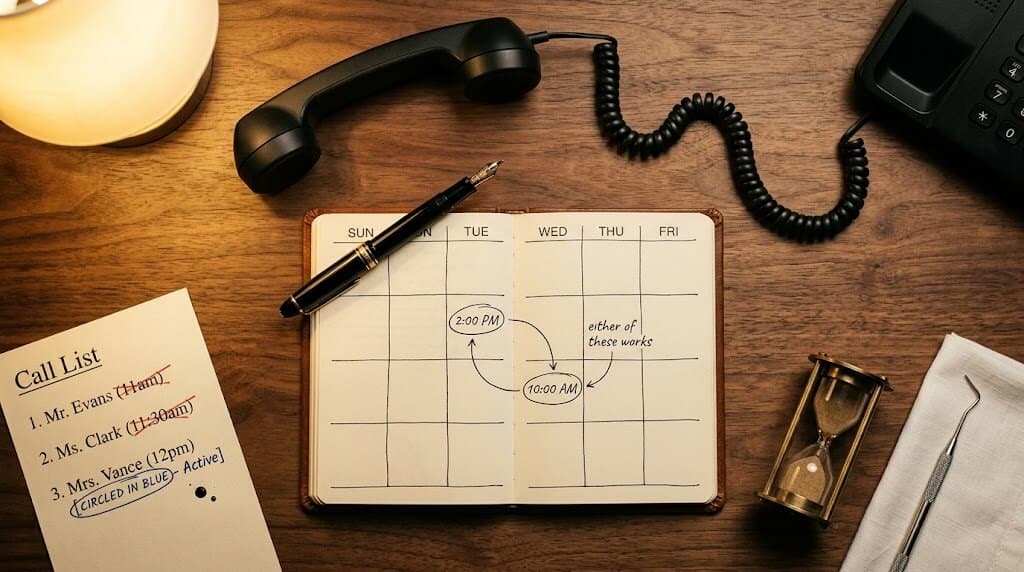
The reason isn't mysterious. A recall SMS gives the patient one option: stop scrolling, click a link, find an opening, decide. A recall call gives them a person who already has the schedule open and can offer "Tuesday at 2 or Thursday at 10." One creates a decision fork the patient can defer. The other closes the loop in 90 seconds.
Harvard Business Review data puts reactivation at 5 to 7x cheaper than new patient acquisition, which is why this conversation matters financially. A 25-point reactivation gap on a 200-patient lapsed list is 50 booked appointments. At an average lifetime value of $12,000 per general dentistry patient, that gap is real money. Not theoretical money.
Calculate what your lapsed list is worth before you decide on recall channel
Pull your inactive patient count, multiply by your average lifetime value, then apply 18-30% reactivation. The number usually shocks owners into action.
See the empty-chair math →Why SMS Alone Underperforms on True Patient Reactivation
SMS underperforms on real recall because it's a reminder channel, not a reactivation channel. According to the Journal of Dental Hygiene, SMS appointment reminders reduce no-shows by 38%, but that's a confirmation stat. It measures patients who already have an appointment showing up, not patients with no appointment deciding to book one.
Lapsed-patient SMS underperforms for three concrete reasons:
- Read rates collapse on second and third sends to the same number, especially when the patient hasn't visited in over a year.
- Sender recognition disappears after 12+ months, and patients treat the text as spam from an unknown number.
- The response loop is broken: the patient sees the text, intends to reply later, and never does.
BrightLocal data on consumer communication preferences shows that for healthcare decisions specifically, voice still beats text on conversion at almost every touchpoint past the first reminder.
Where SMS earns its keep
Confirmations. Day-of reminders. Short-window recall under six months. Post-call follow-up when the patient didn't pick up. Insurance-end-of-year nudges. None of those are reactivation. All of them are valuable. Keep SMS doing what it's good at, which is touching patients you already have a relationship with at the right moment, and stop expecting it to revive 18-month gaps.
For confirmation specifically, the SMS confirmation script we use ties directly into the recall call workflow. Patients who picked up the call get an SMS within 60 seconds confirming the slot. Patients who didn't get a different SMS with two callable options.
What Makes an Outbound Recall Call Actually Work?
A recall call works when it books on the line. That's the entire test. A call that says "you're due for your hygiene visit" and asks the patient to call back later is barely better than SMS, and worse than a well-written reminder text. The 18-30% reactivation rate assumes a caller who comes in with the schedule open, two specific time slots ready, and the discipline to handle one objection before booking.
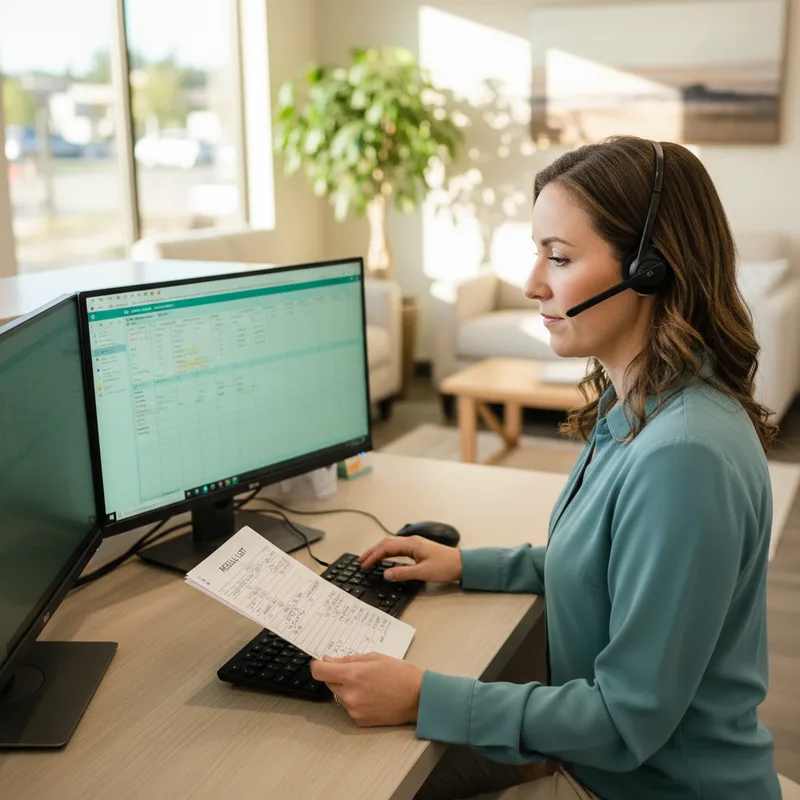
Dental Economics reports that automated and well-run recall systems increase patient return rates by 25 to 40%, but only when the script does three things: opens with the patient's name and last visit date, names two or three concrete time slots, and books the patient before hanging up. Calls that violate any of those rules collapse to single-digit reactivation, the same range as SMS.
The mechanics that drive pickup and conversion
Time of day matters. Tuesday through Thursday, 10am to noon and 4pm to 6pm in the patient's local time zone. Avoid Mondays. Avoid Friday afternoons. Three attempts over 10 days, then voicemail with an SMS follow-up. According to Dental Economics, 80% of voicemails go unreturned, so the SMS follow-up isn't optional. It's the safety net.
The script is the single highest-leverage variable. A caller reading from notes books at 8 to 12%. A caller who has internalized the script and can handle "I've been busy" without flinching books at 25 to 35%. The training delta between those two callers is real, but the thing that actually moves the rate is the willingness to ask for the booking before hanging up.
For a deeper look at the conversion mechanics specifically, the dental call-to-booking conversion benchmarks we published last week walk through what good looks like for both inbound and outbound calls.
The Real Reason Most Practices Fail at Recall Calls
Most dental practices fail at recall calls for one structural reason: capacity. The front desk during clinical hours is fielding inbound calls, checking patients in, verifying insurance, and processing payments. Outbound recall work loses to all of those because the patient in front of the desk wins every time. By the end of the day, the recall list is untouched. By the end of the month, it's two months stale.
The 18 to 30% reactivation rate assumes a calm caller with time. Most practices don't have that caller. According to Dental Economics, the average general practice misses 15 to 20 inbound calls per week just trying to keep up with reactive work. Adding outbound recall on top of that load is how recall programs quietly die.
The practices that do run real recall programs solve this one of three ways:
- A dedicated part-time caller with no other duties, working a focused recall block.
- Batched recall blocks scheduled outside clinical hours, so inbound work doesn't compete.
- An AI voice system that doesn't compete for front desk time at all.
The first two work but cap out around 100 calls per week. The third doesn't cap.
Related: The capacity argument extends past recall. If your team is drowning in calls during clinical hours, the question isn't recall, it's whether you need a second front desk hire or AI. → Dental Front Desk vs AI: Hire or Automate?
What a typical week looks like in practices that try manual recall
Monday: schedule full, no recall work. Tuesday: 12 calls attempted, 4 connected, 1 booked. Wednesday: emergency, all hands on inbound, recall paused. Thursday: 8 calls, 3 connected, 1 booked. Friday: half-day, no recall. Two booked appointments from a 200-patient lapsed list. The math doesn't work, and it's not the team's fault. The structure is wrong.
That's also why the front desk burnout patterns we wrote about show up so consistently in practices that try to do recall manually. The team isn't failing. The job is structurally impossible at the staffing level most practices run.
Dental Recall Calls vs SMS: The Right Channel Mix
The right answer for most practices is calls first, SMS second, with the channel mix tuned to lapsed patient volume. Below 100 lapsed patients, run calls only and use SMS for confirmations. Between 100 and 500, prioritize calls for high-value patients and let SMS handle the rest. Above 500, manual calling breaks, the only model that works at scale is automated voice for tier one with SMS as the safety net.
The numbers in that comparison aren't theoretical. They come from aggregated practice data published by Dental Economics and ADA Health Policy Institute reports tracking patient retention behavior across thousands of practices. Your specific numbers will vary, but the shape of the gap is consistent.
The decision framework is simpler than most owners make it. Recall calls are for reactivation. SMS is for everything else in the patient communication stack. The mistake is using SMS as the primary instrument because it's cheaper per send. That's the same logic as using email for emergency notifications because email is free.
What to do this week
Pull your lapsed-patient list. Sort by lapse window: 0-6 months, 6-12 months, 12-18 months, 18+ months. The 6-18 month bucket is where calls deliver the highest ROI. Start there. Run two weeks of focused calling with a tight script and measure your actual reactivation rate before deciding whether to hire, automate, or both.
Run outbound recall calls without burning your front desk
DentiVoice places recall calls using your script, books directly into the schedule, and sends SMS automatically when the patient doesn't pick up.
See how DentiVoice handles recall →When Does AI Voice Make Recall Calls Possible at Scale?
AI voice unlocks the calls-first model at the volume where manual calling collapses, roughly 100 lapsed patients per week. Below that ceiling, a dedicated human caller works fine and is often the right choice for a small practice that values the relational touch. Above it, AI voice is the only path that doesn't require hiring two more front desk people.
The reason this matters now: AI voice quality crossed a real threshold around 2024. Reactivation rates from a well-tuned AI voice system on tier-one recall (standard 6-12 month lapses on routine hygiene patients) now match human caller rates within a few percentage points. Dental Economics reports that 73% of practices plan to adopt AI tools by 2027, and outbound voice is one of the highest-ROI use cases driving that adoption.
The right division of labor, when both are available, is AI voice for tier one recall, human callers for high-value patients and complex case follow-ups, and SMS as the connecting tissue that fills gaps and confirms bookings. That's not three tools. That's one system with three channels working off the same script and the same schedule.
For practices already running recall manually, the question isn't "should we add AI" but "where does AI absorb the work that's currently not getting done at all." For most practices, that's the 6 to 18 month lapse bucket sitting untouched on the recall list right now.
What "good" looks like in a working AI voice recall program:
- Reactivation rate of 18%+ on tier-one recall, measured monthly against your specific lapsed-patient list.
- SMS fallback fires automatically within 60 seconds of an unanswered call, no manual handoff to the front desk.
- Bookings drop directly into your schedule without anyone re-keying the appointment from a callback log.
- Voicemail strategy is built in: one professional voicemail on the third attempt, then SMS, then the patient cycles back to the list 90 days later.
What "good" looks like in a working AI voice recall program:
- Reactivation rate of 18%+ on tier-one recall, measured monthly against your specific lapsed-patient list.
- SMS fallback fires automatically within 60 seconds of an unanswered call, no manual handoff to the front desk.
- Bookings drop directly into your schedule without anyone re-keying the appointment from a callback log.
- Voicemail strategy is built in: one professional voicemail on the third attempt, then SMS, then the patient cycles back to the list 90 days later.
The Recall Decision That Actually Matters
The dental recall calls vs SMS question is the wrong frame. Calls and SMS aren't competing. They're doing different jobs in a working recall system. Calls reactivate. SMS reminds and confirms. The practices that get this right run both, and the only real question is who or what is making the calls.
If you have a clean lapsed-patient list and a person with the time to work it for two weeks, run a manual recall sprint and measure your actual reactivation rate. That number tells you what to do next better than any benchmark in this article. If you don't have that person, or your front desk is already at capacity, the math points to AI voice on tier one and your best human caller on tier two.
Either way, stop running SMS as your primary recall channel. It's underperforming because it was never the right tool for that job. Move it to confirmations, reminders, and short-window touch, where it consistently earns its keep, and let voice do the work of bringing patients back.
See DentiVoice handle recall calls in your practice
Live demo of outbound recall calls, real-time booking, and SMS fallback in one system. 20 minutes, walks through your specific patient list.
Book a Free Demo →Want more practical playbooks like this?
Browse Resources →Sources & References
- Patient Retention Statistics — ADA Health Policy Institute
- The Value of Customer Retention — Harvard Business Review
- Dental Recall and Reactivation Benchmarks — Dental Economics
- SMS Reminders and Healthcare Appointment Adherence — Journal of Dental Hygiene
- Local Consumer Communication Preferences — BrightLocal
- Adult Oral Health and Dental Visit Frequency — CDC
Frequently Asked Questions
Outbound recall calls reactivate 18 to 30% of lapsed patients on a single contact attempt, while SMS-only recall lands at 4 to 9%. The gap exists because voice handles objections in real time and books the appointment on the call. SMS doesn't.
Use SMS for appointment confirmations, day-of reminders, and short-window recall (under 6 months lapsed). Avoid SMS as the primary channel for patients who've been gone 12+ months. Those patients need a voice conversation to come back.
A focused caller with no other duties can complete 40 to 60 recall calls per day with a 30 to 40% pickup rate. A front desk juggling check-ins and inbound calls usually completes 10 to 15. That capacity gap is why most recall programs underperform.
Rarely, and only on short-lapse patients who already have a relationship with the practice. For 0 to 6 month lapses, SMS can outperform calls on cost per booked patient. Past that window, calls win on every dimension that matters except cost per send.
Under 100 lapsed patients, run calls only with SMS as confirmation. Between 100 and 500, prioritize calls for higher-value patients and let SMS handle the rest. Above 500, automated voice with SMS fallback is the only model that scales without adding staff.
For tier-one recall (standard 6 to 12 month lapses on routine hygiene), AI voice now matches human reactivation rates when the script is tight. Save human callers for high-value patients, complex case follow-ups, and anything where a real conversation drives the booking.
Tuesday through Thursday, 10am to noon and 4pm to 6pm in the patient's local time zone produce the highest pickup rates. Avoid Mondays (full inboxes) and Fridays after 3pm (people are checked out). Three attempts over 10 days, then voicemail with SMS follow-up.
DentiVoice runs both. The AI receptionist places outbound recall calls using your script, books directly into the schedule, and sends an SMS follow-up if the patient doesn't pick up. Calls and SMS work as one system instead of two disconnected campaigns.
Was this article helpful?
Written by
DentalBase Team
Expert dental industry content from the DentalBase team. We provide insights on practice management, marketing, compliance, and growth strategies for dental professionals.