Periodontist Google Ads: Win Implant & Gum Cases
A practical periodontist PPC guide: which implant and gum keywords to bid on, how to budget by case value, and how to turn paid clicks into booked cases.
Share:
Table of contents
Periodontist PPC is paid search advertising built around the high-value keywords a periodontal practice cares about: dental implants, gum grafting, and gum disease treatment. Done right, it puts your practice at the top of Google the moment a patient searches, and a single implant case can return many times its ad cost.
Here's the catch that sinks most campaigns. Implant clicks are among the most expensive in all of dentistry, and a sloppy account burns budget on price-shoppers who never book. The practices that win aren't the ones spending most. They're the ones bidding with precision.
This guide covers which keywords to bid on, how to structure budget around case value, what landing pages and follow-up actually convert, and how to measure return.
What is periodontist PPC, and is it worth the cost?
Periodontist PPC is pay-per-click advertising that targets implant and gum treatment keywords to put your practice atop Google search results. It's worth the cost when case value is high enough to absorb expensive clicks, which for implants and surgical perio cases it usually is. The ROI math favors specialists.
Implant keywords are the priciest in dental advertising, often running well above general dental terms per click. That sounds prohibitive until you weigh it against case value. A single implant or full surgical case is worth thousands, so even a few hundred dollars in ad spend to win one produces strong return. The expensive click is only expensive if the case is cheap, and yours aren't.
Patient lifetime value underwrites the whole approach. According to Dental Economics, that value runs $12,000 to $15,000 for a general practice, and perio and implant patients sit at the top of that range. When the lifetime number is that large, paid search stops being a cost and starts being an investment with a measurable return.
The demand pool is large, too. The National Institute of Dental and Craniofacial Research documents how widespread periodontal disease is across adults, which means a steady volume of people are searching for the treatments you advertise. Paid search lets you reach them the moment their intent peaks, instead of waiting for a referral that may never come.
The math is easier to trust with real numbers in front of you. The figures below are illustrative, not benchmarks, but they show how the calculation works when you plug in your own:
| If your campaign... | Example figure | What it means |
|---|---|---|
| Monthly ad spend | $2,000 | What you put in |
| Cost per booked case (CPA) | $400 | So roughly 5 booked cases |
| Value per implant case | $5,000 | Conservative single-case value |
| Revenue from those cases | $25,000 | 5 cases at $5,000 |
| Return on ad spend (ROAS) | ~12:1 | $12 back for every $1 spent |
Run your own numbers, not these. The point is the ratio: when a single case is worth thousands and your cost to win one is in the hundreds, even an expensive implant click clears the bar with room to spare. The campaigns that fail aren't the ones with high click costs. They're the ones where the spend never converts to a booked case at all, which is why cost per acquisition, not cost per click, is the number to watch.
So the question isn't whether perio PPC is expensive. It's whether your account is built to win cases instead of clicks.
Which keywords should periodontists bid on?
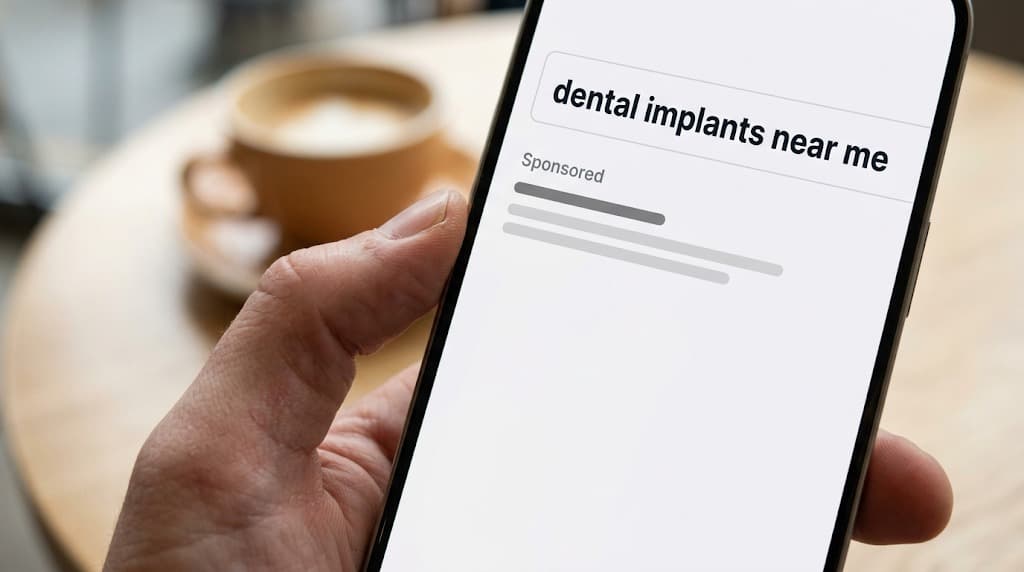
Periodontists should bid on high-intent treatment and local keywords like dental implants, gum grafting, and gum disease specialist near me, while excluding the cheap, broad terms that waste budget. Tight keyword targeting is the single biggest lever on a periodontal campaign's return.
The mistake that drains budgets is mixing everything into one campaign. When implants share a budget with general terms, Google spends your money on the cheapest clicks, usually broad searches that don't convert to surgical cases. Separate your high-value keywords into their own tightly themed campaigns so spend flows where the cases are.
High-value treatment terms
"Dental implants," "gum graft surgery," "LANAP," "full mouth implants." Expensive per click, but the cases pay for themselves.
Local and "near me" terms
"Periodontist near me," "gum specialist [city]." Ready-to-book intent, paired with a tight geographic radius.
Negative keywords
Block "free," "cheap," "jobs," "school," and "dental school" to stop paying for clicks that never convert.
Cost-context terms
"Dental implant cost," "gum surgery price." High intent, but pair with a landing page that frames value, not just a number.
Geo-targeting tightens it further. Most patients choose a provider within a short drive, so set a radius around your practice and don't pay for clicks outside it. Google's own Google Ads documentation covers the campaign settings behind this. For where paid search fits your wider plan, our periodontist marketing guide maps it against SEO and reviews.
How should you set a periodontist PPC budget?
Set a periodontist PPC budget by weighting spend toward your highest-value procedures and judging it against case value, not click cost. A budget built around cost per acquisition keeps you from chasing cheap clicks that never become surgical cases. Allocation matters more than total size.
Start by concentrating budget on the procedures worth the most. An implant campaign deserves more spend than a general perio-cleaning campaign, because the case it produces is worth far more. Don't spread budget evenly across services that have wildly different values.
Build allocation around case value
The principle is simple: put money where the return is. A practical starting split weights implants and surgical cases heaviest, with smaller allocations to local-intent and cost-context terms.
- Implants and surgical cases: the largest share, since these produce your highest-value patients.
- Local "near me" terms: a steady allocation for ready-to-book searchers in your radius.
- Gum disease and condition terms: a moderate share to capture mid-intent patients.
- Testing reserve: a small slice to trial new keywords and landing pages.
For a structured way to size the overall number, our dental marketing budget guide walks through tying spend to the cases you actually want.
One more budget lever: bidding strategy. Manual bidding gives you control early, when you have little data. Once a campaign collects steady conversions, automated strategies like target cost-per-acquisition let Google adjust bids toward the patients most likely to book. The shift only works after you've fed the account real conversion data, so start manual, then automate. Rushing automation on a thin account wastes the expensive clicks you can least afford to lose.
Not sure whether to run PPC, SEO, or both?
Paid search buys speed; SEO builds durable rankings. Most perio practices benefit from both, weighted to their goals and timeline.
Read the periodontist SEO guide →Why do most periodontal PPC campaigns waste money?
Most periodontal PPC campaigns waste money by sending paid clicks to a generic homepage, using broad-match keywords, and failing to follow up fast. Expensive implant clicks magnify every mistake, so a poorly built account loses money faster than a general dental one would. The leaks are predictable and fixable.
The biggest leak is the landing page. Sending an implant click to your homepage forces the patient to hunt for what they searched. Build a dedicated landing page for each major procedure, with clear information, trust signals, and an obvious way to book. The ad and the page have to match the search.
Broad-match keywords without negatives are the second leak. They pull in price-shoppers, job seekers, and students who click but never book, draining a budget on traffic that can't convert. And speed seals it: research on lead follow-up, like HubSpot's marketing statistics library, consistently shows fast response drives conversion, and the window between a paid search and a phone call can be minutes, not hours.
That last point ties paid search to the front desk. A click you paid premium for is wasted if the call hits voicemail.
Related: A fast page protects every expensive click you pay for. → Why website speed costs you patients
How do you turn paid clicks into booked implant cases?
Turn paid clicks into booked cases by matching each ad to a dedicated landing page, making booking effortless, and answering inquiries within minutes. Periodontal PPC clicks are too expensive to lose at the final step. The fastest, clearest practice converts the case.
The handoff from click to consult is where money is made or lost. A patient who clicks an implant ad, reaches a focused page, and can book in two taps converts. One who lands on a cluttered homepage or fills a form and waits a day does not. The CDC reports that nearly half of adults aged 30 and older show signs of periodontal disease, so the demand is there; capturing it is a conversion problem, not a traffic one.
Response speed is the deciding factor for high-value inquiries. A premium implant lead that waits for a callback books elsewhere. This is where your front desk becomes part of your ad ROI, and a strong DentalBase setup keeps paid leads from leaking. Winning the click is only the start; the consult still has to close, which is where periodontal case acceptance takes over.
Stop paying premium for clicks that hit voicemail
DentalBase ties your paid search to a front desk that answers fast, so the expensive implant and gum treatment leads you bid on actually get booked.
Book a free demo →Which metrics show your periodontist PPC is working?
Track four metrics to know if your periodontist PPC is working: cost per acquisition, return on ad spend, conversion rate by campaign, and case value by keyword. Clicks and impressions are noise. The numbers that matter tie spend to booked, high-value cases.
Cost per acquisition, not cost per click, is the headline. Divide campaign spend by booked patients, by campaign. A $300 acquisition cost looks high until you set it against a $5,000 implant case, where it's a clear win. Always judge CPA against case value, never in isolation.
- Cost per acquisition: spend divided by booked patients, by campaign
- Return on ad spend: revenue produced for every dollar spent
- Conversion rate by campaign: which keyword groups actually book
- Case value by keyword: which terms bring the high-value implant cases
| Metric | What it tells you | How often to review |
|---|---|---|
| Cost per acquisition | Whether spend is efficient against case value | Monthly |
| Return on ad spend | Revenue produced per dollar spent | Monthly |
| Conversion rate by campaign | Which keyword groups actually book patients | Monthly |
| Case value by keyword | Which terms bring high-value implant cases | Quarterly |
PPC is not a set-and-forget channel. Review these monthly, pause what loses money, and scale what books cases. The accounts that win are the ones someone actually manages.
Periodontist PPC Readiness Check
Check each item your campaigns already do.
Your score: count your checks out of 6. Four or fewer means your campaign is likely leaking budget.
Effective periodontist PPC comes down to one discipline: bid for cases, not clicks. The expensive implant keyword is a bargain when it books a surgical case, and a money pit when it sends a price-shopper to your homepage. The difference is account structure, landing pages, and how fast you answer.
Start with one fix this week. Check whether your implant ads point to a dedicated landing page or your homepage. If it's the homepage, you've found the leak costing you the most.
Bid with precision, answer fast, and your highest-value cases start coming from search.
Make every periodontal PPC dollar book a case
DentalBase manages the paid search and fast front-desk response that turn expensive implant and gum treatment clicks into booked consults. Book a quick demo to see it on your market.
Book a free demo →Want more guides on growing your practice?
Browse resources →Sources & References
Frequently Asked Questions
Periodontist PPC is pay-per-click advertising that targets implant and gum treatment keywords to place a periodontal practice at the top of Google search results. Practices bid on terms like dental implants and gum grafting, paying per click to reach patients actively searching for specialist care.
Usually yes. Implant keywords are among the most expensive in dental PPC, but a single implant or surgical case is worth thousands, so even a few hundred dollars in ad spend per booked case produces strong return. Judge cost against case value, not click price.
Bid on high-value treatment terms like dental implants and gum graft surgery, plus local 'near me' searches, while excluding cheap broad terms with negative keywords. Keep implant and surgical keywords in their own campaigns so budget flows to the searches that produce real cases.
There's no single number; allocation matters more than total size. Weight spend toward your highest-value procedures, concentrate budget on implant and surgical campaigns, and judge results by cost per acquisition against case value rather than by total spend or clicks.
The common leaks are sending paid clicks to a generic homepage, using broad-match keywords without negatives, and slow follow-up. Expensive implant clicks magnify every mistake, so dedicated landing pages, tight targeting, and fast response are essential to protect the budget.
Was this article helpful?
Written by
DentalBase Team
Expert dental industry content from the DentalBase team. We provide insights on practice management, marketing, compliance, and growth strategies for dental professionals.