AI Dental Receptionist Case Study: 35% More Bookings
This AI dental receptionist case study shows how one practice booked 35% more patients. Before/after data, costs, ROI timeline, and lessons learned.
Share:
Table of contents
An AI dental receptionist case study tells you more about this technology than any feature list ever could. You get real numbers from a real practice, with before-and-after data that shows exactly what changed and how long it took. That's what this article delivers. This fits into a broader shift toward automated front desks, which our DentalBase AI receptionist guide covers in full.
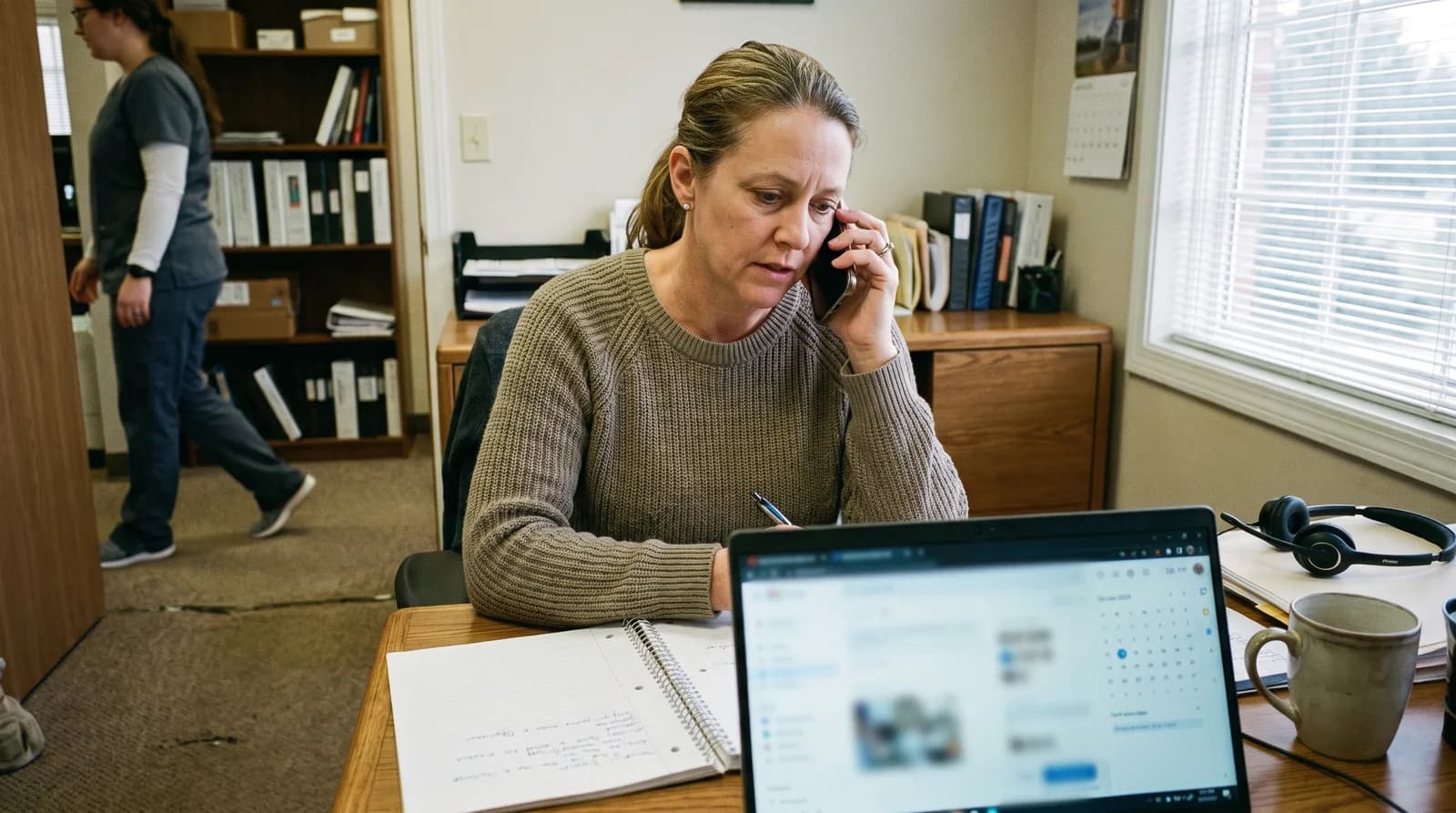
Most dental offices run into the same bottleneck: a small front desk team juggling check-ins, insurance calls, and a phone that won't stop ringing. According to ADA research, 38% of new patient calls go unanswered during business hours. And 80% of callers who hit voicemail won't try again, based on reporting from Dental Economics. That's not a minor inefficiency. It's a revenue leak.
Below, you'll find a breakdown of how AI dental receptionists work, why practices are adopting them, what one New Hampshire practice experienced after going live, and what ROI you can realistically expect. Every section is built to stand on its own, so skip to whatever matters most to you.
What Does an AI Dental Receptionist Actually Do?
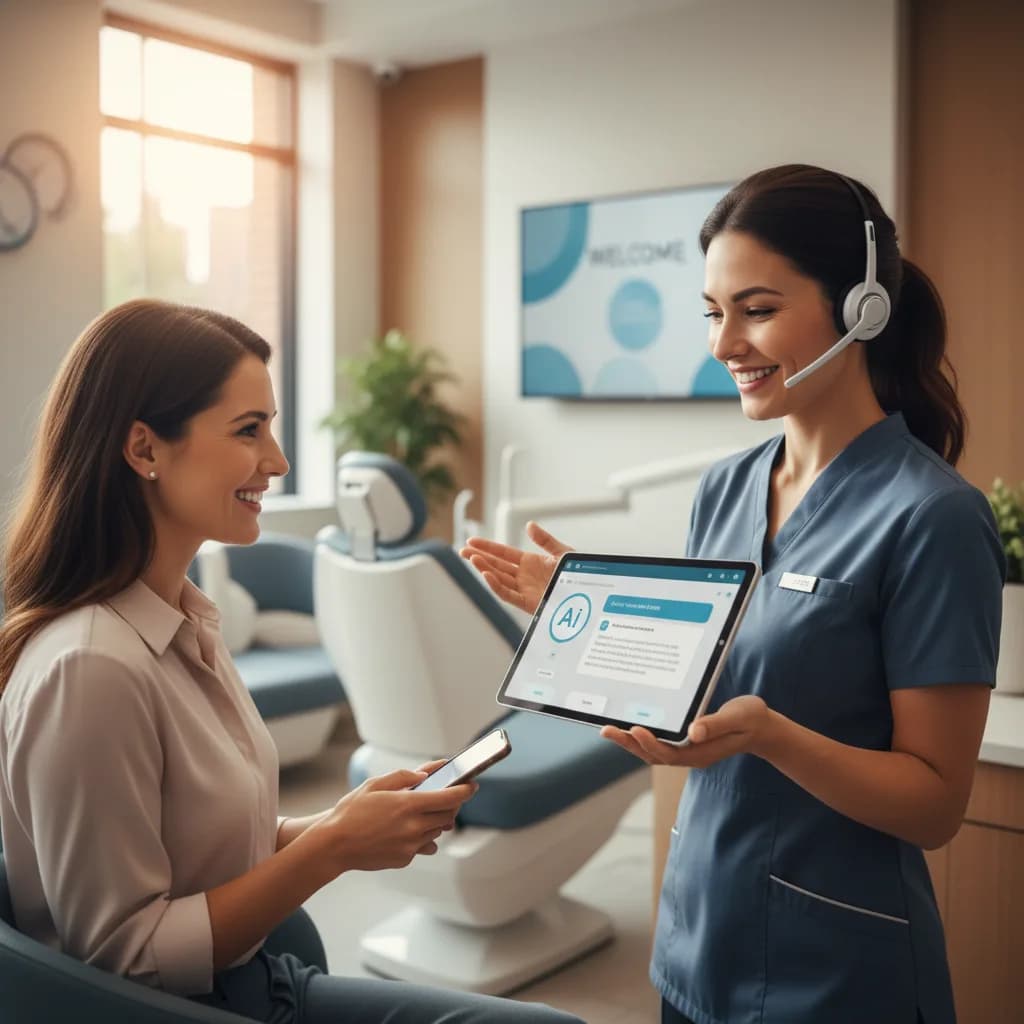
An AI dental receptionist is software that answers patient calls, schedules appointments, and handles routine questions using natural language processing, all without putting anyone on hold. It connects directly to your practice management system and works around the clock.
That's the short version. Here's what it looks like in practice.
When a patient calls, the system picks up instantly and identifies why they're calling. Appointment request? It checks real-time availability in your PMS, whether that's Open Dental, Dentrix, or Eaglesoft, and books the slot while the patient is still on the line. Cancellation? It offers alternatives before confirming. Emergency? It routes the call to the on-call provider within seconds.
The difference between this and a basic auto-attendant is context. Auto-attendants play a menu and transfer calls. An AI receptionist understands what a patient means when they say "I chipped my front tooth at lunch and it hurts," then routes that as urgent rather than filing it as a general inquiry. It also remembers previous conversations, so a returning patient doesn't have to repeat their insurance details or explain their treatment history.
Most systems also handle text messages and online chat with the same logic. A patient texting "can I move my Thursday cleaning to next week?" gets a real answer with available times, not a "someone will get back to you" reply. That responsiveness is what separates AI reception from the voicemail-and-callback cycle most practices still rely on.
See How DentiVoice Handles Calls for Dental Practices
AI-powered call answering, scheduling, and patient communication, connected to your PMS.
Learn About DentiVoice →Why Are Dental Practices Switching to AI Receptionists?
Dental practices are switching because the front desk model hasn't scaled with patient expectations or call volume. Staffing gaps, rising labor costs, and after-hours demand are pushing owners toward automation that doesn't call in sick.
The numbers paint a clear picture. The average dental practice misses 15-20 calls per week, according to Dental Economics. After-hours calls make up 27% of total patient call volume. And average hold time before a patient hangs up? About 90 seconds. That's not enough time for a front desk team handling check-ins and insurance verification to even pick up.
Staff turnover compounds the problem. Administrative roles in dental offices see turnover rates between 30-40%, which means your best-trained receptionist might leave before their first anniversary. Every replacement costs weeks of recruiting, onboarding, and lost productivity. Meanwhile, patients who call during that transition get inconsistent service or no answer at all.
There's also the after-hours gap. A two-provider practice closes at 5 PM, but patients don't stop needing to reschedule, ask about post-op care, or book appointments just because the office is dark. Without coverage, those calls become missed opportunities. Based on our experience at DentalBase, practices that add after-hours AI answering typically recover 10-15 appointments per month that would have gone to a competitor.
That's why the shift is happening. It's not about replacing your front desk team. It's about giving them backup so they can focus on the patients standing in front of them.
Related: See how unanswered calls affect your bottom line → 38% of Dental Calls Go Unanswered: The Revenue Impact
AI Dental Receptionist Case Study: Peterborough Family Dental
This AI dental receptionist case study follows Peterborough Family Dental, a two-provider practice in Peterborough, New Hampshire, through their first 90 days with an AI phone system. The results include a 42% increase in new patient bookings and a 10-point drop in no-shows.
The Practice Before AI
Dr. Muhammad Rahim and Dr. Jasper Ainslie run a general and cosmetic dentistry practice serving the Monadnock region. Two front desk staff handle everything: check-ins, insurance verification, treatment plan follow-ups, and phones. The practice runs on Open Dental.
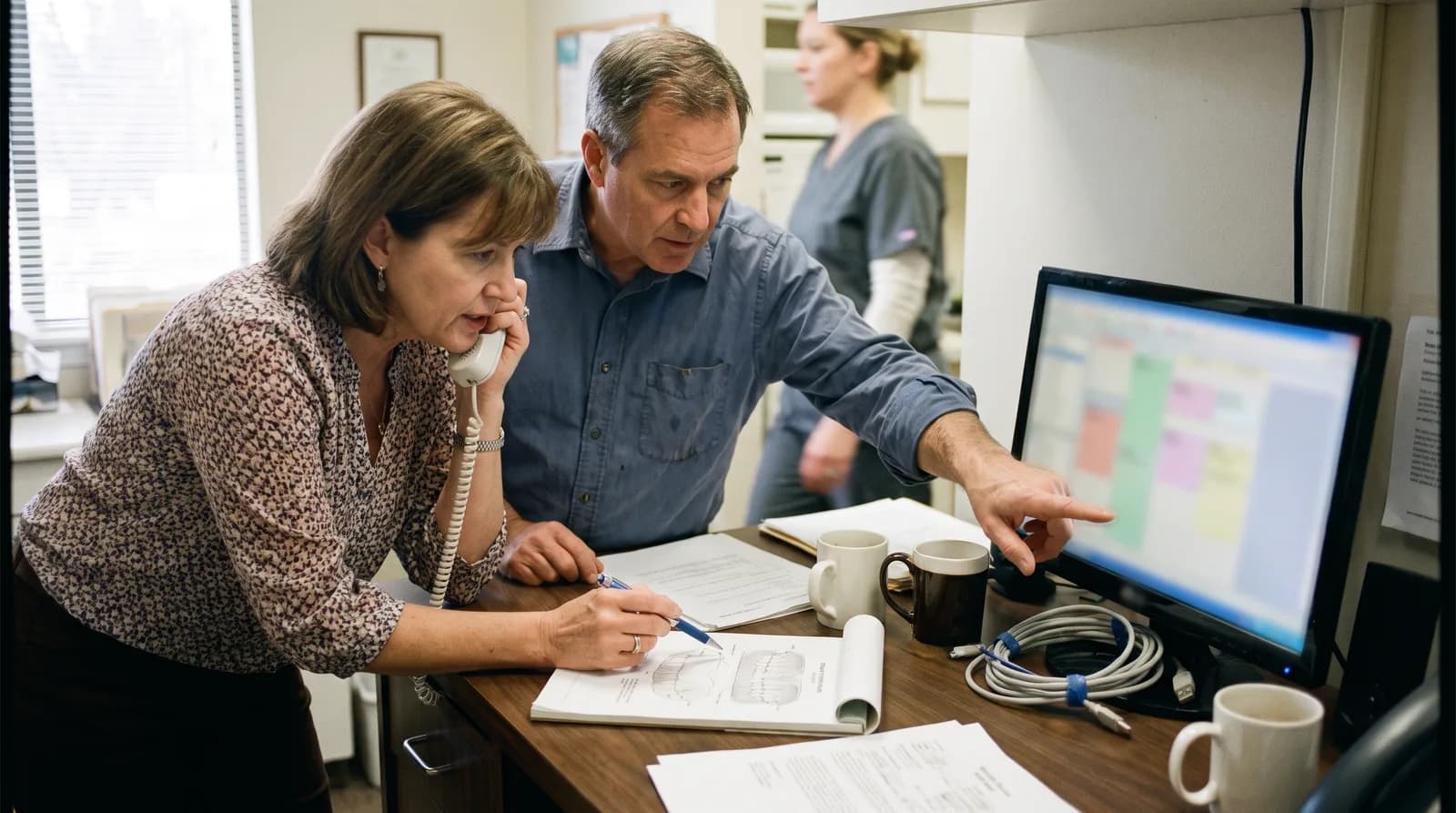
Before going live with DentiVoice, the practice was fielding roughly 120 calls per day. During peak hours, between 9-11 AM and 2-4 PM, hold times regularly exceeded six minutes. Call abandonment sat at 15%. The no-show rate had climbed to 19%, partly because the team couldn't consistently send confirmations when the phones were ringing nonstop.
The real cost wasn't just missed appointments. It was new patients calling once, getting voicemail, and booking elsewhere. In a market like southern New Hampshire, where patients have multiple providers within a 20-minute drive, that second chance rarely comes.
Implementation and 90-Day Results
DentiVoice went live after a two-week setup that included Open Dental API configuration, call flow customization for the practice's scheduling rules, and staff training on the escalation process. No downtime. No disruption to existing phone lines.
Here's what changed over the first 90 days:
| Metric | Before DentiVoice | After 90 Days |
|---|---|---|
| Call abandonment rate | 15% | 2.8% |
| Avg hold time (peak hours) | 6.2 minutes | 1.4 minutes |
| No-show rate | 19% | 9% |
| Calls handled without staff | 0% | 61% |
| New patient bookings/month | ~38 | ~54 |
| Patient satisfaction (post-visit survey) | 3.6 / 5 | 4.4 / 5 |
The 16 additional new patients per month translated to roughly $14,500 in added monthly revenue, calculated from the practice's average new patient value of approximately $900 across initial exam, cleaning, and first-phase treatment. Against a monthly DentiVoice cost that's a fraction of one full-time hire's salary, the system paid for itself well before the 90-day mark.
What the numbers don't show is the qualitative shift. Front desk staff stopped spending half their day on the phone and started spending it on the patients in the office. Insurance verification backlogs cleared. Confirmation calls went out on time, every time. The team described it as "getting their mornings back."
Want Results Like Peterborough Family Dental?
See how DentiVoice can handle your practice's calls, scheduling, and follow-ups.
Book a Free Demo →What ROI Can You Expect From an AI Dental Receptionist?
Most practices that implement an AI dental receptionist reach positive ROI within three to five months, driven by recovered missed calls, lower no-show rates, and reduced staffing pressure. The exact timeline depends on your call volume and current abandonment rate.
The cost comparison is straightforward. AI receptionist systems typically run $200-800 per month depending on call volume and features. A full-time front desk hire costs $25,000-40,000 annually in salary alone, before benefits, training, and turnover expenses. You're not replacing that person entirely, but you're removing the need to hire a second or third one to cover overflow and after-hours calls.
Peterborough Family Dental's numbers illustrate this well. Their $14,500 monthly revenue increase came primarily from two sources: new patients who would have abandoned the call, and existing patients who stopped no-showing because confirmations went out consistently. The practice didn't add a single clinical hour to capture that revenue. They just stopped losing the patients who were already trying to reach them.
Practices that see the fastest payback share a few characteristics. They're handling 100+ calls per day with two or fewer front desk staff. They have measurable after-hours call volume, typically 20-30% of total calls. And they're already losing patients to hold times or voicemail, even if they haven't quantified it yet.
Here's a useful benchmark. If your practice misses even 5 new patient calls per week and your average new patient value is $800-1,200, that's $16,000-24,000 in lost monthly revenue. An AI receptionist recovering even half of those calls pays for itself several times over. The math isn't complicated. The hard part is admitting the problem exists.
Related: A deeper look at the financial case for AI reception → AI Dental Receptionist ROI: Complete Guide
How Do You Stay HIPAA Compliant With an AI Receptionist?
Staying HIPAA compliant with an AI receptionist requires a signed Business Associate Agreement with your vendor, AES-256 encryption for all patient data, and documented access controls that limit who can review call transcripts and recordings.
That covers the legal baseline. But compliance in practice means more than checking boxes.
Your AI vendor should encrypt patient communications both in transit and at rest. That includes voice recordings, text transcripts, and any data synced with your PMS. If a vendor can't confirm AES-256 or equivalent encryption standards in writing, that's a disqualifier. The HHS HIPAA Security Rule is specific about safeguards for electronic protected health information, and "we take security seriously" on a website doesn't meet the standard.
Patient consent is the other piece practices overlook. Your privacy notice should disclose that an AI system may handle their calls. Some states have additional requirements around automated call recording. It's worth having your compliance officer or attorney review the disclosure language before go-live, not after a patient files a complaint.
On the operational side, build a monthly audit process. Pull a sample of 20-30 AI-handled calls per month and review them for accuracy, appropriate escalation, and data handling. Document what you find. This isn't just good practice. It's what federal oversight bodies expect when they audit your compliance program.
- Signed BAA with your AI vendor before any patient data flows through the system
- AES-256 encryption for voice recordings, transcripts, and PMS data syncs
- Role-based access controls so only authorized staff can review AI call logs
- Updated privacy notice disclosing AI-assisted communication handling
- Monthly call audits with documented findings and corrective actions
DentalBase Is Built for HIPAA Compliance
Every DentiVoice deployment includes a signed BAA, encrypted data handling, and audit-ready call logs.
Explore DentalBase Services →How Should a Practice Prepare for AI Receptionist Implementation?
Preparing for an AI receptionist starts with auditing your current call workflows, verifying your PMS supports API integration, and defining clear escalation rules so your team knows exactly when the AI hands off to a human.
Start with your call data. If you don't know how many calls you're missing, you can't measure improvement. Most VoIP systems and PMS platforms can pull call volume, abandonment rates, and peak-hour patterns. Run that report for the last 90 days. That baseline becomes the benchmark you'll compare your AI dental receptionist case study against internally.
Next, confirm your PMS compatibility. Open Dental, Dentrix, and Eaglesoft all support API connections, but each has different configuration requirements. Ask your AI vendor for a technical spec document before signing anything. Peterborough Family Dental's two-week setup was smooth specifically because they confirmed Open Dental API access upfront and mapped their scheduling rules before the integration began.
Related: Not sure which platform fits your practice yet? See our complete walkthrough on how to choose an AI dental receptionist, and compare every major option in the 2026 dental virtual receptionist buyer’s guide.
Escalation protocols matter more than most practices realize. Your AI needs clear instructions on what constitutes an emergency, when to transfer to a specific provider, and how to handle situations it can't resolve. Build these rules with your clinical team, not just your office manager. A patient describing facial swelling needs a different response path than someone asking about whitening options.
Finally, train your staff before go-live. Not on how to use the AI, but on how their role changes. Front desk team members who spent 60% of their day on the phone will suddenly have that time back. Redirect it toward in-office patient experience, insurance follow-ups, or treatment plan presentations. The practices that get the most from AI reception are the ones that plan for what their team does instead of answering phones, not just what the AI does instead of them.
Related: A full breakdown of what to automate and what to keep human → Dental Front Desk Automation: What to Automate and What to Keep Human
The Peterborough Family Dental case study proves something that feature lists and vendor demos can't: an AI dental receptionist doesn't just answer phones. It recovers revenue you didn't know you were losing. The 42% jump in new patient bookings, the 10-point drop in no-shows, the staff finally having time for the patients in front of them, all of that came from solving one problem. The phone.
If your practice is fielding 100+ calls a day with a small front desk team, the math is already working against you. Every missed call is a patient who books somewhere else. Every voicemail is a follow-up that probably won't happen. An AI receptionist doesn't fix everything, but it fixes the bottleneck that's costing you the most.
Your next step is simple. Pull your call data for the last 90 days, look at your abandonment rate, and ask whether you can afford to keep losing those patients.
Stop Losing Patients to Missed Calls
See how DentiVoice answers every call, books appointments, and pays for itself within months.
Book a Free Demo →Explore More Guides and Tools for Dental Practice Growth
Browse Resources →Sources & References
Frequently Asked Questions
An AI dental receptionist case study documents a real dental practice's experience implementing AI phone answering technology. It includes before-and-after metrics like call abandonment rates, no-show percentages, new patient bookings, and revenue impact over a defined period, typically 90 days.
Most dental practices reach positive ROI within three to five months of implementing an AI receptionist. The timeline depends on call volume, current abandonment rates, and average new patient value. Practices with 100+ daily calls and high after-hours volume typically see results faster.
Yes, leading AI dental receptionist systems integrate with Open Dental, Dentrix, and Eaglesoft through API connections. These integrations allow real-time appointment scheduling, patient record updates, and calendar syncing without manual data entry from your front desk team.
AI dental receptionists use urgency detection to identify emergency calls based on the patient's language and symptoms. Calls flagged as urgent are immediately routed to the on-call provider or designated staff member, typically within seconds of the system recognizing the emergency.
AI dental receptionist systems typically cost between $200 and $800 per month depending on call volume and features. That's significantly less than the $25,000-40,000 annual salary for a full-time receptionist, and most practices recover the cost within three to five months.
Reputable AI dental receptionist vendors are HIPAA compliant when properly configured. Compliance requires a signed Business Associate Agreement, AES-256 encryption for all patient data, role-based access controls, and regular security audits. Verify these elements in writing before implementation.
Was this article helpful?
Written by
Dentalbase Team
The Dentalbase Team is a collective of dental marketing experts, AI developers, and practice management consultants dedicated to helping dental practices thrive in the digital age.