Dental Front Office Automation: What to Automate (2026)
Dental front office automation guide for 2026. Learn which front desk tasks to automate with AI, which to keep human, and how to measure ROI.
Share:
Table of contents
Dental front office automation isn't about replacing your receptionist with a robot. It's about figuring out which of the 15 things they do every hour can be handled by software, and which ones genuinely need a human being. Most practices get this wrong in one of two ways: they automate nothing and burn out their team, or they automate everything and patients feel like they're talking to a vending machine.
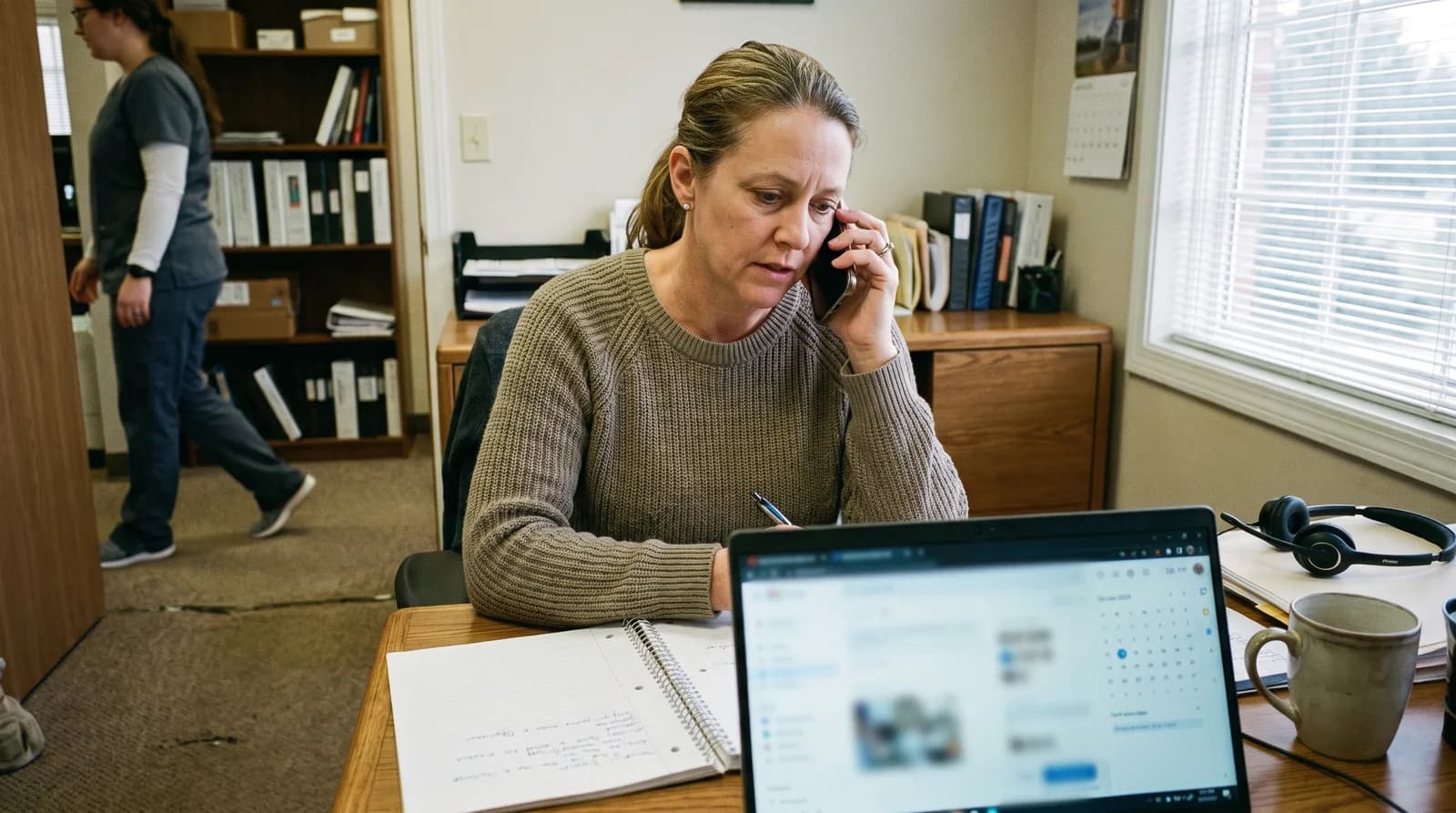
The reality is that your front office handles a mix of tasks with very different requirements. Some are repetitive, time-sensitive, and perfect for automation. Others require empathy, judgment, and the kind of nuance that only a person can deliver. According to Dental Economics, the average dental practice misses 15-20 calls per week, not because the team is lazy, but because they're doing six things at once. AI receptionist tools exist to take the repetitive load off your team's plate so they can focus on the work that actually requires a human.
This article breaks down what your front office actually spends time on, which parts you can automate today, which parts you shouldn't, and how to tell if it's working. If you're weighing the idea of front office automation for the first time or trying to figure out where your current setup falls short, this is the guide to start with.
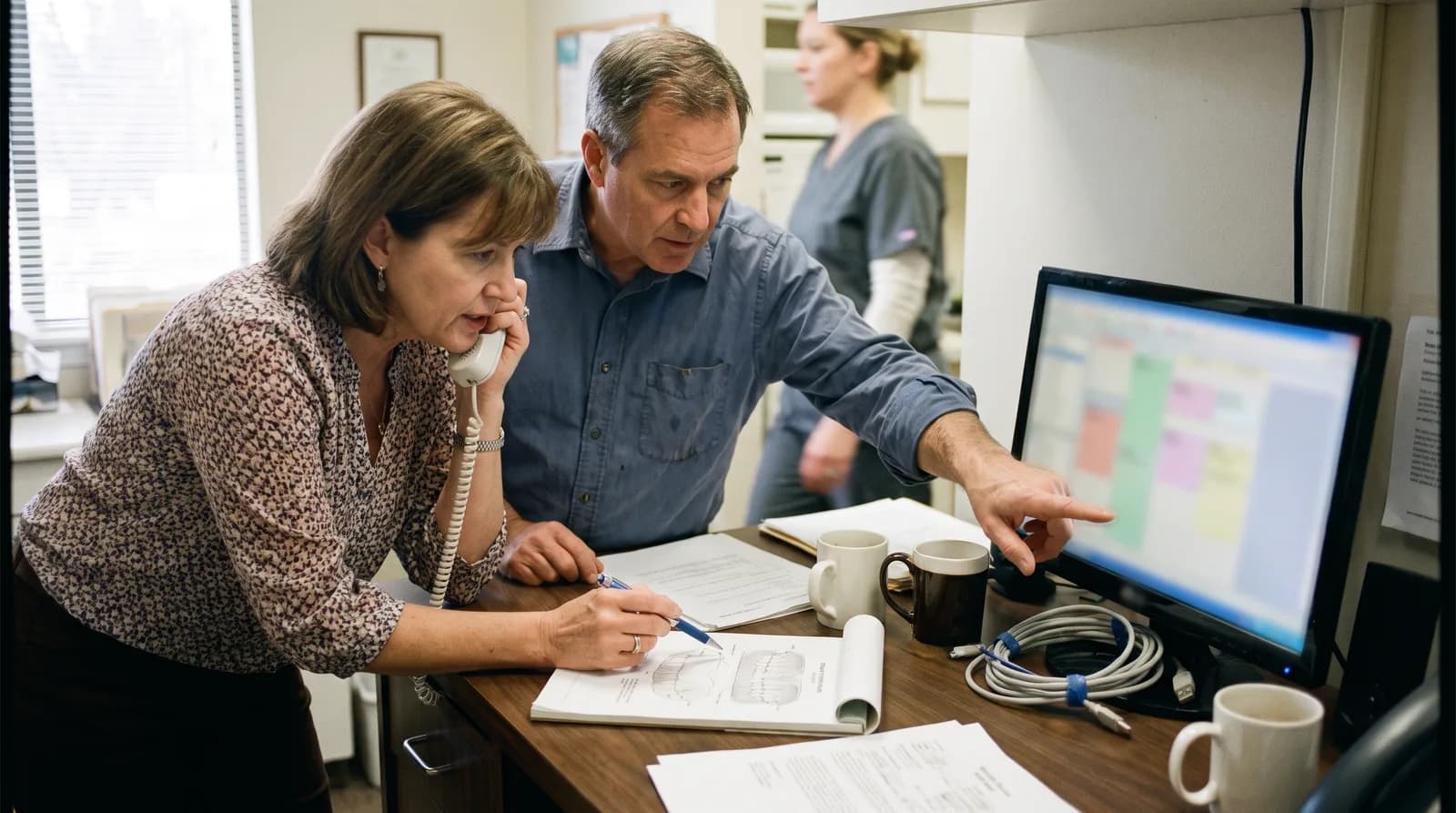
Here is the honest version, from someone who has actually run a front desk through a busy Monday: the phones do not stop, the fax machine spits out insurance forms, two patients are standing at the window, and the hygienist needs a chart pulled. That is the exact moment a missed call becomes a lost patient. Dental front desk automation is not a luxury add-on for that scenario. It is the difference between a team that drowns and a team that runs the day.
When I first mapped my own front office, I assumed the answer was "hire another person." It was not. Roughly two-thirds of what was eating the day was repetitive, rules-based work a machine handles better than a stressed human at 4:45pm. The remaining third genuinely needed a person. Sorting those two piles is the whole game, and it is what the rest of this guide walks through. To see where these tools sit in a wider stack, start with the full DentalBase services overview.
Ask yourself three questions before you automate anything:
- Is this task repetitive and rules-based? If a task follows the same script every time, it is a strong automation candidate.
- Does the patient actually want a human here? Nobody wants a robot delivering a treatment plan, but nobody misses a human reading them an appointment reminder either.
- Is this task quietly costing me patients? Unanswered calls and slow callbacks leak revenue every single day, which is exactly where automation pays for itself first.
What Does Your Front Office Actually Spend Their Time On?
Before you automate anything, you need to know where the hours go. Most practice owners have a vague sense that their front desk is "busy," but they haven't mapped the specific tasks consuming the day. Without that map, you'll automate the wrong things and miss the biggest wins.
Here's what a typical day looks like for a dental receptionist at a practice seeing 25-30 patients:
| Task | Estimated Daily Time | Automatable? |
|---|---|---|
| Answering and making phone calls | 2-3 hours | Mostly yes |
| Appointment confirmations and reminders | 45-60 min | Yes |
| Patient check-in and checkout | 1-2 hours | Partially |
| Insurance verification and eligibility | 1-1.5 hours | Partially |
| New patient intake and paperwork | 30-45 min | Yes |
| Treatment plan and financial discussions | 30-60 min | No |
| Handling patient complaints or concerns | 15-30 min | No |
| Recall and reactivation outreach | 30-45 min | Yes |
Add it up and your receptionist is doing 6-9 hours of work in an 8-hour day. Something's always getting squeezed. Usually it's the phone. That's why 38% of new patient calls go unanswered during business hours, according to ADA Practice Transitions. Your team isn't ignoring the phone. They're checking in Mrs. Patterson while verifying Mr. Gonzalez's Delta Dental coverage while the phone rings for the third time in ten minutes.
The question isn't whether your front office needs help. It's which tasks you take off their plate first. The real cost of your front desk goes well beyond salary when you factor in missed calls, no-shows from forgotten reminders, and the revenue that walks out the door every week.
Which Front Office Tasks Can You Automate Today?
Not every front office task needs AI. Some just need better software. The tasks you can automate today fall into two categories: things that need conversational AI (like phone calls) and things that just need smart workflows (like reminders and intake forms). Knowing the difference helps you pick the right tool for each job.
Daily Time Recovered
Where Front Office Automation Saves the Most Hours
Phone Call Handling
This is the biggest automation win for your front office. An AI receptionist answers inbound calls, asks what the patient needs, checks your PMS for availability, and books the appointment. It handles the calls your team can't get to during peak hours and every call that comes in after close. Based on Dental Economics data, after-hours calls represent 27% of total volume. That's a quarter of your phone traffic that's fully automatable with zero impact on your in-office operations.
For small practices running with one or two front desk staff, phone automation isn't a luxury. It's how you stop losing the 15-20 calls per week that your team physically can't answer. And because 80% of callers who reach voicemail don't leave a message and won't call back (Forbes), each missed call is a patient you'll likely never hear from again.
Full automation is not the only model. Many practices get better results running AI alongside their existing team rather than replacing anyone. Our guide to building a human-plus-AI omnichannel front desk explains how to split the workload so each side handles what it does best.
Appointment Confirmations and Reminders
If your team is still making manual confirmation calls, that's 45-60 minutes per day that software should be handling. Automated reminder sequences via SMS and email, timed at 7 days, 48 hours, 24 hours, and 2 hours before the visit, are proven to reduce no-shows by 23-42% compared to single-method reminders, according to research from the Journal of Medical Internet Research. Set it up once and it runs itself.
The timing of your reminders matters more than most practices realize. A single text 24 hours before the visit is better than nothing, but a multi-touch sequence across channels catches the patients who miss the first message, ignore texts, or need a phone-based nudge from your automated confirmation system.
New Patient Intake
Digital intake forms that patients complete on their phone before they arrive save 15-20 minutes per new patient at the front desk. The data flows into your PMS without manual entry. No clipboards, no illegible handwriting, no staff re-typing the same information. Most PMS platforms support this natively or through add-ons. If yours doesn't, third-party tools connect to Dentrix, Open Dental, and Eaglesoft.
Recall and Reactivation
Patients who haven't visited in 6+ months need outreach, but that outreach doesn't need to be a phone call from your team. Automated recall sequences via text and email catch the easy wins. For patients who don't respond to texts, AI-powered outbound calls can follow up conversationally and rebook. According to the ADA, 20-30% of patients become inactive within 18 months without follow-up. Automation keeps that outreach consistent even when your team gets swamped with in-office demands.
The right reactivation campaign doesn't just send a generic "we miss you" text. It segments by how long the patient's been gone, what treatment they still need, and which channel they're most likely to respond to. That's where AI-driven AI-driven automation starts pulling ahead of basic reminder software.
Related: A deeper look at which reactivation workflows actually bring patients back. → AI Dental Patient Reactivation: Complete Guide
Which Front Office Tasks Should Stay With Your Team?
Automation has clear limits in dental offices, and knowing where those limits are prevents you from creating a patient experience that feels cold or impersonal. Some front desk tasks require emotional intelligence, clinical judgment, or the kind of relationship-building that no software can replicate.
Treatment Plan Presentations
When a patient hears they need a crown, an implant, or a root canal, they have questions that go beyond scheduling. How much will insurance cover? What are the payment options? What happens if they wait? These conversations require a person who can read the patient's body language, adjust their tone, and build trust. Automating treatment plan discussions would save time on paper but cost you case acceptance in practice.
Your treatment coordinator or front desk lead should own these conversations. What you can automate is the follow-up: sending treatment plan summaries via email, triggering reminder sequences for patients who haven't scheduled, and flagging unscheduled treatment in your morning huddle reports.
Patient Complaints and Sensitive Situations
A patient upset about a billing error, a bad experience with a provider, or unexpected pain after a procedure needs a human who can listen, empathize, and resolve. An AI system saying "I understand your frustration" doesn't carry the same weight as your office manager saying it with genuine concern. These interactions are rare (maybe 2-3 per week in most practices) but they're high-stakes for patient retention.
Complex Insurance Conversations
Basic questions like "Do you accept Delta Dental?" can be answered by AI. But when a patient calls about a denied claim, a pre-authorization issue, or a coverage dispute that involves coordination between two plans, that conversation needs someone who can dig into the specifics. These calls take 10-20 minutes each and require judgment about what to say, what not to promise, and when to involve the insurance company directly.
In-Person Check-In and Checkout
You can partially automate check-in with kiosks or tablet sign-ins. But the moment when a patient walks through your door and someone greets them by name, asks about their kid's soccer game, and makes them feel welcome? That's not a task. That's the reason patients stay with your practice instead of switching to the office down the street. Don't automate your first impression.
The bottom line: let automation handle the phone and the paperwork. Let your team handle the people standing in front of them. That split is where the real front desk training payoff happens, because your staff has the bandwidth to actually be present instead of multitasking through every interaction.
See how practices split the workload
Your front desk focuses on in-office patients while AI catches every call, including after-hours and overflow.
Learn About AI Reception →38%
of new patient calls go unanswered during business hours, per ADA Practice Transitions data.
80%
of callers who reach voicemail never leave a message and do not call back, according to Forbes.
90 sec
is the average hold time before a patient hangs up, based on Marchex call data.
Read those three numbers together and the math gets uncomfortable. According to ADA Health Policy Institute research, convenience is now a top factor in how patients choose a provider, so a phone system that lets calls ring out is quietly training your community to book somewhere else. The CDC oral health data shows how many adults skip regular dental visits, and a hard-to-reach phone line only widens that gap. This is the single clearest case for dental front desk automation: the phone line is where most practices bleed, and it is the easiest place to stop the bleeding.
How Do You Automate Phone Calls Without Patients Noticing?
This is the question that makes most practice owners nervous about front office automation. If patients realize they're talking to AI, will they feel dismissed? Will they hang up? Will they leave a bad review? The short answer: not if it's done right. The long answer requires understanding what "done right" actually means.
Voice Quality and Conversation Flow
The AI voice receptionists from even two years ago sounded robotic and followed rigid scripts. Today's systems use natural language processing that handles interruptions, understands context, and responds conversationally. A patient who says "Actually, wait, can we do morning instead?" mid-sentence gets a natural response, not a confused loop back to the beginning of the call flow.
The voice itself matters. Systems that use high-quality text-to-speech with natural pacing, appropriate pauses, and human-like inflection sound indistinguishable from a real receptionist on most calls. Patients calling to book a cleaning or reschedule an appointment don't analyze whether they're talking to a person or AI. They care whether the problem gets solved. Fast.
When to Disclose and When to Transfer
Some states require disclosure that the caller is speaking with an automated system. Even where it's not required, transparency builds trust. A simple opening like "Hi, this is the scheduling assistant at Smile Dental" sets the right expectation without making a big deal out of it. Most patients don't care, as long as the system is helpful.
The key is knowing when to hand off. Good AI systems detect when a conversation exceeds their capabilities: a patient getting emotional, a complex billing dispute, a clinical question that requires provider input. When that happens, the system should transfer to a live team member with full context from the conversation so the patient doesn't have to repeat themselves. That handoff is where most systems either shine or fail. The best front office automation platforms don't just transfer the call. They pass a summary of what the patient already said, what they need, and any account details the AI already pulled up.
Configuring for Your Practice's Voice
The AI should sound like your practice, not like a generic call center. That means customizing the greeting, the tone, the way it references your providers, and the specific language it uses for your services. If your practice culture is warm and casual, the AI shouldn't sound corporate. If you're a specialty practice that communicates formally, it shouldn't sound like a chatbot.
Spend time during setup getting this right. Record your actual receptionist handling a few calls and use those as the baseline for how the AI should communicate. The practices that invest in this configuration step report significantly higher patient satisfaction with their automated calls. If you're evaluating options, the top AI receptionist demos for 2026 show you exactly how this configuration works before you commit.
Want to hear what it sounds like?
Listen to actual AI-handled calls and see how the system books, reschedules, and transfers, configured for a real dental practice.
Book a Free Demo →What About Insurance Verification and Patient Intake?
Insurance verification and patient intake are two of the most time-consuming front office tasks, and they're ripe for automation. But the approach is different from phone call automation. These aren't conversational AI problems. They're workflow automation problems that require a different set of tools.
Workflow Comparison
Morning Routine: Manual vs. Automated Front Office
Before Automation
- ✗ 25+ manual insurance calls
- ✗ Paper clipboards at check-in
- ✗ Hand-type data into PMS
- ✗ Phone ringing unanswered
- ✗ Coverage gaps found at chair
90-120 min
After Automation
- ✓ Batch eligibility runs overnight
- ✓ Digital forms pre-filled by patient
- ✓ Data synced to PMS automatically
- ✓ AI catches overflow + after-hours
- ✓ Flags + exceptions reviewed in huddle
15-20 min
Insurance Verification
Manual insurance verification eats 1-1.5 hours per day. Your team calls the carrier, waits on hold, reads off subscriber IDs, and writes down coverage details. For a practice seeing 25-30 patients daily, that's 25-30 verifications that need to happen before or on the day of the appointment.
Automated eligibility tools pull coverage data directly from insurance carriers via electronic connections. They run verifications in batches the night before, flagging patients whose coverage has lapsed, changed, or has limitations that affect the next day's procedures. Your team reviews the flags in the morning instead of making 25 phone calls.
This isn't AI. It's basic data integration that most PMS platforms already support or can add through third-party tools. If your team is still calling insurance companies manually for routine eligibility checks, that's the first front office automation win you should pursue. It frees up over an hour per day with almost no change to your patient-facing workflow.
Digital Patient Intake
Paper intake forms create three problems: they take time to fill out in the waiting room, the handwriting is often unreadable, and someone has to manually enter the data into your PMS. Digital intake solves all three. Patients complete forms on their phone before they arrive. The data maps directly into your system. Check-in takes 2 minutes instead of 15.
For practices still using clipboards, the switch to digital intake typically saves 15-20 minutes per new patient and reduces data entry errors significantly. It also gives your team the patient's information before they walk through the door, so they can prep for the visit, verify insurance, and identify any red flags in the medical history ahead of time.
The combination of automated insurance verification and digital intake transforms your morning workflow. Instead of starting the day buried in phone calls and paperwork, your team starts with a clean dashboard: tomorrow's patients verified, forms completed, notes prepped. That's the kind of front office setup that books more appointments because the team has bandwidth to actually answer the phone. If you're building your dental AI platform from scratch, these workflow automations are the foundation layer that makes everything else work.
Related: A full roadmap for automating practice workflows step by step. → Dental Practice Automation: 2026 Roadmap
How Do You Automate Without Losing the Personal Touch?
This is the fear that stops most practice owners from pulling the trigger. "My patients chose us because we're not a factory. If they start talking to robots, they'll leave." It's a valid concern. But it's also based on a false choice between automation and personal service. The right approach gives you both.
Automate the Tasks Patients Don't Care About
Nobody has an emotional attachment to the confirmation text they receive 48 hours before their cleaning. Nobody treasures the experience of waiting on hold while your receptionist finishes a checkout. Nobody feels a deep human connection during the 30-second call where they say "I need to move my Thursday appointment to Friday." These are transactional interactions. Patients want them done quickly and correctly. They don't care who or what does them.
The interactions patients do care about are different. The warm greeting when they walk in. The conversation about their treatment options. The empathetic response when they're nervous about a procedure. The follow-up call after a difficult extraction. These are relationship moments, and they should stay with your team.
Use Front Office Automation to Create More Time for Personal Service
Here's the part most practices miss. Front office automation doesn't reduce personal service. It creates space for more of it. When your receptionist isn't spending 2 hours on the phone handling routine scheduling calls, they have time to walk a nervous patient to the operatory, spend an extra minute explaining a treatment plan, or follow up personally with someone who missed their appointment.
The practices with the highest patient satisfaction scores aren't the ones with the fewest technologies. They're the ones that use technology for the routine stuff so their people can focus on the human stuff. That's not a compromise. It's the whole point. And when you track the data, you'll see it: first-visit return rates go up when front desk staff have the bandwidth to actually connect with new patients instead of rushing through intake while the phone rings.
Let Patients Choose Their Channel
Some patients prefer texting. Some prefer calling. Some want to book online at midnight. Others want to walk in and talk to a person. Automation gives your front office the ability to serve all of these preferences without needing a team of five at the front desk. The patient who wants a quick text exchange to reschedule gets it. The patient who wants to chat with your office manager about their treatment plan gets that too. Both feel like they got personal service, because they did, just through different channels.
According to BrightLocal, 72% of patients say convenience is a top factor when choosing a dental provider. Automation is how you deliver convenience without sacrificing warmth. And it doesn't need to be complicated. A clear automation roadmap helps you roll out changes in phases so neither your team nor your patients feel overwhelmed.
Not sure where to start with front office automation?
See how other practices built their automation stack, what they spent, and what they got back in time and revenue.
Read the Automation Guide →How Do You Roll Out Dental Front Desk Automation Without Chaos?
Roll it out one task at a time, not all at once. The practices that struggle with dental front desk automation are the ones that flip every switch in the same week, confuse the team, and then blame the software. A staged rollout over four to six weeks lets your staff trust each layer before the next one goes live.
This is the exact sequence I would use again if I were starting from scratch tomorrow, in order of fastest payback to lowest:
- Turn on after-hours and overflow call answering first. This captures revenue you are currently losing tonight, so it pays for the whole project almost immediately.
- Automate appointment reminders and confirmations next. Multi-channel reminder sequences are the most reliable no-show reducer, and patients already expect them.
- Add recall and reactivation outreach in week three. Let the system work your PMS data for overdue patients instead of a staff member running reports.
- Layer in digital intake and insurance verification once the phones are stable. These remove clipboard time and pre-appointment phone tag without touching the patient relationship.
- Review the analytics weekly and tune the scripts. Automation is not "set and forget"; the first month is where you catch the awkward phrasing and fix it.
Related: If phone volume is your first bottleneck, this breakdown helps you size it before you buy anything. Read the dental phone capacity guide →
What surprised me most? The staff pushback I braced for never really came. Once the team saw the phones stop ringing over their shoulder during a crown prep, they stopped seeing automation as a threat and started asking what else they could hand off. The trust curve is real, and staging the rollout is how you earn it. For a deeper look at how the human and automated layers split the work, see our take on blending an AI receptionist with your human team.
How Do You Measure Whether Front Office Automation Is Working?
You've automated reminders, set up an AI receptionist, moved to digital intake. Now how do you know it's actually making a difference? Without measurement, you're guessing. And guessing is how practices pay for tools they never fully use.
ROI Snapshot
Monthly Front Office Automation Math: Single-Location Practice
Extra appts booked
20
AI calls + recovered no-shows
Avg production/visit
$200
Hygiene + scheduled tx
Monthly AI cost
$400
Platform subscription
Revenue from automation
$4,000/mo
Net return
$3,600/mo
ROI
10x
The Metrics That Matter
| Metric | What It Tells You | Where to Find It |
|---|---|---|
| Call answer rate | Percentage of inbound calls answered (human + AI combined) | Phone system or AI platform analytics |
| AI booking rate | Percentage of AI-handled calls that result in a booked appointment | AI receptionist dashboard |
| No-show rate | Whether automated reminders are reducing missed appointments | PMS appointment reports |
| Front desk call volume | Whether AI is actually reducing calls your team has to handle | Phone system logs |
| New patient conversion rate | Whether more inquiries are converting to booked first visits | PMS new patient reports |
| Insurance verification time | Hours saved per day on manual eligibility checks | Staff time tracking |
Baseline First, Measure Monthly
Track these numbers for at least 30 days before you turn anything on. That's your baseline. Then measure monthly after implementation and compare. Most practices see call answer rates jump from 60-70% to 95%+ within the first month because the AI catches every overflow and after-hours call. No-show rates typically drop 20-40% once automated reminder sequences are running consistently.
Share the data with your team during morning huddles and monthly meetings. When your front desk sees that the AI handled 120 calls last month that they would've missed, the value becomes real. When they see their daily call volume drop by 30% while patient satisfaction holds steady, the resistance to automation disappears. The numbers do the persuading for you.
The ROI Calculation
Keep it simple. Take the number of additional appointments booked through automation (AI-handled calls + after-hours bookings + recovered no-shows), multiply by your average production per visit, and subtract the monthly cost of your automation tools. For most practices, a $400/month AI receptionist that books 20 extra appointments per month at $200 average production delivers $4,000 in revenue against $400 in cost. That's a 10x return before you even count the staff time savings.
Track these KPIs weekly and do a deeper review monthly. If the numbers aren't improving after 60 days, the problem isn't the technology. It's the configuration. Review your AI's call handling scripts, adjust your reminder timing, and make sure the PMS integration is syncing correctly. Automation is a system, not a switch. It needs tuning.
For a broader view of which numbers actually drive practice growth, the real math behind no-show costs puts the ROI of front office automation into sharper focus. Most owners underestimate what an empty chair actually costs when you add up lost production, wasted staff time, and the ripple effect on same-day scheduling.
Dental This approach works when you respect the line between what machines do well and what people do well. Automate the phone calls, the reminders, the intake forms, the insurance checks, and the recall outreach. Keep the treatment conversations, the empathetic moments, and the first impressions human. That's not a technology strategy. It's a staffing strategy that happens to use technology.
The practices that get this right don't have fewer people at the front desk. They have people who are less overwhelmed, more present with patients, and free to do the work that actually builds loyalty and drives fewer missed opportunities. This kind of automation isn't the future of dentistry. It's already here, and the practices adopting it now are the ones your competitors will be trying to catch up to in 12 months.
What Makes a Great AI Dental Front Desk System?
A full ai dental front desk system goes beyond answering phones. It books appointments directly into your PMS, handles after-hours calls, recognizes existing patients, and transfers complex conversations to a live team member, all without requiring manual oversight from your staff.
Not all automation tools are built the same way. The difference between a tool that helps and one that creates more work usually comes down to three things: how well it integrates with your PMS, how naturally it handles edge cases, and whether it knows when to hand off to a person.
Here’s what separates a solid ai dental front desk setup from a basic call answering bot:
| Capability | Basic Answering Bot | Full AI Dental Front Desk |
|---|---|---|
| Appointment booking | Takes a message | Books directly into PMS |
| After-hours coverage | Voicemail only | Live booking 24/7 |
| Patient recognition | None | Pulls from PMS history |
| Overflow handling | Queue or missed call | AI handles, logs, routes |
| Human handoff | Not available | Warm transfer on demand |
Practices that have deployed this setup consistently report the same thing: their human staff stop feeling reactive and start feeling proactive. They’re not sprinting to answer every call. They’re doing the relationship-building work that fills chairs over the long term. See a full walkthrough of these capabilities in the AI receptionist service page.
How Do You Know If Your Front Desk Is Past Capacity?
Watch four signals, not your gut feeling. Most owners sense their front desk is stretched but cannot prove it, so they either over-hire or ignore it until someone quits. Dental front desk automation decisions get much easier once you replace "they seem busy" with numbers you actually track each week.
Here are the warning signs that your front office has hit its ceiling, and what each one usually means:
| Warning Sign | What It Usually Means | First Fix |
|---|---|---|
| Voicemail fills up daily | Calls arrive faster than staff can answer | Overflow call automation |
| No-show rate creeping up | Reminders are inconsistent or single-channel | Automated reminder sequences |
| Recall list keeps growing | Nobody has time to work overdue patients | Automated recall and reactivation |
| Front desk skips lunch | Workload exceeds an eight-hour day | Digital intake and verification |
When two or more of these show up together, you are not looking at a motivation problem, you are looking at a capacity problem. The front desk bandwidth guide shows how to measure the tipping point, and the DentiVoice call analytics breakdown shows how to attach a dollar figure to it. According to the Bureau of Labor Statistics, receptionist roles are projected for slow growth against rising demand, which means "just hire more people" is getting harder and more expensive every year.
Not sure which signal is costing you the most?
A short call analytics review shows exactly where your front desk is leaking patients before you commit to any tool.
See it in a live demo →How Does Dental AI Admin Differ From Practice Management Software?
Dental AI admin tools are action-taking systems that work on top of your PMS. Your practice management software (Dentrix, Eaglesoft, Open Dental) stores and organizes data. Dental AI admin tools read that data and automatically fire off patient communications, fill schedule gaps, and handle inbound requests without requiring a staff member to initiate each step.
Related: Deciding where AI fits is one piece of a complete dental front desk staffing plan. See what belongs in a fully staffed front office →
This is one of the most common points of confusion among practice owners exploring automation for the first time. Think of it this way: your PMS knows a patient is due for a recall visit. It won’t do anything with that information unless someone runs a report and calls the patient. A dental AI admin system reads that same data and automatically sends a recall text, follows up if there’s no response, offers online booking, and marks the appointment confirmed, all without anyone touching it.
PMS vs. Dental AI Admin: The Key Difference
Your PMS stores the data. Your dental AI admin layer acts on it, automatically, at scale, without manual triggers. Both are necessary. Neither one replaces the other.
This distinction matters when you’re evaluating tools. If a vendor is selling you a better scheduling interface, that’s still PMS territory. If they’re selling you automated outreach that fires based on PMS data without human input, that’s the dental AI admin layer you’re actually looking for. The PMS integration guide covers how these layers connect in practice.
The combination of a strong PMS and a capable dental AI admin system is what allows practices to scale communication volume without proportionally scaling headcount. You’re not hiring a second receptionist to handle twice as many callbacks, you’re letting the AI handle the volume growth while your existing team handles the complexity growth.
See What Your Front Office Looks Like With AI Backup
Watch a live demo of AI handling phone calls, booking appointments, and handing off to your team, configured for your practice.
Book a Free Demo →More guides for running a smarter practice
Browse Resources →Sources & References
Frequently Asked Questions
Phone call handling, appointment confirmations and reminders, new patient intake forms, recall and reactivation outreach, and basic insurance eligibility checks. These repetitive, time-sensitive tasks are ideal for front office automation because they follow predictable patterns and don't require empathy or clinical judgment.
Modern AI voice systems use natural language processing with human-like pacing and inflection. For routine calls like scheduling and rescheduling, most patients don't notice or don't care as long as the problem gets solved quickly. Good systems transfer to a human when the conversation gets complex.
Phone call automation saves 2-3 hours per day, automated reminders save 45-60 minutes, digital intake saves 15-20 minutes per new patient, and insurance verification automation frees up 1-1.5 hours. Combined, practices typically recover 4-6 hours of staff time daily.
No. Automation handles overflow calls, after-hours volume, reminders, and intake paperwork. Your receptionist still manages in-person check-ins, treatment plan conversations, patient complaints, and complex insurance discussions. The goal is reducing overload, not replacing people.
AI receptionist platforms run $200-800 per month. Digital intake tools cost $50-150 monthly as add-ons. Automated insurance verification varies by volume. Total front office automation costs for a single-location practice typically range from $300-1,000 per month.
Start with appointment reminders and confirmations since they require the least workflow change and deliver immediate no-show reduction. Then add phone call automation for after-hours and overflow. Digital intake and insurance verification are easy additions once those foundations are running.
Most practices see a 10x return within 90 days. A $400/month AI receptionist that books 20 extra appointments at $200 average production delivers $4,000 in monthly revenue against $400 in cost, before counting staff time savings and reduced no-show losses.
Start by mapping where your team spends the most time on repetitive tasks. Prioritize tools that integrate with your existing PMS, offer reporting dashboards, and include a live handoff option for complex calls. Look for dental-specific platforms over generic solutions.
An AI dental front desk is a software layer that handles inbound and outbound patient communication automatically, answering calls, booking appointments, sending reminders, and processing intake forms. It integrates directly with your practice management software so actions taken by the AI appear immediately in your schedule. Unlike a basic answering service, a true AI dental front desk operates 24/7, recognizes existing patients, and transfers complex calls to a human team member when needed.
Dental AI admin tools automate the action layer that sits on top of your PMS. This includes recall outreach triggered by due-date data, automated confirmation sequences for upcoming appointments, no-show follow-up texts, new patient intake form delivery, and inbound call handling. The distinction from practice management software is that dental AI admin tools take action automatically based on PMS data, they act on it without requiring manual staff triggers.
Roll out dental front desk automation one task at a time over four to six weeks. Start with after-hours call answering, then reminders, recall, and finally intake. Staging it lets staff trust each layer before the next goes live.
Was this article helpful?
Written by
DentalBase Team
Expert dental industry content from the DentalBase team. We provide insights on practice management, marketing, compliance, and growth strategies for dental professionals.