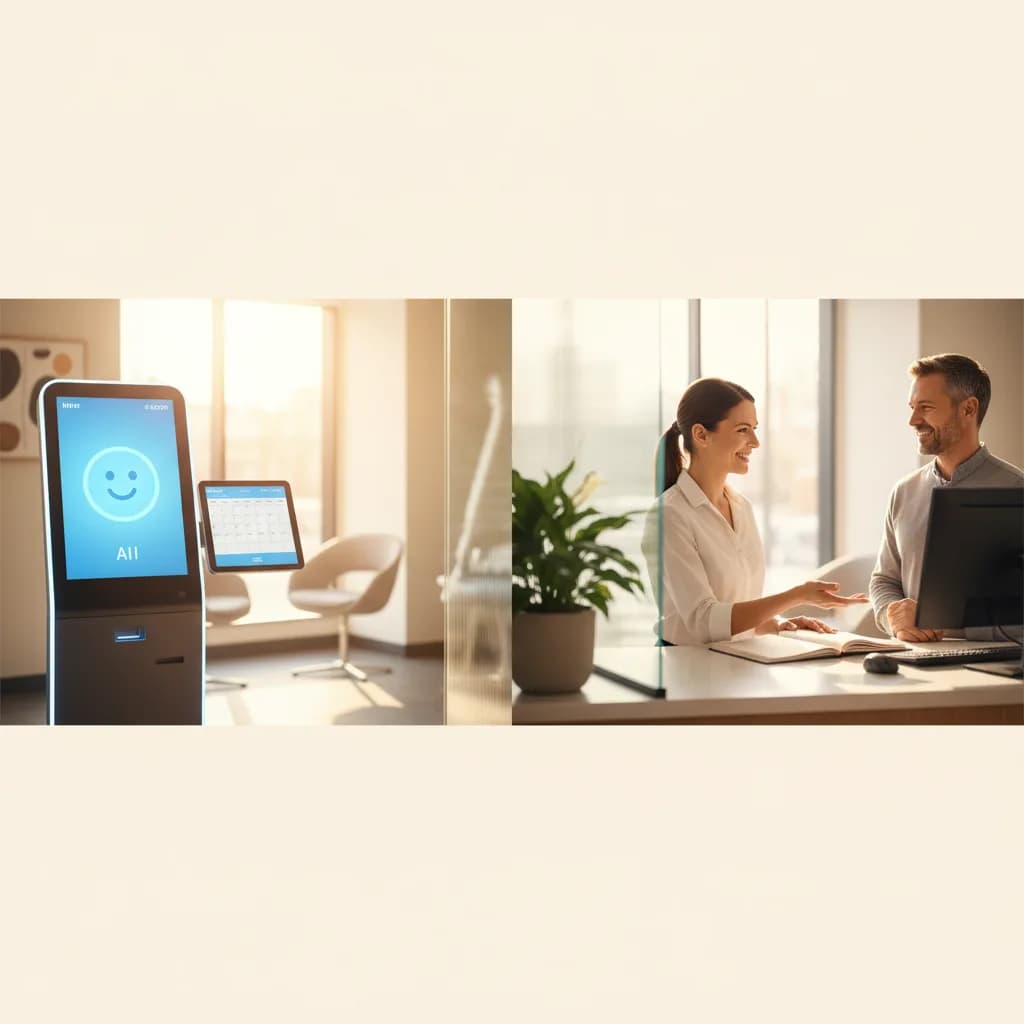
AI Receptionist vs Human Staff: Pros and Cons for Dentists
AI vs human dental receptionist or a call center? Compare all three with real cost data, coverage, patient experience, and the hybrid model for 2026.
Share:
Table of contents
The AI vs human dental receptionist question keeps coming up in every practice owner conversation about front desk operations in 2026. So does the dental call center option. And the framing is wrong in both cases. Not because it doesn't matter, but because the answer for 90% of dental practices isn't one or the other. It's a combination. This is one piece of a larger picture, see our complete AI receptionist guide for dental practices for the full rundown.
That said, understanding exactly where AI outperforms your front desk team, where your team outperforms AI, and where both leave a traditional dental call center behind is the only way to make a smart decision about how to staff your phones. This article breaks down the real pros and cons with actual cost data, patient experience research, and practical guidance on how the best-performing practices are structuring their front desk operations in 2026.
What Does Each Option Actually Do?
Before comparing the AI vs human dental receptionist tradeoffs, it helps to be specific about what each one handles day to day. The overlap is smaller than most people assume.
A human receptionist manages the physical front desk: greeting patients, handling check-in and checkout, collecting copays, scanning insurance cards, coordinating with the clinical team on schedule changes, managing patient emotions in the waiting room, and answering the phone when they can get to it. That last part, "when they can get to it," is where the problem starts.
An AI receptionist answers phone calls. That's the core function. It picks up every inbound call, talks to the patient using natural language, books appointments into your practice management system, handles rescheduling, answers basic questions about hours, insurance, and services, and captures new patient information. It does this 24 hours a day, 7 days a week, on unlimited simultaneous lines.
A dental call center sits somewhere between the two. Call center agents are real people, but they work off-site, follow scripts, and take messages for your team to return later. They don't have access to your PMS, can't book appointments in real time, and rotate across dozens of accounts. The patient gets a live voice, but not a resolution. That distinction matters more than most practice owners realize when comparing a call center for dental offices against an AI receptionist that books directly into your schedule.
The two roles aren't competing for the same job. They're covering different parts of the same workflow. According to the American Dental Association, staffing shortages remain the top operational challenge for dental practices in 2026, which is exactly why this AI vs human dental receptionist conversation matters more than ever.
Where Does AI Beat Human Staff?
AI wins on consistency, coverage, and cost. Those three factors account for the vast majority of the ROI practices see when they add an AI receptionist to their operations.
24/7 phone coverage with zero gaps
Your front desk team works 40 hours a week. Your phone rings 168 hours a week. That's 128 hours of unanswered calls every week, including evenings, weekends, lunch breaks, and every moment your team is helping a patient at the counter.
According to Dental Economics, after-hours calls represent 27% of total patient call volume, and 38% of new patient calls go unanswered during business hours. An AI receptionist answers every single one of those calls on the first ring. No hold music. No voicemail. A dental call center technically offers after-hours coverage too, but patients get a message-taker, not a scheduler. The call center agent writes down a name and number, and your staff calls back the next morning. By then, half those callers have already booked with someone else. For a deeper look at why these calls matter, see our after-hours revenue guide.
Unlimited simultaneous call handling
A human receptionist handles one call at a time. While they're on that call, every other caller goes to hold or voicemail. During a Monday morning rush, that might mean four or five missed calls in 30 minutes. An AI receptionist handles all five of those calls simultaneously, each with the same quality and attention. For practices managing high call volume, this alone justifies the investment.
Dramatically lower cost per call
A full-time front desk hire costs $35,000-58,000 annually with benefits. A dental answering service or call center runs $500-1,500 per month depending on call volume, and still only takes messages. An AI receptionist costs $200-600 per month, covering every hour of the week with actual appointment booking. That's $2,400-7,200 per year versus $6,000-18,000 for a call center that can't book, versus $35,000+ for a single person who covers only business hours.
This doesn't mean you fire your receptionist. It means you stop hiring specifically for phone coverage and let your team focus on the work that requires a human in the room. The full ROI breakdown walks through the exact math for different practice sizes.
Consistent accuracy on routine tasks
AI doesn't forget to log a call. It doesn't accidentally double-book a provider. It doesn't misquote your office hours because it's distracted by a patient at the counter. For the 70-80% of calls that are routine (scheduling, confirmations, hours, directions, basic insurance questions), an AI receptionist performs at a consistent level every single time.
Automated reminders and no-show reduction
Most AI platforms include outbound capabilities: confirmation calls, SMS reminders, and follow-up messages sent 48 and 24 hours before appointments. Practices using automated confirmations typically see no-show rates drop by 15-30%. A human receptionist can do this too, but it eats up hours of time that could be spent on higher-value work.
See how DentiVoice handles the calls your team can't reach
DentiVoice answers every call, books into your PMS, and covers after-hours without adding headcount.
See DentiVoice in Action →Where Do Humans Beat AI?
If AI could do everything a human receptionist does, this wouldn't be an AI vs human dental receptionist comparison. It would be a retirement notice. Humans still win decisively in several areas that directly affect patient loyalty and practice reputation.
Emotional intelligence with anxious or upset patients
A parent calls about a child who fell and knocked out a front tooth. A patient calls in tears about a surprise bill. An elderly patient is confused about their appointment and getting frustrated. These are moments that require empathy, patience, and the ability to read emotional cues in someone's voice. AI can detect some frustration patterns and escalate, but it can't provide the reassurance that a skilled human receptionist delivers instinctively.
According to a BrightLocal survey, 88% of consumers say the quality of a phone interaction directly impacts their perception of a business. For emotionally charged calls, that quality still requires a human.
In-office patient experience
An AI receptionist can't greet a patient who walks through the door. It can't hand them a clipboard, calm a nervous first-time visitor, or chat with a regular patient about their grandkids while checking them in. The in-office experience, everything from arrival to checkout, is entirely a human responsibility. This is where your team's personality and warmth directly influence patient retention and referral behavior.
Complex problem solving in real time
A patient needs to reschedule three connected appointments across two providers. An insurance plan changes mid-treatment and the patient wants to understand their new out-of-pocket cost. A double booking needs to be resolved while both patients are standing at the counter. These situations require judgment, flexibility, and the ability to work across multiple systems while managing a real-time conversation. AI handles the predictable. Humans handle the unpredictable.
Relationship building that drives retention
Long-time front desk staff know patients by name. They remember that Mrs. Chen prefers Tuesday mornings. They ask about the vacation that Mr. Thompson mentioned last time. These micro-interactions build loyalty that no AI can replicate. According to the ADA Health Policy Institute, patient retention is the single largest driver of practice revenue stability, and relationship-based retention starts at the front desk.
Related: Struggling with front desk turnover? Retention starts with workload balance. → Reduce Dental Staff Turnover Without Raising Wages
What Does an AI vs Human Dental Receptionist Comparison Actually Look Like?
Numbers tell the story more clearly than opinions. Here's how the two stack up across the metrics that matter most to dental practice operations.
| Factor | AI Receptionist | Human Staff | |
|---|---|---|---|
| Annual Cost | $2,400-$7,200 | $6,000-$18,000 | $35,000-$58,000 |
| Hours Covered | 168 hrs/week (24/7) | 24/7 (message-taking only) | 40 hrs/week |
| Simultaneous Calls | Unlimited | Limited by agent count | 1 at a time |
| Emotional Intelligence | Basic (escalation rules) | Moderate (scripted empathy) | High (instinctive) |
| In-Office Presence | None | None | Full (greet, check-in, checkout) |
| Routine Call Accuracy | Consistent (no variance) | Variable (agent turnover) | Variable (distraction-dependent) |
| Complex Problem Solving | Transfers to human | Takes message for callback | Handles directly |
| No-Show Reduction | 15-30% via automated reminders | None (no PMS access) | Manual (time-intensive) |
How Are the Best Practices Structuring This in 2026?
Some practices try a dental call center as a middle ground before discovering it creates more problems than it solves. Call centers take messages but can't act on them, which means your front desk still spends the first hour of every morning returning calls. The debate ends the same way in most practices that actually test all three options: they skip the call center and keep AI plus their in-house team. The hybrid model, where AI handles phone volume and humans handle in-office experience, is the pattern delivering the best results across practice types and sizes.
The hybrid model in practice
Here's what a typical day looks like at a practice running a hybrid front desk:
- 7:00 AM: AI has already answered 6 overnight calls and booked 3 appointments. Staff reviews the AI call log in 10 minutes.
- 8:00 AM-12:00 PM: AI handles overflow calls while the front desk team manages check-ins, checkout, and in-person patients.
- 12:00 PM-1:00 PM: Team is on lunch. AI covers all incoming calls without interruption.
- 1:00 PM-5:00 PM: Same split. Staff focuses on the patients in front of them while AI catches every phone call.
- 5:00 PM-7:00 AM: AI covers the full after-hours window, booking appointments and triaging emergencies.
The result? Zero missed calls. Staff that isn't constantly interrupted by the phone. And patients who can always reach someone, whether it's 2 PM or 2 AM. For a step-by-step guide on setting this up, see our front desk automation guide.
Which tasks go where
The split is straightforward once you map it to call complexity:
- AI handles: appointment booking, rescheduling, confirmations, hours/directions questions, insurance panel inquiries, new patient intake capture, after-hours coverage, overflow during peak volume
- Humans handle: in-person patient experience, complex insurance disputes, emotional or distressed callers, multi-appointment coordination, treatment plan discussions, relationship-building conversations
This model lets your team spend their time on the 20-30% of interactions that actually require a human, instead of burning hours on the 70-80% that don't. The daily front office workflow checklist shows exactly how to structure each morning around this division.
Find the right balance for your practice
We'll walk through your call volume, staffing model, and missed call data to show exactly where DentiVoice fits.
Book a Free Demo →How Do You Decide What's Right for Your Practice?
The AI vs human dental receptionist choice depends on three factors specific to your practice: your current miss rate, your staff workload, and your growth goals.
If you're missing fewer than 5 calls per week and your team handles the workload comfortably, AI is a nice-to-have for after-hours coverage. If you're missing 15+ calls per week, struggling with no-shows, or your team is visibly overwhelmed, AI isn't optional. It's the fastest path to recovering lost revenue without adding headcount.
If you're evaluating a dental answering service or call center, ask one question: does the caller hang up with a confirmed appointment, or a promise that someone will call them back? That answer separates tools that solve the problem from tools that delay it.
Start by measuring your actual miss rate for two weeks. Track every call that goes to voicemail, every hold that lasts more than 30 seconds, and every after-hours ring that nobody answers. Most practices are surprised by the number. That data point is worth more than any vendor demo. Once you know the baseline, the cost-benefit calculation makes itself. Our 30-question AI receptionist FAQ answers every follow-up question you're likely to have, and the complete guide to choosing an AI dental receptionist provides a vendor evaluation framework.
The dental practices that win this decision aren't the ones that pick one over the other. They're the ones that figure out exactly where each one adds value, and stop asking either one to do the other's job.
Compare the alternatives
Weighing your front desk options? These guides break down the other ways to handle dental phone calls and scheduling.
- Answering Service vs Virtual Receptionist
- Call Center vs AI Receptionist
- Front Desk vs AI: Hire or Automate
- Front Desk vs AI: Hire or Automate
Ready to build a hybrid front desk?
Book a 15-minute demo. We'll show you a live call, walk through your PMS integration, and give you a straight answer on pricing.
Book a Free Demo →Explore more guides and tools for dental practice growth.
Browse Resources →Sources & References
Frequently Asked Questions
No. AI handles phone calls and routine scheduling. Human staff handle in-office patient experience, complex insurance issues, emotional conversations, and the relationship-building that drives patient retention. Most practices use both.
AI costs $200-600 per month ($2,400-7,200/year) and covers 24/7 with actual appointment booking. A dental call center costs $500-1,500 per month ($6,000-18,000/year) but only takes messages. A full-time front desk employee costs $35,000-58,000 annually with benefits and covers 40 hours per week. AI is the cheapest option that actually resolves patient calls.
On modern dental-specific platforms, most callers don't notice. Satisfaction scores on AI-handled calls range from 68-91%. The highest scores come from after-hours callers who expected voicemail and got a real conversation instead.
AI handles scheduling, rescheduling, confirmations, insurance panel questions, office hours, new patient intake, and after-hours calls. Humans handle emotional callers, complex insurance disputes, multi-appointment coordination, and in-office patient interactions. A call center takes messages for all call types but resolves none, which is why most practices skip it.
The hybrid model uses AI for all phone-based routine tasks and after-hours coverage while human staff focus on in-office patient experience and complex conversations. This gives practices zero missed calls without overloading the team and eliminates the need for an external call center.
Most practices see positive ROI within 60-90 days. If you're missing 15 calls per week and each new patient is worth $1,200+ in lifetime value, recovering even 3-4 of those calls per week covers the AI subscription cost.
Most dental AI platforms integrate with Dentrix, Open Dental, Eaglesoft, and Curve Dental. The AI reads live availability and books appointments directly into your PMS without manual entry by staff. Call centers don't have this integration, which is why they're limited to message-taking.
Reputable vendors build HIPAA compliance into their platforms with encrypted calls, secure storage, access controls, and signed Business Associate Agreements. Always verify BAA willingness before sharing patient data with any vendor, including call center services.
Was this article helpful?
Written by
Dentalbase Team
The Dentalbase Team is a collective of dental marketing experts, AI developers, and practice management consultants dedicated to helping dental practices thrive in the digital age.