Automate Hygiene Recall with AI: A Dentist's Guide
Automate hygiene recall AI systems that sync with your PMS, contact due patients via SMS, email, and phone, then book cleanings automatically.
Share:
Table of contents
Hygiene recall is the revenue backbone of every dental practice, and the fastest way to protect it is to automate hygiene recall AI systems that contact every patient at exactly the right time without anyone on your team remembering to do it. The average dental hygiene patient generates $600-1,200 annually in recurring production.
Multiply that by every patient who misses a recall appointment because nobody called, texted, or emailed them, and the revenue leak compounds every year as lapsed patients accumulate. A practice with 1,500 active hygiene patients losing 15% annually to missed recalls forfeits $135,000-270,000 in hygiene production alone.
Manual recall systems depend entirely on front desk staff pulling due-patient lists from the PMS, making outbound calls during business hours, sending postcards or emails, and manually tracking who responded and who needs follow-up. That work competes with same-day scheduling, check-ins, and inbound calls. On busy days, recall outreach doesn't happen. During staff transitions, it stops for weeks.
According to the ADA Health Policy Institute, practices using automated recall systems maintain 15-25% higher patient retention rates than those relying on manual processes. AI takes automation further by adding intelligent timing, personalization, multi-channel delivery, and self-optimizing sequences that improve with every campaign cycle.
The shift toward AI-driven recall has accelerated in 2026 as more practices realize that front desk burnout directly erodes recall performance. When your team is stretched thin answering inbound calls, verifying insurance, and managing walk-ins, outbound recall work gets pushed to "later." Later turns into never.
Practices that moved their recall workflows to AI in 2025 are now reporting 12-month retention rates 18-22 points higher than offices still running manual processes, according to early data from Dental Economics. That gap keeps widening because AI recall compounds: every patient you retain today is a patient you don't have to spend $200-500 in marketing to replace next year.
How Does AI Hygiene Recall Differ from Basic Automated Reminders?
Most dental practices already send some form of automated appointment reminders. AI hygiene recall is fundamentally different in five ways that produce measurably better results.
| Feature | Basic Automation | AI Hygiene Recall |
|---|---|---|
| Timing | Fixed interval (6 months from last visit) | Adaptive (based on patient behavior patterns) |
| Channels | Single (usually email or postcard) | Multi-channel (SMS, email, AI phone) |
| Personalization | Name merge field only | Name, provider, treatment, insurance, preferences |
| Response handling | None (patient must call office) | AI books directly into PMS |
| Optimization | Static (same sequence forever) | Self-improving (learns from response data) |
The practical impact: basic automation achieves 40-55% recall compliance rates. AI-powered recall systems achieve 65-80% compliance by reaching the right patient through the right channel at the right time with a message that removes every barrier to rebooking. That 15-25 percentage point improvement represents significant recovered revenue. For a practice with 1,500 hygiene patients, moving from 50% to 70% compliance recovers 300 additional hygiene visits annually at $200-400 per visit ($60,000-120,000). See our AI receptionist guide for the complete platform capabilities.
Automate hygiene recall with AI that books appointments directly
DentalBase connects to your PMS, identifies patients due for hygiene, sends personalized multi-channel outreach, and schedules appointments automatically.
Book a Free Demo →What Does It Take to Automate Hygiene Recall AI Systems End to End?
To automate hygiene recall AI effectively, the system needs four connected components working together as a continuous pipeline. These components run from initial patient identification through confirmed appointment booking, operating 24/7 without staff involvement. Each piece feeds the next, so gaps in any one stage break the chain.
The 4-Stage AI Recall Pipeline
PMS Sync
Monitors recall dates in real time. Catches overdue patients missed by manual processes.
Smart Timing
Analyzes each patient's response history to pick the right channel and send window.
Multi-Channel
Coordinates SMS, email, and AI phone calls in a sequenced campaign with auto-suppression.
Direct Booking
Converts responses into confirmed PMS appointments without staff involvement.
PMS integration and due-patient identification
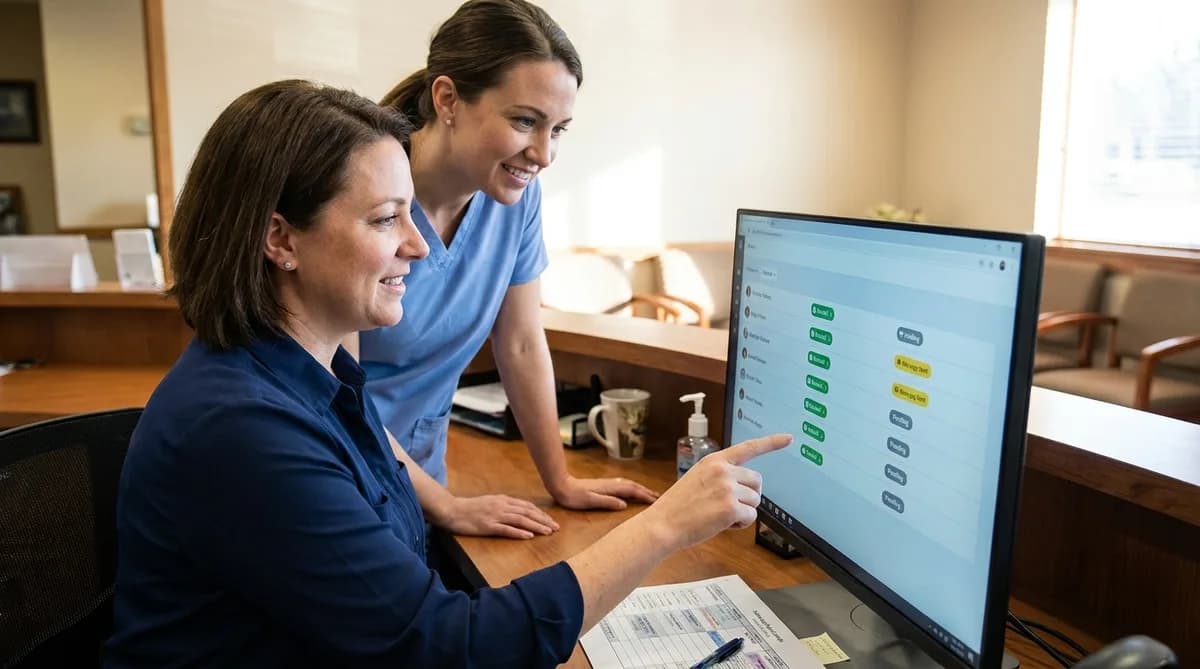
The AI connects to your practice management software and monitors recall schedules in real time. When a patient's recall date approaches (typically 2-4 weeks before due), they enter the outreach pipeline. When they book, they automatically exit. The system also catches patients who are already overdue but were never contacted because the manual process missed them. On day one of implementation, most practices discover 50-100+ patients who are overdue and were never contacted, representing immediate recoverable production.
This continuous monitoring means no patient falls through the cracks regardless of office workload or staffing. The integration pulls patient name, provider, recall interval, insurance status, preferred contact method, and communication history to personalize every touchpoint.
Intelligent timing and channel selection
Rather than sending every patient the same message at the same time, the AI analyzes each patient's historical response patterns. Patients who typically respond to SMS receive SMS first. Patients who ignore texts but answer phone calls get an AI phone call as the primary touchpoint. Patients approaching insurance benefit expiration receive urgency messaging about using remaining coverage. The system sends pre-due reminders (2-4 weeks before recall date), due-date reminders (on the recall date), and overdue follow-ups (1-4 weeks past due) in a coordinated sequence.
Multi-channel outreach sequence
- Pre-due SMS (2-3 weeks before): "Hi [Name], your next cleaning with [Provider] is coming up. Book your preferred time: [Link]." Response rate: 35-45%.
- Due-date email (on recall date): "Subject: Time for your cleaning, [Name]. Your 6-month cleaning is due. [Provider] has openings this week and next. [Button: Book Now]." Response rate: 12-18%.
- Overdue SMS (1 week past due): "Hi [Name], you're overdue for your cleaning at [Practice]. We saved you a spot. Tap to book: [Link]." Response rate: 20-30%.
- Overdue AI phone call (2-3 weeks past due): The AI calls, identifies itself, references the patient's recall schedule, offers available times, and books directly. Conversion rate: 15-25% of answered calls.
AI Recall Outreach Timeline
Pre-Due SMS
Friendly booking link. 35-45% response rate. Catches patients who just need a nudge.
Due-Date Email
Detailed email with provider availability. 12-18% response rate. Reaches inbox-checkers.
Overdue SMS
Urgency messaging with one-tap booking. 20-30% response rate. Recovers procrastinators.
AI Phone Call
AI calls, offers times, books directly. 15-25% conversion on answered calls. Last resort before lapse.
Sequence auto-stops when the patient books at any step (click-based suppression).
Click-based suppression stops the sequence when a patient books at any step. For the complete framework on building automated outreach sequences, see our reactivation campaigns guide.
Related: Get the timing right on every patient reminder for higher open and response rates. → Dental Appointment Reminder Timing Guide
What Special Considerations Apply to Different Patient Segments?
To automate hygiene recall AI effectively, the system must handle different patient types with messaging and urgency matched to their clinical situation and motivations. A perio maintenance patient who misses a 3-month interval faces real clinical consequences. A new patient who skips their second visit is simply forming a habit elsewhere.
| Patient Segment | Recall Interval | First Touch | Key Message Angle | Avg Production/Visit |
|---|---|---|---|---|
| Perio Maintenance | 3-4 months | 2 weeks before due | Clinical urgency, gum health | $250-500 |
| New Patients (Year 1) | 6 months | 3-4 weeks before due | Relationship building, provider name | $200-400 |
| Insurance-Driven | 6 months | 3 weeks before due | Remaining benefits, "use it or lose it" | $200-400 |
| Lapsed (6+ months overdue) | Reactivation | Immediate on identification | We miss you, easy rebooking | $200-600 |
Perio maintenance patients
Patients on 3-4 month periodontal maintenance intervals require more frequent recall sequences than standard 6-month hygiene patients. Configure shorter trigger windows (2 weeks before due rather than 3-4 weeks) and more urgent messaging about the clinical importance of maintaining their schedule. "Hi [Name], your periodontal maintenance appointment is coming up. Keeping your 3-month schedule is important for your gum health. Book here: [Link]." These patients also have higher average production per visit ($250-500) due to the complexity of periodontal care, making timely recall even more financially significant.
New patients in their first year
Patients who completed their first visit within the last 12 months are at the highest risk of lapsing. They haven't built the habit of returning to your practice specifically. Send their first recall reminder earlier (3-4 weeks before due) with messaging that reinforces the relationship: "Hi [Name], Dr. [Provider] would love to see you for your next cleaning. It's been about 6 months since your first visit." Include the treating provider's name because new patients connect more strongly with their specific clinician than with the practice brand.
Insurance-driven patients
Many patients are motivated primarily by insurance coverage. For these patients, add insurance benefit reminders to recall messaging: "Your dental benefits include 2 cleanings per year. You have 1 remaining before your plan resets in [month]." Year-end campaigns in October-November targeting patients with unused insurance benefits can recover 15-25% of overdue patients who simply forgot they were leaving money on the table. Connect insurance-driven recall to your broader review generation strategy since these patients are often highly satisfied but never thought to leave a review.
See how AI handles recall, reactivation, and booking in one platform
DentalBase segments patients automatically and sends the right message through the right channel at the right time.
Book a Free Demo →How Do You Handle Compliance for Automated Hygiene Recall?
Automated recall systems must comply with three regulatory frameworks that govern how you contact patients electronically. Non-compliance risks are significant because automated systems send high message volumes, amplifying any single violation across hundreds of patients simultaneously. Getting this wrong can cost more than missed recalls ever would.
HIPAA
Recall messages referencing specific treatments, provider names, or appointment history contain protected health information. Your automation platform must have a signed Business Associate Agreement. All PHI must be encrypted in transit and at rest. "Your cleaning is due" is generally safe. "Your periodontal maintenance with Dr. Smith is due" requires encrypted delivery. Fines reach $50,000 per violation.
TCPA
The Telephone Consumer Protection Act requires prior express consent for automated texts and calls. Collect consent through new patient paperwork (standard practice). Include opt-out instructions in every message ("Reply STOP to unsubscribe"). Honor opt-outs within 24 hours. Penalties range from $500-1,500 per unsolicited message.
State Regulations
Some states impose additional requirements beyond federal law. The FTC requires truthful, non-deceptive messaging in all automated communications. Ensure your platform handles state-level variations automatically for multi-location practices.
AI Recall Compliance Checklist
Verify each item before launching automated outreach.
HIPAA Requirements
TCPA Requirements
Operational Safeguards
Build compliance into the system architecture from day one. Log all consent records with timestamps. Maintain an automated do-not-contact list. Restrict PHI in non-encrypted channels. Exclude patients who have transferred records to another provider. Apply these same standards across your review collection and lead outreach systems for consistent compliance.
Related: Build a complete patient review system that captures feedback from every recall visit. → Build a Patient Review Collection System That Runs Itself
How Do You Measure Recall Performance and Optimize Results?
The metrics that matter for AI hygiene recall connect directly to production numbers and patient retention rates you can track in your PMS. Review them weekly and run optimization tests monthly. Most practices see meaningful improvement after three to four monthly cycles of testing one variable at a time.

| Metric | Target | Action If Below Target |
|---|---|---|
| Recall compliance rate | 65-80% | Expand channels or adjust timing windows |
| Pre-due booking rate | 50-60% | Send reminders earlier or test message copy |
| Overdue recovery rate | 25-40% | Add AI phone calls for non-responsive patients |
| Hygiene production/month | Track trend line | Correlate with compliance changes |
| Annual patient attrition | Under 10% | Investigate experience issues or add reactivation campaigns |
Review the dashboard on the first Monday of each month. Identify the weakest metric and test one change over 30 days: different pre-due timing, new SMS copy, additional channel for non-responsive patients, or adjusted sequence spacing. This single-variable approach produces clear data. After 3-4 optimization cycles, your recall system will be calibrated to your patient population's specific preferences, communication habits, and scheduling patterns.
According to Moz, practices with consistent review velocity rank higher in local search. Every recalled patient who visits and leaves a Google review feeds both retention and discoverability. Use Google Analytics 4 to track booking link conversions from recall messages. Pair recall performance with your marketing plan, social media strategies, and content calendar for compounding patient growth. According to the BrightLocal Consumer Review Survey, 98% of patients read reviews before choosing a local provider, recalled patients who visit and review compound your local search authority.
Quick ROI: What Does a 20-Point Compliance Jump Mean for You?
Based on a practice with 1,500 active hygiene patients.
300
Additional visits recovered annually
$90K
Average recovered production (at $300/visit)
$0
Marketing cost per recovered patient
Retained patients cost nothing to re-acquire. Every lapsed patient costs $200-500 in marketing to replace.
Want to see the real math on missed calls and no-shows?
Our no-show cost calculator breaks down exactly how much empty chairs cost your practice each month.
Calculate Your No-Show Cost →AI hygiene recall transforms the most important recurring revenue stream in your practice from a manual, inconsistent process into a self-running system. The four components work together: PMS integration identifies due patients continuously, intelligent timing matches each patient's behavior patterns, multi-channel sequences reach patients through SMS, email, and AI phone calls with click-based suppression, and automated scheduling converts responses into confirmed appointments.
Start by connecting your PMS and launching the pre-due SMS sequence. That single channel will measurably improve compliance within 30 days because it catches the patients who intended to rebook but simply forgot or never got around to calling. Add the due-date email and overdue phone call sequences over the next 60 days.
Within one quarter, every hygiene patient in your practice will receive the right message at the right time through the right channel. According to NIDCR research, patients who maintain consistent recall appointments have significantly better long-term oral health outcomes, giving practices both a clinical and financial reason to invest in AI recall. Your recall compliance will climb from the industry average of 40-55% toward the AI-powered target of 65-80%.
The practices that automate hygiene recall AI-powered systems early gain a compounding advantage as retention improvements accumulate year over year. And here's what most practice owners overlook: recall isn't just about the cleaning appointment itself. Every hygiene visit is a diagnostic touchpoint that identifies restorative work, whitening candidates, and ortho referrals.
A practice recovering 300 hygiene visits per year through AI recall isn't just adding $60,000-120,000 in hygiene production. It's creating 300 additional opportunities for treatment acceptance that would have otherwise walked out the door to a competitor. For practices connecting recall to ad campaigns, patient reactivation, and social media management, DentalBase integrates every patient touchpoint from recall to reactivation to reputation into one AI-powered dental marketing platform.
Never lose a hygiene patient to a missed recall again
DentalBase automates your entire recall system with PMS integration, intelligent timing, multi-channel outreach, and direct booking that keeps your hygiene schedule full.
Book a Free Demo →Explore more guides and tools for dental practice growth.
Browse Resources →Sources & References
Frequently Asked Questions
AI recall adds adaptive timing based on each patient's behavior patterns, multi-channel delivery through SMS, email, and AI phone, personalization pulled from PMS data including provider and insurance, direct appointment booking without staff involvement, and self-optimizing sequences. Basic automation uses fixed timing and a single channel.
Target 65-80% compliance with AI-powered recall versus the 40-55% industry average with basic automation. That 15-25 percentage point improvement means recovering roughly 300 additional hygiene visits per year for a practice with 1,500 active patients, worth $60,000-120,000 in production.
Start with a pre-due SMS 2-3 weeks before the recall date (35-45% response), follow with a due-date email on the recall date (12-18%), send an overdue SMS one week past due (20-30%), and finish with an AI phone call 2-3 weeks past due (15-25% conversion). Click-based suppression stops the sequence once the patient books.
Moving from 50% to 70% compliance for 1,500 hygiene patients recovers about 300 visits at $200-400 each, producing $60,000-120,000 in annual hygiene revenue. Each visit also creates opportunities for treatment acceptance on restorative work, whitening, and referrals identified during the hygiene exam.
Yes, when set up correctly. Your platform needs a signed Business Associate Agreement. Messages that reference specific treatments or providers must go through encrypted channels. Generic messages like 'your cleaning is due' are generally acceptable. HIPAA fines can reach $50,000 per violation, so compliance is non-negotiable.
The AI tracks response data from your PMS over time. Patients who consistently open and act on SMS get text-first sequences. Patients who ignore texts but answer calls receive AI phone outreach as the primary channel. The system adapts continuously as new response data comes in from each campaign cycle.
The pre-due SMS sequence alone produces measurable compliance improvements within 30 days. Adding email and phone channels over the next 60 days builds the full system. Three to four monthly optimization cycles are enough to calibrate timing, copy, and channel mix specifically for your patient population.
Track five metrics: recall compliance rate (target 65-80%), pre-due booking rate (target 50-60%), overdue recovery rate (target 25-40%), monthly hygiene production trend, and annual patient attrition (target under 10%). Each month, identify the weakest metric and test one change over 30 days.
Was this article helpful?
Written by
Dentalbase Team
The Dentalbase Team is a collective of dental marketing experts, AI developers, and practice management consultants dedicated to helping dental practices thrive in the digital age.