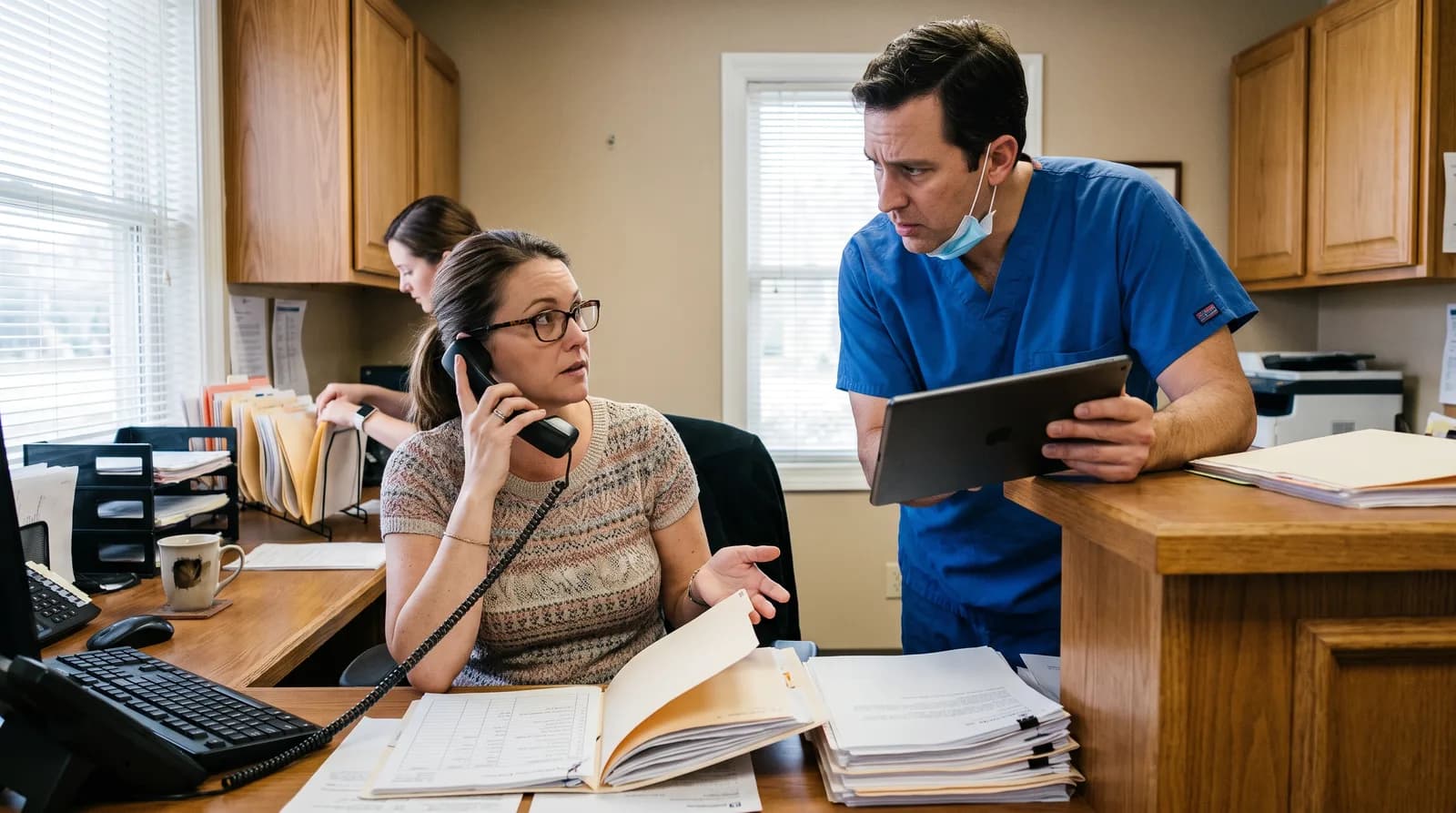
Dental Treatment Plan Follow-Up: A Step-by-Step Guide
How to run dental treatment plan follow-up that recovers cases patients already accepted, without nagging them into silence.
Share:
Table of contents
Dental treatment plan follow-up is the work most practices skip, even though the patient already said yes in the room. "I'll think about it" is not a no. It is an unbooked yes, sitting in a chart, waiting for someone to call. I have watched the treatment, along with the production it represented, just disappear because nobody made that call.
Between running DentalBase and treating patients at my own practice in Peterborough, New Hampshire, I have presented plans that got an enthusiastic nod in the chair and then watched the patient walk out and never come back. Not because they changed their mind, but because nobody followed up before they forgot why it mattered. This guide is the part of my own process that happens after the chair: the cadence, the words, and the stop rule I use to recover unscheduled treatment without turning it into nagging.
What Is Dental Treatment Plan Follow-Up?
Dental treatment plan follow-up, the way I run it, is the structured outreach that happens after a patient accepts a diagnosis but leaves without booking it. It is a distinct job from no-show or recall follow-up, because the patient already said yes to the clinical need, they just have not committed to a date.
I think about this differently from the four-job structure most owners use. A no-show broke a commitment they already made to me. A recall patient is overdue for routine care. A patient with an unscheduled treatment plan agreed, in my chair, that they need the work. The follow-up challenge is not convincing them again. It is closing the gap between their agreement and their action before that agreement fades from memory.
That distinction matters because the script, the timing, and the tone for this job all look different from a basic reminder. If you have not yet mapped how this fits with your other follow-up tracks, I covered the full structure in my guide to building a dental patient follow-up system, which this piece slots into.
Why Is "I'll Think About It" Different From a No or a No-Show?
"I'll think about it" is different because the patient has already accepted the clinical case I presented, just not the scheduling decision. Treating it like a no means writing off treatment the patient actually wants. Treating it like a no-show means using the wrong script entirely.
A no-show broke an appointment they had already committed to keep with me, and no-show rates carry their own benchmarks and true costs worth tracking separately. A patient with an unscheduled treatment plan never made that commitment in the first place, they made a different one in my chair: agreeing that the work needs to happen. In my experience, the hesitation usually sits somewhere narrower than the clinical decision: cost, timing, or a spouse they want to consult before committing money or time off work.
Same Patient, Three Different Follow-Up Jobs
| Situation | What They Already Agreed To | What the Follow-Up Needs to Solve |
|---|---|---|
| No-show | Keeping the appointment | Rebooking, fast |
| Recall overdue | Routine maintenance care | A nudge back into the cycle |
| Unscheduled treatment | The clinical need itself | Removing the scheduling barrier |
Related: The hesitation behind "I'll think about it" often starts in the room, before the patient ever leaves without booking. See how I handle implant case acceptance in the chair →
How Much Does One Unscheduled Treatment Plan Actually Cost You?
One unscheduled treatment plan costs me the full value of that case, plus whatever future treatment depends on it, and that number is usually larger than I expect until I actually total it up. Dental Economics has tracked treatment-plan acceptance as a core practice metric for exactly this reason.
Dental Economics has long framed case acceptance as one of the most significant numbers in a practice, and I have seen the same logic play out on a single plan. Picture a hygiene patient I diagnosed with two crowns at $1,800 combined who says "let me think about it" and never comes back. That is not a missed cleaning. That is $1,800 in production gone, plus the cleanings and exams that patient would have kept booking with me if they had stayed engaged. The dollar figure above is an illustrative example, not a guarantee for any specific case or fee schedule.
The CDC reports that roughly 1 in 5 adults aged 20 to 64 have untreated cavities, and unscheduled treatment plans are part of how that gap grows. A diagnosis that goes unscheduled does not disappear clinically. In my own practice, it often comes back worse and more expensive once the patient finally returns, which usually means a larger treatment plan and a harder conversation the second time around.
The economics compound at the practice level too. The ADA Health Policy Institute tracks dental economic trends quarterly, and unscheduled treatment sits squarely inside the production gap I watch in my own numbers. Ten unscheduled plans worth $1,500 each is $15,000 in diagnosed, agreed-to treatment sitting unbooked. That is a far easier number for me to act on than a vague sense that "treatment acceptance could be better."
What Follow-Up Cadence Actually Recovers Unscheduled Treatment?
Effective dental treatment plan follow-up, in my own practice, starts within 48 hours of the visit, while the conversation is still fresh, then steps down in frequency and intensity over the following weeks. Waiting longer than a few days lets the urgency I built in the room fade completely.
Speed matters most on the first touch. I have my team make a same-day or next-day call, ideally from someone the patient has already met, which reinforces what we discussed without sounding like a sales follow-up. After that, the sequence widens out: a text a few days later, an email with relevant information a week or two after that. BrightLocal has found text replies average 60 times faster than email replies, which is part of why a quick text often outperforms a phone call nobody picks up.
A Sample Timing and Channel Sequence
A Sample Recovery Sequence
DAY 1-2
Phone call referencing the specific treatment discussed
DAY 5-7
Short text checking on questions or scheduling
DAY 14
Email with financing info or what waiting means
DAY 30
Final personal touch, then move to long-cycle nurture
I adjust the spacing for higher-stakes cases. A $200 filling and a $15,000 implant case do not deserve the same urgency from my team. They started with the same "I'll think about it," but the number of touches should differ.
Running This Cadence by Hand Takes Real Time
Four touches per case, multiplied across every diagnosed-but-unbooked patient, adds up fast for a front desk that is already stretched. DentalBase's AI receptionist can run the routine touches in this sequence so my team can focus on the higher-value calls.
See How It Works →What Should You Actually Say So It Lands as Care, Not Sales Pressure?
What I tell my team to say should reference the specific clinical reason the treatment matters, not the dollar amount or the schedule opening. Patients can tell the difference between "we have an opening Thursday" and "I want to make sure that tooth does not get worse before we see you again."
I train my team to lead with the clinical stake, not the calendar. Something like: "I wanted to check in on the crack we found on that lower molar. It could get worse if it waits too long, and I'd rather see you sooner than later." That references the specific finding, ties it to a real consequence, and only then opens the door to scheduling. Compare that to a generic "just following up on your treatment plan," which reads as a billing reminder, not care.
I keep the tone consistent across channels in my own practice. A text can be shorter, but it should carry the same clinical specificity, not just "still interested in scheduling?"
Care Framing vs. Sales Framing
- Care framing: "We want to make sure that filling doesn't turn into something bigger."
- Sales framing to avoid: "Just checking if you're ready to book your treatment plan."
- Care framing: "I asked my team to follow up on the crown we discussed."
- Sales framing to avoid: "We have an opening this week if you'd like to schedule."
When Should You Stop Following Up and Let It Go?
I stop following up once my team has completed a defined sequence, typically three to four touches over about a month, without a response. At that point the patient moves to long-cycle nurture rather than active chasing, and the file gets revisited at the next recall cycle instead of every few days.
Without a stop rule, I have seen two things go wrong. Either the team gives up after one unanswered call and the treatment plan dies quietly, or someone keeps calling for months and the patient starts to feel hounded. Both outcomes hurt the relationship. A defined stop point protects my patients from feeling pursued and protects my team from wasting time chasing a lead that has gone cold for now.
Two Failure Modes, One Fix
Too Little
One call, no answer, case quietly dies.
Too Much
Calls for months, patient feels hounded.
The Fix
3 to 4 touches, then move to nurture, on purpose.
The exit message matters as much as the cadence. I use a final, low-pressure note ("We're here whenever you're ready, no rush") that leaves the door open without applying more pressure than the relationship can absorb.
How Do You Log Unscheduled Treatment So Nothing Falls Through?
I log unscheduled treatment by flagging every diagnosed-but-unbooked case in my practice management system the moment the patient leaves the chair, with a due date for the first follow-up touch attached. Without that flag, the case exists only in a provider's memory, and memory is not a tracking system.
Most practice management platforms have an unscheduled treatment report built in already, mine included. The problem was never the absence of the tool. Nobody owned checking it on a fixed schedule, so cases sat in the report for weeks without anyone noticing they had gone past the point where a quick follow-up would have worked. I assign one person on my team to pull that report weekly and confirm every entry has a next follow-up date attached. They flag anything that has gone silent past the stop-rule window so it can move to long-cycle nurture deliberately, instead of just falling off everyone's radar.
What I Have My Team Track
- Flag the case as unscheduled the same day it happens, not at end of week.
- Attach a specific dollar value and clinical urgency level to each entry.
- Review the full list weekly, not just when someone remembers to.
How Does This Fit Into Your Broader Follow-Up System?
Dental treatment plan follow-up is one of four distinct jobs inside the complete follow-up system I run, alongside new-patient, no-show, and recall follow-up. It needs its own owner, trigger, and stop rule, even though it shares the same underlying structure as the other three.
Run it in isolation and it competes for the same front-desk attention as no-shows and recall calls, usually losing because it feels less urgent in the moment. A no-show is loud: an empty chair, a gap in the schedule, something everyone in my office notices immediately. An unscheduled treatment plan is quiet. The patient already left, the chart just sits there, and nothing forces anyone to act on it today. I have found that building it as one named track inside a documented system, with its own person responsible and its own weekly review, stops it from getting crowded out by louder problems. HubSpot's research on follow-up persistence found that most people give up after two or three attempts. The data actually favors more touches when the lead was genuinely warm, which is exactly the trap an undefined process falls into here too.
Should You Run This Sequence Yourself or Get Help?
I run this sequence in-house when I have someone with protected time and a clear script. I lean on help when my front desk is already absorbing no-shows, recall, and new-patient calls on top of this. Most practices land somewhere in between, automating the routine touches and keeping a human on the higher-value cases.
A $200 filling probably does not need a person calling three times. A $15,000 implant case probably should. The honest answer, in my experience, is that the system, not the headcount, decides whether this works. Whether a person on my team or an AI receptionist handling routine outreach makes each touch, the trigger, timing, and stop rule have to exist first. Either way, the goal is the same one I care about for every part of the visit: the patient experience that actually drives retention, not just a closed case.
The patients who told me "I'll think about it" are not lost patients. They are unfinished conversations, and most of them are still waiting for someone to pick the thread back up. I treat dental treatment plan follow-up as its own job, with its own cadence and its own stop rule, and I recover production that was already agreed to in my chair. Start with the cases sitting in your system right now, the ones diagnosed in the last 30 days with no booking attached, and make the first call today.
Recover the Treatment Plans Already Sitting in Your System
DentalBase helps practices design and run unscheduled treatment follow-up without adding to the front desk's plate.
Book a Free Demo →Want more practice management guides like this one?
Browse Resources →Sources & References
Frequently Asked Questions
Dental treatment plan follow-up is the structured outreach that happens after a patient accepts a diagnosis in the chair but leaves without booking the treatment. It is a distinct job from no-show or recall follow-up.
Follow up within 48 hours of the visit, while the conversation and urgency from the diagnosis are still fresh. Waiting longer lets the patient's sense of urgency fade and makes the case harder to recover.
Reference the specific clinical finding and consequence discussed in the room, not the price or the open schedule slot. A message tied to the clinical reason reads as care, while a generic reminder reads as a sales follow-up.
Stop after a defined sequence, typically 3 to 4 touches over about a month, without a response. At that point move the patient to long-cycle nurture instead of continuing to call, which protects the relationship.
A no-show broke an appointment commitment, while an unscheduled treatment patient already accepted the clinical need but never committed to a date. The two need different scripts and different timing.
It varies by practice, but a handful of unscheduled plans at $1,000 to $2,000 each can represent tens of thousands of dollars in diagnosed, agreed-to treatment sitting unbooked at any given time.
Either can work once the trigger, cadence, and stop rule are defined. Lower-value, routine cases are good candidates for automation, while higher-value cases usually benefit from a person handling the outreach.
Was this article helpful?

Written by
Dr. Muhammad Abdel-rahim DMD
Muhammad Abdel-rahim, DMD, is a dentist and implantologist at Peterborough Family Dental & Implant Center with a passion for blending clinical excellence, leadership, and innovation. He believes dentistry extends beyond restoring smiles to building trust, confidence, and sustainable systems that help patients and teams thrive. With experience leading and scaling dental practices, Dr. Abdel-rahim brings a strategic mindset to patient care and practice growth. He is particularly interested in communication, critical thinking, and the thoughtful application of artificial intelligence to improve clinical outcomes, workflows, and the overall patient experience.