AI Dental Receptionist: A Complete How-To Guide for Dentrix
Learn how an AI Dental Receptionist integrates with Dentrix practice management software. Complete guide to implementation, benefits, and HIPAA compliance.
Share:
Table of contents
An AI Dental Receptionist is transforming how dental practices manage front-desk operations. This impact is particularly strong when integrated with established practice management systems like Dentrix. This technology combines artificial intelligence with existing dental software. It automates patient communications, appointment scheduling, and administrative tasks while maintaining seamless workflow integration.
The integration of AI technology with Dentrix creates a powerful solution. It helps dental practices improve efficiency while reducing staff workload. Modern dental practices face increasing pressure to provide excellent patient service. They must manage costs and streamline operations while aligning with evidence-based oral healthcare standards. These standards are outlined by organizations such as the American Dental Association. By connecting an automated receptionist system with Dentrix's comprehensive patient management capabilities, practices can achieve 24/7 patient support. This is possible without compromising data security or compliance standards.
This comprehensive guide will walk you through everything you need to know. It covers implementing an AI receptionist solution with your Dentrix system. It includes technical requirements, compliance considerations, and practical implementation strategies for U.S. dental practices.
What Is an AI Dental Receptionist?
Simple Definition
An AI dental receptionist is a software system. It uses artificial intelligence and natural language processing. It handles patient interactions typically managed by human front-desk staff. This technology can engage with patients through phone calls, text messages, web chat, and email. It can provide information, schedule appointments, and send reminders. It also answers common questions about dental services.
The system understands patient inquiries expressed in natural language. It provides appropriate responses using pre-programmed knowledge about the dental practice and services offered. It also considers appointment availability when generating responses. When integrated with practice management software like Dentrix, the AI system accesses real-time scheduling information. It can access patient records and treatment histories to provide personalized responses. These capabilities are delivered while maintaining HIPAA compliance. The interactions often reinforce patient education topics aligned with public health guidance. Examples include preventive care recommendations described by the Centers for Disease Control and Prevention. For deeper details on features, workflows, and real-world results, practices reference a complete guide. They also reference a case study on AI dental receptionist systems.
Common Deployment Channels
AI dental receptionists typically operate across multiple communication channels to meet patients where they prefer to interact. Phone integration allows the system to answer incoming calls and transfer urgent matters to staff. It also handles routine inquiries about office hours, insurance acceptance, and service information. Text messaging capabilities enable appointment confirmations, reminders, and follow-up communications.
Web-based chat integration provides instant support for website visitors, helping convert inquiries into appointments while capturing lead information directly into the practice management system. Email automation handles routine correspondence, appointment confirmations, and patient education materials. When properly configured with Dentrix, all these interactions sync seamlessly with patient records, ensuring continuity of care and comprehensive communication tracking.
Core Functions of an AI Dental Receptionist
Patient Communication Tasks
The primary patient-facing functions of an AI dental receptionist include appointment scheduling, confirmation, and rescheduling based on real-time availability from Dentrix. The system can provide detailed information about dental procedures, office policies, insurance acceptance, and payment options while maintaining a consistent, professional tone. It handles initial patient intake by collecting basic demographic and insurance information, which automatically populates into Dentrix patient records.
The AI system excels at managing routine inquiries about office hours, location, parking information, and preparation instructions for specific procedures. It can also reinforce preventive care messaging and oral hygiene guidance that reflects clinical best practices supported by institutions like the National Institute of Dental and Craniofacial Research. For existing patients, the system can access appointment history and provide personalized reminders about upcoming preventive care or follow-up treatments.
Administrative Support Tasks
Beyond patient interactions, AI dental receptionists provide valuable administrative support by generating automated reports on appointment scheduling patterns, no-show rates, and common patient inquiries. The system can trigger follow-up sequences for missed appointments, overdue treatments, or incomplete treatment plans based on data from Dentrix patient charts.
Inventory and scheduling optimization represent additional administrative benefits, as the AI can analyze appointment patterns and suggest optimal scheduling strategies to maximize chair utilization. The system maintains detailed logs of all patient interactions, creating a comprehensive communication history that integrates with Dentrix notes and treatment records. This documentation proves valuable for quality assurance, staff training, and regulatory compliance auditing.
How an AI Dental Receptionist Works with Dentrix
Technology Components
The integration between AI receptionist systems and Dentrix relies on Application Programming Interface (API) connections that enable real-time data synchronization. These APIs allow the AI system to read appointment availability, patient information, and treatment schedules directly from Dentrix databases while maintaining strict security protocols. Natural language processing engines interpret patient communications and generate appropriate responses based on practice-specific information and Dentrix data.
Cloud-based infrastructure typically hosts the AI system, ensuring reliable uptime and scalability while maintaining HIPAA-compliant data handling. The integration includes voice recognition technology for phone interactions, text processing for written communications, and machine learning algorithms that improve response accuracy over time. Security layers include encryption for data transmission, user authentication protocols, and audit logging that meets healthcare industry standards.
What This Looks Like Inside Dentrix
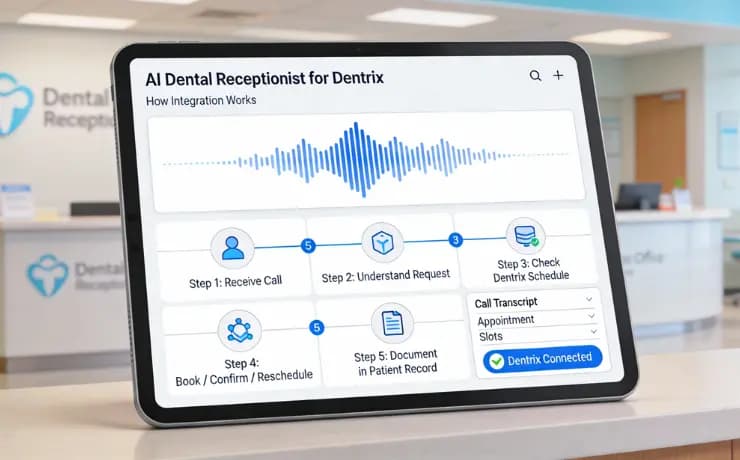
A patient calls at 12:15 PM. The front desk is busy. DentiVoice answers on the first ring.
It checks the incoming number against your Dentrix Family File. If the patient exists, it pulls their name, provider, and history. If not, it starts a new intake.
The patient asks for a cleaning. DentiVoice reads your Appointment Book in real time, checks the correct provider column and operatory, and offers open slots. The patient picks Thursday at 9:00 AM. DentiVoice writes the appointment directly into Dentrix, the same as if your front desk entered it manually.
A confirmation text goes out. Intake forms are sent if it's a new patient.
When your receptionist finishes with the patient in front of her, the booking is already on her screen. No voicemail. No callback. Done.
Want to see how DentiVoice sounds on a real patient call?
Book a 15-minute demo and we'll walk you through a live example using your Dentrix setup.
Benefits for Dental Practices Using Dentrix
Operational Efficiency
Integrating AI receptionist technology with Dentrix creates significant operational efficiency gains through 24/7 availability that extends beyond normal business hours. Patients can schedule appointments, receive information, and complete intake processes at their convenience, reducing phone volume during peak hours when staff members need to focus on in-office patient care. The automation handles routine tasks that typically consume 2-3 hours of daily staff time, allowing human team members to concentrate on complex patient needs and clinical support.
Data accuracy improves substantially when AI systems input information directly into Dentrix, eliminating transcription errors and ensuring consistent data formatting. Automated appointment confirmations and reminders reduce no-show rates by an average of 15-20%, while systematic follow-up processes help maintain consistent patient communication for preventive care and treatment completion.
Staff Workload Management
AI integration allows existing front-desk staff to focus on high-value activities like insurance verification, treatment planning support, and complex patient problem-solving rather than answering repetitive questions about office hours and basic procedures. Staff productivity increases when routine appointment scheduling and patient intake processes operate automatically, creating more time for detailed insurance pre-authorizations and patient education.
The system provides valuable staff support during busy periods, vacation coverage, and unexpected absences by maintaining consistent patient service levels. Training requirements decrease for new staff members since the AI handles basic patient interactions while new employees focus on learning clinical support functions and complex administrative procedures.
Before and After: Five Calls, Two Workflows
| Scenario | Without DentiVoice | With DentiVoice + Dentrix |
|---|---|---|
| New patient calls during busy period | Voicemail. Callback 40 min later. Patient gone. | Answered. Booked into Dentrix. Forms sent. |
| Two calls at once | One answered. One lost. | Both answered. Both booked. |
| After-hours reschedule (7:30 PM) | Missed. Potential no-show. | Rebooked. Confirmation sent. Schedule updated. |
| Insurance question | Hold. Second call missed. | Instant answer. Appointment offered on the spot. |
| Staff calls in sick | Answer rate collapses for the day. | No change. Every call still answered. |
How many of these five scenarios happened in your practice last week?
Run a free call audit and see your actual numbers.
HIPAA, Security, and Compliance Considerations
HIPAA Requirements
Implementing an AI dental receptionist with Dentrix requires strict adherence to HIPAA regulations governing protected health information (PHI). The AI system must include Business Associate Agreement (BAA) provisions that clearly define responsibilities for PHI handling, storage, and transmission. All patient communications through the AI system must meet the same privacy standards as traditional receptionist interactions, including secure data handling and limited access to necessary information only.
Audit trail capabilities become essential for HIPAA compliance, requiring detailed logging of all patient interactions, data access events, and system modifications. The integration must include patient consent processes for AI communications and clear privacy notices explaining how automated systems handle their health information. Staff training on HIPAA requirements for AI systems ensures proper oversight and incident response procedures.
Data Security Practices
Security measures for AI-Dentrix integration include end-to-end encryption for all data transmission between systems, multi-factor authentication for system access, and regular security audits of integration points. The AI system must maintain the same security standards as Dentrix, including secure hosting environments, regular software updates, and vulnerability assessments.
Data backup and disaster recovery procedures ensure continuity of both AI and Dentrix operations while maintaining security standards. Access controls limit AI system permissions to only necessary Dentrix data fields, following the principle of least privilege for PHI access. Regular penetration testing and security assessments verify that integration points remain secure against evolving cyber threats.
| Security Component | Implementation Requirement | Dentrix Integration |
|---|---|---|
| Data Encryption | AES-256 encryption for data at rest and in transit | Must encrypt all API communications with Dentrix |
| Access Controls | Role-based permissions and multi-factor authentication | Limited to necessary Dentrix data fields only |
| Audit Logging | Comprehensive logging of all PHI access and modifications | Synchronized with Dentrix audit trails |
| Backup Procedures | Encrypted, geographically distributed backup systems | Coordinated with existing Dentrix backup schedules |
How to Implement an AI Dental Receptionist with Dentrix
Preparation Steps
Successful implementation begins with a comprehensive assessment of current Dentrix configuration, including software version, server specifications, and existing integration points that might affect AI system deployment. Practices should audit their current patient communication workflows to identify which functions the AI system should handle initially versus those requiring human oversight during the transition period.
Staff training preparation includes developing protocols for AI system oversight, escalation procedures, and integration with existing Dentrix workflows. Technical preparation involves ensuring adequate internet bandwidth, server capacity, and network security configurations to support the AI integration. Practice owners should establish clear success metrics, including response time improvements, appointment booking rates, and patient satisfaction measures to evaluate implementation effectiveness.
Launch and Optimization
The launch process typically follows a phased approach, beginning with basic appointment scheduling integration before expanding to more complex patient communication functions. Initial configuration includes training the AI system on practice-specific information, service offerings, and common patient inquiries while establishing proper connections to Dentrix scheduling and patient management modules.
Ongoing optimization involves analyzing interaction logs to identify common patient questions that require additional AI training, adjusting response templates based on patient feedback, and refining escalation triggers to ensure appropriate human intervention. Regular performance reviews examine appointment booking conversion rates, patient satisfaction scores, and staff time savings to validate return on investment and identify areas for continued improvement.
DentiVoice connects to Dentrix in days, not weeks. No new hardware.
No system replacement. See how it works inside your practice.
Limitations and Best-Fit Use Cases
While AI dental receptionists excel at routine communications and administrative tasks, they have important limitations that practices must understand before implementation. Complex insurance inquiries, emergency situations, and sensitive patient concerns require human judgment and empathy that current AI technology cannot replicate effectively. The system works optimally for practices with high call volumes, routine appointment scheduling needs, and standardized procedures that can be clearly programmed into the AI platform.
AI receptionists perform exceptionally well for new patient intake, appointment confirmations, basic procedure information, and routine follow-up communications. However, treatment planning discussions, insurance pre-authorization complexities, and patient complaint resolution require human staff intervention. The technology serves as a valuable complement to human receptionists rather than a complete replacement, handling routine tasks while enabling staff to focus on complex patient needs.
Practices considering AI implementation should evaluate their current communication patterns, staff capacity, and patient demographics to determine optimal use cases. Successful implementations typically begin with clearly defined functions and gradually expand capabilities as staff and patients become comfortable with the technology.
The Future of AI in Dental Front Offices
The evolution of AI technology in dental practices continues advancing toward more sophisticated natural language processing, predictive analytics for patient behavior, and enhanced integration capabilities with practice management systems like Dentrix. Future developments will likely include voice biometric patient identification, automated insurance verification processes, and intelligent scheduling optimization based on treatment types and provider availability.
Emerging trends suggest AI systems will become more proactive in patient care coordination, identifying patients overdue for preventive care, following up on incomplete treatment plans, and managing recall schedules automatically. As practices expand their digital presence, aligning AI-driven communication with broader marketing efforts—such as keyword research strategies for dental practices—will help ensure consistent messaging and improved patient acquisition.
Conclusion
Implementing an AI Dental Receptionist with Dentrix integration offers dental practices a powerful solution for improving operational efficiency while maintaining high standards of patient care and compliance. The technology excels at handling routine patient communications, appointment scheduling, and administrative tasks that traditionally consume significant staff time and resources.
Key takeaways for practice owners include the importance of thorough preparation, staff training, and phased implementation approaches that allow gradual integration with existing workflows. HIPAA compliance, data security, and patient privacy must remain top priorities throughout the implementation process, requiring careful vendor selection and ongoing oversight procedures.
The most successful AI receptionist implementations complement rather than replace human staff, handling routine tasks while enabling team members to focus on complex patient needs and clinical support functions. Practices should evaluate their specific communication patterns, patient demographics, and operational challenges to determine whether AI integration aligns with their strategic goals.
For dental practices ready to explore AI receptionist technology, the next step involves conducting a comprehensive needs assessment, researching HIPAA-compliant vendors with proven Dentrix integration capabilities, and developing a detailed implementation plan that includes staff training and patient communication strategies. Consider consulting with dental technology specialists who can guide optimal configurations for your specific practice environment and patient population.
Frequently Asked Questions
An AI dental receptionist handles essential front office tasks including answering phone calls, scheduling and rescheduling appointments, confirming upcoming visits, and providing basic practice information. It can access patient records through practice management software like Dentrix to check availability, update appointments, and handle routine inquiries 24/7. The AI system uses natural language processing to understand patient requests and respond appropriately, while seamlessly integrating with existing dental practice workflows.
Yes, reputable AI dental receptionist systems are designed to be HIPAA compliant when properly configured. They use encrypted data transmission, secure authentication protocols, and maintain detailed audit logs of all patient interactions. The AI system must have a signed Business Associate Agreement (BAA) with the dental practice, implement appropriate safeguards for protected health information (PHI), and follow strict data handling procedures to ensure patient privacy and regulatory compliance.
AI cannot completely replace human dental receptionists but serves as a powerful supplement to front office staff. While AI excels at routine tasks like appointment scheduling, call answering, and basic inquiries, human receptionists remain essential for complex situations, emotional support, in-person interactions, and nuanced problem-solving. The most effective approach combines AI automation for routine tasks with human staff for personalized patient care and complex situations.
Dental offices use AI phone systems to automatically answer incoming calls, route patients to appropriate services, schedule appointments by checking real-time availability in practice management software, and handle common inquiries about hours, services, and insurance. The AI can take messages, confirm appointments, and even conduct appointment reminders. Advanced systems integrate directly with Dentrix and similar platforms to access patient records and update scheduling information during calls.
Was this article helpful?
Written by
DentalBase Team
The DentalBase Team is a collective of dental marketing experts, AI developers, and practice management consultants dedicated to helping dental practices thrive in the digital age.