How to Measure Dental Brand Building Success
Measure your dental brand with the right metrics: branded search, reviews, retention, and referrals that prove your practice is becoming known.
Share:
Table of contents
How to Measure Dental Brand Building Success
Measuring dental brand building success means tracking a short list of leading and lagging indicators that prove your practice is becoming known, trusted, and chosen by name. Most dental practices invest in branding without that system in place. The work gets done. Whether it is working is a separate question, and most owners never answer it systematically.
That gap matters because brand building is slow by design. It compounds over months and years. According to BrightLocal research, 98% of consumers read local reviews before choosing a healthcare provider. Without the right signals, practices either abandon brand investment too early or keep funding the wrong channels indefinitely. Neither outcome serves the practice well.
Why Brand Measurement Is Often Skipped
According to the American Dental Association, patient trust is consistently among the most important factors in practice selection and retention. Trust is a brand outcome. It is one of the few things that cannot be built with a single ad campaign.
What Does Brand Building Actually Mean for a Dental Practice?
Brand building for a dental practice means deliberately shaping how patients in your market recognize, trust, and choose your practice over others. It is not aesthetics alone. It is whether a prospective patient has already formed a positive impression before the first appointment call. Every touchpoint either builds that impression or erodes it.
That impression is shaped by everything they encounter. Your Google Business Profile. Your review volume and tone. Your website experience. Your social presence. And word-of-mouth from existing patients. A dental brand is the deliberate effort to improve all of those touchpoints consistently over time.
The reason measurement matters is that brand work operates on a different time horizon than paid advertising. A Google Ad can produce results the day it runs. A brand investment often produces visible results months later. According to HubSpot research, brand consistency across all platforms can increase revenue by up to 23%. Tracking the right leading indicators is the only way to know whether the investment is compounding before the lagging revenue signals arrive.
That is also why dentists who want to measure brand performance need to stop looking for one perfect KPI. Brand strength shows up as a pattern across visibility, trust, recall, and patient behavior. The job is not to find a magic metric. The job is to build a dashboard that reflects how a real patient chooses a practice.
Which Metrics Tell You Whether Your Dental Brand Is Working?
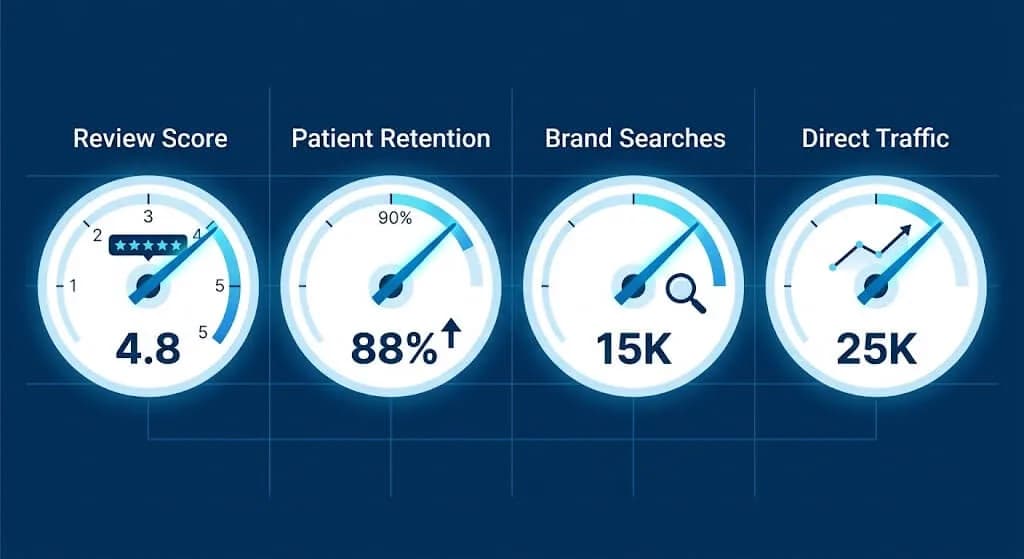
The metrics that tell you whether your dental brand is working fall into two groups: leading indicators that shift first, and lagging indicators that confirm growth in revenue terms. Leading indicators include branded search volume and review velocity. Lagging indicators include retention rate and acquisition cost trend. Read them together, not in isolation.
Branding cannot be reduced to a single number. But it can be tracked with a short list of signals. Leading indicators tell you the brand is gaining traction. Lagging indicators confirm it months later in revenue and retention. According to Gartner research, businesses that measure brand health quarterly outperform those that only track conversion metrics.
Core Brand Metrics for a Dental Practice
1 | Branded search volume which shows how many people search your practice name specifically, usually through Google Search Console query data |
2 | Direct website traffic which captures visitors who type your URL directly and signals stronger name recognition |
3 | Review count and average rating which remain the most visible public trust signals in local search |
4 | Patient retention rate which is one of the most financially meaningful lagging brand indicators |
5 | New patient referral rate which is one of the clearest signals of brand advocacy |
6 | New patient acquisition cost trend where a declining cost over 12 to 24 months can signal stronger organic brand pull |
To measure brand performance well, these metrics need to be read together. A rise in branded search with flat retention tells a different story than a rise in branded search with growing referrals and stronger review velocity. Context matters more than any isolated number.
How Do Online Reviews Reflect Your Brand Health?
Online reviews reflect your dental brand health by showing aggregated patient sentiment in real time. Volume signals popularity. Recency signals current quality. Average rating signals consistency. Together, they confirm or contradict the impression your marketing creates. A patient making a trust decision often relies on reviews more than any other touchpoint.
Reviews are the most public and measurable expression of patient sentiment your practice has. A patient who encounters your dental brand online and then reads your reviews is making a trust decision based almost entirely on what they find there. According to BrightLocal data, 88% of consumers say they would use a business that responds to all of its reviews.
What matters is not just the star rating. Review recency carries significant weight in both local search rankings and patient perception. A practice with 150 reviews, most of which are two years old, will often lose a prospective patient to a practice with 40 reviews posted in the last six months.
Review Cadence Tip
Track your monthly new review count as a standalone metric. A consistent rate of 3 to 5 new reviews per month usually signals a healthy brand feedback loop. A drop in that rate can precede softer inquiry volume later.
Building a reliable review pipeline is a system problem, not a personality problem. Our complete guide on getting more dental reviews covers the practical mechanics of building that system without pressuring patients.
One more thing matters here: review language. If patients repeatedly mention kindness, clear explanations, cleanliness, no-rush visits, and staff professionalism, those are not random compliments. They are evidence of what your brand actually means in the market. That kind of wording helps you read brand performance at the perception level, not just the numeric level.
What Does Your Website Traffic Tell You About Brand Recognition?
Website traffic tells you about brand recognition through two specific channels: direct traffic and branded search volume. Both isolate intent. Both measure whether patients seek out your practice by name rather than landing through a generic search or paid ad. Rising trends in either signal that your brand is becoming known in your local market.
These are two of the most underused indicators in dental practice analytics. Both measure whether patients seek out your practice specifically rather than finding you through a generic search or a paid ad click.
When direct traffic grows month over month, more people in your local market know your name and navigate to you intentionally. That is brand recognition showing up in a measurable channel. When branded search volume rises in Google Search Console, it confirms the same pattern from the search side.
These two metrics together are more meaningful than total traffic because they isolate intent. They tell you how many people in your area have internalized your brand well enough to recall and seek it out. For a detailed breakdown of how organic visibility connects to brand growth, our dental SEO beginner's guide for 2026 covers the full relationship.
Need clearer visibility into your brand metrics?
DentalBase helps practices connect SEO, reviews, and patient data so brand performance is easier to track and act on.
See How It WorksHow Do You Track Brand Awareness in Your Local Market?
You track local brand awareness through Google Business Profile insights, intake form sources, and repeat reach on social. GBP shows direct local engagement: calls, direction requests, and website visits from your map listing. Intake form data reveals how new patients found you. Together, these channels expose the actual reach of your brand in the area you serve.
Beyond website analytics, local brand awareness shows up in a few predictable places that many practices track inconsistently or not at all.
Your Google Business Profile insights are a direct signal of local engagement. How many people clicked to call. How many requested directions. How many visited your website from the profile. These numbers reflect local intent from patients who found you in a map result and chose to engage. A growing trend means your brand is gaining pull in the local search context.
Easy Brand Data Source
Add a simple "how did you hear about us?" field to your new patient intake form if you do not already have one. The answers are among the highest-signal brand data points available. Many practices underestimate how much they learn from them.
The CDC's health communication research consistently shows that patient awareness and trust in a healthcare provider are built through repeated, consistent exposure rather than a single strong impression. Local brand tracking is how you verify that those repeated touchpoints are actually accumulating in the right direction.
Social engagement can play a role here too, but interpret it carefully. Likes and impressions matter less than repeat reach inside your service area, profile visits from local users, and traffic back to the website. Branding metrics should stay close to patient behavior, not vanity signals.
What Role Does Patient Retention Play in Brand Measurement?
Patient retention plays the role of confirmation in brand measurement. It is a lagging indicator that tells you whether the brand experience held up after the first visit. According to Bain & Company, increasing retention by just 5% can lift profits by 25% to 95%. For a dental practice, retention is often the most financially significant brand signal of all.
Retention tells you how the brand experience landed after a patient visited, not before. But it is also one of the most financially significant metrics in the list. A patient who returns for recall visits, refers a family member, and leaves a review after the second appointment is the compounding return on your brand investment.
Practices with declining retention rates often find the root cause in the brand experience rather than in clinical quality alone. Patients who feel uncertain about their provider do not usually say so directly. They simply do not rebook. The practice may blame scheduling friction or insurance issues rather than the trust gap that actually exists.
If retention is below 70 percent, that is often a brand signal before it is an operations signal. Improving it requires the same systematic approach as any other brand metric. Diagnose the touchpoints where trust is not being reinforced. Address them deliberately. Our guide on increasing patient numbers with the right tools covers the retention side of growth in more detail.
This is where a lot of dentists misread branding ROI. They look only at new patient volume and miss the fact that stronger brand trust often shows up first in lower churn, higher case acceptance, and more referrals from existing patients. That is still ROI. It is just quieter than ad click data.
How Often Should You Review Your Brand Metrics?
You should review your dental brand metrics on a tiered cadence: monthly for fast-moving signals like reviews and GBP activity, quarterly for branded search and retention, and annually for full brand audits. Brand metrics move slowly by design. Weekly checks create noise. The signal lives in 90-day trends.
Brand metrics move slowly, and that is by design. Checking them weekly usually creates noise. The signal lives in 90-day trends, not daily fluctuations. A useful cadence for most practices looks like this:
Recommended Brand Metrics Review Cadence
| Monthly: New review count, current average rating, GBP call and click data, direct website traffic |
| Quarterly: Branded search volume trend, patient retention rate, new patient source breakdown from intake forms |
| Annually: Full brand audit including local share-of-voice, referral rate trend, and acquisition cost over the trailing 12 months |
The goal is not to react to every data point. It is to identify a direction over time and make channel-level decisions based on that trajectory. Practices that track these numbers quarterly usually allocate marketing budgets more accurately than those relying on gut feel or last month's appointment volume alone. For context on what strong production growth looks like when brand and acquisition work together, our analysis of growing implant case volume is a useful reference point.
Brand Building Is Measurable If You Know Where to Look
Your dental brand is measurable if you know where to look. The signals are real and consistent: branded search queries, direct traffic, review cadence, retention rate, referral percentage, and what patients write on intake forms when asked how they found you. None of these is a single conversion event. Together, they form a clear picture.
Dental brand building does not have a clean conversion event the way a paid ad does. That is what makes it feel unmeasurable to practices that have only ever tracked clicks and calls. But the signals are real and consistent.
The practices that grow most sustainably over a five-year period are rarely the ones running the largest ad budgets. They are the ones that invested in being known, built a feedback loop to measure it, and made incremental adjustments based on what the data was telling them. The National Institute of Dental and Craniofacial Research consistently notes that patient trust in a dental provider is built through repeated positive experiences over time. Brand metrics are the instrument panel that tells you whether those experiences are translating into the growth your practice is capable of.
The real shift is mental before it is technical. Stop asking whether branding worked this week. Start asking whether the practice is becoming more known, more trusted, and more often chosen by name over time. That is the signal that matters.
Want to See Your Brand Metrics in One Place?
DentalBase connects your SEO, reputation, and patient data so you can track what your brand is actually doing and act on it.
Book a Free DemoContinue Reading
| How to Get More Dental Reviews: A Complete GuideBuild the review pipeline that feeds your brand's most visible signal. |
| How to Increase Patient Numbers With the Right ToolsTurn strong brand metrics into a steadily growing active patient base. |
| How to Increase Dental Implant Cases by $360K/YearSee how brand trust converts into high-value case acceptance over time. |
Frequently Asked Questions
Online reviews are the most publicly visible brand signal a dental practice has. Review volume, recency, and average rating directly influence how prospective patients perceive the practice before their first visit. A consistent stream of positive reviews signals an active, trusted brand far more reliably than a large but outdated review total.
Brand building is a long-horizon investment. Most practices begin to see measurable shifts in branded search volume, direct traffic, and referral rates within six to twelve months of consistent effort. Retention improvements typically appear first; share-of-voice gains in local search take longer to compound.
Industry benchmarks vary, but practices with strong brand loyalty typically retain 75 to 85 percent of active patients year-over-year. Practices below 65 percent are often losing patients to competitors with stronger local brand presence, even when clinical quality is comparable.
Direct website traffic (visits from patients who type your URL rather than clicking an ad or search result) is one of the clearest measures of unaided brand recall. When direct traffic grows month-over-month, it means more people in your market know your practice name and seek you out specifically.
Was this article helpful?
Written by
DentalBase Team
The DentalBase Team is a collective of dental marketing experts, AI developers, and practice management consultants dedicated to helping dental practices thrive in the digital age.