AI Dental Insurance Verification: How It Works (2026)
AI dental insurance verification checks eligibility during patient calls, runs overnight batch processing, and eliminates 8-15 hours of weekly hold time.
Share:
Table of contents
AI dental insurance verification transforms the most time-consuming front desk task into an automated workflow. It runs during patient calls, before appointments, and in overnight batch processing, replacing the manual phone-based process entirely. The traditional process, call insurer, hold 10-20 minutes, transcribe coverage details, enter into PMS, consumes 8-15 staff hours weekly and produces 5-15% transcription errors that cause claim denials.
AI handles the same task in seconds with under 1% error rate, freeing your team to focus on patients instead of insurance company hold music. According to BrightLocal, 98% of consumers research businesses online before choosing a provider. Patients who receive instant coverage confirmation during their first call book at significantly higher rates than patients told "we'll check and call you back."
This guide covers how AI dental insurance verification works at the front desk: during inbound calls, in overnight batch processing, and in real-time treatment planning. It also covers what AI can and cannot verify, the integration requirements, and the measurable impact on production and patient satisfaction. For the broader comparison of verification solutions, see our benefits verification guide.
How Does AI Verify Insurance During Patient Phone Calls?
The most valuable application of AI dental insurance verification happens in real time during inbound patient calls. When a new patient calls to book, the AI collects insurance information conversationally. It queries the clearinghouse via EDI and confirms active coverage before the call ends. No staff involvement. No hold time.
| Call Stage | What AI Does | Time | Patient Experience |
|---|---|---|---|
| Information collection | Asks for insurance provider, subscriber ID, DOB | 30-45 seconds | Natural conversation |
| Real-time verification | Queries clearinghouse database via EDI | 3-10 seconds | Brief pause or conversation filler |
| Coverage confirmation | Confirms active coverage and key benefits | 15-20 seconds | "Your insurance is active and covers cleanings at 100%" |
| Appointment booking | Books with verified coverage attached to record | 30-45 seconds | Books with financial confidence |
The entire process takes under 2 minutes during a natural phone conversation. Compare that to the traditional workflow: patient calls, staff takes info, patient hangs up. Staff calls the insurer (10-20 minute hold). Staff calls the patient back. Patient decides whether to book. The traditional process takes 2-3 separate interactions over 1-2 days. AI collapses it into one call. Patients who receive instant verification book at 30-40% higher rates than patients told to wait for a callback. For practices where 38% of calls go unanswered, AI reception handles both the answering and the verification in one seamless interaction.
Verify insurance during every call, automatically
DentalBase AI reception collects insurance information conversationally, verifies coverage in seconds, confirms benefits to the patient, and books the appointment with verified data attached.
Book a Free Demo →How Does AI Handle Batch Verification and Pre-Appointment Processing?
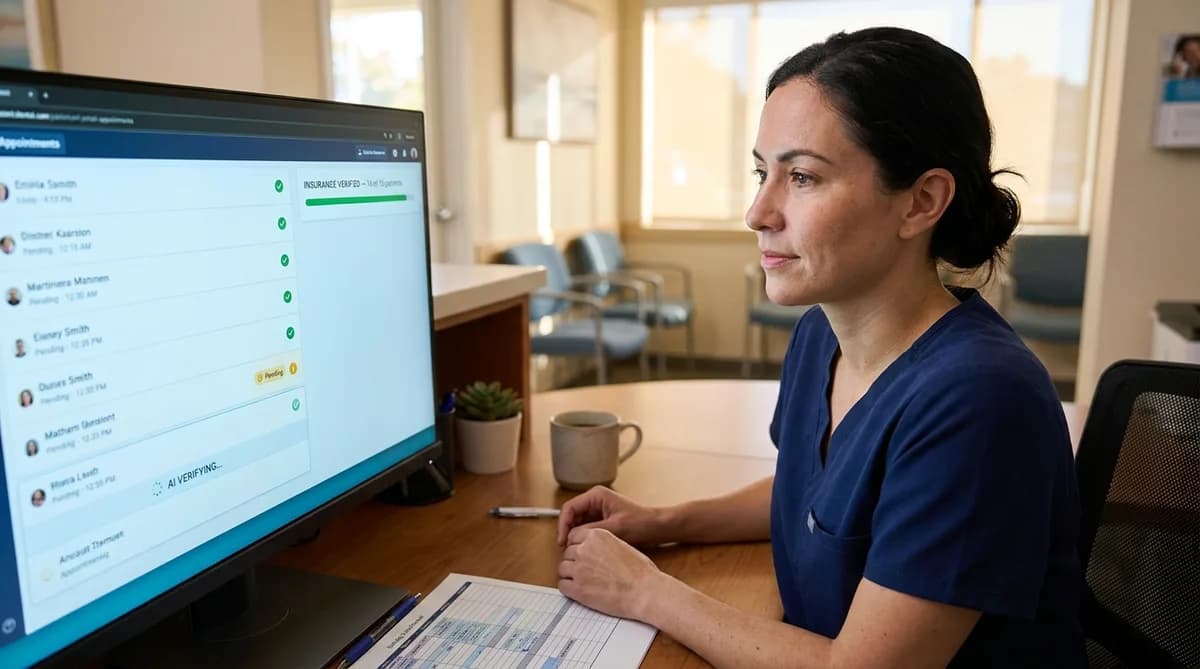
Beyond real-time call verification, AI dental insurance verification runs overnight batch processing. It checks every patient on tomorrow's schedule automatically. Staff arrives to a complete dashboard of verified coverage statuses, not a stack of manual calls to make before the first patient walks in.
Overnight Batch Verification
At a scheduled time (typically 10pm-6am), the AI queries the clearinghouse for every patient with an appointment in the next 24-48 hours. Staff arrives to a dashboard showing verification status: green (active, benefits confirmed), yellow (coverage changes detected, review needed), red (inactive or failed, contact patient). This eliminates the morning rush of manual verification calls.
Coverage Change Detection
The batch process compares current verification results against the patient's last visit. If coverage has changed (new employer, plan termination, benefit year reset, remaining balance changes), the system flags the appointment for staff review. This catches the 8-12% of patients whose coverage changes between visits before they arrive and discover an unexpected bill.
Outbound Confirmation with Coverage Details
During automated confirmation calls, AI includes coverage information: "Hi [FirstName], confirming your appointment tomorrow at 2pm. Your insurance covers your cleaning at 100% with no out-of-pocket cost." This pre-visit cost transparency reduces the financial anxiety that drives 15-25% of cancellations per our cancellation guide.
Benefits Remaining Alerts
The system identifies patients with benefits expiring at year-end and triggers targeted outreach: "You have $800 remaining in dental benefits that expire December 31. Would you like to schedule before year-end?" Connect to email campaigns for full automation.
For single-location practices seeing 20-40 patients daily, batch-only verification combined with real-time confirmation is usually sufficient. For multi-location groups or DSOs with 60+ daily appointments, running both modes ensures no patient slips through with stale coverage data.
The right setup depends less on practice size than on where your front desk bottlenecks. If manual morning verification calls are the daily pressure point, batch resolves it immediately. If new patient booking rate is the priority, real-time call verification moves that metric faster. See our front desk bottleneck guide for a full breakdown of which lever to pull first.
What Can and Cannot AI Dental Insurance Verification Handle Automatically?
AI dental insurance verification handles roughly 85-90% of eligibility checks without any staff involvement, covering all standard benefit categories for commercially insured patients. The remaining 10-15% involve complex structures that require human judgment. A well-built system routes those cases to staff with specific context rather than failing silently.
What AI Verifies Automatically
Active/inactive coverage status, subscriber and dependent eligibility, remaining annual maximum, deductible status (met/remaining amount), copay and coinsurance percentages by procedure category (preventive, basic, major, ortho), frequency limitations (cleanings per year, X-rays per period), and waiting period status for new plans.
What AI Flags for Staff Review
Complex benefit structures with multiple tiers, coordination of benefits (dual coverage), pre-authorization requirements for specific procedures, coverage for non-standard services (implants, sedation, TMJ), and situations where the clearinghouse returns incomplete data. These represent 10-15% of verifications and require staff judgment to interpret.
What AI Cannot Verify
Coverage for experimental procedures not in the payer's database, informal benefit exceptions negotiated between the practice and specific payers, and benefits under plans that don't participate in electronic clearinghouses. These edge cases require traditional phone verification. According to the ADA Health Policy Institute, electronic verification covers 85-95% of commercially insured patients at most general dentistry practices.
The system should handle the routine 85-90% automatically and route the complex 10-15% to staff with specific context about why manual review is needed. This is dramatically more efficient than staff manually verifying 100% of patients when only 10-15% actually require human judgment.
Related: See how verified insurance data improves treatment acceptance. → Automated Dental Benefits Verification: Top Solutions Compared
What Integration Does AI Dental Insurance Verification Require?
AI dental insurance verification requires three technical components to work: a clearinghouse EDI connection, bidirectional PMS integration, and an enrollment period with major payers. Most practices are fully operational within 2-4 weeks of signing with a platform.
PMS Integration
The AI platform connects to your practice management system (Dentrix, Eaglesoft, Open Dental) via API or direct database connector. Bidirectional means it reads recall schedules and patient records, then writes verified coverage data and confirmed appointments back automatically. One-directional integrations, read-only, still require staff to manually enter results. Confirm bidirectional support for your specific PMS version before purchasing.
Clearinghouse EDI Enrollment
Your practice must be enrolled with a clearinghouse (Availity, Change Healthcare, Tesia, or similar) to submit electronic eligibility requests. Most practices already have clearinghouse access for claims. If not, enrollment takes 1-2 weeks. The AI platform connects to the clearinghouse on your behalf using your existing NPI and Tax ID credentials.
Payer Coverage
Electronic eligibility verification covers the major commercial payers (Delta Dental, MetLife, Cigna, Aetna, Guardian, United Concordia) and most regional plans, roughly 85-95% of commercially insured patients. Medicaid coverage varies by state. The platform should provide a payer list during the sales process so you can verify coverage for your patient mix before committing.
No IT department is required for implementation. Most dental AI platforms handle the PMS connector setup, clearinghouse configuration, and payer credentialing as part of onboarding. Staff training typically takes one day. The main variable is the EDI enrollment timeline, if your practice is already enrolled with a clearinghouse for claims, setup time drops to 3-5 business days. According to Dental Economics, practices that complete full platform onboarding within the first two weeks see significantly faster time-to-ROI than those with extended implementation timelines.
How Does Verification Data Flow into Treatment Planning?
The highest-value application of AI dental insurance verification is connecting coverage data to chair-side treatment presentations. That's the moment patients decide whether to accept or defer care. Verified cost data at chair-side produces 15-25% higher treatment acceptance because it eliminates the cost uncertainty that causes patients to say "let me think about it."
Pre-Populated Treatment Estimates
When the provider identifies treatment needs, the software automatically calculates the patient's estimated out-of-pocket cost using verified insurance data. "Crown on #14: insurance covers 50% after deductible. Your estimated cost: $420." This specific dollar amount produces 15-25% higher treatment acceptance than "we'll check with insurance and let you know."
Same-Visit Treatment Acceptance
When verification is complete before the patient sits in the chair, the provider can present treatment and the patient can accept in the same visit. Without pre-verification, the patient leaves saying "let me think about it", and 40-60% never follow through on scheduling the treatment.
Payment Plan Integration
For treatments with higher patient portions, the verified data feeds into payment plan calculators: "Your insurance covers $1,200 of this $2,400 implant. Your portion is $1,200, which breaks down to $100/month for 12 months." Combining verified costs with payment options produces the highest treatment acceptance rates. See our ROI tracking guide for measuring acceptance rate improvements.
Connect verification to recall automation, benefit resets trigger outreach automatically. Use it with reactivation campaigns to target lapsed patients who still have active coverage. And feed it into recall gap analysis to surface patients with unused benefits.
What Results Should You Expect from AI Insurance Verification?
AI dental insurance verification delivers measurable impact across five practice metrics. Most practices see staff time savings and booking rate improvements within the first 30 days. Treatment acceptance gains build over 60-90 days as the team adapts to presenting verified costs at chair-side.
- Staff time saved: 8-15 hours weekly. At $20-30/hour, that's $8,320-23,400 annually redirected from hold time to patient-facing activities. The freed time often reduces the need for additional front desk hiring as the practice grows.
- Verification error rate: under 1% versus 5-15% manual. Each eliminated error prevents a potential claim denial ($25-50 rework cost, 30-90 day payment delay). Across 200+ monthly claims, reducing errors from 10% to under 1% saves $4,500-10,800 annually in denial rework alone.
- New patient booking rate: 30-40% increase. Patients who receive instant coverage confirmation during their first call book immediately instead of waiting for a callback. This is the single highest-revenue impact because each additional new patient produces $400-800 in first-visit production.
- Treatment acceptance: 15-25% increase. Verified cost presentations during treatment planning eliminate the "let me think about it" response that loses 40-60% of undecided patients. Each percentage point of acceptance improvement adds $15,000-30,000 in annual production for a typical practice.
- Cancellation reduction: 10-15% fewer cancellations. Pre-visit coverage confirmation eliminates the cost uncertainty that drives cancellations. Patients who know their out-of-pocket costs show up. Patients who don't know cancel. According to NIDCR research, patients with clearly understood treatment costs are significantly more likely to complete their full care plan.
Compliance with HIPAA applies to all insurance data collection, transmission, and storage. Ensure EDI connections are encrypted, clearinghouse vendors have BAA coverage, and AI call recordings containing insurance information are stored in HIPAA-compliant systems. Per TCPA, automated outbound calls require prior consent.
Connect to your unified AI platform, marketing strategy, and social media for the complete practice growth system. Per Moz, patients who receive excellent service experiences contribute to review velocity that strengthens local rankings. The Bureau of Labor Statistics reports dental support staff wages averaging $21-28/hour. Every hour recovered from manual verification is a direct labor cost saving, and a compounding return on the AI investment.
AI that verifies insurance during every patient call
DentalBase AI reception collects insurance, verifies in seconds, confirms coverage to patients, and books appointments with verified data in your PMS.
Book a Free Demo →Explore more guides and tools for dental practice growth.
Browse Resources →Sources & References
Frequently Asked Questions
AI reception collects insurance information conversationally (provider, subscriber ID, DOB), queries the clearinghouse database in 3-10 seconds, and confirms coverage to the patient before the call ends. The entire process takes under 2 minutes during a natural conversation.
8-15 staff hours weekly. Manual verification takes 10-20 minutes per patient on hold with insurers. AI verifies in 3-10 seconds. Staff time redirects to answering phones, scheduling, and patient care. Annual savings: $8,320-23,400 in labor costs.
AI handles 85-90%: eligibility status, benefits remaining, deductibles, copays by category, frequency limits, and waiting periods. Staff handles 10-15%: complex multi-tier plans, dual coverage coordination, pre-authorization requirements, and non-standard services.
The system automatically queries the clearinghouse for every patient scheduled in the next 24-48 hours. Staff arrives to a dashboard color-coded by status: green (verified), yellow (coverage changes), red (failed/inactive). Eliminates the morning verification rush.
Pre-verified cost presentations ('Your portion is $420') produce 15-25% higher acceptance than 'we'll check insurance.' Patients decide during the appointment instead of leaving to 'think about it,' which loses 40-60% who never follow through.
Yes. Batch verification compares current results against the last visit. Changes (new employer, plan termination, benefit reset, balance changes) are flagged before the patient arrives. This catches the 8-12% of patients whose coverage changes between visits.
Patients who receive coverage confirmation during their first call book at 30-40% higher rates. The traditional process (call back later with coverage details) loses momentum. Patients who hang up without booking often call a competitor who can confirm coverage immediately.
Yes when EDI connections are encrypted, clearinghouse vendors have BAA coverage, and call recordings with insurance information are stored in HIPAA-compliant systems. All insurance data is PHI. TCPA requires consent for automated outbound calls containing coverage information.
Was this article helpful?
Written by
Dentalbase Team
The Dentalbase Team is a collective of dental marketing experts, AI developers, and practice management consultants dedicated to helping dental practices thrive in the digital age.