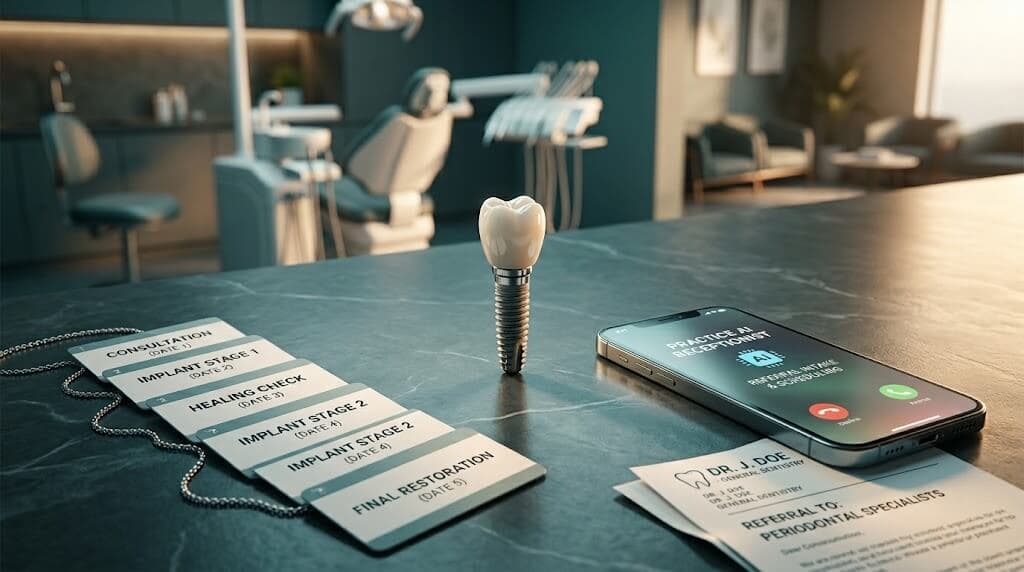
AI Receptionist for Periodontal Implant Practices (2026)
An AI receptionist for periodontal implant practices handles referral intake, multi-stage scheduling, and post-surgical follow-up. See how it works.
Share:
Table of contents
An AI receptionist for periodontal implant practices solves a problem most general dental offices never face: managing a front desk that fields referral calls from other dentists, coordinates treatment sequences stretching across months, and handles case values that can reach tens of thousands of dollars per patient. If your perio or implant practice misses even a handful of these calls each week, the revenue impact is far larger than it would be for a hygiene recall no-show. According to the ADA Health Policy Institute, 38% of new patient calls go unanswered during business hours in dental offices.
That's a problem for any practice. But when the caller is a general dentist trying to place a surgical referral, or a patient weighing a treatment that could cost thousands, the stakes multiply. This article breaks down how an AI receptionist periodontal implant workflow operates, from referral intake to post-op follow-up, and where DentalBase fits into the picture.
Why Do Periodontal and Implant Practices Have Unique Front Desk Challenges?
Perio and implant offices operate on a referral-driven model with multi-stage treatment timelines and unusually high case values, which makes every phone interaction more complex and more valuable than in a general practice.
Most patients don't find you through a Google search. They're sent by a general dentist who diagnosed periodontal disease, bone loss, or a failing tooth that needs extraction and implant placement. That means your front desk handles two types of inbound calls: patients calling to schedule after receiving a referral, and dental offices calling directly to place one. Each call type requires different information capture. A patient call needs insurance details, medical history flags, and appointment availability. A referring office call needs the referring doctor's name, the patient's condition, urgency level, and preferred timeline.
Then there's the treatment arc itself. A single implant case might span consultation, CBCT imaging, extraction, bone grafting, implant placement, a healing period, and final restoration. That's potentially six or more appointments spread over three to nine months. Your front desk isn't just booking one visit. They're sequencing a care plan.
Here's where it gets expensive. The CDC reports that periodontal disease affects nearly half of adults over 30 in the United States, which means referral volume is steady. Case values in periodontal and implant treatment run dramatically higher than routine dental work. According to Dental Economics, 80% of callers who reach voicemail don't leave a message and won't try again. A missed call from a full-arch implant patient isn't a lost cleaning. It's a lost case that your practice may never recover.
Add complex insurance dynamics on top of that. Implant cases sometimes cross into medical insurance territory, especially when bone grafting is tied to trauma or pathology. Your team has to know which questions to ask before the patient even walks in. That's a lot to handle between check-ins, treatment plan presentations, and post-op calls. An AI receptionist periodontal implant solution takes the phone burden off your team so they can focus on in-office patients.
See How DentiVoice Handles Periodontal and Implant Calls
DentiVoice answers referral calls, captures case details, and books directly into your PMS without putting callers on hold.
See How DentiVoice Works →How Does an AI Receptionist Handle Referral Intake Calls?
An AI receptionist identifies the caller type within seconds, distinguishes a referring dental office from a self-referred patient, and captures the specific data each call type requires before confirming next steps.
When a general dentist's office calls to place a referral, the conversation follows a different path than a patient inquiry. The AI asks for the referring doctor's name, practice name, the patient's name and contact information, the reason for referral (periodontal disease, implant evaluation, extraction with grafting, etc.), and whether the case is urgent. That last point matters. A patient with an acute periodontal abscess needs a different scheduling priority than someone exploring elective implant options.
For patient-initiated calls, the AI shifts to a different script. It collects insurance information, asks about medical history flags that affect surgical planning (blood thinners, bisphosphonates, uncontrolled diabetes), and checks appointment availability against your PMS. If the patient mentions they were referred by a specific dentist, the system logs that referral source automatically.
Why does the referral source matter so much? Because your relationship with referring doctors is the engine of your practice. If a general dentist sends you a patient and never hears back, they'll start sending referrals elsewhere. The AI captures that data cleanly so your team can close the loop with the referring office, whether that's a thank-you call, a treatment update, or a case completion letter. According to BrightLocal, 98% of people read local reviews before choosing a business, and trust signals influence how professionals and patients choose providers alike.
Urgent vs. Elective Referral Routing
Not every referral has the same timeline. The AI uses decision logic to route calls based on urgency:
- Same-day or next-day: Failing implant, acute periodontal abscess, post-surgical complication from another provider
- Within one week: Active periodontal disease with bone loss, extraction needed before orthodontic treatment
- Standard scheduling: Elective implant consultation, second opinion on treatment plan, cosmetic gum recontouring
Your team sets the rules. The AI follows them consistently, every call, every time.
Related: For a broader comparison of AI receptionist platforms and how they handle specialty workflows → AI Dental Receptionist Comparison: 10 Platforms (2026)
What Does an AI Receptionist Periodontal Implant Scheduling Workflow Look Like?
An AI receptionist integrated with your practice management system can sequence multi-stage implant appointments across months, assign the correct appointment types, and send preparation instructions for each visit automatically.
Implant treatment doesn't fit into a single appointment slot. A typical full implant case moves through consultation, CBCT imaging (sometimes combined with the consult), extraction if needed, bone grafting, implant placement, a healing period with check-ins, and final prosthetic delivery. Some stages happen weeks apart. Others require months of healing before the next step.
An AI receptionist connected to Open Dental, Dentrix, or Eaglesoft can book the initial consultation and, depending on your configuration, pre-schedule the follow-up sequence. It knows which appointment types your PMS uses for "implant consult" vs. "implant surgery" vs. "implant restoration." That distinction matters because appointment types control operatory assignment, time blocks, and provider schedules.
Sedation Scheduling and Pre-Op Instructions
Perio and implant procedures often involve IV sedation or oral conscious sedation. That adds layers to the scheduling call. The AI delivers pre-op instructions clearly:
- Nothing to eat or drink after midnight before the procedure
- Arrange for a companion to drive you home after sedation
- Bring your medical clearance letter if you take blood thinners or bisphosphonates
- Wear loose, comfortable clothing with short sleeves for IV access
These aren't optional details. Missing one can force a same-day cancellation, which costs your practice both time and revenue. The AI doesn't just mention these requirements once. It can send follow-up confirmations via text or email that repeat the sedation prep checklist before the procedure date.
| Treatment Stage | What the AI Receptionist Handles | Key Details Captured |
|---|---|---|
| Referral Intake | Answers call, identifies referral vs. patient, logs source | Referring doctor, condition, urgency, patient contact |
| Consultation Booking | Schedules consult, collects insurance and medical flags | Insurance type (dental/medical), medications, health conditions |
| CBCT / Imaging | Books imaging visit, sends prep instructions if separate | Appointment type, imaging location, prep requirements |
| Surgery (Implant / Graft) | Confirms surgery date, delivers sedation pre-op checklist | NPO instructions, companion driver, clearance letter |
| Healing Check-Ins | Outbound follow-up calls, schedules healing appointments | Pain level, swelling, medication adherence, complications |
| Final Restoration | Books prosthetic delivery, confirms time with restorative provider | Appointment type, provider, lab coordination notes |
See DentiVoice Handle Multi-Stage Implant Scheduling
Book a demo to see how the AI sequences implant appointments from consult through restoration inside your PMS.
Book a Free Demo →How Does an AI Receptionist Handle Post-Surgical Follow-Up?
An AI receptionist runs outbound follow-up calls after surgical procedures like implant placement, bone grafting, and sinus lifts, checking patient recovery status and escalating concerns to your clinical team in real time.
Post-op follow-up is one of the most time-consuming tasks in a periodontal practice. After a bone graft or implant surgery, your team should ideally call the patient within 24 to 48 hours to check on swelling, pain levels, bleeding, and whether they're following medication and dietary instructions. Multiply that by the number of surgical cases you complete each week, and the phone time adds up fast.
DentiVoice handles these outbound calls automatically. The AI contacts the patient, asks structured recovery questions, and logs the responses. If everything sounds normal, the call ends with a reminder about their next healing check appointment. If the patient reports something outside expected parameters, like heavy bleeding three days post-graft or numbness that hasn't resolved, the AI flags it as urgent and routes a notification to your clinical team.
Missed Healing Appointments
Healing check visits are easy for patients to skip. They feel fine, they're busy, and the appointment doesn't involve active treatment. But skipping these visits can delay implant loading or miss early signs of graft failure. The AI calls patients who miss healing appointments and reschedules them. That's a small action that protects a large investment, both yours and the patient's.
According to the Bureau of Labor Statistics, dental employment is projected to increase by 4% from 2022 to 2032, and demand for specialists including periodontists continues to grow. That means your schedule can't afford gaps from preventable no-shows. For practices that want a deeper look at automating follow-up workflows, this guide covers the full setup process.
Related: Not sure which AI receptionist fits your periodontal or implant practice? → How to Choose an AI Dental Receptionist: Complete Guide
How Can DentalBase Support Periodontal and Implant Practice Growth?
DentalBase pairs an AI receptionist periodontal implant workflow with dental marketing services so your practice doesn't just answer more calls, it generates more of the right calls from patients actively searching for periodontal and implant care.
Here's the gap most perio and implant practices don't see. You might get steady referrals from general dentists, but there's a growing population of patients who search for implant providers directly. According to Moz, local ranking factors like Google Business Profile optimization, review volume, and on-page relevance heavily influence which practices appear in the local pack. If your practice doesn't show up when someone searches "dental implants near me" or "periodontist near me," you're invisible to patients who are ready to book.
DentalBase SEO services target those high-value implant and perio keywords so your practice shows up when patients search. But driving traffic is only half the equation. If those patients call and reach voicemail, you've spent marketing dollars to generate a lead that never converts. That's where DentiVoice closes the loop. It answers every call, captures the patient's intent, collects insurance information, and books the consultation. According to Dental Economics, after-hours calls represent 27% of total patient call volume, and those are exactly the calls an AI receptionist catches.
Insurance Crossover: Dental vs. Medical
Implant cases frequently involve both dental and medical insurance. Bone grafts tied to pathology, implants following trauma, and certain periodontal surgeries may qualify for medical coverage. Patients call with questions about this constantly, and the answers are rarely simple. The AI won't quote benefits (that's your billing team's job), but it will collect the right information upfront: dental insurance carrier, medical insurance carrier, the reason for treatment, and whether the case involves trauma or pathology. Your billing coordinator gets a complete intake before the patient's first visit, which saves a round of phone tag later.
For practices that also want to understand the financial return on AI reception, the AI Dental Receptionist ROI Guide breaks down the math.
Explore DentalBase Marketing + AI Reception
See how DentalBase combines SEO, PPC, and AI call handling to grow periodontal and implant practices.
View All Services →The biggest risk for a periodontal or implant practice isn't clinical. It's operational. You can place implants flawlessly, but if your front desk can't keep up with referral calls, multi-stage scheduling, and post-surgical follow-up, you're leaving high-value cases on the table. An AI receptionist built for dental practice workflows handles the volume and complexity your specialty demands, without adding headcount.
If you're running a perio or implant practice and you're not sure how many calls you're actually missing, start there. Book a DentiVoice demo, review your current call data, and see what an AI receptionist periodontal implant solution picks up that your team can't.
Ready to Stop Losing High-Value Implant Cases to Voicemail?
See how DentiVoice handles referral intake, multi-stage scheduling, and post-op follow-up for periodontal and implant practices.
Book a Free Demo →Want more guides on growing your dental practice?
Browse Resources →Sources & References
Frequently Asked Questions
Yes. The AI identifies the caller's intent within the first few seconds of conversation. When a general dentist or their staff calls to place a referral, the system captures the referring doctor's name, practice, patient details, and reason for referral before confirming next steps.
The AI books the initial consultation and can inform the patient that imaging will be part of the visit. If your practice schedules CBCT as a separate appointment, the AI sequences both visits in order and provides prep instructions for each.
Yes. DentiVoice answers calls around the clock. After-hours calls account for a significant share of total patient call volume, according to Dental Economics. For high-value implant inquiries, capturing those calls at night or on weekends prevents them from going to a competitor.
The AI can explain that implant coverage varies by plan, collect the patient's insurance details for verification, and flag cases that may involve medical insurance crossover. It won't quote specific benefits but ensures your billing team has the information they need before the first visit.
The AI uses escalation triggers. If a patient reports excessive bleeding, unusual swelling, or severe pain beyond expected recovery parameters, the system flags the call as urgent and routes it to your clinical team immediately rather than logging a routine follow-up note.
DentiVoice operates under a Business Associate Agreement and follows HIPAA safeguards for protected health information. All call data, patient details, and referral records are encrypted in transit and at rest.
Was this article helpful?
Written by
DentalBase Team
The DentalBase Team is a collective of dental marketing experts, AI developers, and practice management consultants dedicated to helping dental practices thrive in the digital age.