
Best Online Marketing for Dentists: A 2026 Channel Guide
Compare the best online marketing for dentists by goal, cost, and ROI. See which channels bring patients and how to prioritize your budget in 2026.
Share:
Table of contents
The search for the best online marketing for dentists usually starts with a frustrated practice owner and a shrinking budget. You know patients are looking. ADA Health Policy Institute data shows convenience now ranks among the top reasons people pick a provider, and 71% of people run a search before they ever book a dentist, according to Pew Research. The hard part isn't demand. It's deciding where your money actually works.
Every channel claims to be the one. SEO agencies say organic. Ad platforms say paid. Social consultants say reels. Meanwhile, "dentist near me" alone draws roughly 1.2 million US searches a month, per Google Trends, and most of that attention never reaches a practice that hasn't set its foundation. This guide compares the channels by goal, cost, and speed, so you can build a dental marketing plan that fits your practice instead of someone's sales pitch.
What is the best online marketing for dentists?
The best online marketing for dentists is a coordinated mix of channels, not a single tactic. For most practices that means a fast website, a strong Google presence, local search, and selective paid ads working together. The right blend depends on your goals, budget, and how crowded your local market is.
Think of it as a system with a foundation and a set of accelerators. The foundation is everything a patient hits after they find you: a site that loads quickly, books appointments, and answers basic questions. Google treats page speed as part of page experience, and consumers expect a load under three seconds. Get that wrong and paid traffic just leaks away.
Accelerators are the channels that send people to that foundation. Around 68% of online experiences begin with a search engine, BrightEdge reports, which is why search tends to anchor most dental plans. Start with the foundation. Then add the channel that matches your single most pressing goal, whether that is faster new-patient calls or steadier long-term growth.
Not sure where your budget should go first?
DentalBase maps SEO, paid search, social, and website work to your specific growth goals so spend follows results.
See our marketing services →Which online marketing channels actually bring in dental patients?
Seven online channels reliably bring in dental patients: local SEO, Google Ads, Google Business Profile, online reviews, social media, email and reactivation, and video. Each one suits a different goal and timeline. No single channel does everything, which is why matching a channel to a goal matters more than chasing whatever is trending.
Roughly 46% of all Google searches seek local information, according to Google, so local visibility usually does the heavy lifting for a single-location practice. Paid search buys speed. Reviews and social build the trust that closes the decision. The table below lines them up so you can see the tradeoffs at a glance.
Comparing the channels at a glance
| Channel | Primary goal | Time to results | Typical cost | Benchmark |
|---|---|---|---|---|
| Local SEO | Steady long-term patient flow | 3-6 months | Time or retainer | 3.5% organic conversion |
| Google Ads (PPC) | Fast visibility, new procedures | Days | $6-8 per click | ~2% conversion |
| Google Business Profile | Map pack and 'near me' searches | 2-6 weeks | Free to manage | 35% more site clicks |
| Online reviews | Trust and final decision | Ongoing | Low | 98% read before choosing |
| Social media | Brand familiarity, recall | Months | Time or ad spend | 1.2% average engagement |
| Email and reactivation | Re-booking lapsed patients | Immediate | Very low | $44 return per $1 |
| Video and YouTube | Education, case explanation | Months | Production time | 48% more engagement |
Read the table by your goal, not top to bottom. Need patients this month? Paid search and Google Business Profile move fastest. Building a durable pipeline? Local SEO and reviews compound over time. Many practices run two or three of these at once, then double down on whatever their tracking proves is working. To see how new patients actually find local practices, our breakdown of how to market a dental practice covers the offline pieces too.
How much should a dental practice budget for online marketing?
Most dental practices invest 3-7% of collections in marketing, with newer or competitive-market practices at the higher end. On a per-patient basis, acquiring a new patient through digital channels typically costs $150-300, while dental keywords run $6-8 per click. Budget against patient value, not gut feel.
The math gets clearer when you anchor it to lifetime value. Dental Economics puts the average general-practice patient at $12,000-15,000 over time. Spend $250 to win a patient worth $12,000 and the channel pays for itself many times over, even after factoring in the patients who never convert. That ratio is what separates a marketing investment from a marketing expense. Cross-industry figures, like the HubSpot marketing statistics report, add context, though dental acquisition costs usually run higher.

How to sequence your marketing spend
Sequence spending instead of splitting it evenly. A practical order for most practices:
- Fix the foundation first. A fast, bookable website and a complete Google Business Profile come before any ad spend. They convert the traffic everything else sends.
- Capture existing demand. Claim the people already searching your name and "dentist near me" through local SEO and Google Business Profile.
- Buy speed where it counts. Add paid search for high-value services or to fill a slow schedule fast.
- Build trust and recall. Layer in reviews, social, and reactivation once the first three are steady.
Related: New practices and established ones should spend in a different order, which our owner's guide breaks down by stage. Read the dental marketing guide →
Is SEO or paid search the better starting point?
Neither is universally better; they solve different problems. Paid search delivers patients within days but stops the moment you stop paying. SEO takes three to six months to build but keeps working after. The right starting point depends on whether your priority is speed or staying power.
The conversion numbers tell part of the story. Organic search converts at about 3.5% for dental, while paid search sits just under 2%, per WordStream. Organic visitors often convert better because they chose your result. But paid puts you at the top tomorrow, and around 52% of paid clicks come from mobile, where "near me" intent is strongest. Paid search drives roughly 35% of traffic for dentists.
Most growing practices eventually run both. Use ads to fill gaps and promote specific procedures while dental SEO builds the free, durable traffic underneath. If you can only fund one to start, choose by urgency: an empty schedule next month points to ads, a steady three-year plan points to SEO.
Want paid and organic working together, not against each other?
DentalBase runs SEO and Google Ads as one plan with shared tracking, so you can see which clicks turn into booked patients.
Book a free demo →How much do Google Business Profile and online reviews matter?
For a local dental practice, they matter enormously; together they often decide who gets the call. Reviews shape trust before a patient ever visits your site. A BrightLocal consumer survey found 98% of people read local reviews before choosing a business, and 88% favor businesses whose owners respond to reviews.

Google Business Profile is the listing that feeds the map pack, the cluster of three results that sits above organic links on local searches. It's free to manage and one of the highest-return assets in local search. Practices that post regularly to their profile see about 35% more website clicks, BrightLocal reports. Software Advice has found 77% of patients use online reviews when choosing a dentist.
Two habits move the needle here. First, ask every happy patient for a review, consistently, not occasionally. Second, reply to all of them, good and bad, because that visible responsiveness is what the 88% are reacting to. The follow-up calls that ask for reviews can run on autopilot.
That last point is where many practices stall. Asking for reviews and reactivating lapsed patients takes phone time the front desk rarely has. A dental AI receptionist can handle recall and follow-up calls so review requests actually go out.
Does social media marketing work for dentists?
Yes, but mostly for trust and recall rather than direct booking. Social media keeps your practice familiar so you're the name patients remember when they need care. Around 97% of surveyed dentists use Facebook as their main platform, per Dental Economics, and 41% of people say social content influences their treatment choice.
Format matters more than frequency. Video posts earn about 48% more engagement than static images on dental accounts, Hootsuite reports, and healthcare engagement on Instagram averages near 1.2%, per Sprout Social. Short clips that explain a procedure or introduce the team tend to outperform polished promotions. Choose the platform by your patients, not the trend; social media management pays off when it stays consistent.
Set realistic expectations. Social rarely produces a flood of same-week bookings. It does keep you visible to the people researching for weeks before they commit, and it gives your reviews and website something to reinforce. For practices with case-heavy services, YouTube can extend that education further.
How do you measure the ROI of online marketing for dentists?
You measure it by tracking which channel produced each new patient and what that patient is worth. Without attribution, every channel claims credit and none can be proven. The two numbers that matter most are cost per new patient and the revenue those patients generate.
Google reports 86% of users contacted a provider after running a search, but a search isn't a booking. The gap between click and booked patient is where most practices lose visibility. Call tracking closes it by tying phone calls back to the channel that drove them, since most dental conversions still happen by phone.
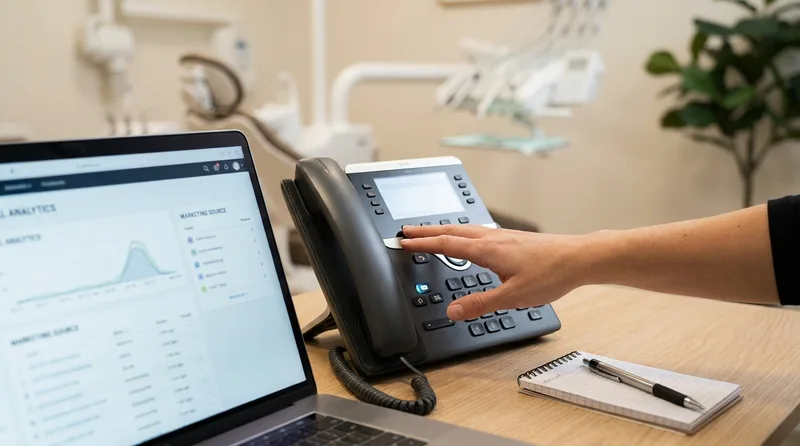
What to track to prove ROI
Track these at a minimum:
- Cost per new patient by channel. Total spend divided by patients that channel produced.
- Call source and outcome. Which channel rang the phone, and whether the call booked.
- Conversion rate from your website. Visits that turn into a booked appointment.
- Review volume and rating trend. A leading indicator of future local visibility.
Pull these into one view rather than seven dashboards. When attribution lives in one place, you can shift budget toward what books patients and away from what only looks busy. Our look at paid search for dentists walks through call tracking setup in detail.
Should you hire a dental marketing company or do it in-house?
It depends on your time, budget, and how many channels you plan to run. One channel, like a Google Business Profile, is manageable in-house. A coordinated mix across SEO, ads, social, and tracking usually needs either a dedicated hire or an agency. The dental market is large and competitive, with US dental employment projected to grow 4% through 2032, per the Bureau of Labor Statistics.
In-house gives you control and lower hard costs, but it competes with clinical and front-desk priorities, and one person rarely masters every channel. An agency brings specialists and tools, at a retainer. The deciding factor is usually whether marketing keeps slipping to the bottom of someone's task list.
How to evaluate a marketing partner
If you do evaluate a partner, judge them on these:
- Dental-specific experience. They should know dental margins, patient value, and local search, not just generic marketing.
- Transparent tracking. You see calls, bookings, and cost per patient, not vanity metrics.
- Clear ownership. You keep your website, ad accounts, and profile if you leave.
- One coordinated plan. Channels reinforce each other instead of running in silos.
Putting your channel mix together
The best online marketing for dentists isn't a channel you pick once. It's a mix you match to your goals, fund in the right order, and adjust as your tracking shows what books patients. Foundation first, then the accelerator your practice needs most.
Start with one honest question: what is the single biggest gap in your patient flow right now? Answer that, point your first dollars there, and measure the result before you expand. The practices that win online aren't the ones spending the most. They're the ones who can prove what their spending earns.
See where your marketing dollars actually go
DentalBase combines dental SEO, paid search, social, and call tracking in one platform, with attribution that shows which channel books each patient.
Book a free demo →Want more practical guides on dental growth and marketing?
Browse our resources →Sources & References
Frequently Asked Questions
On a small budget, the best online marketing for dentists is a complete Google Business Profile plus local SEO. Both capture patients already searching, cost little beyond time, and feed the map pack that drives 'near me' calls.
It varies by channel. Google Ads can produce calls within days, while local SEO usually takes three to six months to build momentum. Reviews and social compound gradually, so expect a blended timeline rather than one switch.
Yes. A Google Business Profile drives discovery, but your website converts that interest into a booking. Consumers expect pages to load in under three seconds, and a slow or unbookable site wastes the traffic every other channel sends.
Most practices invest 3-7% of collections in marketing. For a practice collecting $1 million a year, that's roughly $2,500-5,800 monthly across channels, weighted toward the goal that matters most at your current stage.
They serve different goals. SEO captures patients actively searching for a dentist, which usually drives more direct bookings. Social media builds familiarity and trust over time. Most practices need search first, then add social for recall.
Yes, for one or two channels. Managing a Google Business Profile and asking for reviews is realistic in-house. A coordinated mix across SEO, ads, social, and tracking usually needs a dedicated hire or an agency to run well.
For speed, paid search paired with a strong Google Business Profile works fastest. Ads can place you at the top within days for high-value services, while your profile captures nearby searches. Track calls so you fund what converts.
Was this article helpful?
Written by
DentalBase Team
Expert dental industry content from the DentalBase team. We provide insights on practice management, marketing, compliance, and growth strategies for dental professionals.