
Dental SEO: The Practice Owner's Complete Ranking Guide
Dental SEO drives new patient appointments from search. Learn the local SEO, on-page, and content strategies that help dental websites rank.
Share:
Table of contents
Dental SEO, the practice of optimizing your website and online presence to rank in Google for patient searches, is how practices get found by the 1.2 million people who search "dentist near me" every month in the United States. The practices that appear at the top of those results collect the majority of those clicks. The ones that don't rank are largely invisible to patients actively looking for care right now.
A dental SEO strategy covers your Google Business Profile, your website's technical health, the content on your service pages, the reviews patients leave, and the local signals that tell Google your practice is the right answer for nearby searchers. Done consistently, it builds compounding organic visibility that doesn't reset when a budget runs dry.
This guide walks through each layer, what it is, why it matters, and how practices actually execute it. The goal is to give you a clear enough picture to evaluate whether to invest in this channel, what questions to ask a provider, and what results are realistic for your market. For an overview of all the channels that contribute to patient growth, see the full DentalBase services overview.
Why does search visibility matter so much for dental practices?
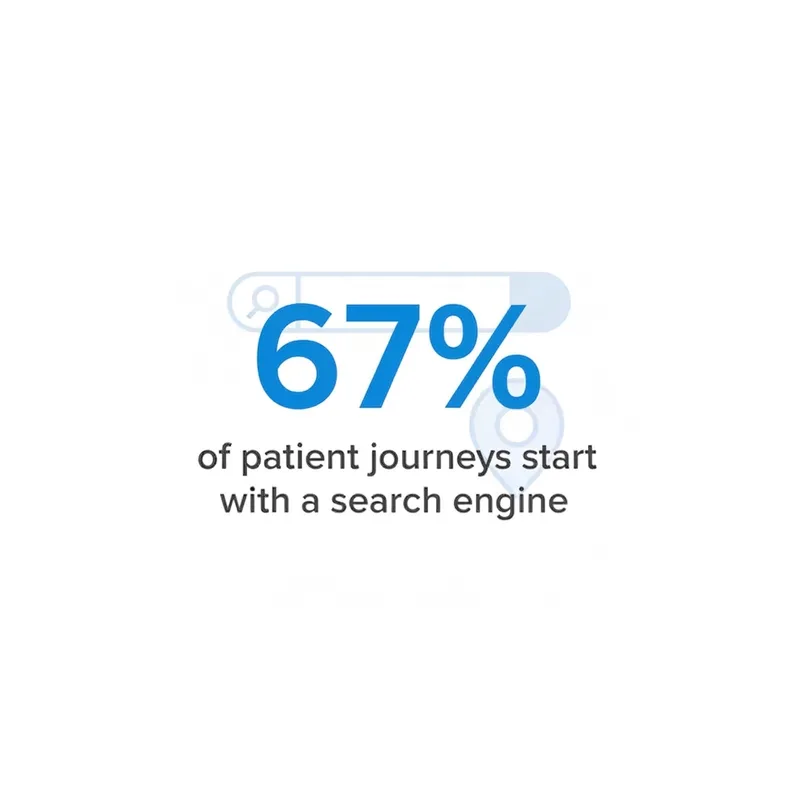
Dental practices succeed or fail on patient flow, and patient flow increasingly starts online. According to BrightEdge research, 68% of all online experiences start with a search engine. For healthcare specifically, that means patients are researching symptoms, comparing providers, reading reviews, and making scheduling decisions through organic search, often before they've visited any practice's website directly.
That behavior pattern has direct revenue implications. WordStream data puts the organic search conversion rate for dental at 3.5%, meaning roughly 35 out of every 1,000 organic visitors book an appointment or make contact. That compares favorably to paid search, where the dental PPC conversion rate runs just under 2%. Organic traffic costs more to establish but converts at a higher rate once the rankings are in place.
The math sharpens further when you factor in patient lifetime value. According to Dental Economics, the average patient lifetime value for a general dentist runs between $12,000 and $15,000. A single new patient from an organic search is worth far more than the cost of the content or citation that earned that ranking.
The problem is that organic visibility doesn't arrive automatically. A new dental website with no optimization effort will not rank for competitive local terms. The practices showing up in your market's Map Pack and top organic results have almost always done deliberate SEO work, claimed and optimized their Google Business Profile, built out service pages, earned reviews, and maintained technical site health over months or years.
What is Google Business Profile, and how does it drive local dental rankings?
Your Google Business Profile (GBP) is the single most visible asset in local dental SEO. It's the listing that appears in the Map Pack, the block of three practices with a map that shows up for location-specific searches, and it populates the knowledge panel when someone searches your practice name directly. Getting into the Map Pack typically generates more clicks than any individual organic listing.
Google uses three core signals to determine Map Pack placement: relevance (does your profile match what the user searched?), distance (how close is the practice to the searcher?), and prominence (how well-known and trusted is the practice across the web?). Relevance and prominence are where SEO work has the most leverage.
Specific optimizations that affect GBP performance:
- Business name, address, and phone (NAP): Must be exact and consistent across every directory, citation, and web mention. Inconsistencies erode trust signals.
- Primary category: "Dentist" is the obvious choice for general practices; specialists should use their specific category (e.g., "Orthodontist," "Oral Surgeon"). Secondary categories add nuance.
- Services section: GBP lets you list individual services, implants, Invisalign, whitening, emergency care. Each service added improves relevance matching for those specific searches.
- Photos: Practices that post regular photos of the office interior, team, and equipment see higher engagement. Google uses photo activity as a freshness signal.
- Review volume and recency: A BrightLocal consumer review survey found that 98% of people read local reviews before choosing a business. Review count and average star rating are direct ranking inputs for the Map Pack.
- Q&A section: Pre-populating common questions and answers reduces friction and gives Google structured information to pull into search results.
Dental practices using Google Business Profile posts regularly see 35% more website clicks, according to BrightLocal data. Posts, announcements, offers, procedure highlights, signal activity and give Google's algorithm more reasons to favor your listing over a dormant competitor profile.
How do you optimize dental service pages for SEO?
On-page SEO refers to everything within your website that affects how Google understands and ranks your pages. For a dental practice, this means each service you offer should have a dedicated page with content structured to match how patients search, not how a dentist thinks about the procedure.
A patient searching "tooth extraction cost" wants to know what the procedure involves, roughly what it costs, and what to expect afterward. A page that answers those questions with specific language, local context, and verifiable information will outperform a thin page that simply lists the service name and a phone number.
Key on-page elements for dental service pages:
- Title tag: Include the service keyword and location (e.g., "Dental Implants in [City], [Practice Name]"). Keep it under 60 characters.
- Header structure: Use a single H1 that matches the page topic, then H2s for major subtopics (cost, procedure, recovery, FAQs). Google uses heading structure to understand page organization.
- Geo-specific copy: Mention the city, neighborhood, or region naturally in the body text. This reinforces local relevance beyond just the GBP.
- Internal links: Link from service pages to related content and from blog posts back to service pages. Internal linking distributes ranking authority and helps Google index your site architecture.
- Schema markup: Structured data (JSON-LD) for LocalBusiness, Dentist, FAQPage, and BreadcrumbList gives Google machine-readable signals about your practice, hours, location, and content type.
- Page speed: Google confirmed page experience as a ranking factor. According to Google's Core Web Vitals documentation, consumers expect websites to load in 3 seconds or less. Slow pages lose both rankings and the visitors who bounce before the content loads.
The technical layer matters too. Mobile usability is non-negotiable, mobile accounts for 62% of all dental-related searches according to Google data. A site that's hard to use on a phone loses both rankings and conversions simultaneously.
What role does content play in a dental SEO strategy?
Content is how a dental website builds topical authority, the signal to Google that your site is a reliable, thorough resource on dentistry for your area. A single optimized homepage and a few service pages can earn you rankings for branded and high-intent searches. A content strategy that includes educational articles, condition guides, procedure FAQs, and cost explainers earns rankings for the long tail of searches patients run during the research phase.
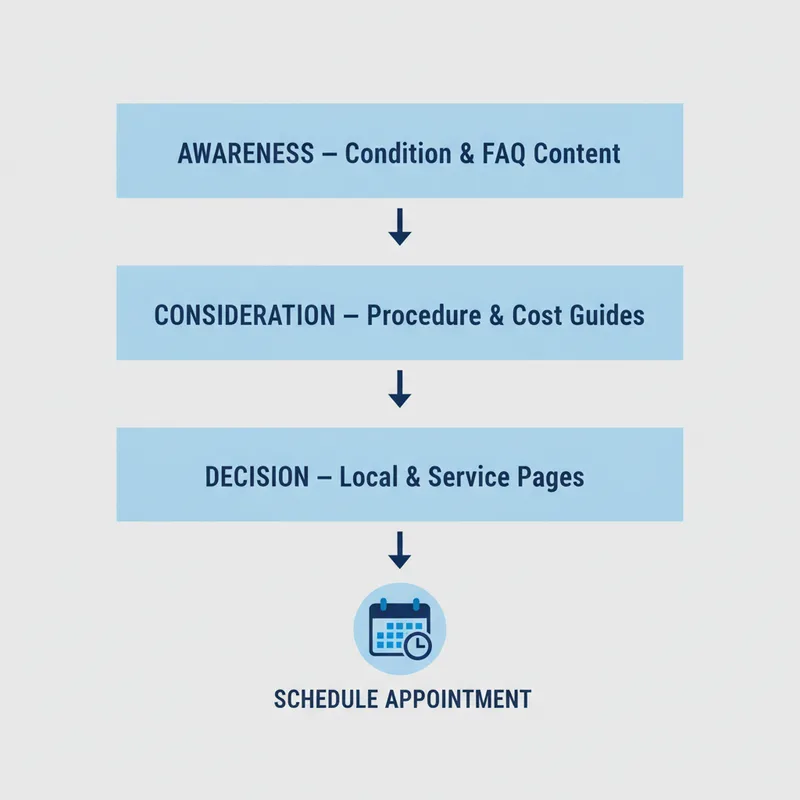
That research phase is longer than most practices assume. PatientPop data found that 48% of patients conduct over two weeks of research before scheduling. During that window, they're reading articles about what a procedure involves, how much it costs, what the recovery looks like, and which practices in their area specialize in their concern. Content that answers those questions positions a practice as the informed, trustworthy option, before the patient has even called.
Effective content categories for dental SEO:
- Procedure explainers: "What is a dental crown?" / "How does Invisalign work?", captures patients in the awareness and consideration stages.
- Cost guides: "How much does a dental implant cost?", one of the highest-intent research queries in dentistry. Practices that answer this question directly (with realistic ranges and factors that affect pricing) earn trust before a competitor does.
- Condition content: "What causes sensitive teeth?" / "Why are my gums bleeding?", intercepts patients at the first moment of concern, before they've decided to book anywhere.
- Local content: "Dentists accepting new patients in [City]", hyperlocal articles that target searchers at the final decision stage.
- FAQ content: Patient questions answered in structured FAQ format rank well for voice search and appear in Google's People Also Ask boxes, which generate clicks without requiring a top-10 position.
For a deeper look at how a consistent publishing cadence builds organic authority, this guide on blogging for dentists breaks down what topics work and how to structure a manageable editorial calendar. And if you want to understand where patients are finding practices before they land on a blog post, the analysis in where do dental patients come from puts organic search in context alongside other acquisition channels.
How do reviews and reputation management connect to dental SEO?
Reviews are both an SEO signal and a conversion factor. On the SEO side, Google treats review volume, recency, and average rating as inputs for Map Pack ranking, a practice with 300 reviews and a 4.8-star average will generally rank above a comparable practice with 40 reviews and no owner responses. On the conversion side, reviews are often the final decision point before a patient books.
According to a BrightLocal consumer review survey, 88% of people are likely to use a business if the owner responds to all reviews. That response behavior, acknowledging positive reviews and professionally addressing negative ones, is visible to prospective patients and signals to Google that the practice is active and engaged.
Practical review strategy for dental practices:
- Ask every satisfied patient for a review before they leave the office. In-person requests outperform follow-up emails in conversion rate.
- Send a review request via text message within 24 hours of a completed appointment. SMS open rates are significantly higher than email.
- Respond to every review, positive and negative. A professional, empathetic response to a negative review often reassures prospective patients more than the review itself deters them.
- Never incentivize reviews or fabricate them. Google's policies and FTC guidelines prohibit both, and violations can result in profile penalties.
- Distribute reviews across platforms: Google matters most for SEO, but Healthgrades, Zocdoc, and Yelp influence patients who search on those platforms directly.
Reviews also generate a secondary SEO benefit: the text of reviews often contains natural-language keywords ("the best dentist for anxiety," "fastest emergency dental care in [City]") that reinforce relevance signals for searches you haven't explicitly targeted on your own pages.
What does link building look like for a dental practice?
Links from other websites to your site are a trust signal, Google interprets them as third-party endorsements of your content and authority. A dental practice doesn't need to build links at the scale of a national news site, but a consistent local link profile distinguishes practices that rank well from those that don't.
Dental practices have natural link-building opportunities that many don't pursue:
- Local directories: Google Business Profile, Yelp, Healthgrades, Zocdoc, the ADA Find-A-Dentist directory, and local Chamber of Commerce listings all provide authoritative inbound links.
- Dental associations: State dental association membership often includes a directory listing that links to member practice websites.
- Sponsorships and community involvement: Sponsoring a local school event, youth sports team, or community health fair typically earns a link from the organization's website, local links carry strong geographic relevance signals.
- Supplier and vendor links: Dental suppliers, lab partners, and equipment manufacturers sometimes feature practices on their websites.
- Guest content: Contributing educational dental health articles to local media outlets, parenting blogs, or community publications earns links and introduces the practice to new audiences simultaneously.
The quality of links matters more than quantity. One link from a legitimate state dental association directory is worth more than ten links from low-quality directories with no real traffic or editorial standards.
How should a dental practice track SEO performance?
An SEO investment without measurement is guesswork. Dental practices need a tracking setup that connects visibility metrics (where the website ranks) to business outcomes (how many new patients those rankings generate).
Core SEO Metrics to Track
| Metric | What It Measures | Why It Matters |
|---|---|---|
| Keyword rankings | Position in Google for target terms | Indicates visibility trajectory |
| Organic traffic | Sessions arriving via organic search | Volume signal for content and rankings |
| Map Pack appearances | Frequency in the local 3-pack | Directly tied to phone calls and clicks |
| Conversion events | Phone calls, form fills, bookings | The revenue-linked metric |
| Review velocity | New reviews per month | Feeds GBP ranking signals over time |
Google Search Console gives you keyword impression and click data for free. Google Analytics tracks organic sessions and on-site behavior. A rank tracking tool (such as those offered by Moz Rank Tracker or similar platforms) monitors keyword positions over time. GBP Insights shows how many people found your profile, called, or requested directions, a direct local conversion measure.
Tracking new patient source in your practice management software closes the loop. When you know which patients came from organic search specifically, you can calculate a true cost-per-acquisition and compare it against paid channels. That comparison often makes the case for sustained SEO investment more clearly than any ranking report.
For practices evaluating how SEO fits into a broader acquisition mix, the data in new dental patient acquisition covers multiple channels with sourcing context worth reviewing before setting a budget allocation.
How does AI search change dental SEO in 2026?
Google's AI Overviews, the summary responses that appear above traditional organic results, are reshaping how practices think about content structure. According to Search Engine Land, AI Overviews now appear in 60% or more of all searches, and when they do, organic click-through rates drop measurably for the queries they cover.
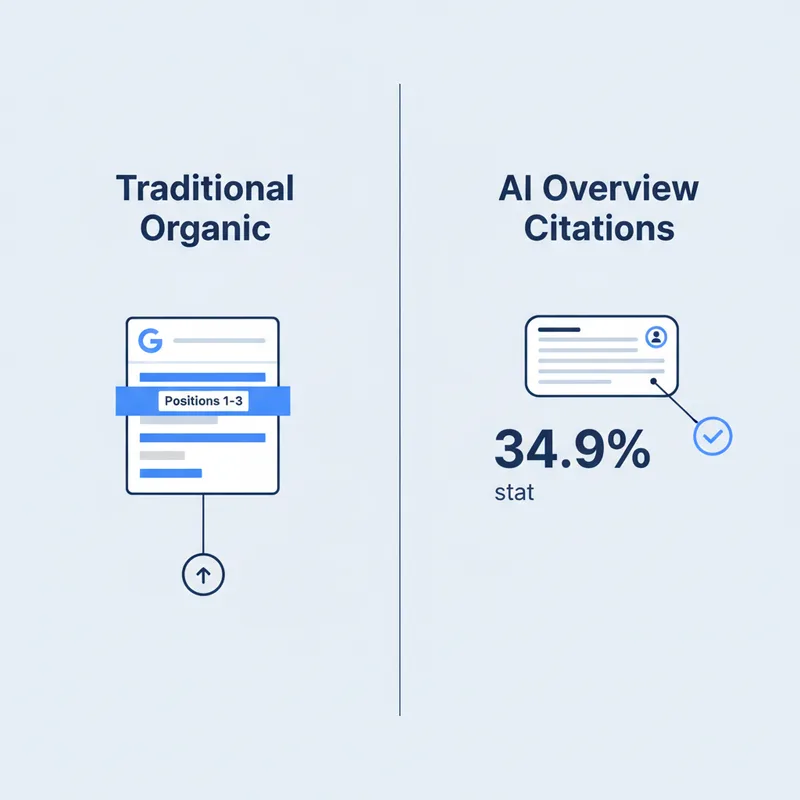
That sounds alarming. The nuance is that AI engines primarily surface content with verifiable citations and direct, structured answers. Research from Authoritas found that content with verifiable citations earns a 34.9% AI citation rate compared to 3.2% without citations. Practices whose websites include structured FAQ sections, cited statistics, and clear answer-first content are more likely to be the source AI Overviews draw from, not less visible, but visible in a different place.
Practical adjustments for AI search compatibility:
- Structure service pages and blog content to answer a specific question in the first paragraph, then elaborate. AI engines extract lead paragraphs at higher rates than buried information.
- Add FAQ schema markup to pages with question-and-answer content. This signals to Google the content is structured for direct answers.
- Cite statistics and sources. Attributed data is treated as more authoritative than unsourced claims by both human readers and AI ranking systems.
- Keep answers concise. According to seoClarity data, AI engines extract 40-60 word answer blocks at 2.7x the rate of longer passages.
AI search doesn't make dental SEO less relevant, it changes the format of content that performs well. Practices that have already built authoritative, well-cited local content are better positioned for AI visibility than those just starting.
How do you build a dental SEO strategy that compounds over time?
The practices that see the strongest long-term SEO returns treat it as a system, not a one-time project. They work on multiple layers simultaneously, technical health, local signals, content, and reviews, rather than focusing on a single tactic and expecting it to carry the full load.
A compounding dental SEO strategy typically follows a phased approach. The first phase addresses technical and local foundations: site speed, mobile usability, GBP completeness, and citation consistency. These set the floor. The second phase builds content depth, service pages, condition guides, FAQ content, that earns rankings for a wider range of patient queries. The third phase focuses on authority: link building, review generation, and structured data that signal trust to both Google and prospective patients.
Each phase reinforces the others. Better content earns more links. More links improve overall domain authority. Stronger domain authority makes new content rank faster. Review volume improves Map Pack placement, which drives more traffic, which generates more reviews. The flywheel builds momentum gradually and then accelerates.
Worth noting: an SEO strategy built on this model takes time to show full results, typically 6 to 12 months before compounding effects become clearly measurable. Practices expecting immediate returns are usually better served by pairing SEO with paid search advertising that delivers visibility while organic authority develops.
The practices that don't see returns from dental SEO usually fall into one of three patterns: they stopped too early (before compounding effects took hold), they focused on a single tactic (content without technical fixes, or links without content), or they never tracked outcomes (and so couldn't tell whether the investment was working or needed adjustment).
If you're evaluating whether a dedicated SEO program is the right fit for your practice, the dental SEO services overview covers the execution model in detail. For practices that want to see how dental SEO connects to the broader set of growth tools available, the DentalBase resources library has supporting guides on attribution, channel mix, and patient acquisition tracking.
SEO is not a shortcut or a quick fix. It's an investment in sustained organic visibility that, built correctly, keeps returning value long after the work is done, and that's exactly the kind of asset a dental practice can grow on.
Dental SEO Services
Want your practice to show up when patients search?
See how DentalBase builds and manages dental SEO programs for practices ready to grow through organic search.
Explore Dental SEO ServicesRelated Reading
- Dental Implant Lead Generation: A Practical 2026 Guide
How implant-focused practices generate qualified leads through organic and paid search. - What a Year of Dental Patient Reviews Actually Taught Me
A practice owner's firsthand account of building a review strategy that sticks. - AI for Dentists: A Practical 2026 Guide to What Works
How AI tools fit alongside SEO in a modern practice growth stack.
See DentalBase in action
Explore how dental practices use DentalBase to track SEO performance, manage reviews, and connect marketing to new-patient bookings.
Sources & References
Frequently Asked Questions
Most practices see measurable movement in local rankings within 3 to 6 months of consistent work. Highly competitive markets may take 6 to 12 months. SEO compounds, early gains build on each other as authority grows.
Yes. Dental SEO layers standard local signals (Google Business Profile, citations, reviews) with healthcare-specific considerations: HIPAA-compliant testimonials, service-page depth, and condition-based content that matches patient research patterns.
A general practice typically targets one primary keyword per page. A full site strategy spans 20 to 60 keywords, service terms, condition terms, and location variants, distributed across dedicated pages and supporting blog content.
Not strictly required, but a blog accelerates authority. Content targeting common patient questions, 'how much does a dental implant cost' or 'what causes tooth sensitivity', captures mid-funnel searchers and builds topical depth Google rewards.
Google Ads delivers immediate visibility but stops the moment the budget runs out. Dental SEO builds sustained organic presence that generates traffic without per-click costs. According to WordStream, organic search converts dental visitors at 3.5% versus roughly 2% for paid, making both worth evaluating based on practice goals.
Reviews are a direct Google Business Profile ranking signal. Practices with more recent, high-star reviews and consistent owner responses tend to rank higher in the Map Pack. A BrightLocal study found 98% of people read local reviews before choosing a business.
Was this article helpful?
Written by
DentalBase Team
Expert dental industry content from the DentalBase team. We provide insights on practice management, marketing, compliance, and growth strategies for dental professionals.