Dental Front Desk vs AI: Hire or Automate? (2026)
Dental front desk vs AI: when a second hire wins, when an AI receptionist wins, and the call-volume threshold that flips the answer.
Share:
Table of contents
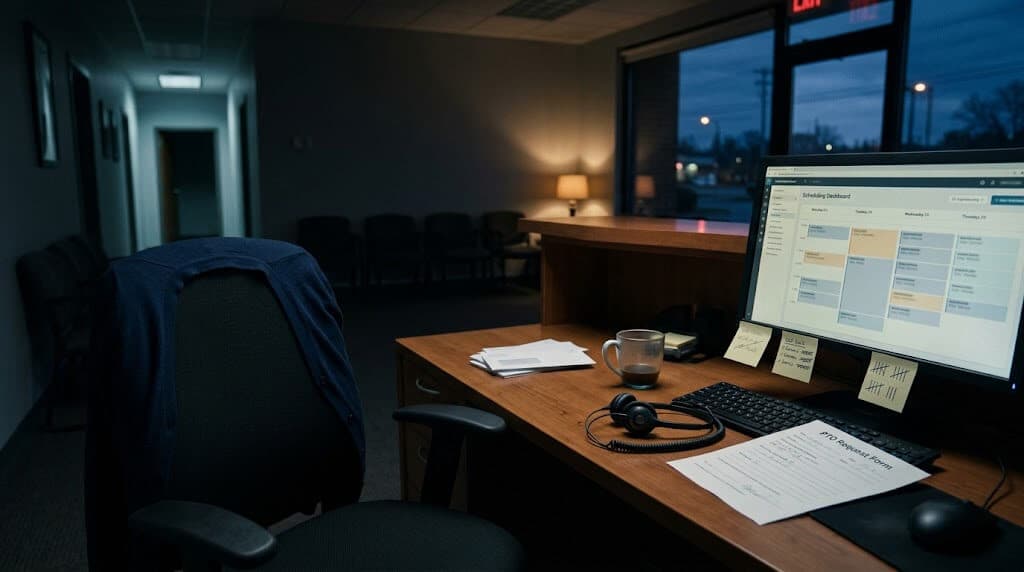
Your front desk is drowning. The phone rings during a hygiene check-in, the insurance company is on hold for a verification, and the next new patient call that comes in goes to voicemail. Sound familiar? That moment is when most owners type "dental front desk vs ai" into a search bar and start weighing the two options.
The choice isn't really hire-or-don't. It's a question of which gap you're solving: hours of coverage, capacity during clinical blocks, or judgment work that needs a human in the room. Get that wrong and you'll either spend $60,000 you didn't need to or save $60,000 by automating something that should have stayed human.
This article walks through the real cost of each option, the tasks that map to each, and the call-volume threshold where the answer flips. By the end, you'll know which one to add first and why.
Dental Front Desk vs AI: Which One Should You Add First?
For most growing dental practices, the answer is AI first, then evaluate. AI receptionists run $300 to $1,200 per month and handle the predictable 70% of phone work, while a second hire costs $52,000 to $72,000 fully loaded and only covers business hours. Below 250 calls per week, AI alone usually closes the gap.
That guidance flips once you cross roughly 350 weekly patient interactions or once your treatment plan presentations and insurance escalations start backing up. At that point, you're past what software handles well, and a second human becomes the better unit of capacity. The middle range, 200 to 350 calls, is where most owners get the answer wrong. We've broken down why most practices miss calls in the first place, and the answer almost always points to capacity, not phone hardware.
Here's the thing nobody tells you. The choice isn't binary. Most practices that get this right end up running both: one human at the desk, plus AI handling overflow, after-hours, and recall outreach. The question isn't "which one." It's "which one first," and that depends on whether your bottleneck is hours of coverage or task complexity. 73% of dental practices plan to adopt AI tools by 2027, but most are still pairing it with at least one human. The AI receptionist ROI math usually pencils out long before the second hire conversation does.
What Does a Second Front-Desk Hire Actually Cost a Dental Practice?
A second front-desk hire costs $52,000 to $72,000 per year fully loaded. Base pay runs $35,000 to $48,000 depending on market, plus 25-30% in benefits, payroll taxes, and PTO. Add 6-12 weeks of ramp time and a roughly $4,000 turnover replacement cost averaged over typical tenure.

Most owners only model base salary, which is why hiring decisions feel cheaper than they are. The fully loaded number includes health insurance contributions, employer payroll taxes, dental and vision benefits if you offer them, paid time off, sick days, training time, and the productivity gap during the first two months when the new hire is shadowing rather than producing. BLS data on receptionist roles puts the median wage around $34,000 nationally, but dental front-desk roles trend higher because of insurance and treatment coordination work.
Then there's turnover. Average tenure for dental front-desk staff sits around 18-24 months. Dental Economics estimates the all-in turnover replacement cost at 30-50% of annual salary once you factor in recruiting, onboarding, and lost production. That's another $12,000 to $18,000 every two years, baked in. Worth modeling honestly before you post the job.
Dig into the full hidden cost stack first
Front-desk costs go far beyond payroll. We broke down every line item, including the ones owners forget to model.
Read the Front-Desk Cost Breakdown →What Does an AI Receptionist Actually Cost (and What Does It Replace)?
An AI dental receptionist costs $300 to $1,200 per month, or $3,600 to $14,400 per year. That's 70-90% less than a second human hire. It answers 100% of calls including the 27% that come in after hours, books appointments, sends reminders, and routes complex calls to your team in real time.
What it replaces is more nuanced. AI handles new patient intake, appointment booking and rebooking, hygiene recall outreach, basic insurance questions ("do you take Delta Dental?"), reminder calls, missed-call text-backs, and after-hours coverage. That's roughly 60-80% of the call volume in a typical practice. 38% of new patient calls go unanswered during business hours at the average practice. AI fixes that without adding a person.
What AI Doesn't Do Well
It struggles with treatment plan presentations where the patient pushes back on cost. It can't handle a complicated insurance appeal where the response depends on knowing your billing manager's relationship with the payer. It doesn't read body language at check-in. And it shouldn't be the only voice a patient hears when they're calling about a clinical emergency at 11pm. Those moments need a human, full stop.
The tasks that almost always belong with a human, not AI:
- In-office check-in and patient flow: managing the lobby, intake forms, and routing to operatories
- Treatment plan presentations: especially $3,000+ cases where financing and emotional reassurance close the deal
- Insurance escalations and appeals: the calls where your billing manager's relationship with the payer matters
- Clinical emergency triage: bleeding, swelling, post-op concerns that need clinical judgment
- Sensitive financial conversations: payment plans, collections, hardship cases
The math gets interesting when you compare specific scenarios. A solo practice doing 180 calls a week with one front-desk person who's overwhelmed: AI alone usually solves it for $500/month. A three-provider practice doing 320 calls a week with two front-desk people who can't keep up: AI plus a third person, not just a third person. Different bottlenecks, different solutions.
When Does a Human Front-Desk Hire Win Over AI?
A human hire wins when the bottleneck is judgment work, not call volume. Treatment plan presentations, insurance escalations, financial arrangement conversations, multi-visit case coordination, and in-office patient management all require context, empathy, and authority that AI doesn't have yet. If your team is overwhelmed during clinical hours specifically with these tasks, hire a human.
Here's a real test. Walk into your front desk on a Wednesday at 2pm and watch what's actually happening. If the existing person is fielding back-to-back insurance verifications, walking patients through treatment plans, and managing check-ins simultaneously, the bottleneck is bodies in the room. AI can't physically check someone in or hand them a clipboard. That's a hire conversation, not a software conversation.
Same logic applies to specialty practices. A perio or implant practice presenting $8,000 treatment plans needs a treatment coordinator who can read the patient, answer financing questions, and close. AI handles the call that books the consultation. The coordinator handles the conversation that converts it. Two different jobs, two different solutions. Front-desk staff who own treatment coordination tend to stay longer too, because the role is more rewarding than pure phone work.
The Multi-Location Caveat
If you're running 3+ locations, hiring "a second front-desk person" usually means hiring three or six. The math changes fast. AI scales horizontally at near-zero marginal cost, while human hires scale linearly. Multi-location groups almost always lead with AI and then layer humans where complexity demands it. Solo and small group practices have more flexibility on the sequence.
When Does AI Win Over a Second Hire?
AI wins when the bottleneck is hours of coverage, predictable task volume, or after-hours leakage. If 27% of your call volume hits outside business hours, no second hire fixes that. If your team is fine until lunch and during huddles, AI fills those gaps for $500/month. If your problem is missed calls and voicemail, AI is purpose-built for that.
The clearest indicator is your missed-call rate during the day. If 15-20 calls per week are going to voicemail and you can hear the phone ringing during clinical hours from down the hall, that's an overflow problem, not a "we need another person at the desk all day" problem. Forbes reported that 80% of callers who reach voicemail don't leave a message and don't call back. Every one of those is a lost patient, and a single missed new patient call represents $1,200+ in lifetime value walking out the door.
After-hours is the other obvious AI win. A new patient who searches "dentist near me" at 8pm and reaches voicemail is gone by morning. The only way to capture them is to answer when they call. No reasonable hire is staffing your phones at 8pm, but AI does it for the same flat monthly fee. That's the whole conversion case for an AI-front phone model, and it's why after-hours revenue capture has become the easiest ROI conversation in dental ops.
See how AI handles your call overflow before you hire
DentalBase AI Receptionist answers every call, books appointments, and routes complex cases to your team. Run a 60-day pilot before you commit to a second hire.
See AI Receptionist →The Call-Volume Threshold: A Decision Framework
Use weekly patient call volume as your primary input. Below 200 calls, AI alone usually wins. Between 200-350 calls, layer AI on one human. Above 350 calls, you need both AI and a second human, or AI plus a treatment coordinator. The exact threshold shifts based on after-hours volume, complexity, and clinical mix, but the bands hold for most general practices.
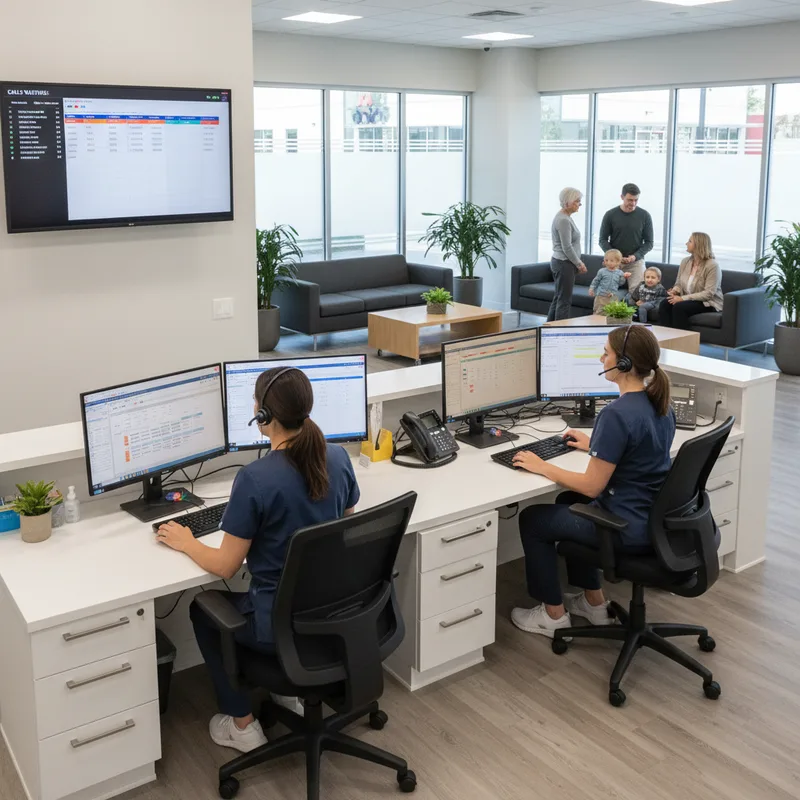
Here's the framework laid out side by side. Use it as a starting point, not a rulebook. Your specific patient mix, insurance contracts, and team setup will move the lines.
| Weekly Call Volume | Best Add | Why | Annual Cost |
|---|---|---|---|
| Under 150 | AI only | One person can handle the day; AI catches overflow and after-hours | $3,600-$6,000 |
| 150-250 | AI first, evaluate at 90 days | Pilot reveals whether the gap is volume or task complexity | $6,000-$10,000 |
| 250-350 | AI + 1 human (most cases) | AI handles predictable volume; human handles judgment work | $58,000-$80,000 |
| 350-500 | AI + 2 humans, one coordinator | Treatment plan and insurance work needs dedicated capacity | $110,000-$155,000 |
| 500+ | AI + tiered front-desk team | Specialize roles: scheduling, insurance, treatment coordination | $165,000+ |
Before you commit either way, run a 60-90 day AI pilot. That window covers a full insurance cycle and at least one slow week. Track three numbers: answered call rate, booking conversion rate, and after-hours capture. If after-hours capture jumps and your team still feels underwater during the day, you have a hire conversation. If the numbers improve and the team breathes again, AI was the answer.
Final Word: It's Almost Never One or the Other
The dental front desk vs AI debate frames the question wrong. The real question is sequencing. AI is the lower-risk, lower-cost first move that tells you what gap actually exists. A second hire is the higher-cost, higher-judgment move you make once the data justifies it.
Owners who hire first and add AI later usually overspend by $30,000 to $60,000 in the first year. Owners who add AI first, measure for 90 days, and then hire only if the data demands it tend to land on the right team size with the right tools. Cheaper, faster, and easier to reverse if you got it wrong.
If you're sitting on the fence, start with the smaller bet. Pilot AI for a quarter, watch the numbers, then decide. Most owners I talk to who ran the pilot ended up not hiring the second person, or hired a treatment coordinator instead of another phone-answerer. The role that got cut was the one they didn't actually need; the role they kept was the one that drove revenue. Frame the decision that way and the dental front desk vs AI question stops being scary and starts being a math problem.
One more practical note. Whoever you add, human or AI, measure the same numbers: answered call rate, booking rate, after-hours capture, and same-week conversion to a kept appointment. Scoring every call is the only way to know if either solution is actually working, and most practices skip it.
See the dental front desk vs AI math on your own numbers
Book a free demo. We'll plug your weekly call volume into the framework and show you exactly which gap an AI receptionist closes for your practice.
Book a Free Demo →More tools and guides for dental practice owners
Browse Resources →Sources & References
Frequently Asked Questions
A dental front desk hire is a salaried team member who handles patient interactions, insurance work, and treatment coordination in person. An AI receptionist is software that answers phones around the clock, books appointments, and routes complex calls to your team. Both fix the dental front desk vs AI capacity problem differently.
Most practices benefit from a second front-desk hire once weekly call volume exceeds 250 to 300 patient interactions, assuming the existing team is already maxed on insurance verifications and treatment plan coordination. Below that range, AI usually closes the gap at a fraction of the cost.
An AI receptionist replaces 60-80% of routine front-desk phone work, including new patient intake, appointment booking, and reminders. It does not replace insurance verification edge cases, treatment plan presentations, or in-office check-in. Most practices pair AI with one human, not zero.
A second front-desk hire runs $52,000 to $72,000 per year fully loaded. Base salary is $35,000 to $48,000, plus 25-30% in benefits, payroll taxes, and PTO, plus 6-12 weeks of ramp time and roughly $4,000 in average turnover replacement cost.
Yes. AI receptionist pricing ranges from $300 to $1,200 per month, or $3,600 to $14,400 per year. That is 70-90% cheaper than a second human hire and covers nights, weekends, and lunch breaks. The dental front desk vs AI cost gap widens as call volume grows.
In-office check-in, treatment plan presentations, financial conversations, insurance appeals, complex scheduling for multi-visit cases, and emergency triage where clinical context matters. AI handles the predictable 70%; humans handle the judgment 30% that drives revenue.
Run a 60-90 day pilot. That window captures full insurance cycles, hygiene recall waves, and at least one slow week. Track answered call rate, booking rate, and after-hours capture. The data tells you whether the gap is hours-of-coverage or capacity-during-the-day.
Was this article helpful?
Written by
DentalBase Team
Expert dental industry content from the DentalBase team. We provide insights on practice management, marketing, compliance, and growth strategies for dental professionals.