
Doctor Marketing Strategies That Actually Bring in Patients
Doctor marketing strategies that work for dental practices in 2026. Learn how to attract new patients with SEO, referrals, reputation, and paid ads.
Share:
Table of contents
Doctor marketing strategies don't follow the same playbook as selling shoes or SaaS subscriptions. Your patients aren't impulse buyers. They're researching, reading reviews, asking friends, and calling your office before they ever sit in your chair. That process takes days or weeks, and if your marketing doesn't match how people actually find and choose a dentist, you're spending money without filling chairs.
This article breaks down the strategies that move the needle for dental practices in 2026, from the digital channels worth your budget to the offline tactics most owners overlook. You'll walk away with a channel-by-channel framework, budget benchmarks, and a clear picture of what separates practices that grow from those that stall.
What Makes Doctor Marketing Strategies Different From Other Industries?
Healthcare marketing operates under constraints that most industries don't face. HIPAA limits how you can use patient data in advertising, the ADA has guidelines around claims and testimonials, and your audience makes decisions based on trust rather than price alone. These factors demand a marketing approach built specifically for healthcare.
Think about how a patient actually finds you. According to Pew Research, 71% of people looking for a dentist run a search before scheduling. They type "dentist near me" into Google, scan the local pack, read three or four reviews, check your website, and then call. That's five touchpoints before a single conversation happens. Miss any one of them, and you've lost the patient to the practice down the street.
Retail marketing can push discounts and urgency. Healthcare can't. A patient choosing a doctor isn't swayed by a 20%-off coupon the way they'd grab a deal on headphones. They want proof that you're competent, trustworthy, and convenient. Your marketing has to build that proof across every channel, from your website design to how your front desk answers the phone.
The Trust-First Buying Cycle
According to Software Advice, 77% of patients use online reviews when finding a dentist. That's not just a nice-to-have metric. It means your reputation is your top-of-funnel, whether you manage it or not. A practice with 200 Google reviews and a 4.8 rating doesn't need to outspend the competition on ads. The reviews do the selling.
The other thing that separates healthcare marketing? Locality. According to Google, 46% of all Google searches seek local information, and "dentist near me" generates 1.2 million searches monthly in the US alone. Your marketing strategy has to be built around your zip code, not your state or country.
Which Digital Channels Drive the Most New Patients?
Local SEO and Google Business Profile drive the highest-intent traffic for dental practices, followed by paid search and social media. Each channel serves a different stage of the patient journey, and the practices that grow fastest are the ones matching their spend to how patients actually search.
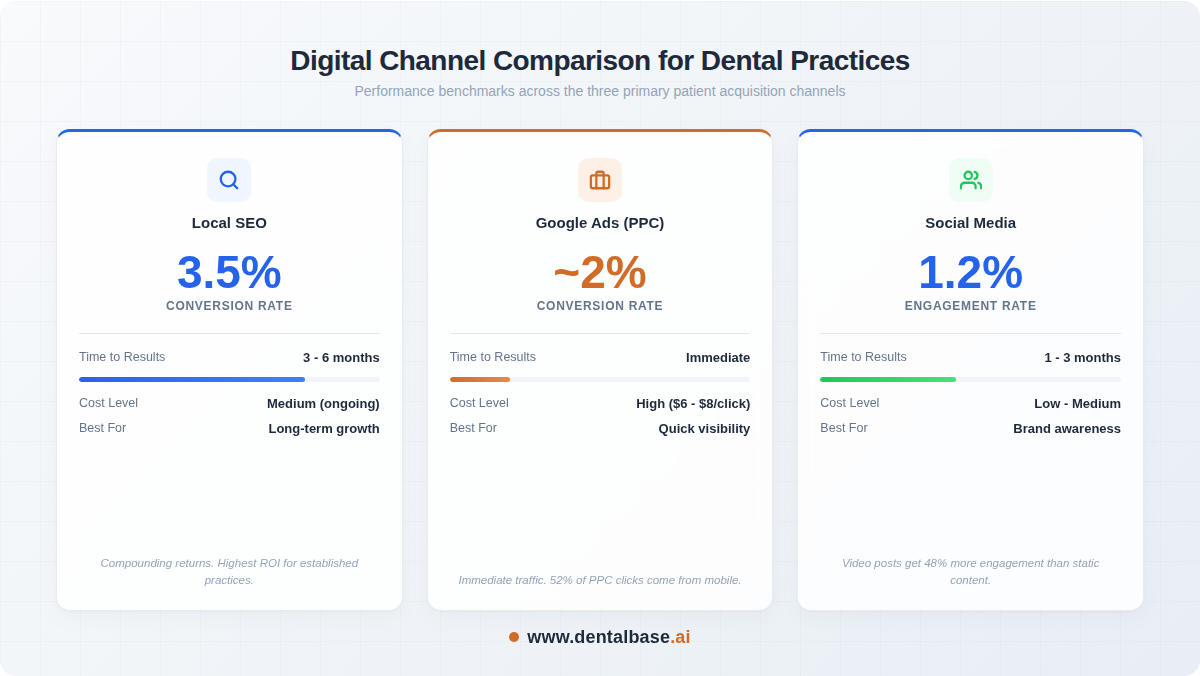
Here's what the data says. According to BrightEdge, 68% of all online experiences start with a search engine. For dental specifically, organic search converts at about 3.5% according to WordStream, while paid search converts just under 2%. That gap matters when you're spending $6-$8 per click on dental keywords.
| Channel | Avg. Conversion Rate | Time to Results | Cost Level |
|---|---|---|---|
| Local SEO | 3.5% | 3-6 months | Medium (ongoing) |
| Google Ads (PPC) | ~2% | Immediate | High ($6-$8/click) |
| Social Media | 1.2% engagement | 1-3 months | Low-Medium |
| Email Marketing | $44 return per $1 | 1-2 months | Low |
| Google Business Profile | 35% more clicks | 2-4 weeks | Free |
SEO vs. PPC: Where to Start
If you're a new practice or just starting to invest in marketing, Google Ads gives you immediate visibility while SEO builds momentum. But here's the thing: paid search drives about 35% of traffic for dentists, and 52% of those PPC clicks come from mobile devices. That means your landing pages need to load fast and convert on a phone screen, or you're paying for clicks that don't turn into calls.
SEO takes longer but compounds. A blog post that ranks for "dental implant cost" today will bring in patients for years without additional ad spend. That's why the smartest practices pair short-term PPC with long-term keyword targeting through content.
Want Your Practice to Show Up When Patients Search?
DentalBase's dental SEO service is built specifically for practices that want to rank in local search and the Google Map Pack.
Learn About Dental SEO →How Do Referral Programs Fit Into a Doctor Marketing Strategy?
Physician-to-physician and patient referral programs remain one of the lowest-cost acquisition channels for dental practices, yet most offices run them informally or not at all. A structured referral system turns your happiest patients and your professional network into a predictable source of new appointments.
Consider a general dentist who builds relationships with three local orthodontists, two oral surgeons, and a pediatrician. Each of those providers sees patients who need general dental care, and a warm referral from a trusted doctor closes faster than any Google ad. The patient shows up already trusting you because someone they trust made the introduction.
Patient referrals work the same way but at a different scale. A three-provider practice seeing 40 patients per day has 200 potential referral conversations per week. Even if just 5% of those patients refer a friend or family member, that's 10 new patient leads per week at zero ad cost. But you won't see those numbers unless you ask, track, and follow up.
Building a Referral System That Scales
The practices that get referrals consistently do three things: they ask at the right moment (post-treatment, when satisfaction is highest), they make it easy (a card, a text link, or a QR code), and they track every referral back to its source. That last piece is where most practices fall short. If you don't know which referring doctor or patient sent someone your way, you can't nurture that relationship or measure ROI.
This is where marketing attribution becomes critical. Knowing that Dr. Patel's orthodontic office sent you 14 patients last quarter lets you send a thank-you, strengthen that relationship, and double down on what's working. Without attribution, referrals feel random. With it, they become a repeatable channel.
Related: Learn how to connect every new patient back to the marketing channel that brought them in. → From Google Ad to Filled Chair: How Connected Systems Close the Loop
Why Does Online Reputation Control Your Patient Pipeline?
Online reputation is the single most visible trust signal in any marketing plan for doctors. According to BrightLocal, 98% of people read local reviews before choosing a business, and 88% say they're likely to use a business if the owner responds to all reviews. Your star rating and review volume are doing more selling than your website copy.
Here's what makes reputation so powerful for dental practices specifically. A patient searching "dentist near me" sees the Google local pack first, which prominently displays your star rating, review count, and most recent reviews. Google's algorithm uses review signals as a ranking factor for local results. So your reputation doesn't just influence whether someone clicks on your listing. It affects whether your listing shows up at all.
Review Volume Matters More Than Perfect Scores
A practice with 350 reviews at 4.7 stars will outperform a practice with 12 reviews at 5.0 stars every time. Patients are skeptical of perfect ratings anyway. What they want is volume, recency, and proof that you respond to feedback. According to Software Advice, 77% of patients use online reviews when finding a dentist, and they pay attention to how the practice handles negative ones.
That said, don't just chase reviews passively. The practices with strong reputations have a system: they ask every patient after a positive visit (via text or email), they respond to every review within 48 hours, and they flag negative reviews for the office manager to address personally. It's not glamorous work. But it compounds.
Connecting Reputation to Revenue
According to Dental Economics, the average patient lifetime value for a general dentist runs between $12,000 and $15,000. If a strong reputation brings in even five additional patients per month that you wouldn't have gotten otherwise, that's $60,000-$75,000 in lifetime value added each month. For a marketing channel that costs almost nothing to maintain, that's hard to beat.
See How DentalBase Connects Marketing to Revenue
From SEO and ads to call tracking and attribution, DentalBase shows you exactly which channels produce patients.
Book a Free Demo →How Should You Allocate Your Marketing Budget Across Channels?
Most dental practices spending $3,000-$8,000 per month on marketing should split their budget across SEO, paid search, and reputation management, with the exact ratio depending on their growth stage and local competition. There's no universal formula, but there are clear patterns that separate practices growing at 15% per year from those that plateau.
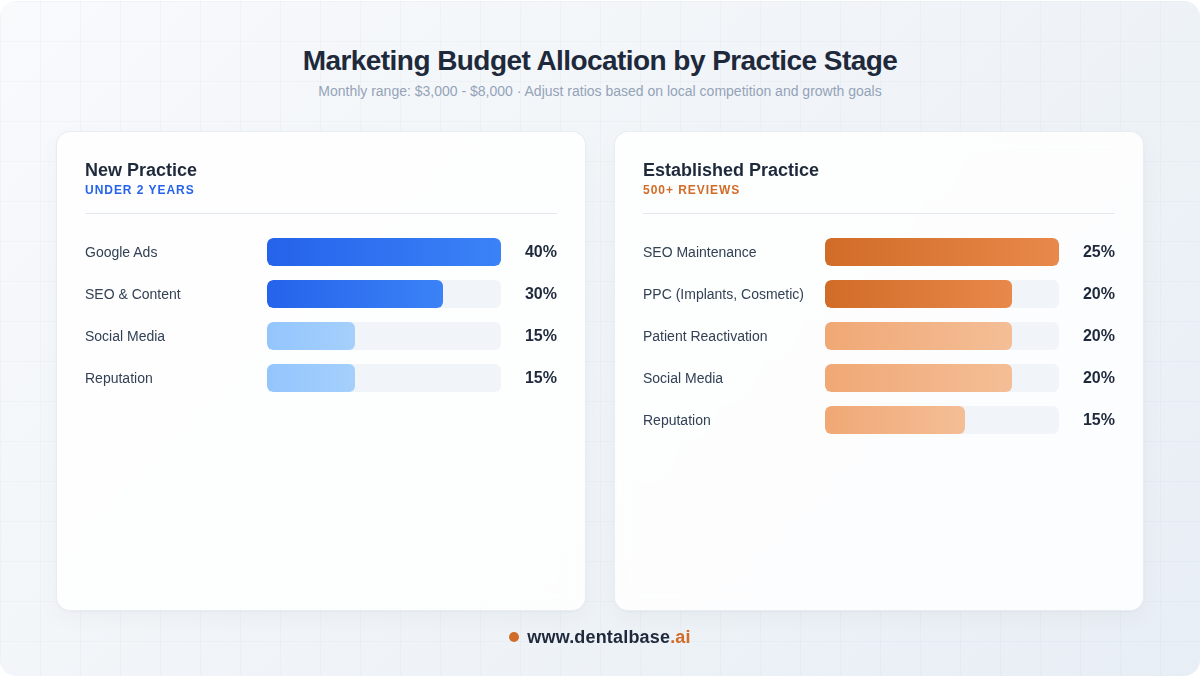
A newer practice (under two years, still building a patient base) typically needs heavier PPC investment because organic rankings take time. A reasonable split might look like 40% Google Ads, 30% SEO and content, 15% social media, and 15% reputation management and patient communication. As your SEO gains traction and your review count grows, you can shift budget away from paid search toward content and retention.
What Established Practices Should Prioritize
An established practice with 500+ Google reviews and page-one rankings for key terms is in a different position entirely. Here, the biggest ROI often comes from retention and reactivation rather than new patient acquisition. According to the ADA, 20-30% of patients become inactive within 18 months without follow-up. Reactivating those patients costs 5-7 times less than acquiring new ones, according to Harvard Business Review research on customer retention economics.
For established practices, a smarter split might be 25% SEO maintenance and content, 20% PPC (focused on high-value procedures like implants and cosmetic), 20% patient reactivation and recall, 20% social media and community presence, and 15% reputation management.
The Budget Mistake That Costs the Most
The single most expensive mistake isn't overspending on a channel. It's spending on any channel without knowing what it produces. According to Dental Economics, the average cost to acquire a new dental patient through digital channels runs $150-$300. If you're spending $5,000 per month on marketing but can't tell whether those dollars produced 15 new patients or 50, you're flying blind. That's why practices using proper marketing attribution consistently outperform those relying on gut feel.
Not Sure If Your Marketing Budget Is Working?
DentalBase tracks every patient from first click to filled chair so you know exactly where your money goes.
Explore DentalBase Services →What Doctor Marketing Strategies Fail Most Often (and Why)?
The most common doctor marketing strategy failures come from spreading budget too thin across channels, ignoring phone conversion, and not tracking which marketing source produced each patient. These three mistakes quietly drain thousands of dollars per month from practices that otherwise have strong clinical reputations.
Spreading thin is the classic trap. A practice owner hears they need SEO, Google Ads, Facebook, Instagram, TikTok, email, direct mail, and a podcast. So they allocate $500 to each and get results from none. Every channel has a minimum effective dose. For Google Ads targeting dental keywords at $6-$8 per click, a $500 monthly budget gives you roughly 65-80 clicks. At a 2% conversion rate, that's one or two new patients. Not enough to justify the management overhead.
The Missed Call Problem Nobody Talks About
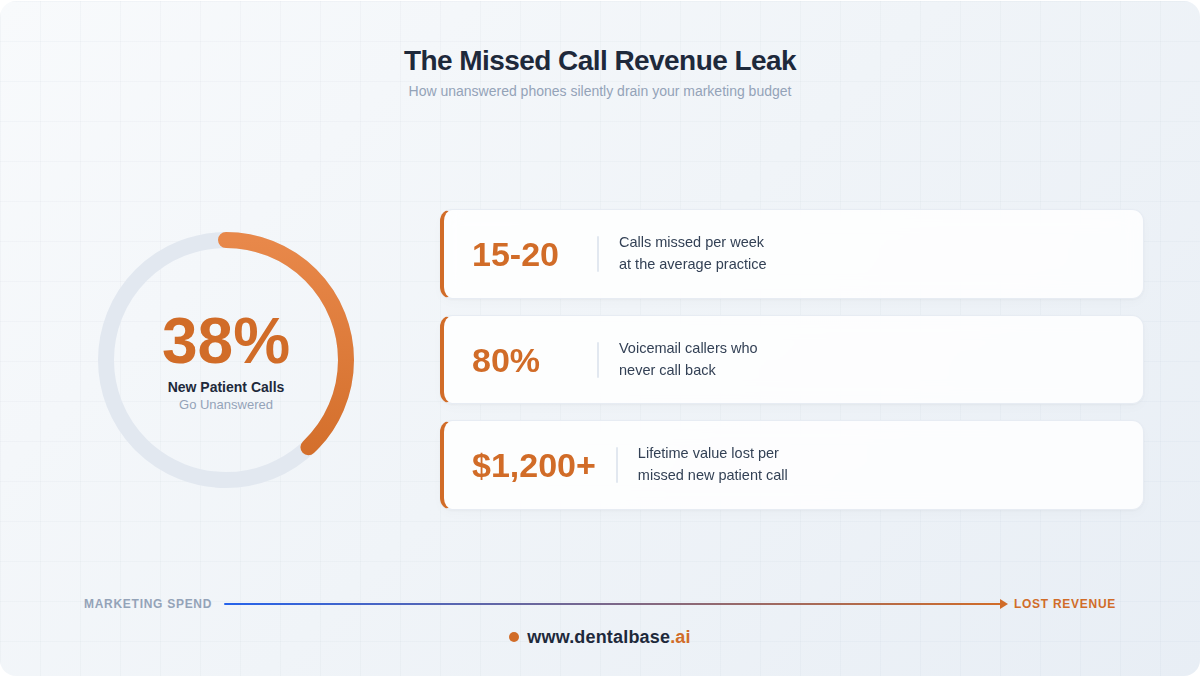
Here's the thing most marketing agencies won't mention. According to ADA Practice Transitions, 38% of new patient calls go unanswered during business hours. The average dental practice misses 15-20 calls per week, according to Dental Economics. And 80% of callers who reach voicemail don't leave a message and won't call back, according to Forbes.
So you could have the best advertising strategy in your market, driving hundreds of calls per month, and still lose a third of those potential patients because nobody picked up the phone. That's not a marketing problem. It's an operations problem that marketing budgets pay for. Practices solving this gap with AI receptionist technology or dedicated call staff see immediate improvements in patient acquisition without increasing ad spend.
Vanity Metrics vs. Revenue Metrics
The other failure pattern is measuring the wrong things. Social media impressions, website traffic, and email open rates feel good in a monthly report. Worth tracking? Sure. But they don't tell you whether your marketing produced patients. The only metrics that matter for doctor marketing strategies are: new patient calls by source, booked appointments by channel, cost per acquired patient, and patient lifetime value by acquisition channel. Everything else is context, not a KPI.
Your practice needs to connect the dots from ad click to phone call to scheduled appointment to completed treatment. Without that chain, you're guessing. And guessing gets expensive when your digital marketing strategy is running across four or five channels simultaneously.
The practices that win at marketing in 2026 aren't necessarily the ones with the biggest budgets. They're the ones who know exactly what each dollar produces, who answer every call, and who build their strategy around how patients actually search and decide. Doctor marketing strategies work when they're built on data, not assumptions. Start by auditing your current channels, fixing your phone answer rate, and tracking attribution across every patient touchpoint. That foundation alone will outperform most of your competitors.
Ready to See Which Marketing Channels Actually Produce Patients?
DentalBase connects your SEO, ads, calls, and appointments into one dashboard so you can stop guessing and start growing.
Book a Free Demo →Explore more guides and tools for dental practice growth.
Browse Resources →Sources & References
Frequently Asked Questions
Most dental practices invest $3,000-$8,000 per month across digital marketing channels. The exact amount depends on your market's competition, growth goals, and whether you're a newer or established practice. Newer practices often lean heavier on paid search for immediate visibility.
Local SEO and Google Business Profile consistently deliver the highest-intent patients for dental practices. Organic search converts at about 3.5% for dental, and optimizing your Google Business Profile can increase website clicks by 35%. PPC supplements SEO with immediate visibility.
Healthcare marketing must account for HIPAA compliance, ADA guidelines on advertising claims, a trust-first patient decision cycle, and hyper-local search intent. Patients research providers for days or weeks before booking, unlike impulse-driven retail purchases.
The biggest leak is unanswered phone calls. According to industry data, 38% of new patient calls go unanswered during business hours, and 80% of callers who reach voicemail never call back. Fixing phone answer rates often improves patient acquisition more than increasing ad spend.
Yes. Physician-to-physician and patient referral programs are among the lowest-cost acquisition channels for dentists. A structured system that asks patients at the right moment, makes referring easy, and tracks every referral source can generate 10 or more new patient leads per week at zero ad cost.
According to BrightLocal, 98% of people read local reviews before choosing a business. Google also uses review signals as a local ranking factor. A practice with 350 reviews at 4.7 stars will consistently outperform one with 12 reviews at a perfect 5.0 rating.
Focus on revenue metrics over vanity metrics. Track new patient calls by source, booked appointments by channel, cost per acquired patient, and patient lifetime value by acquisition channel. Impressions, website traffic, and social media followers provide context but don't measure actual patient growth.
Was this article helpful?
Written by
DentalBase Team
Expert dental industry content from the DentalBase team. We provide insights on practice management, marketing, compliance, and growth strategies for dental professionals.