AI Dental Patient Reactivation: 2026 Complete Guide
AI dental patient reactivation brings inactive patients back automatically. PMS integration, channel strategy, HIPAA rules, and ROI math inside.
Share:
Table of contents
What Is AI Dental Patient Reactivation and How Does It Work?
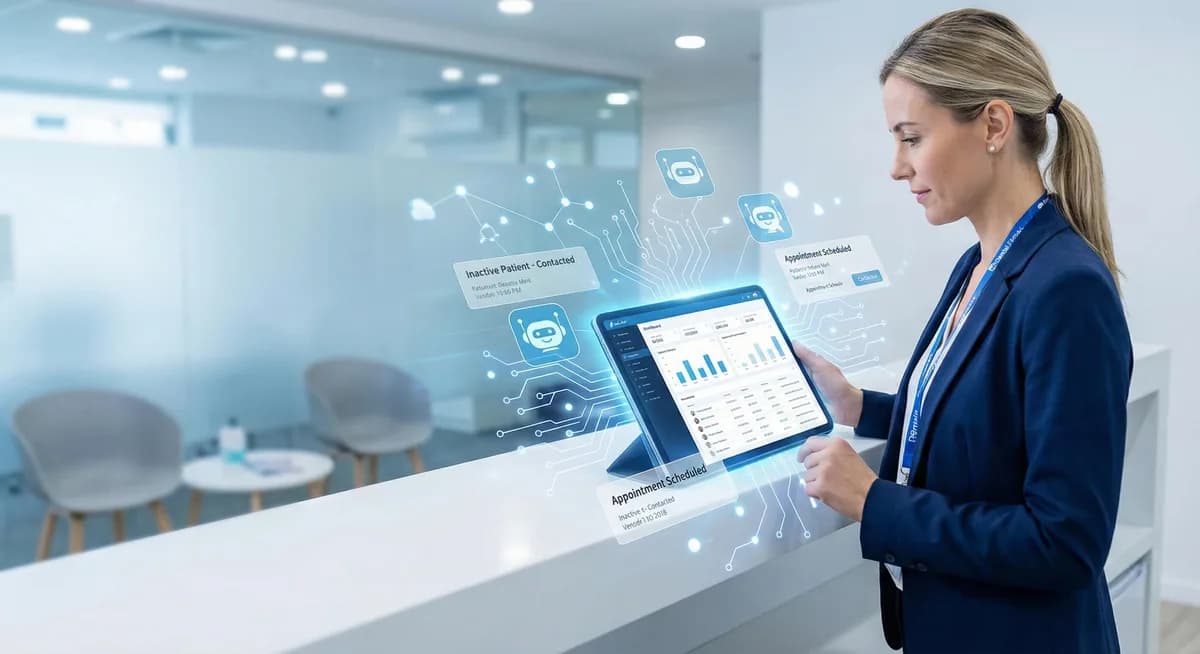
AI dental patient reactivation is an automated system that identifies patients who haven't visited within a defined period, typically 6-18 months. The AI scores each patient by likelihood of return, then runs personalized multi-channel outreach to bring them back without staff building lists or making manual follow-up calls.
The AI Reactivation Pipeline
STAGE 1
Identify
Flag patients past recall interval (6-18 months)
STAGE 2
Score
Rank by return likelihood: history, treatment, distance, insurance
STAGE 3
Outreach
Personalized SMS, email, or AI phone via preferred channel
STAGE 4
Convert
Handle responses, book appointment, send reminders
Runs continuously from PMS data. No manual list management.
The four-stage pipeline
The system runs in four continuous stages. Stage one flags patients who have exceeded their recall interval. Stage two scores each patient by return probability based on visit history, last treatment type, insurance status, and distance from the practice. Stage three sends personalized messages through the patient's preferred channel. Stage four handles responses, schedules the appointment, and sends confirmations. The AI adapts based on response data, learning which messages, timing, and channels work best for different segments in your specific market.
Integration with practice management software
The AI connects directly to your PMS through an API integration. It reads appointment history, treatment plans, recall schedules, contact information, and insurance data in real time. That matters. When a patient crosses the inactivity threshold, they automatically enter the reactivation pipeline. When they book an appointment, they automatically exit. No manual list management required. Reactivated patients should also enter your Google review collection workflow immediately to capture fresh reviews from their return visit. Systems like the DentalBase AI receptionist include this PMS integration natively.
Reactivate inactive patients without adding staff
DentiVoice identifies inactive patients, sends personalized outreach across SMS, email, and phone, and books appointments directly into your PMS.
Book a Free Demo →Which Outreach Channels Drive the Highest Reactivation Rates?
AI dental patient reactivation uses multiple channels in sequence because different patients respond to different communication methods. Channel performance varies by the patient's age, past communication history, and how long they've been inactive. A layered approach combining SMS, AI phone outreach, and email consistently outperforms any single-channel campaign.
| Channel | Best For | Response Rate | Reactivation Rate |
|---|---|---|---|
| SMS | 6-12 month inactive, ages 25-55 | 30-45% | 15-22% |
| AI phone call | 12-18 month inactive, ages 40+ | 15-25% | 18-28% |
| Recently inactive, all ages | 15-25% | 8-15% |
SMS reactivation
SMS is the highest-response channel for patients inactive 6-12 months. Keep messages under 160 characters with the patient's first name, practice name, and a direct booking link or reply option. "Hi [Name], it's been a while since your last visit at [Practice]. We'd love to see you. Reply YES to book or tap here: [Link]." The conversational AI handles responses, answers questions about insurance or availability, and schedules the appointment. Send during business hours, 10am to 2pm on weekdays, for highest open rates. According to BrightLocal, 98% of consumers use the internet to find local businesses, so patients who receive your text while browsing their phone are primed to act.
AI phone outreach
AI phone calls convert the highest percentage of long-inactive patients, 12-18 months out, because voice creates a personal connection that text channels cannot. The AI identifies itself, references the patient's last visit, mentions any outstanding treatment plans, and offers convenient booking times. It handles objections like "I changed insurance" by checking accepted providers, "I moved" by offering to help find a practice if too far, and "I've been meaning to call" by booking immediately. Practices already using AI reception for inbound calls can extend the same system to outbound reactivation. See how AI reception handles the 38% of calls that go unanswered.
Email reactivation
Email works best as the first touchpoint for recently inactive patients (6-8 months) and as a follow-up channel for patients who didn't respond to SMS. Subject lines referencing the patient's name and time elapsed perform best: "We miss seeing you, [Name]" or "[Name], it's been 8 months since your last cleaning." Include a prominent booking button and one specific reason to return: an outstanding treatment plan, an upcoming insurance deadline, or a seasonal promotion. Use Google Analytics 4 UTM parameters on all email links to track which reactivation campaigns drive the most bookings. Layer email with your broader patient retention strategies for compounding reach.
Related: See the exact message copy for each segment. → Dental Patient Reactivation Campaigns: What to Say
How Do You Segment Patients and Personalize Reactivation Messages?
Not all inactive patients should receive the same message. The system achieves higher conversion by segmenting patients on two dimensions: how long they've been away and what treatment history they have. Segment-matched messaging converts 2-3x higher than generic "we miss you" outreach, which is why thoughtful segmentation is the single biggest lever in any reactivation campaign.
Segmentation by inactivity duration
- 6-9 months (warm): These patients likely intend to return but haven't gotten around to booking. Light-touch outreach works: a friendly reminder with a direct scheduling link. "It's been a few months since your last visit. Ready to schedule your next cleaning?" Conversion rates for this segment are 20-30%.
- 9-15 months (cooling): These patients need a specific reason to return. Reference outstanding treatment plans, insurance benefits expiring at year-end, or new services the practice now offers. Conversion rates drop to 12-20%.
- 15-24 months (cold): These patients have likely moved on mentally. AI phone outreach works best here because it feels more personal. Offer a special reactivation incentive if possible, such as a complimentary exam for returning patients. Conversion rates: 5-12%.
- 24+ months (dormant): Low probability of return. A single email or SMS is worth the minimal effort, but don't allocate significant resources. Conversion rates: 2-5%.
Segmentation by treatment history
Patients with incomplete treatment plans are the highest-value reactivation targets. A patient who was diagnosed for implants or crown work but never scheduled represents thousands in accepted but unscheduled production. Big difference. The AI references their specific treatment: "Hi [Name], we noticed your implant consultation from last year was never scheduled. We'd love to help you complete that treatment." This specificity converts 2-3x higher than generic messaging. Pair treatment-based reactivation with your dental recall system so reactivated patients enter retention immediately.
Related: Reactivation only holds if your retention system catches returning patients. → Dental Patient Retention: The Complete Guide
What Compliance Rules Govern AI Patient Reactivation?
Running automated patient outreach at scale requires compliance across three overlapping frameworks. Violations carry significant financial and legal consequences, including per-message fines and potential class-action exposure. Every practice deploying an AI reactivation system needs written policies covering consent capture, opt-out handling, and PHI transmission before the first campaign goes live.
- HIPAA: All patient data processed by the AI system (names, contact information, treatment history, appointment records) constitutes protected health information. The AI platform must have a signed Business Associate Agreement. Messages referencing treatment details must be transmitted through secure, encrypted channels. Fines reach $50,000 per violation.
- TCPA: The Telephone Consumer Protection Act regulates automated calls and texts. Patients must have provided prior express consent for automated messages. Include opt-out instructions in every text ("Reply STOP to unsubscribe"). Maintain an up-to-date do-not-contact list. Violations carry penalties of $500-1,500 per unsolicited message.
- State regulations: Some states have additional telemarketing and patient communication requirements. California's CCPA and state-level health privacy laws may impose restrictions beyond federal requirements. Consult legal counsel for multi-state practices.
Your AI platform should handle compliance automatically: encrypting all PHI in transit and at rest, logging consent records, honoring opt-out requests within 24 hours, and restricting outreach to patients with documented consent. Never send reactivation messages to patients who have formally requested transfer of records to another provider. The same compliance standards apply whether you're reactivating patients or collecting patient reviews.
HIPAA-compliant AI reactivation built for dental
DentiVoice handles patient identification, multi-channel outreach, scheduling, and compliance in one platform with BAA coverage and encrypted PHI handling.
Book a Free Demo →How Do You Measure Reactivation ROI and Optimize Over Time?
AI dental patient reactivation generates measurable revenue that justifies ongoing investment, but only if you track the right metrics. Review these five numbers monthly to prove ROI to ownership and spot which segments or channels need attention. Without measurement, campaigns drift and results stall. With it, you get a continuous feedback loop that compounds results quarter over quarter.
Reactivation vs New Patient Acquisition
Reactivation
$5-15
cost per reactivated patient
$300-800 first-visit revenue
60-70% 12-month retention
10-20x campaign ROI
New Patient Acquisition
$150-300
cost per new patient
$200-500 first-visit revenue
40-55% 12-month retention
2-4x campaign ROI
Reactivated patients convert at lower cost and retain longer than new acquisitions.
| Metric | Target | Why It Matters |
|---|---|---|
| Reactivation rate | 15-25% of contacted | Primary effectiveness measure |
| Cost per reactivation | $5-15 | Compare to $150-300 new patient acquisition cost |
| Revenue per reactivated patient | $300-800 first visit | Reactivated patients often have treatment backlog |
| 12-month retention | 60-70% | Measures whether reactivation sticks long-term |
| Campaign ROI | 10-20x | Revenue generated vs total platform cost |
The ROI math on a real practice
Take a three-provider practice with 2,400 active charts and roughly 300 patients past their 9-month recall. Running AI reactivation at 20% conversion brings back 60 patients. At $500 average first-visit revenue (cleaning, exam, and whatever immediate treatment surfaces), that's $30,000 recovered in a single campaign cycle. Platform costs run around $500 per month. The ROI sits at 60x. Even at conservative 10% conversion with $300 average revenue, 30 patients generate $9,000 against $500 in platform costs. No other dental marketing channel comes close, because you're reaching patients who already chose your practice once. And each reactivated patient who leaves a Google review strengthens your local SEO profile. Moz ranks review signals among the top 3 local ranking factors, so reactivation feeds both revenue and discoverability.
Monthly optimization
Review segment-level conversion rates on the first Monday of each month. If warm patients (6-9 months) are converting below 20%, test new message copy or send timing. If cold patients (15-24 months) show zero response to SMS, shift that segment to AI phone outreach. Test one variable per segment per month for clear cause-and-effect data. After 3-4 cycles, you'll know exactly which channels and messages work for each patient segment in your specific market. Connect reactivation data to your no-show reduction playbook and social media management for an integrated patient growth system.
The revenue hidden in your inactive patient list is almost always larger than the next ad campaign you're about to fund. The reactivation system identifies patients automatically from your PMS, segments by inactivity duration and treatment history, runs outreach across SMS, AI phone, and email, handles scheduling without staff involvement, and keeps HIPAA and TCPA compliant throughout. Start small. Run your first campaign on the warm segment, 6-9 month inactive patients via SMS, and that single effort typically recovers $5,000-15,000 in first-visit revenue within 30 days. Layer in AI phone outreach for the cooling and cold segments over the next 60 days. Within a quarter, you'll have a continuous reactivation engine that prevents patient attrition from eroding practice growth. For practices connecting reactivation to ad campaigns, review generation, and social media campaigns, DentalBase integrates every patient touchpoint into one AI-powered growth platform.
Bring back inactive patients on autopilot
DentiVoice identifies, contacts, and schedules inactive patients automatically with HIPAA-compliant multi-channel outreach.
Book a Free Demo →Explore more guides and tools for dental practice growth.
Browse Resources →Frequently Asked Questions
AI dental patient reactivation is an automated system that identifies inactive patients from your PMS, scores them by likelihood of return, and sends personalized outreach across SMS, email, and AI phone calls. The goal is to bring patients back without staff manually building lists or making calls.
A typical practice reactivates 15-25% of contacted patients at $300-800 first-visit revenue each. For a practice with 300 inactive patients, that's $15,000-60,000 in recovered revenue per campaign cycle, against platform costs of roughly $500 per month.
SMS drives the highest response rate (30-45%) for 6-12 month inactive patients. AI phone calls produce the highest conversion rate (18-28%) for 12-18 month inactive patients. Email serves best as a first touchpoint for recently inactive patients or as a follow-up channel.
Yes, if the platform provides a signed Business Associate Agreement and encrypts all patient data in transit and at rest. Messages referencing specific treatments must travel through secure channels. Never pick a platform that won't sign a BAA or store PHI in non-encrypted databases.
The AI connects to your PMS through an API integration and reads appointment history, treatment plans, recall schedules, and contact data in real time. When a patient crosses the inactivity threshold, they automatically enter the reactivation pipeline. When they book, they automatically exit it.
Most practices see initial bookings within 7-14 days of the first campaign. Full ROI becomes measurable after the first 30-day cycle when reactivated patients complete their appointments. Cumulative retention and revenue data become clear by month three.
AI handles the high-volume, repeatable work of identifying, contacting, and scheduling inactive patients. Recall coordinators shift toward higher-value work: relationship building with complex cases, treatment plan follow-up, and managing the patients who need a human voice before rebooking.
The system honors opt-out requests within 24 hours, adds the patient to a do-not-contact list, and stops all automated outreach to that number. Opt-outs are permanent unless the patient explicitly re-consents. Compliance logging tracks every consent change for TCPA and HIPAA audits.
Was this article helpful?
Written by
DentalBase Team
The DentalBase Team is a collective of dental marketing experts, AI developers, and practice management consultants dedicated to helping dental practices thrive in the digital age.