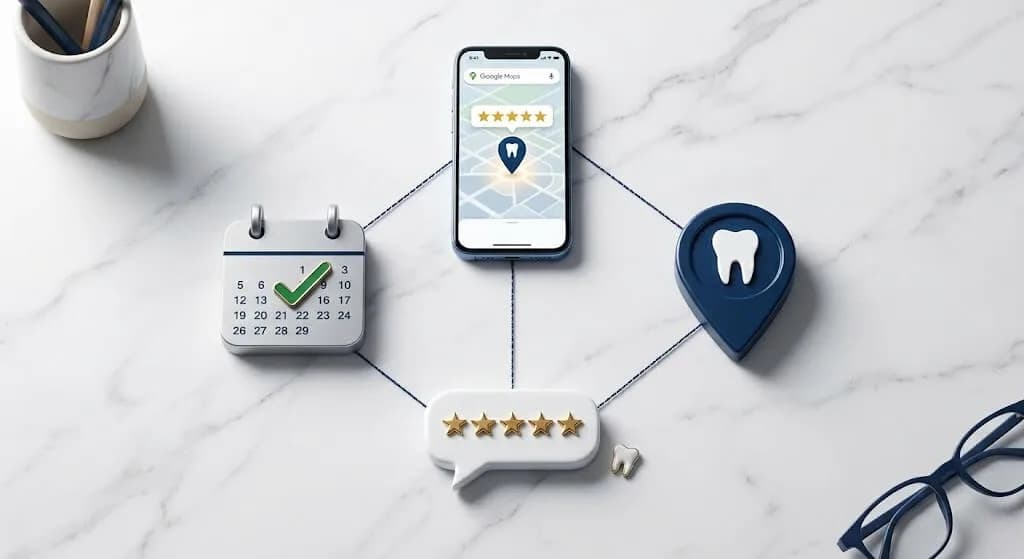
How to Increase Patient Numbers with the Right Tools
Discover the tools that consistently increase dental patient numbers in 2026, from local SEO and review management to AI scheduling and smart follow-up systems.
Share:
Table of contents
How to Increase Patient Numbers with the Right Tools
By the DentalBase Team | March 11, 2026
Most dental practices hit a growth ceiling not because of clinical quality, but because of operational gaps. The tools they use to attract, capture, and retain patients are either missing entirely or working in isolation. If your goal is to increase dental patient numbers in a way that holds month over month, the answer is not one tactic. It is a set of tools that support the full patient journey.
This guide breaks down the four main categories of tools that matter most, what each one is responsible for, and why a connected approach usually performs better than a fragmented one.
Why Most Practices Plateau Before They Should
According to BrightLocal's Local Consumer Review Survey, most consumers use Google to evaluate a local business before making contact. For dental practices, that means many patients form an impression before your phone ever rings. If the tools shaping that early experience are weak, your practice may lose attention before the clinical team ever has a chance to help.
The American Dental Association consistently highlights patient communication and trust as central to practice health. Today, much of that trust begins online.
The Four Areas That Move Patient Numbers
Most growth opportunities in a dental practice fall into four categories. Knowing where the biggest gap is helps you decide which tools to prioritize first.
01 | Visibility Getting found before the first call Local SEO, Google Business Profile, and paid local search tools help more patients discover your practice. | 02 | Reputation Turning searchers into inquiries Reviews, rating strength, and response management help patients trust your practice quickly. |
03 | Communication Capturing the demand you create Call handling, online scheduling, and intake automation help reduce drop-off between interest and booking. | 04 | Retention Growing from the patients you already have Recall reminders, reactivation campaigns, and follow-up sequences help fill the schedule more efficiently. |

Visibility Tools: Getting in Front of Patients Before They Choose Someone Else
The first step to increase dental patient numbers is controlling what happens when someone searches for a dentist near them. That search usually produces paid placements, map results, and organic website listings. Practices that show up strongly across more than one of those areas usually have a better chance of earning the first contact.
Local SEO is the foundation of long-term visibility. According to Google's SEO Starter Guide, clear and useful content helps search engines understand what your website offers. For dental practices, that usually means strong service pages, a well-managed Google Business Profile, and consistent business information across directories. Our beginner's guide to dental SEO explains those pieces in more detail.
Paid local search can support visibility while SEO builds. Google Ads and map-focused campaigns can help your practice appear earlier in the decision process, especially for high-intent searches. If you want a clearer breakdown, our guide on Google Maps ads for dentists covers the main options and how they fit into a local growth strategy.
Reputation Tools: Turning Search Visibility Into Booked Appointments
Visibility gets patients to your profile. Reputation helps them decide whether to contact you. A practice with strong search presence but a weak or outdated review profile can still lose attention to a competitor that looks more trusted at a glance.
Review volume and recency are two of the strongest signals patients notice. A profile with only a handful of older reviews can make a practice look inactive, even when that is not the case. One of the most practical ways to increase dental patient numbers is to treat review generation as an ongoing process instead of an occasional campaign. Consistent requests after appointments help build trust and support stronger local visibility over time.
Our guide on how to get more Google reviews as a dentist walks through timing, messaging, and system setup in more detail.
Communication Tools: Capturing Every Lead Your Visibility Creates
Visibility and reputation create interest. Communication tools determine how easily that interest becomes an appointment. This is where many practices lose momentum. A missed call, a slow callback, or a clunky booking process can all create friction at the moment a patient is ready to act.
Communication Tools That Protect Your Lead Flow
- AI call answering to help cover inbound calls outside busy front desk moments
- Online scheduling so patients can request or book care without waiting for office hours
- Automated intake forms to reduce friction before the first visit
- Two-way SMS for confirmations, rescheduling, and simple questions
- Missed-call text-back to help recover contact when a call is not answered
Practices that increase dental patient numbers efficiently usually make it easy for patients to move from interest to a confirmed appointment with as little friction as possible.
Retention Tools: The Growth Channel Most Practices Underuse
Patient acquisition gets a lot of attention, but retention often produces some of the fastest wins. Re-engaging an existing patient is usually more efficient than attracting a brand-new one, because there is already some familiarity and trust in place.
Signs Your Retention System Has Gaps
- Your recall reminders go out once and are not followed up
- Patients who miss appointments receive little or no outreach afterward
- Reactivation campaigns only happen when the schedule feels slow
- Post-treatment follow-up is inconsistent for visits that usually need another step
- You do not have a clear view of how many patients are currently overdue
Effective retention tools include recall reminders, reactivation sequences, post-treatment follow-up, and communication systems that help your team see who needs outreach without extra manual work. This part of the process matters because increasing dental patient numbers is not only about bringing in new leads. It is also about keeping existing patients active and returning.
If you want to understand why retention is often overlooked in reporting, our analysis of why dental marketing agencies track the wrong metrics looks at that gap more closely.
Why Tools Work Better as a System Than in Isolation
These four categories influence each other. A stronger review profile can support local visibility. Better call handling can help more ad-driven leads become booked appointments. A retention system can bring patients back more consistently, which creates more chances for reviews and referrals. The tools work best when they support the same patient journey instead of operating as disconnected parts.
Disconnected Tools
| Connected System
|
Practices that grow steadily are not always the ones with the largest budgets. They are often the ones whose systems are aligned well enough that fewer opportunities are lost between discovery, contact, and return visits. That alignment is what helps increase dental patient numbers in a way that is easier to sustain.
Growth Tools Audit: Where Does Your Practice Stand?
Before adding new software or services, it helps to identify which of the four categories currently has the biggest gap in your practice.
Quick Self-Assessment
- Do you appear in the top Google Maps results when you search for a dentist in your city?
- Does your Google profile show recent review activity?
- Are inbound calls handled consistently, including busy periods and after-hours opportunities?
- Can patients request or book an appointment online without calling?
- Do overdue patients receive automated outreach before your team has to build a manual list?
- Do you know which channels are producing real new-patient opportunities?
If you answered no to two or more of those questions, the issue may be more about systems than budget. Increasing spend before fixing communication and retention gaps often creates more waste than growth.
One Platform Across All Four Areas
Many practices do not struggle because they lack options. They struggle because they are using too many disconnected tools that make growth harder to manage. Separate vendors for SEO, reviews, scheduling, and recall can create unnecessary complexity and make it harder to see what is really helping increase dental patient numbers.
DentalBase is built around a more connected model. It brings together local SEO support, reputation management, DentiVoice AI call handling, online scheduling, and recall and reactivation tools in one system. That kind of setup can make it easier to track where leads are coming from, how they are converting, and where the biggest operational gaps still are.
If your current setup feels fragmented, the real question is not just which tool to add next. It is whether your existing tools are helping the practice work as one coordinated system.
See All Four Growth Areas Working Together
Get a full walkthrough of the DentalBase platform and where your practice may have the most room to grow.
Book a Free DemoRelated Reading
Go deeper on the paid visibility tools that can help your practice appear earlier in local search.
Build a review system that supports trust and helps strengthen local visibility.
Understand the visibility foundation that supports long-term growth.
Learn which numbers better reflect sustainable growth and where common reporting can fall short.
Frequently Asked Questions
The tools that consistently move patient numbers cover four areas: visibility (local SEO and Google Maps ads to get found), reputation (review generation and management to convert searchers into callers), communication (AI call answering and online scheduling to capture every lead), and retention (automated recall and reactivation systems to bring existing patients back). Practices that see the most growth typically have all four working together rather than relying on one channel in isolation.
It depends heavily on which tools are deployed. Paid Google ads can generate calls within days of launching. Online scheduling and AI call answering show results from the first week by recovering leads that would otherwise have been lost. Review generation takes one to three months to meaningfully improve a profile. Local SEO typically takes three to six months for measurable ranking movement. A connected approach that includes both fast-acting and compounding tools produces the most consistent growth curve.
Acquisition tools focus on attracting people who have never visited your practice: paid ads, SEO, review profiles, and social media. Retention tools focus on keeping and reactivating patients who have already seen you: recall reminders, reactivation campaigns, follow-up sequences, and patient communication platforms. Both matter for practice growth, but retention is often overlooked despite being significantly less expensive per patient than acquisition.
Yes, and often the highest-ROI moves are low-cost. Fully optimizing your Google Business Profile costs nothing but time. Implementing a systematic review request process costs little but can dramatically improve your local rankings and conversion rate. An AI receptionist that answers missed calls pays for itself quickly by recovering leads that were previously lost. The practices that grow most efficiently tend to fix the leaks in their existing systems before adding expensive new channels.
Significantly. According to BrightLocal's annual Local Consumer Review Survey, most consumers read online reviews before contacting a local business, and Google is the most used platform for this. For dental practices, a profile with a high volume of recent positive reviews not only converts more searchers into callers — it also directly influences your ranking in Google's local map pack. Reputation is simultaneously a trust signal, a conversion tool, and an SEO factor.
Was this article helpful?
Written by
DentalBase Team
The DentalBase Team is a collective of dental marketing experts, AI developers, and practice management consultants dedicated to helping dental practices thrive in the digital age.