How to Optimize Google Business Profile for Your Dental Office
Step-by-step guide to optimizing your dental Google Business Profile for local search, more patient calls, and higher Google Maps rankings in 2026.
Share:
Table of contents
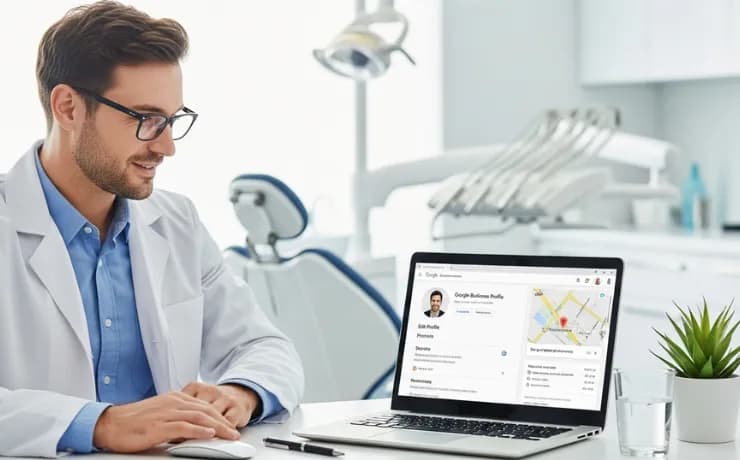
Your Google Business Profile for dentists is often the first thing a prospective patient sees before they ever visit your website. When someone searches "dentist near me," Google pulls profile data, reviews, and photos into the Local Pack, and that three-listing box captures a significant share of all local clicks. If your profile is incomplete, outdated, or missing reviews, you're handing those clicks to a competitor down the street.
A BrightLocal survey found that 98% of consumers read online reviews for local businesses. For dental practices specifically, reviews and profile completeness are among the fastest signals a patient uses to choose one office over another. This guide walks you through every step of optimizing your dental GBP so your practice shows up, stands out, and converts searchers into booked appointments.
42%
more direction requests with complete profiles
35%
more website click-throughs from optimized listings
98%
of consumers read online reviews for local businesses
Why Does Your Google Business Profile Matter for Local Dental Search?
Your GBP listing is your digital storefront in local search. It's often the first point of contact between your practice and potential patients, so it needs to accurately represent your services and make a strong first impression.
Here's the practical reason this matters: when someone types "dentist near me" or "emergency dentist in [city]," Google decides which three practices appear in the Local Pack at the top of results. That decision relies heavily on your profile data. Practices with fully completed profiles, active reviews, and regular updates rank higher than practices with bare-minimum listings. Google has stated that businesses with photos receive 42% more requests for directions and 35% more click-throughs to their websites.
The Local Pack isn't just about visibility. It also builds trust. Patients see your office hours, read reviews, view photos of your waiting room, and check whether you accept walk-ins. All of that happens before they ever click through to your website. If your listing is sparse, a competing practice with 200 reviews and updated photos wins the click. Simple as that.
Related: Google made significant local search algorithm changes in 2025 and 2026 that directly affect dental practices. → Google's 2026 Local SEO Updates: A Dental Practice Guide
Your GBP also acts as free advertising. Unlike paid Google Ads, maintaining a profile costs nothing. But the catch is that "free" doesn't mean "set it and forget it." Google rewards active profiles, which means weekly posts, fresh photos, and prompt review responses are part of the ongoing work.
How Do You Claim and Verify Your Dental Google Business Profile?
Claiming and verifying your listing is the required first step before any optimization can begin. Without verification, you can't control what patients see when they search for your practice.
Start by going to Google Business Profile Manager and signing in with a Google account your practice controls. Search for your business name. If your practice already appears (which it often does, because Google creates listings from public data), click "Claim this business." If it doesn't appear, click "Add your business" and follow the prompts.
Google offers several verification methods:
| Verification Method | How It Works | Timeline |
|---|---|---|
| Postcard | Google mails a code to your office address | 5-14 business days |
| Phone | Automated call or text with a verification code | Minutes (not always available) |
| Code sent to a confirmed business email | Minutes to hours | |
| Video | Record a short video of your signage and location | 1-5 business days |
Once verified, you have full control over your listing. One thing to watch: if your practice was previously listed under a former owner or associate, you may need to request ownership transfer through Google's support process. Don't skip this. An unverified or contested listing can show outdated information for months.
Need help setting up your dental marketing?
DentalBase offers a full suite of marketing services built specifically for dental practices, from SEO to social media.
View All Services →What Information and Photos Should Your Profile Include?
Complete profiles outperform partial ones by a wide margin. Google's own data shows that businesses with complete listings are 2.7 times more likely to be considered reputable by searchers, so every field you fill out matters.
Start with the basics. Your business name should match your official practice name exactly. Don't stuff keywords into it ("Smith Family Dentistry | Best Dentist in Dallas | Implants & Braces"). Google penalizes keyword-stuffed names and can suspend your listing. Use your real name. Period.
Business Details That Affect Rankings
| Profile Field | What to Enter | Why It Matters |
|---|---|---|
| Business Name | Your official practice name, no keywords | Google suspends listings with keyword-stuffed names |
| Address | Exact match to your website and directories | NAP consistency is a core local ranking factor |
| Phone Number | Local number (not a toll-free/tracking number) | Local numbers improve local SEO trust signals |
| Hours of Operation | Accurate hours including lunch breaks and holidays | Incorrect hours lead to negative reviews |
| Services | Every service you offer with descriptions | Helps Google match your listing to specific searches |
| Website URL | Your practice homepage | Drives click-through traffic from search |
A detail many practices overlook is NAP consistency. NAP stands for Name, Address, and Phone number. According to Moz's Local Search Ranking Factors study, NAP consistency across your website, GBP, and third-party directories like Healthgrades, Yelp, and Zocdoc is one of the most heavily weighted local ranking signals. If your website says "Suite 200" but your GBP says "Ste 200," that discrepancy can hurt you.
Photos That Build Trust
Photos are a powerful way to connect with prospective patients. Including high-quality, engaging images makes your practice feel more welcoming before a patient ever walks through the door. You should upload these types:
- Exterior shots: Help patients recognize your building when they arrive. Include signage and the parking area.
- Interior photos: Your waiting area, treatment rooms, and front desk. Clean, well-lit, modern.
- Team photos: Professional headshots and candid group photos. Patients want to see who they'll meet.
- Equipment and technology: If you have digital scanners, same-day crown machines, or laser technology, show it.
Aim to add 3 to 5 new photos per month. Google rewards fresh visual content, and practices that regularly upload photos see higher engagement than those that uploaded a batch two years ago and stopped.
Want better local search visibility for your practice?
DentalBase's SEO team helps dental offices optimize their profiles, build review strategies, and improve local rankings.
Explore Dental SEO →How Do Patient Reviews Affect Your Google Rankings?
Patient reviews are one of the strongest ranking signals for your GBP and one of the most influential factors in a prospective patient's decision to call your office. Google confirms that review quantity, quality, and recency all affect local rankings.
A BrightLocal study found that reviews account for roughly 17% of Google's Local Pack ranking factors. That makes reviews the second most important category after on-page signals. And the data goes further: 87% of consumers read online reviews for local businesses, and 73% say they only pay attention to reviews written within the past month.
How to Get More Reviews Without Being Pushy
Ask at the right moment. The window after a positive treatment outcome is when patients are most willing to leave a review. Here's what works for dental practices specifically:
- Train your front desk to ask during checkout: "Would you mind leaving us a Google review? It really helps other patients find us."
- Send a follow-up text or email with a direct review link within 2 hours of the appointment.
- Place a small card or QR code at the front desk that takes patients directly to your review page.
Don't offer incentives. Google's policies prohibit offering discounts or gifts in exchange for reviews, and violating this can result in review removal or listing suspension.
Responding to Reviews Matters More Than You Think
Respond to every review, positive and negative, within 24 hours. Positive review responses show prospective patients that you're engaged and appreciative. Negative review responses are even more important. A calm, professional reply to a complaint can actually improve trust. Other patients reading reviews want to see how you handle problems, not just praise.
Review Response Framework for Dental Practices
Positive Review
- Thank the patient by name
- Reference something specific they mentioned
- Express that you look forward to seeing them again
Aim for 2-3 sentences. Keep it genuine, not scripted.
Negative Review
- Acknowledge the concern with empathy
- Apologize for the experience (not blame)
- Invite them to call the office to resolve it
Never argue, disclose patient details, or get defensive.
Keep negative review responses short: acknowledge the concern, apologize for the experience, and invite the patient to call the office directly. ADA Health Policy Institute research consistently shows that patient trust correlates with how a practice communicates, not just clinical outcomes.
Related: Missed calls are a top reason dental practices lose new patients. → Dental Call-to-Booking Conversion Rate: 2026 Benchmarks
How Can Google Posts and Messaging Drive More Appointments?
Google allows you to publish posts directly on your profile, and these posts appear right in your listing when patients search for your practice. Most dental offices ignore this feature entirely, which creates an easy competitive advantage for practices that use it.
You can publish several types of posts:
- Offers: Limited-time promotions on whitening, new patient specials, or seasonal discounts.
- Updates: New technology, expanded hours, staff additions, or office renovations.
- Events: Community events, free screening days, or oral health workshops.
Post at least once per week. Each post stays visible for about seven days before it gets pushed down, so consistency matters. Google's algorithm treats regular posting as an activity signal, and Moz research indicates that active profiles tend to appear more frequently in the Local Pack than inactive ones.
GBP Maintenance Schedule
| Frequency | Task | Time Needed |
|---|---|---|
| Daily | Respond to new reviews and messages | 5-10 minutes |
| Weekly | Publish a Google Business post (offer, update, or event) | 10-15 minutes |
| Monthly | Upload 3-5 new photos (office, team, or equipment) | 15-20 minutes |
| Quarterly | Audit hours, services, NAP consistency, and Q&A section | 30-45 minutes |
| As Needed | Update holiday hours, closures, or new services | 5 minutes per change |
Why Messaging Is Worth Enabling
GBP messaging lets patients text your practice directly from your Google listing. For patients who don't want to call (and that group is growing, especially among adults under 40), messaging removes a friction point. You can enable it through your GBP dashboard under the messaging settings.
The catch: messaging only helps if you respond quickly. Google tracks your response time and displays it on your profile. If your average response time is "within a few hours," patients will move on to a practice that replies in minutes. If your front desk can't handle real-time messaging, consider routing messages to a dedicated team member or using an AI receptionist to catch messages during busy periods and after hours.
Never Miss a Patient Message or Call
DentiVoice AI Receptionist answers calls and messages 24/7, books appointments, and follows up with patients automatically.
Book a Free Demo →What GBP Optimization Mistakes Should Dental Offices Avoid?
Even practices that claim their listing often make mistakes that quietly cost them rankings, clicks, and patient calls. Knowing what to avoid is as valuable as knowing what to do right.
Here are the most common mistakes dental offices make with their profiles:
- Keyword stuffing the business name. Adding "Best Dentist in [City]" or listing services in your business name violates Google's guidelines and risks suspension. Your name field should be your actual practice name. Nothing more.
- Inconsistent NAP across directories. If your address is "123 Main St Suite 4" on Google but "123 Main Street #4" on your website and "123 Main, Ste 4" on Healthgrades, Google sees three different businesses. This hurts your local rankings significantly. If your rankings recently fell rather than plateaued, our diagnostic checklist for a Google Maps ranking drop starts with exactly this kind of listing inconsistency.
- Ignoring negative reviews. Unanswered negative reviews send a signal that you don't care about patient experience. Even a brief, professional response changes how other readers perceive the complaint.
- Setting it and forgetting it. Practices that haven't posted in six months or updated photos in a year fall behind competitors who treat their profile like a living asset. Google favors activity.
- Wrong business hours. Nothing generates a one-star review faster than a patient driving to your office and finding the door locked. Update hours for holidays, temporary closures, and schedule changes within 24 hours.
According to HubSpot's marketing research, 60% of smartphone users have contacted a business directly from search results using the "click to call" option. If your listing has the wrong phone number or outdated hours, you're losing those calls to a practice with accurate information.
Related: Your website matters just as much as your GBP. See what to fix first. → 13 Things to Remove for Better Dental Website Conversion
If your practice has multiple locations, the risk of inconsistency multiplies. Each location needs its own profile with unique photos, hours, and posts. Managing this manually gets messy fast, which is why multi-location dental groups often use a dental marketing platform to keep every listing accurate and active.
GBP Self-Audit Checklist
Check each item you have completed for your Google Business Profile.
Your score: count your checks out of 9. Anything below 7 means your profile needs attention.
The good news: most of these mistakes are fixable in an afternoon. Block 60 to 90 minutes, audit your current profile against the checklist above, and fix what you find. That single session will put your practice ahead of the majority of local competitors who haven't touched their profile in months.
Your GBP isn't a secondary marketing channel. For most dental practices, it's the primary way new patients discover, evaluate, and contact your office. The practices that treat their profile as a living, active asset, not a one-time setup task, are the ones that consistently appear in the Local Pack and generate steady appointment volume from local search.
If you haven't audited your profile in the past 90 days, now is the time. Verify your information, add recent photos, respond to pending reviews, and publish your first post this week. That's where content marketing and local search strategy start, right at your Google Business Profile.
Ready to Improve Your Practice's Local Search Visibility?
DentalBase helps dental offices optimize their GBP listings, manage reviews, and build local SEO strategies that drive real patient growth.
Book a Free Demo →Explore more guides and tools for dental practice growth.
Browse Resources →Sources & References
Frequently Asked Questions
Verification typically takes 5 to 14 days when using the postcard method. Phone and email verification are faster, sometimes completing within 24 hours, but Google doesn't offer these options to every practice. Video verification is an additional option Google has rolled out in some regions.
Post at least once per week and update photos monthly. Review your hours, services, and contact details quarterly or whenever something changes. Google's algorithm rewards profiles that show regular activity over dormant ones, so consistency matters more than volume.
Yes. Review quantity, recency, and response rate are confirmed local ranking signals. A BrightLocal study found that reviews account for roughly 17% of the factors Google uses to rank businesses in the Local Pack. Responding to reviews also builds patient trust.
Yes. Create a separate profile for each physical location with its own address, phone number, and hours. Use Google Business Profile Manager to manage them from one dashboard. Each profile needs unique photos and location-specific posts to perform well.
The Local Pack is the map-based section at the top of Google search results showing three local businesses. It captures a large share of clicks for searches like 'dentist near me.' Appearing in this section depends heavily on your GBP completeness, reviews, and proximity.
Small single-location practices can manage GBP effectively in-house by spending 30 to 60 minutes per week on posts, review responses, and photo uploads. Multi-location groups or practices lacking staff bandwidth often see better results from professional management.
Upload exterior shots so patients recognize your building, interior photos of the waiting area and operatories, professional team headshots, and photos of your equipment. Google reports that profiles with photos receive 42% more direction requests than those without.
Messaging gives patients a low-barrier way to ask questions before booking. Practices that respond within five minutes during business hours report higher conversion from inquiry to appointment. It won't replace phone calls, but it captures patients who prefer texting over calling.
Was this article helpful?
Written by
DentalBase Team
Expert dental industry content from the DentalBase team. We provide insights on practice management, marketing, compliance, and growth strategies for dental professionals.