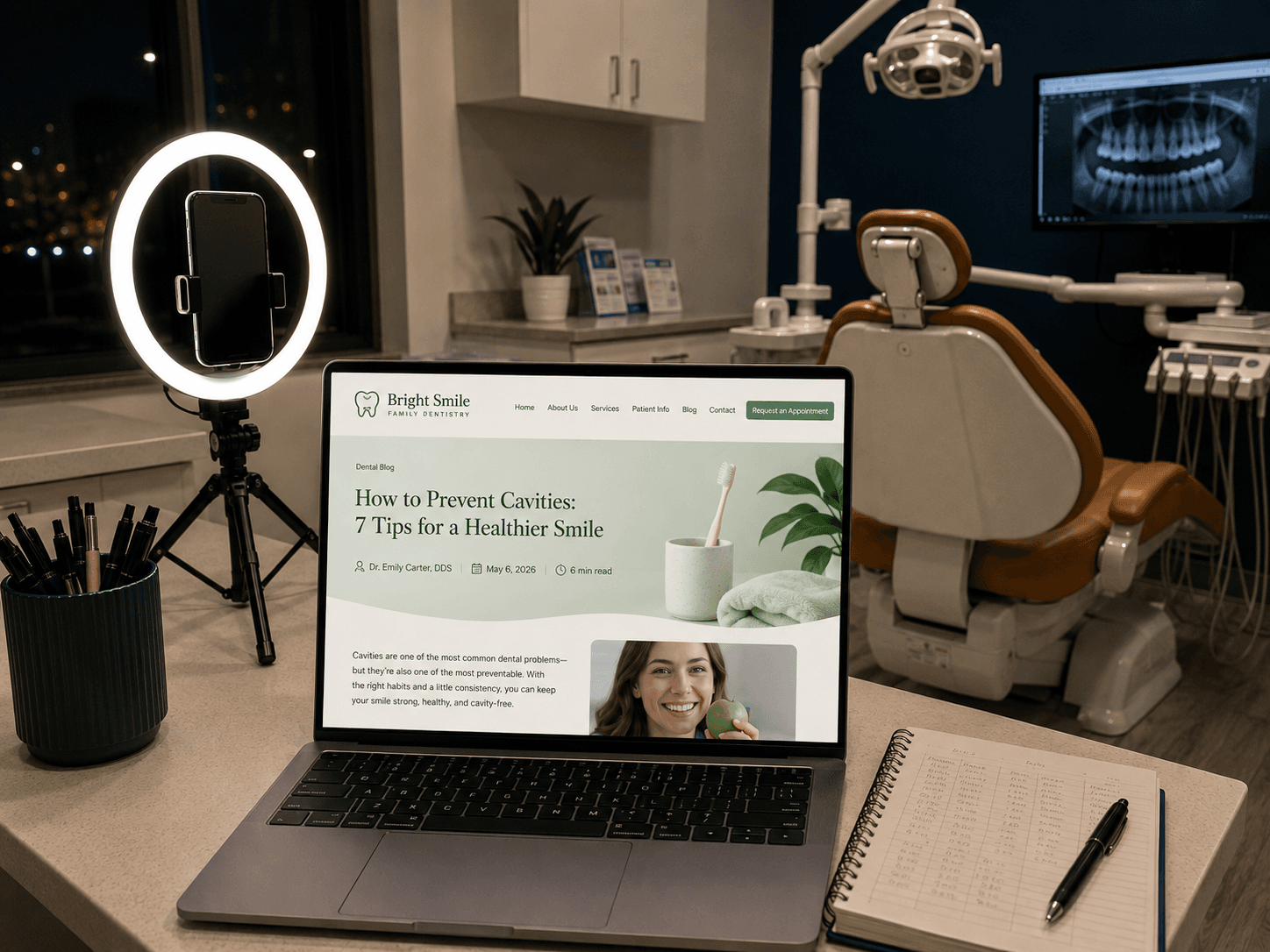
Content Marketing for Dentists: A 2026 Strategy Guide
Learn how content marketing for dentists drives new patients in 2026. Frameworks, formats, and a quarterly content plan that scales with your practice.
Share:
Table of contents
Content marketing for dentists is the practice of publishing educational articles, videos, and local guides that answer the questions patients ask before they book. Done well, it earns trust and traffic for years. Done poorly, it produces a graveyard of "5 Tips for Healthy Teeth" posts nobody reads.
The numbers explain why it matters. BrightLocal's 2024 Local Consumer Review Survey found that 75% of consumers always or regularly read online reviews of local businesses, and 41% use three or more sites before deciding. Patient research isn't a quick check, it's a multi-stop journey. If your practice isn't part of that journey, you're invisible during the most important step in patient decision-making.
This guide covers what content marketing is for a dental practice in 2026, which formats work, and a realistic timeline for results.
What is content marketing for dentists?
Content marketing for dentists is a marketing approach that earns patient attention through educational content rather than buying it through ads. Instead of paying $7 per click, you publish articles, videos, and posts that show up in search and social feeds when patients are actively looking for answers.
The four formats that matter for dental practices are blog content, short-form video, social media posts, and email. Each one does a different job. Blog posts capture search intent. Video builds trust because patients can see and hear the dentist before they ever walk in. Social keeps the practice top of mind for existing patients. Email reactivates lapsed ones.
Here's the structural difference from paid advertising. Dental Economics notes that paid search drives meaningful traffic for dentists, but at $6 to $8 per click for competitive dental keywords. The meter never stops. A blog post that ranks for "dental implants cost [your city]" earns clicks for free for two years or longer. Content compounds. Ads don't.
That doesn't make ads bad, it makes them a different tool. Most practices need both.
Need an SEO foundation before you start publishing?
Content without technical SEO is a tree falling in an empty forest. Get the on-site work right first.
Explore Dental SEO →Why content marketing works for dental practices
Content marketing works because the patient journey to a dental booking is long, research-heavy, and trust-driven. Patients don't impulse-buy a root canal. They search, they read, they compare, they ask friends, then they book. Content shows up at every stage of that loop.

The data backs this up at every step. ADA Health Policy Institute data shows convenience and online presence as top drivers of patient choice. The decision is made online before the phone rings.
The local layer is non-negotiable
Google reports that 46% of all searches seek local information, and "dentist near me" generates roughly 1.2 million monthly searches in the United States. A dental marketing content strategy that ignores local intent is leaving most of its potential traffic uncovered. This is where dentist local content marketing earns its keep, neighborhood pages, community partnership posts, and city-specific procedure guides all answer queries that pure clinical content doesn't.
AI search has changed what gets cited
HubSpot's 2026 State of Marketing Report notes that AI search optimization is now the top SEO priority for marketers, with structured, source-cited content getting cited at far higher rates than opinion-driven posts. Healthcare queries already trigger AI summaries on a large share of searches. Translation: vague articles full of opinions don't get cited. Articles with specific numbers, named sources, and clean structure do. Your content has to look like a research paper, not a brochure.
The shift accelerated fast. In early 2026, Google searches ending without a click reached 68%, according to Search Engine Land's coverage of the SparkToro zero-click research, up sharply from the year before. Over the same period, BrightLocal's 2026 Local Consumer Review Survey found that the share of consumers asking AI tools like ChatGPT for local business recommendations jumped from just 6% to 45% in twelve months. For a dental practice, that means the article answering "how much do veneers cost" or "what to expect after a root canal" is increasingly what an AI assistant reads back to a patient who never visits your website at all. Rank for the right questions, or the AI answers on your behalf using someone else's content.
Related: Local search rules changed this year. → Google's 2026 Local SEO Updates: A Dental Practice Guide
Is content marketing actually worth the investment for a dental practice?
Yes, when the math is run against real numbers. A general dentistry patient's average lifetime value runs $12,000 to $15,000, while acquiring a new patient through paid digital channels costs $150 to $300 (Dental Economics; WordStream). Content marketing lowers that acquisition cost over time because a ranking article keeps producing patients long after the invoice for writing it is paid.
23%
Higher likelihood that small businesses see ROI from blog posts, vs. the average business (HubSpot, 2026 State of Marketing Report)
$12K-$15K
Average lifetime value of a general dentistry patient (Dental Economics)
45%
Share of consumers who used an AI tool for a local business recommendation in 2026, up from 6% a year earlier (BrightLocal)
Three checkpoints make the case:
- Blog and SEO lead every channel on reported ROI. HubSpot's 2026 State of Marketing Report ranks it the top ROI-generating channel marketers report, ahead of paid social.
- Small practices benefit more, not less. They're 23% more likely than average to see ROI from blog content, an edge for a single-location practice over a large DSO with a bigger ad budget.
- The acquisition math compounds in content's favor. At $150-$300 per paid patient against a $12,000-$15,000 lifetime value, a handful of ranking articles can match what dozens of paid conversions cost, for a fraction of the ongoing spend.
None of this replaces paid advertising; it changes which channel earns the marginal dollar once a practice has a few months of runway to invest in content that compounds.
What types of content should a dental practice create?
A dental practice should create six content types: educational blog posts, local content, short-form video, patient stories, an on-site FAQ page, and email newsletters. Each type targets a different stage of the patient journey, and a real content marketing strategy for dentists uses all of them, not just one.
The trap most practices fall into is publishing only one format and expecting it to do everything. The formats compound only when used together.
Educational blog posts
These are the workhorses of dental content marketing. Procedure explainers, cost guides, "what to expect" articles, and recovery timelines. They capture the 71% who search before booking. A single ranking article on "dental implants cost [city]" can drive 200 to 800 visits a month for years.
Local content
Neighborhood guides, community partnerships, "best dentist in [city]" angles, school sports sponsorships written up as posts. This is dentist local content marketing, and it's how you compete with practices that have a head start on Google. Local content ranks faster because the competition pool is smaller.

Short-form video
HubSpot's State of Marketing Report shows short-form video now leads all formats for ROI, with marketers ranking it the top performer for the second year running. Thirty to sixty second clips of procedure explanations, FAQ answers, and office tours give patients the visual proof they need before booking. The dentist on camera is the trust signal that no written page can match.
Patient stories and case studies
Before-and-after content, written or video, works because cosmetic, ortho, and implant patients are the highest-value segments and the most research-intensive; real stories shorten the research window. Get a signed photo and video release before publishing any patient's face or treatment, since this is the one content type with real consent exposure.
Beyond before-and-afters, treat Google Business Profile reviews as content in their own right. BrightLocal found that 88% of consumers are more likely to use a business that responds to every review, so a thoughtful reply is itself published, indexable social proof. Pull short written testimonials onto service pages, and turn your strongest video testimonial into a 30-second social clip. A returning patient explaining why they stayed is a stronger trust signal than anything the practice says about itself.
FAQ pages
A dedicated FAQ page turns front-desk questions into indexable content separate from the blog. Group answers by service, implants, whitening, insurance, first visit, rather than by date, and link each to the full procedure article. AI engines read this page first, so keep each answer to two or three sentences.
Email newsletters
Email is the cheapest channel for retention. HubSpot research consistently ranks email among the highest ROI channels, with welcome emails alone driving open rates above 80%. A monthly newsletter with one health tip, one practice update, and one recall reminder costs almost nothing and pays for itself the first time it brings back a lapsed patient.
| Format | Effort Level | Time to Payoff | Best Use |
|---|---|---|---|
| Blog posts | High | 6-9 months | New patient acquisition |
| Local content | Medium | 3-6 months | Local search visibility |
| Short-form video | Medium | 2-4 months | Trust building, social reach |
| Patient stories | Medium | Immediate | Conversion lift on cosmetic, ortho, implants |
| Email newsletters | Low | 1-2 months | Retention, recall, reactivation |
Outsource the social side
If your team can't shoot weekly video and post three times a week, hand it off to a partner that already does both for dental practices.
See Social Media Services →How do you build a content marketing strategy for a dental practice?
You build a content marketing strategy for a dental practice in five steps: audit what patients actually ask, pick a primary content pillar, plan a quarterly calendar, distribute every piece across multiple channels, and measure results monthly. Skip any of these and the system falls apart inside 90 days.
Most practices fail at step three. They publish one post in week one, two posts in week three, then nothing for two months. Content doesn't compound on a chaotic schedule. It compounds on a boring one.
Step 1: Audit what patients actually ask
Before writing a single post, list the questions your front desk hears every day. Pull them from four places:
- The last 30 days of phone notes from your front desk
- The Q&A section of your Google Business Profile
- Email threads with new patients in the last quarter
- The "people also ask" boxes for your top procedures on Google
You'll end up with 40 to 60 real questions. Those are your topics. No keyword tool can replicate a list pulled from your own patient base.
Step 2: Pick a primary content pillar
Pick the procedure or service that drives the most revenue at your practice. For most general dentists, it's family dentistry or restorative work. For specialty practices, it's the specialty itself. The pillar gets 50% of your content effort. Everything else fights for the remaining half.
Step 3: Plan a quarterly calendar
The realistic cadence for a single practice is one cornerstone post per month plus four supporting pieces, 60 pieces a year across formats. Plan three months at a time, not twelve; the calendar will change. Anchor part of it to fixed dates with built-in search demand, National Children's Dental Health Month in February and National Dental Hygiene Month in October are reliable, recurring hooks.
Step 4: Distribute every piece
This is where most dentists drop the ball. A blog post isn't done when it's published. A finished post should produce a Google Business Profile post, two social posts, an email mention, and several short-form video clips. Distribution multiplies your reach across every channel.
Step 5: Measure monthly
Track four metrics every month, and only four:
- Organic search traffic to your site
- Phone calls from organic visitors
- Scheduled appointments traceable to a specific content page
- Email click-through rate
Don't track vanity metrics. Likes don't pay your associates. Booked patients do.
Pair content with paid ads while you wait
Content takes six months to compound. Google Ads can fund the wait by bringing in patients in week two.
Explore PPC for Dentists →How long does content marketing take to work for a dentist?
Content marketing for dentists takes about six months to produce compounding traffic and nine to twelve months to deliver a steady flow of new patients. Anyone promising results in 30 days is selling something else, usually paid ads dressed up as SEO. The timeline is real, and it's the reason content beats ads in the long run.

Here's why the wait is worth it. The math works against you for the first quarter and dramatically in your favor by year two.
Months 1 to 3: nothing visible
You're publishing, indexing, and waiting. Google hasn't decided how to rank your new pages yet. Don't panic. Don't pivot. The work compounds invisibly during this phase.
Months 4 to 6: first signal
The first ranking blog post appears on page two, then page one. Traffic trickles in, and by month six organic visits run 2x to 4x the starting baseline.
Months 7 to 12: the flywheel
Multiple posts ranking, internal links connecting them, and a measurable lift in calls and bookings traceable to organic content. Dental Economics identifies SEO and content as strategies that compound, with the strongest results by month nine for practices publishing consistently.
The cost reality
The average cost-per-click for dental keywords is $6 to $8 according to Google Ads benchmarks. A single ranking blog post that earns 500 clicks per month for two years equals roughly 12,000 clicks. At $7 average, that's the equivalent of $84,000 in paid traffic from one $300 article. Even with AI search reshaping clicks, the unit economics still hold.
Related: Conferences are a strong source of original content ideas and industry data for your blog. → Top Dental Conferences in the United States (2026 Guide)
The strategic call
The single insight to take from this guide: a working content program isn't a project, it's a system. The practices that win in 2026 aren't the ones that publish more. They're the ones that publish consistently, distribute every piece across multiple channels, and measure what actually books patients. Pick one cornerstone topic, ship one cornerstone post per month, and don't quit before month nine.
Your next step is the boring one: audit what your patients ask, pick your pillar, and put one cornerstone topic on the calendar for the next 90 days. While you build the content engine, make sure your website is converting the traffic content sends it and your phones are answered when patients call. The AI receptionist that catches missed calls protects every visit your articles earn.
See how DentalBase runs content for practices like yours
Strategy, writing, video, and distribution under one roof. Built for practice owners who don't have time to manage five vendors.
Book a Free Demo →Sources & References
- BrightLocal Local Consumer Review Survey
- HubSpot Marketing Statistics
- Dental Economics: Top Dental Marketing Strategies
- Moz Local SEO Beginner's Guide
- ADA Health Policy Institute
- Dental Economics: Bring in New Dental Patients with Internal Marketing
- Moz Beginner's Guide to SEO
- Search Engine Land: Google Zero-Click Searches Reach 68% in Early 2026
Frequently Asked Questions
Most single-location practices spend $1,500 to $4,000 per month on content marketing for dentists, including writing, video, and basic SEO. Spending below $1,500 rarely produces enough volume to compound. Spending above $4,000 makes sense once you have a measurable lead pipeline.
Yes, but only with a clear system. The most common in-house model has the dentist or hygienist record short videos, an office manager handle social posts, and a freelance writer produce one long-form blog post each month. Without that structure, in-house efforts stall within 90 days.
No. AI Overviews appear in over 60% of searches now, and they pull answers from indexed blog content. The blogs that win are the ones with cited statistics, clear answer blocks, and structured data, exactly the format AI engines extract from.
PPC pays for every click at $6 to $8 per dental keyword. Content marketing pays once and earns clicks for years. PPC produces results in 30 days. Content takes six months. Most practices need both, with PPC funding the wait and content lowering the long-term cost per patient.
Yes, for clinical topics. A general writer can handle local guides, FAQs, and patient experience pieces, but procedure explainers, cost articles, and recovery guides need a writer who has worked in dental or has a clinical reviewer. Patients and Google both reward accuracy.
Local content and procedure cost articles convert highest. Local pages capture the 46% of searches with local intent. Cost and 'what to expect' articles capture patients in the research stage. Both show up well in AI search results because they answer specific questions directly.
45% of consumers used an AI tool like ChatGPT for a local business recommendation in 2026, up from just 6% the year before (BrightLocal). Practices without cited, well-structured content are increasingly invisible in those AI-generated answers.
Was this article helpful?
Written by
DentalBase Team
Expert dental industry content from the DentalBase team. We provide insights on practice management, marketing, compliance, and growth strategies for dental professionals.