Social Media for Dentists: Platforms, Content, and Tips (2026)
Social media for dentists works when you match the right content to the right platform. Posts, Reels, Threads tips, and tracking metrics for 2026.
Share:
Table of contents
Social media for dentists isn't about going viral. It's about showing up where your patients already scroll, with content that earns their trust before they ever pick up the phone. A 2024 survey from Dental Economics found that 97% of dentists surveyed use Facebook as their primary social platform, yet most practices still post generic office photos that generate likes but zero appointments. This guide breaks down exactly what to post on Instagram, Facebook, TikTok, and Threads in 2026, how to repurpose a single shoot across every platform, and which metrics tell you whether your social media content for dentists is actually producing patients.
If your practice posts three times a week and can't point to a single appointment that came from social media, the problem isn't the platforms. It's the content strategy. Here's how to fix it.
Prefer to hand this off? DentalBase's growth services cover social media for dentists alongside the channels that book patients.
What Makes Social Media for Dentists Actually Convert?
Social media for dentists converts when each post stops the scroll, delivers value in under five seconds, and gives the viewer one clear next step. The posts that drive appointments start from the patient's perspective, not the practice's perspective. A post announcing "We now offer Invisalign!" gets ignored. A 6-month smile transformation with the patient's reaction gets saved 50 times.
Three elements separate posts that produce bookings from posts that collect passive likes:
- A visual hook in the first frame. The thumbnail or opening second of video needs to create curiosity. Before-and-after splits, text overlays with a surprising question, or a close-up smile reveal all work. A photo of your office exterior does not. According to HubSpot, video posts get 48% more engagement than static posts on healthcare accounts, and that gap keeps widening.
- Value delivery before the pitch. Educational content gets saved. Emotional content gets shared. Promotional content gets ignored unless there's a time-limited offer attached. Target 80% value, 20% promotion across your feed. That ratio earns algorithmic reach on every platform.
- A clear next step. Every post needs to make it obvious what the viewer should do. "Link in bio to book," "DM us for pricing," "Save this for later." Posts without a call to action generate passive engagement but no patient movement. The difference is measurable.
Platform at a Glance
Ages 25-44
Best for: Reels, carousels, smile reveals
Post frequency: 3-4x/week
Top metric: Saves and DMs
Ages 35-65
Best for: Reviews, team posts, community
Post frequency: 3-4x/week
Top metric: Shares and clicks
TIKTOK
Ages 16-35
Best for: Myth-busting, POV, authenticity
Post frequency: 4-5x/week
Top metric: Watch time and follows
THREADS
Ages 25-40
Best for: Text tips, myth-busting, thought leadership
Post frequency: 3-5x/week
Top metric: Reposts and profile visits
Each platform rewards different content. Match the format to the audience that lives there.
Want social content that turns followers into patients?
DentalBase creates, schedules, and manages your social content so your team can focus on patient care.
Explore Social Media Services →Which Instagram Formats Drive the Most Patient Bookings?
Instagram Reels, carousel posts, and Stories each serve a different purpose for dental practices in 2026. Reels drive reach and discovery, carousels drive saves and return visits, and Stories drive direct conversations through DMs. The social media content for dentists that performs on Instagram looks very different from what works on Facebook or TikTok.
Smile Reveal Reels (15-30 seconds)
Shoot a vertical video starting with the patient's "before" (close-up of teeth), use a quick transition effect, and reveal the "after" with the patient's genuine reaction. Keep it under 20 seconds for maximum completion rate. Add a text overlay like "6 months of Invisalign" at the start so viewers know what they're watching before the audio kicks in.
Why this format dominates: smile reveals combine social proof with emotional payoff. Friends tag people who've mentioned wanting similar work. One cosmetic practice reported a single Reel with 12,000 views generated 8 DMs asking about veneers within 48 hours. In 2026, Instagram's algorithm also rewards collaborative Reels, so ask patients to duet their own reaction alongside your original clip. This doubles the reach without doubling the work.
Educational Carousels (5-7 slides)
Build a swipeable set answering one specific question. Slide 1 is the hook ("5 signs you're grinding your teeth at night"). Slides 2-6 cover one sign each. Slide 7 is your call to action. Use consistent brand colors and large, readable text. Carousels are the highest-saved content format on Instagram, and saves signal the algorithm to push the post to more feeds.
According to BrightLocal, 98% of people research local businesses online before choosing one. Educational carousels position your practice as the authority patients find during that research. Aim for at least two carousels per week.
Stories: Polls, Q&A, and Behind-the-Scenes
Post daily low-effort content: a morning "office is open" shot, a poll sticker ("Have you flossed today?"), a Q&A sticker inviting dental questions, or a quick clip of the team between patients. No editing required. Phone footage is expected in Stories.
Interactive stickers generate direct replies that land in your DMs. A practice using question stickers twice a week consistently reports 5-10 DM conversations per week, some converting to appointments. Pair this with your broader social media marketing strategy for the highest return.
What Facebook Content Turns Followers Into Scheduled Patients?
Facebook's organic reach sits lower than Instagram's, but the posts that do perform tend to generate direct patient action. The platform's audience skews 30-65 and is closer to booking decisions than Instagram's younger base. Social media dentistry on Facebook wins through trust and credibility, not trends and aesthetics.
Facebook research almost always runs alongside a Google search, which is why social presence and search visibility work as a pair rather than as alternatives. If organic search is the gap in your setup, this breakdown of how to evaluate a dental SEO agency covers pricing, deliverables, and reporting.
Patient Review Spotlights
Screenshot or create a quote graphic from a 5-star Google review with a brief caption thanking the patient (without naming them unless you have consent). Add "We're accepting new patients this month" and link to your booking page. BrightLocal data shows 88% of consumers trust online reviews as much as personal recommendations. Putting those reviews on Facebook extends their reach beyond Google.
Team Introduction Posts
A candid team photo (not posed) with 3-4 fun facts or a short paragraph about why they love dentistry. "Meet Sarah, our hygienist of 8 years. She's the reason nervous patients leave smiling." These humanize your practice. Patients who feel they already know your team are less anxious about a first visit, and that familiarity reduces no-shows. For a deeper look at creative approaches, see our guide to dental advertisement ideas that convert.
Educational Video (60-90 seconds)
A dentist answering one common question on camera. "Do I really need to floss every day?" "What's the difference between a crown and a veneer?" Keep it casual, one take, no script beyond a few bullet points. Facebook's algorithm favors video that holds attention, so deliver the answer up front. Don't save the payoff for the end. When you're ready to put ad budget behind posts like these, this step-by-step Facebook marketing guide for dental offices covers the paid funnel and a 90-day rollout.
According to HubSpot research, 54% of consumers want more video from brands they follow, and that includes healthcare providers. A three-provider practice posting one educational video per week can build a library of 50+ videos within a year. That library becomes a trust-building asset that compounds over time.
Need your social media handled from content to engagement?
DentalBase manages your Instagram, Facebook, TikTok, and Threads so your practice stays visible where patients spend time.
Book a Free Demo →How Should Dental Practices Use TikTok and Threads in 2026?
TikTok's algorithm pushes content to local users regardless of your follower count, which makes it uniquely valuable for practices that haven't built an audience yet. Threads, Meta's text-first platform, adds a new discovery channel that requires zero video production. Both platforms reward consistency over polish.
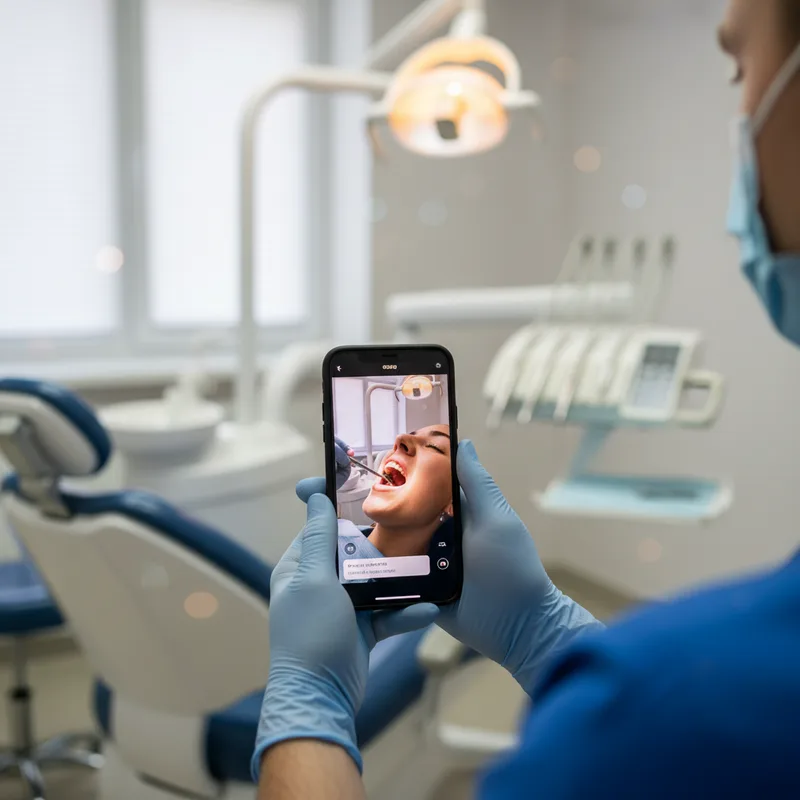
TikTok: Myth-Busting and Procedure POV
The highest-performing dental TikTok format is myth-busting. Look at camera, show a text overlay ("Myth: whitening ruins your enamel"), explain why it's false in 15 seconds, end with "Follow for more dental facts." These clips generate the most comments because they create immediate curiosity.
Procedure POV videos are the second-strongest format. A patient's-eye view of a routine procedure, sped up with music. Veneer placement, Invisalign fitting, or a cleaning with satisfying polishing footage. The hashtag #dentaltiktok has accumulated billions of views, and the "oddly satisfying" factor drives views even from people who aren't looking for a dentist yet. Locals who see your practice name may convert weeks later.
Day-in-the-life team content rounds out the mix. Phone footage shot between patients feels genuine. Studio-quality content feels like an ad and gets scrolled past on TikTok. According to Moz, consistent local signals across platforms reinforce your practice's visibility in local search results as well.
Threads: Text-First Dental Tips
Threads launched as Instagram's text companion and has grown steadily through 2025 and into 2026. For dental practices, it's a low-effort channel where a quick dental tip or myth-bust can reach new people through algorithmic discovery. No video required. No design tools needed. Just type a useful dental fact and post.
Effective Threads formats for dental practices:
- Quick myth-busting: "No, you don't need to rinse with water after brushing. The fluoride in your toothpaste works better when it sits on your teeth. Spit, don't rinse." Short, specific, shareable.
- Opinion-based posts: "Unpopular opinion from a dentist: electric toothbrushes aren't always better. Technique matters more than the tool." These generate replies and debate, which the algorithm rewards.
- Cross-posted carousel context: When you publish an Instagram carousel, share the key takeaway on Threads as a text post linking back to your Instagram. This drives traffic between platforms without extra production work.
The advantage of Threads in 2026 is low competition. Most dental practices haven't started posting there yet, which means early movers get more algorithmic reach per post than on saturated platforms like Instagram or Facebook.
Related: Looking for more ways to attract patients beyond social? → Top Advertising Ideas for Dental Practices
How Do You Repurpose One Shoot Into a Full Week of Posts?
You don't need to create separate content for each platform. One 2-hour monthly batch session can produce enough social media content for dentists across Instagram, Facebook, TikTok, and Threads simultaneously. The key is shooting versatile clips, then adapting each one to match how that platform's algorithm and audience behave.
Here's how one piece of content becomes four posts:
| Original Content | TikTok / Threads | ||
|---|---|---|---|
| 30-sec smile reveal video | Reel with trending audio + hashtags | Native video with longer caption + booking link | TikTok with text overlay hook; Threads text recap of the transformation story |
| Team photo from an event | Feed post + Story with poll sticker | Community post, tag the event page | Skip TikTok (static photos underperform); share a fun team fact on Threads |
| Dentist answering a question | Reel (15 sec, fast-paced) | Longer video (60-90 sec, conversational) | TikTok myth-buster format; Threads text version of the answer |
| Educational slides (5-7 points) | Carousel post (swipeable) | Single image with full text in caption | Rapid-fire TikTok video; Threads thread with one point per post |
Schedule everything through Meta Business Suite or a third-party scheduler in a single sitting. The practices that maintain consistency for 6+ months are the ones batching content. The ones creating one post at a time burn out within weeks. Connect your social calendar to your broader content marketing strategy so blog posts, social content, and email all reinforce the same themes each month. For ready-made monthly themes to batch around, use this month-by-month dental marketing calendar.
Want a team that handles your social content end to end?
From content creation to scheduling to engagement tracking, DentalBase manages the full social workflow for dental practices.
See Social Media Services →What Social Media Metrics Actually Predict New Patients?
Track saves, shares, DMs, website clicks, and booking-page visits per post type. Likes are the least useful metric because they don't correlate with patient acquisition. A post with 20 likes and 15 saves outperforms a post with 200 likes and zero saves every time. Rank metrics by how close they sit to an actual appointment.

Social Metrics Ranked by Patient-Acquisition Value
1. Booking page visits
Direct proxy for appointment intent
★★★★★
2. DMs received
Closest organic metric to a lead
★★★★★
3. Saves
Signals lasting value to the algorithm
★★★★
4. Shares
Expands reach into new local networks
★★★★
5. Likes
Vanity metric with low booking correlation
★★
Here's what each metric actually tells you about your social media dentistry results:
- Saves: the viewer found the content valuable enough to return to. Educational carousels and procedure explainers drive the most saves. High save counts signal the algorithm to push the post to more feeds.
- Shares: the viewer found the content relevant to someone they know. Before-and-after reveals and community posts drive the most shares. Each share puts your practice in front of a new audience within your geographic area.
- DMs: a viewer is interested enough to start a private conversation. This is the closest organic metric to a lead. Every DM should get a response within an hour during business hours. Consider pairing social outreach with an AI receptionist so inquiries don't go unanswered after hours.
- Website clicks: track with UTM parameters in Google Analytics and GA4. This tells you which post types drive actual traffic to your booking page, not just engagement on the platform.
- Booking-page visits: the metric that matters most. A post with 500 views and 3 booking-page visits is doing more for your practice than a post with 5,000 views and zero clicks.
Review these numbers on the first Monday of each month. After 3 months, you'll see clear patterns: which post types generate saves, which drive DMs, and which send people to your website. Double down on whatever produces the most booking-intent actions. Cut what generates empty engagement.
How Do You Build a Repeatable Social Media Dentistry Playbook?
The social media for dentists examples in this guide give you a starting framework, but your own data will reveal what works for your specific practice and patient base. After 90 days of consistent posting, your top performers become templates you can recreate with different topics for compounding results.
The repeatable social media for dentists playbook
- After 90 days, pull your top 5 posts by saves, DMs, and website clicks.
- Break down why each worked, hook, visual format, topic, timing.
- Recreate that exact formula with a new subject.
- Repeat on a steady cadence so your winners compound.
Look at your top 5 posts by saves, DMs, and website clicks. Those are your templates. Break down what made each one work: the hook in the first three seconds, the visual format, the specific topic, or the time of day it went out. Then recreate that exact formula with a new subject. A practice that finds smile reveals with a specific transition effect perform best can replicate the format every two weeks with different patients.
Start this week. Shoot one 15-second smile reveal Reel. Create one educational carousel. Post one team photo with a genuine caption. Write one dental tip on Threads. That's four posts across four platforms covering four audiences. Track which one generates the most saves and DMs over the next 30 days, then do more of whatever works. The practices that compound results on social aren't the creative geniuses. They're the ones who read their data faster and act on it.
Stop guessing what to post
DentalBase builds and manages social content for dental practices, then tracks which posts turn into patients.
Book a Free Demo →More guides and tools for dental practice growth
Browse Resources →Sources & References
Frequently Asked Questions
Most dental practices see results posting 3-4 times per week on Instagram and Facebook, and 4-5 times per week on TikTok. Consistency matters more than frequency. Batching content in a monthly session prevents burnout and keeps quality high across all platforms.
Instagram and Facebook deliver the strongest results for most dental practices. Instagram reaches patients aged 25-44 through Reels and carousels, while Facebook reaches the 35-65 demographic closer to booking decisions. TikTok adds reach for cosmetic and Invisalign content.
Yes, when tracked correctly. According to PwC Health, 41% of people say social media content influences their treatment decisions. Track booking-page clicks and DMs, not likes, to measure whether posts convert to scheduled appointments.
Smile reveal Reels, educational carousels, and patient review spotlights consistently outperform other formats. Video posts get 48% more engagement than static posts on dental accounts, according to Hootsuite data. Before-and-after content drives the most shares.
Threads is worth testing for practices already active on Instagram. The platform rewards text-first dental tips and quick myth-busting without video production. Cross-posting from Instagram is simple, and early adopters face less competition for local visibility.
Track three metrics: booking-page visits from social links, DMs that convert to appointments, and saves on educational content. Use UTM parameters on all social links and review numbers monthly. Likes alone don't predict patient acquisition.
Posting about what the practice wants to say instead of what patients want to see. Ignoring DMs for hours. Treating every platform identically. And measuring success by likes instead of booking-page clicks and direct messages.
Was this article helpful?
Written by
Dentalbase Team
The Dentalbase Team is a collective of dental marketing experts, AI developers, and practice management consultants dedicated to helping dental practices thrive in the digital age.