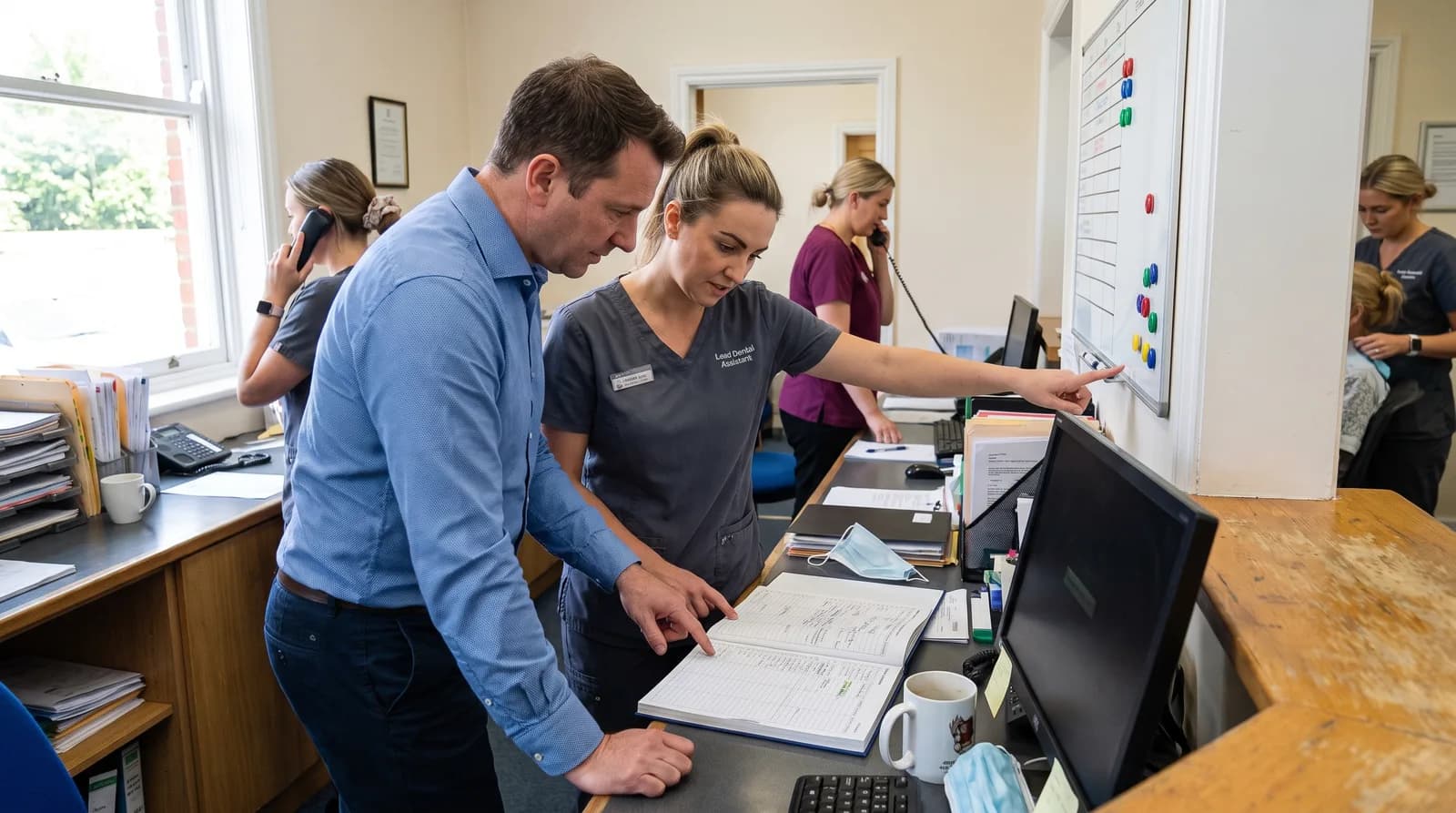
Dental Peak Hour Staffing: Match Team to Demand Curve
Dental peak hour staffing means matching your team to real demand, not average load. Build the schedule from your own PMS data this week.
Share:
Table of contents
I used to think my schedule was full. Then I looked at when it was actually full. Monday mornings, my front desk was drowned in calls, while Wednesday afternoons the phone barely rang. Dental peak hour staffing means matching your team's hours to when demand actually shows up, not spreading the same headcount evenly across a week that was never even to begin with.
This piece on dental peak hour staffing is a companion to the capacity stress test I wrote in If New Patient Volume Doubled, What Breaks First?. That piece asks what breaks first. This one is the fix: how you build a weekly schedule from your own demand curve instead of guessing at coverage.
By the end, you will know how to pull your practice's demand curve from your own PMS, which roles actually need peak coverage, and how to shift an existing schedule without a single new hire. If you want a partner once the schedule is built, DentalBase's growth services cover the systems layer underneath it, but the method below works with or without us.
What is dental peak hour staffing, and why does average load fail?
Dental peak hour staffing means scheduling enough people to cover your busiest hours, not your average hour across the week. Most practices staff for the average and call the schedule full. The average hour never actually happens. Patients arrive in clusters, and average-load staffing leaves every cluster uncovered.
Here is why the average is misleading. If your front desk handles 40 calls on a slow Wednesday and 95 on a Monday, the average is roughly 67. Staff for 67 and Monday still buries you while Wednesday sits half idle. The average is a number nobody experiences. Only the actual hour-by-hour pattern is real, and that pattern is what a schedule should be built against, not a monthly total divided evenly across five days.
Related: Uncovered peaks are exactly where calls start slipping through. See why your front desk still misses calls, and the fix →
In my own practice, I did not see this until I mapped call volume by the hour. The Monday spike was not a bad day. It was the same day, every week, for years, and I had staffed straight through it as if it were any other morning. Fixing that single pattern did more for patient experience than any hire I made that year.
Once you map it, the same three windows show up almost every time:
- Monday mornings, when everything that happened over the weekend hits the phone at once.
- The post-lunch block, when the desk is mid-transition and calls keep arriving.
- The hour before closing, when same-day requests and next-day confirmations cluster.
Not sure which curve is costing you the most?
The capacity stress test walks through all five systems, including staffing, before you touch a single shift.
Run the Stress Test →What does a dental practice's weekly demand curve look like across every role?
A dental practice's demand curve is the hour-by-hour and day-by-day pattern of when work actually arrives for each role. Front desk demand peaks on call volume. Hygiene demand peaks on recall clustering. Provider demand peaks on consult timing. All three curves exist in the same schedule, but they rarely peak at the same hour.
Front desk demand
Front desk load tracks call volume and walk-in traffic, and it spikes hardest on Monday mornings and right after the lunch transition. The phone capacity breakdown covers exactly when and why those call spikes happen, hour by hour.
Hygiene demand
Hygiene load tracks recall scheduling and tends to cluster around school holiday weeks and the first two weeks of a new insurance year, when deductibles reset. A hygiene schedule staffed for an average week misses both surges. The hygiene schedule capacity breakdown shows where new patients fall through in exactly this gap.
Provider and chair demand
Provider demand peaks around consult follow-ups and same-day treatment requests, which cluster on the days consults are scheduled. This curve is the least visible of the three because it hides inside a schedule that looks full on paper. In our experience, this is the curve owners map last, usually after the front desk and hygiene curves are already fixed.
None of these three curves are a supply problem. NIDCR utilization data shows dental demand in most US markets consistently outpaces available capacity, which means timing that demand correctly matters as much as having enough total staff hours to meet it.
How do you pull your own demand curve from your PMS in an afternoon?
You pull a demand curve by exporting three numbers from your PMS by hour and day of week: inbound calls, patients checked in, and treatment consults completed. Two weeks of data is enough to see the pattern. Most owners already have this data sitting unused in reports they have never opened.
The three numbers to track
Run each of these for a two week window, broken out by hour block and day of week, not just a daily total:
- Inbound calls per hour, pulled from your phone system or front desk log.
- Patients checked in per hour, pulled from your PMS appointment log.
- Consults completed per day, pulled from your treatment plan or case acceptance report.
Reading the pattern
Once you have two weeks of data, the pattern is almost always the same three windows: Monday mornings, the post-lunch block, and the hour before closing. You do not need a full quarter of data to see it. Two weeks is enough because the pattern repeats on a weekly cycle, not a seasonal one, for most general practices.
Demand curve self-check
Check each item you can confirm right now.
4 checks: your schedule is demand-based. 2 to 3: you have the data, you have not mapped it yet. Fewer than 2: pull the three numbers above this week.
Which roles actually need peak coverage, and which don't?
Front desk and hygiene need real peak coverage because their demand spikes hard and their work cannot wait. Providers usually do not, because chair time is already booked in advance and rarely spikes the same way. Treating every role identically wastes coverage on the roles that do not need it.
This is the mistake I made for years. I added front desk hours evenly across the week because that felt fair to the schedule. It was not fair to the demand. The front desk needed more bodies on Monday and fewer on Wednesday, and hygiene needed a different pattern entirely, tied to recall clustering rather than call volume.
| Role | Peak sensitivity | Coverage strategy |
|---|---|---|
| Front desk | High. Tracks call and walk-in volume hour by hour. | Staggered shifts, extra coverage Monday morning and post-lunch. |
| Hygiene | Moderate. Tracks recall clustering and insurance cycles. | Flex a hygienist's hours around known clustering weeks. |
| Providers | Low. Chair time is pre-booked and rarely spikes. | Stable schedule, no peak staffing adjustment needed. |
| Treatment coordination | High. Follows consult scheduling, not calendar days. | Block follow-up time right after heavy consult days. |
Dental peak hour staffing accounts for this lag too, since coordination follows the day consults are booked, not the calendar. If Tuesdays are your consult-heavy day, Wednesday morning is when follow-up capacity needs to be highest, and most schedules do not account for that one-day lag at all.
How do you build a shift schedule from a demand curve without adding headcount?
Dental peak hour staffing moves existing hours to match the curve, not by adding new ones. Stagger start times so more people are on the floor during the Monday and post-lunch peaks. Overlap shifts by thirty minutes at transition points instead of a hard handoff. The hours already exist, just in the wrong slots.
Staggered starts
Instead of every front desk person starting at 8am, stagger one start at 7:30 to absorb the Monday call surge before the rest of the team arrives. The total weekly hours do not change. Only the placement does.
Overlap blocks
Build a thirty minute overlap around 1pm, when the post-lunch call spike hits and the desk is also mid-transition from break. That overlap window is usually the single highest-leverage change in the whole schedule.
Flex coverage for hygiene
For hygiene, flex a floating hygienist's hours toward the weeks recall clustering is heaviest instead of scheduling them identically every week. The hygiene demand pattern covered earlier tells you which weeks those are before they hit.
The front desk side of this works the same way. Cross-training front desk employees on more than one role lets you flex coverage toward peak hours without adding a single new shift.
When the schedule still can't absorb the peak
DentiVoice handles the call volume portion of the Monday and post-lunch spikes automatically, so the staggered shift you build here has less ground to cover.
See the AI Receptionist →What does staffing for average load actually cost during off-peak hours?
Skipping dental peak hour staffing costs you twice: understaffed peaks lose patients, and overstaffed off-peaks pay wages for hours with no demand to absorb. Both costs are invisible on a schedule that just looks full, and most owners only ever notice the first one.
Run the math on a single overstaffed off-peak block and the number adds up fast across a year. A front desk person earning $19 an hour, scheduled for three off-peak hours a day that could be reduced to one, is two unnecessary hours a day. Bureau of Labor Statistics wage data puts front desk pay for dental practices in a similar range nationally, so this math holds for most general practices.
Worked example: cost of average-load staffing
Stated assumptions: $19/hour front desk wage, 2 unnecessary off-peak hours per day, 5 days a week, 48 working weeks a year. 2 hours x 5 days x 48 weeks = 480 hours. 480 hours x $19 = $9,120 a year, in one role, in one practice, without adding a single patient.
That $9,120 does not disappear when you cut the hours. It moves to the peak windows where it actually creates coverage. The uncovered side of the ledger is worth just as much: in our experience, a single missed new patient call during a peak window can carry a lifetime value well over $1,200, so an uncovered peak is rarely a small miss. The visible side of the ledger is just as real: Dental Economics puts the average practice's missed calls at 15 to 20 a week, and uncovered peak windows are exactly where those calls go missing.
Before you rebalance the schedule, it is worth checking whether the overall team size is even right for your practice. Our dental practice staffing ratio benchmarks by size and role guide breaks down what a healthy headcount looks like before you touch the shift board.
How do you shift an existing schedule without disrupting the team?
Shifting to dental peak hour staffing works gradually over two to three weeks, changing one or two shifts at a time instead of rewriting the whole board overnight. A sudden full rewrite reads as instability to a team, even when the math behind it is sound. Gradual change reads as a fix.
Start with the highest-leverage change from your demand curve, usually the Monday morning stagger, and run it for a week before touching anything else. Ask the team who is already naturally inclined toward an earlier or later shift. Most practices have at least one person who prefers it, and starting there removes the friction of an assigned change nobody wanted.
Show the team the actual data before you show them the new dental peak hour staffing schedule. A staggered start lands very differently when someone has seen the Monday call spike in their own numbers versus when it just appears on next week's board as an assignment. The data does the convincing so you do not have to, and it matters to patients too: BrightLocal research consistently finds patients choose whichever practice responds fastest, which is exactly what peak coverage protects.
The front desk bandwidth breakdown covers the hour math behind why a single staggered shift creates more headroom than it looks like on paper. Once the first change holds for a week, move to the next one on the list.
What should you change in your schedule this week?
This week, pull two weeks of call and check-in data by hour, identify your single worst-covered peak window, and move one existing shift toward dental peak hour staffing. That is the entire first move. You do not need a new hire or a new system to start.
Related: Staffing ratios are one piece of a complete dental front desk staffing plan. See demand-based staffing models in the complete guide →
Most owners rolling out dental peak hour staffing find the Monday morning gap first, because it is the most visible one. Once that shift is in place, run the same exercise for hygiene clustering and consult follow-up timing. Each fix compounds, because the same total hours are simply landing where the demand actually is.
This connects directly back to the math behind how you set a production goal in the first place. A ceiling calculated from provider hours assumes those hours are covered when patients actually arrive, a point ADA Health Policy Institute data on practice-level variance supports indirectly. A schedule built from the demand curve is what makes that assumption true instead of aspirational.
This article reflects operational experience and general practice management principles, not a guarantee of specific outcomes for any individual practice.
Build the schedule your demand curve actually needs
Book a walkthrough and see how DentiVoice covers the call-volume side of your peaks while your team schedule covers the rest.
Book a Free Demo →More resources for practice owners
Guides, templates, and tools for running a better practice →Sources & References
Frequently Asked Questions
Dental peak hour staffing is scheduling your team to match the hours when patient demand actually arrives, instead of spreading the same headcount evenly across the week. Most practices staff for an average that no single hour ever experiences.
Pull two weeks of call volume, check-in, and consult data from your PMS, broken out by hour and day of week. The pattern almost always repeats weekly rather than seasonally, so two weeks is enough to see it clearly.
Front desk and hygiene need real peak coverage because their workload spikes hard on specific days. Providers usually don't, since chair time is booked in advance and rarely spikes the same way.
No. Peak hour staffing works by moving existing hours to match demand, using staggered starts and shift overlaps, not by adding headcount. Most practices already have enough total hours, just placed in the wrong slots.
A single role staffed two unnecessary hours a day at $19 an hour can cost roughly $9,120 a year across 48 working weeks. That cost is invisible on a schedule that looks full but isn't matched to demand.
Plan on two to three weeks for a full transition, changing one or two shifts at a time. Gradual changes read as a fix to the team, while a sudden full rewrite reads as instability.
Was this article helpful?

Written by
Dr. Muhammad Abdel-rahim DMD
Muhammad Abdel-rahim, DMD, is a dentist and implantologist at Peterborough Family Dental & Implant Center with a passion for blending clinical excellence, leadership, and innovation. He believes dentistry extends beyond restoring smiles to building trust, confidence, and sustainable systems that help patients and teams thrive. With experience leading and scaling dental practices, Dr. Abdel-rahim brings a strategic mindset to patient care and practice growth. He is particularly interested in communication, critical thinking, and the thoughtful application of artificial intelligence to improve clinical outcomes, workflows, and the overall patient experience.